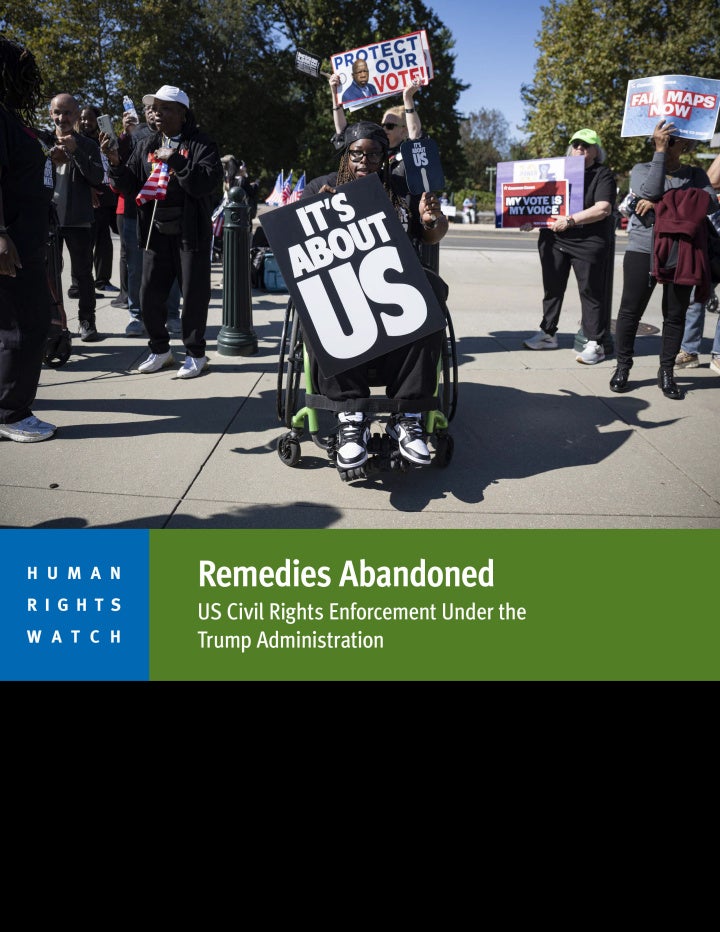
US Civil Rights Enforcement Under the Trump Administration
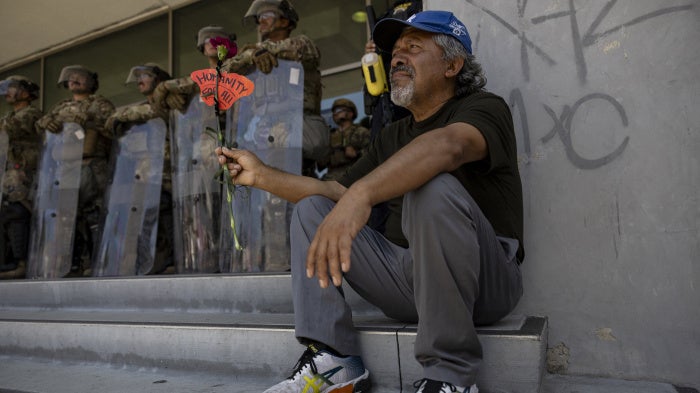
The 112-page report, “Remedies Abandoned: US Civil Rights Enforcement Under the Trump Administration,” documents the administration’s efforts to unravel the work of four key agencies between January 2025 and the spring of 2026: the Justice Department’s Civil Rights Division, which lost about 75 percent of its attorneys; the Education Department’s Office of Civil Rights, which moved to lay off nearly half its staff in one day and closed 7 of its 12 regional offices; the Housing and Urban Development Department’s Fair Housing Office, which shrank dramatically; and the Equal Employment Opportunity Commission, which reached its lowest staffing levels in over 40 years.
Prospects in 2005 for Internally Displaced Kurds in Turkey
This 37-page report details how the Turkish government has failed to implement measures for IDPs the United Nations recommended nearly three years ago. Since the European Union confirmed Turkey’s membership candidacy in December, the Turkish government appears to have shelved plans to enact those measures.
The control orders envisioned in the Prevention of Terrorism Bill 2005 (hereafter “the Bill”) offer a seriously flawed alternative to the disastrous policy of indefinite detention under the Anti-Terrorism Crime and Security Act 2001, a policy ruled contrary to human rights law by the House of Lords Judicial Committee.
This report documents more than 200 enforced disappearances perpetrated by the Nepali army and police and analyzes the factors responsible for the crisis.
This 48-page report documents how, in the weeks and months after the bombing that killed 30 people in the resort town of Taba, the State Security Investigation agency conducted mass arrests in northern Sinai without a warrant or judicial order as required by Egyptian law.
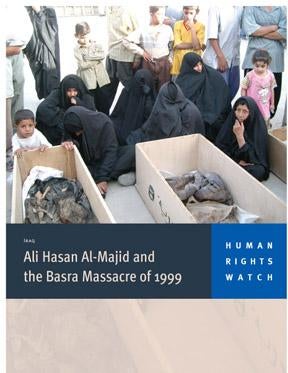
Al-Majid earned the sobriquet “Chemical Ali” because of his role in the genocidal Anfal campaign between February and August 1988, and his use of chemical weapons against Kurdish villagers in northern Iraq beginning in April 1987.
On September 27, 2004, the leader of a powerful armed group threatened to launch an “all-out war” in the Niger Delta - sending shock waves through the oil industry – unless the federal government ceded greater control of the region’s vast oil resources to the Ijaw people, the majority tribe in the Niger Delta.
US: Life Without Parole Sentences for Children in Colorado
Across Colorado, residents are beginning to question whether children who commit a crime before the age of eighteen should ever be sentenced to life without parole. Historically, this harshest of prison sentences was restricted to adults.
This 65-page report analyzes aspects of Spain’s criminal law and procedures that fall short of its commitments under international human rights law. Problematic practices include the use of incommunicado detention and secret legal proceedings, limitations on the right to a lawyer during the initial period of detention, and lengthy periods of pre-trial detention.
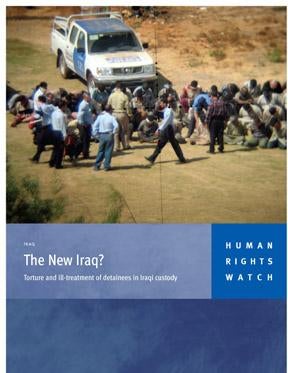
Torture and ill-treatment of detainees in Iraqi custody
This 94-page report documents how unlawful arrest, long-term incommunicado detention, torture and other ill-treatment of detainees (including children) by Iraqi authorities have become routine and commonplace. Human Rights Watch conducted interviews in Iraq with 90 detainees, 72 of whom alleged having been tortured or ill-treated, particularly under interrogation.
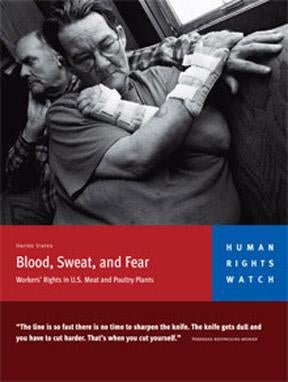
Workers in the U.S. meat and poultry industry endure unnecessarily hazardous work conditions, and the companies employing them often use illegal tactics to crush union organizing efforts. In meat and poultry plants across the United States, Human Rights Watch found that many workers face a real danger of losing a limb, or even their lives, in unsafe work conditions.
Since February 2003, Darfur has been the scene of massive crimes against civilians of particular ethnicities in the context of an internal conflict between the Sudanese government and a rebel insurgency. Almost two million people have been forcibly displaced and stripped of all their property and tens of thousands of people have been killed, raped or assaulted.
Two years after the start of negotiations for the demobilization of paramilitary groups, Colombian President Alvaro Uribe plans to present a draft law to govern demobilization at an international donors’ conference in Cartagena, Colombia, on February 3-4, 2005.
This briefing paper describes new and disturbing information about recent large-scale arrests of Montagnard Christians living in Vietnam’s Central Highlands and the torture of Montagnard activists, house church leaders, and others, including individuals who have been deported or have voluntarily returned from Cambodia
Rwandan armed groups, like many other armed groups in the eastern Democratic Republic of Congo (DRC), kill, rape, and otherwise injure civilians and often loot or extort their property. Under the terms of the Lusaka Accords and the Pretoria Agreement ending four years of war in the Congo, the Congolese government agreed to disarm these groups, but has failed to do so.