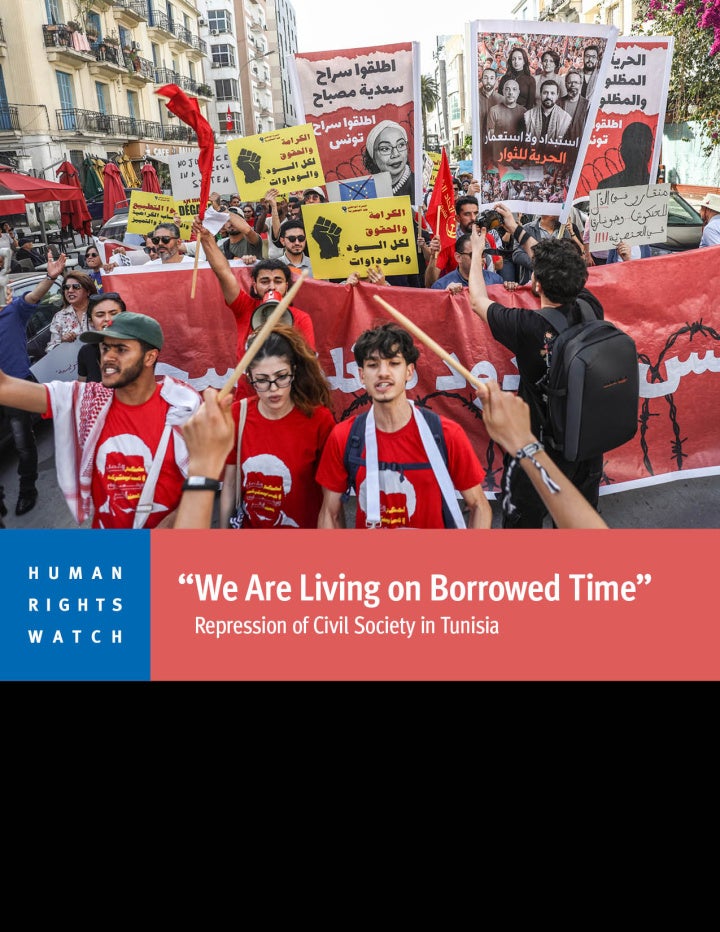
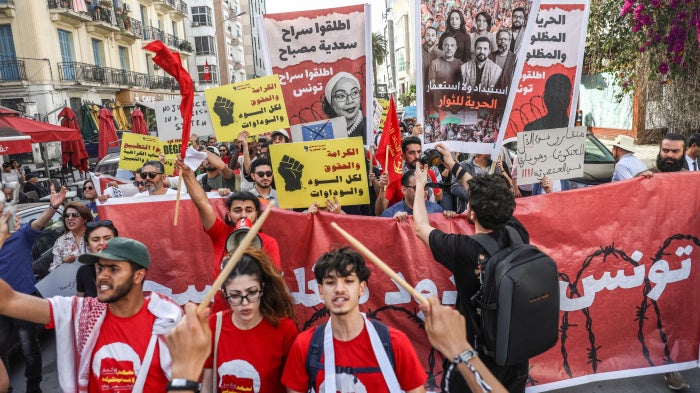
The 49-page report, “‘We Are Living on Borrowed Time’: Repression of Civil Society in Tunisia” documents the Tunisian authorities’ escalating repression of local and international civil society groups, workers, members, and affiliates through the weaponization of abusive prosecutions, arbitrary arrests, detention, financial and criminal investigations, mass suspensions, and threats of dissolution.
Written Testimony Submitted to the U.S. House of Representatives Committee on Ways and Means
Human Rights Watch welcomes the opportunity to testify regarding workers’ human rights under the proposed United States-Dominican Republic-Central America Free Trade Agreement (D.R.-CAFTA). Human Rights Watch takes no position on free trade per se, but we take an active interest in workers’ human rights.
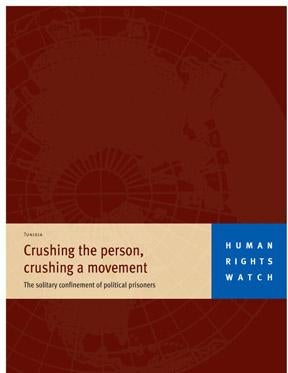
This 39-page report charges that the government’s policy of isolation is driven not by legitimate penological concerns. Rather, this national policy seeks to punish and demoralize jailed leaders of the banned Nahdha (Renaissance) party, as part of government efforts to destroy the country’s Islamist movement.
Diplomatic Assurances No Safeguard Against Torture
This 91-page report documents the growing practice among Western governments—including the United States, Canada, the United Kingdom, and the Netherlands—of seeking assurances of humane treatment in order to transfer terrorism suspects to states with well-established records of torture.
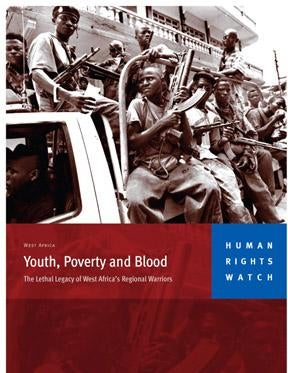
The Lethal Legacy of West Africa’s Regional Warriors
The lives of “regional warriors” are documented in this 66-page report. Based on interviews with some 60 former fighters who have crossed borders to fight in Liberia, Sierra Leone, Côte d’Ivoire and Guinea, the report explores the forces driving the phenomenon of cross-border mercenary activity in West Africa.
Georgia has a long record of tolerating torture and ill-treatment by law enforcement agents. The new government that came to power after the November 2003 ‘Rose Revolution’ has taken some steps to address such abusive practices, but these efforts have proven inadequate to stem them.
This briefing paper documents how the Sudanese security forces, including police deployed to protect displaced persons, and allied Janjaweed militias continue to commit rape and sexual violence on daily basis.
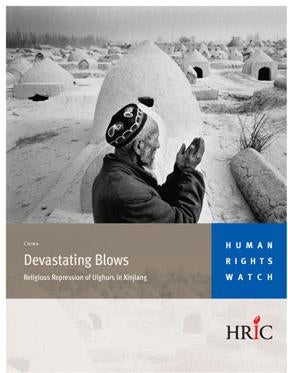
This 114-page report is based on previously undisclosed Communist Party and government documents, as well as local regulations, official newspaper accounts, and interviews conducted in Xinjiang. It unveils for the first time the complex architecture of law, regulation, and policy in Xinjiang that denies Uighurs religious freedom, and by extension freedom of association, assembly, and expression.
The potential future dangers of widespread production and continued proliferation of cluster munitions demand urgent action to bring the humanitarian threat under control. At least seventy countries stockpile cluster munitions and the aggregate number of submunitions in these stockpiles is staggering.
This 80-page report documents the recent removal of critical HIV/AIDS information from primary school curricula, including information about condoms, safer sex and the risks of HIV in marriage.
`Abd al-Salam `Ali al-Hila, a Yemeni intelligence officer, disappeared in Cairo in 2002. Since then, he is believed to have been held without trial in Azerbaijan, Afghanistan, and Guantanamo Bay.
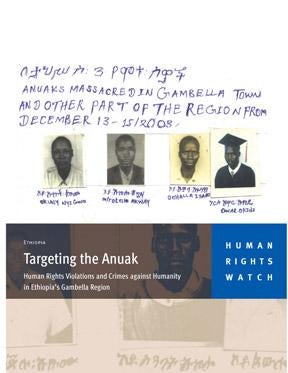
Human Rights Violations and Crimes against Humanity in Ethiopia’s Gambella Region
Since late 2003, the Ethiopian National Defense Force (ENDF) has committed numerous human rights violations against Anuak communities in the Gambella region of southwestern Ethiopia that may amount to crimes against humanity. These abuses have taken place in a region plagued by longstanding ethnic tensions to which the Ethiopian military has become a party.
Governments around the world have done far too little to combat the entrenched, chronic abuses of women’s and girls’ human rights that put them at risk of HIV. Misguided HIV/AIDS programs and policies, such as those emphasizing abstinence until marriage, ignore the brutal realities many women and girls face.
Zimbabweans go to the polls on March 31, 2005. President Robert Mugabe and senior government officials of the government of Zimbabwe have emphasized the need for peaceful elections, and put in place electoral reforms that, they argue, meet the Southern African Development Community (SADC) Principles and Guidelines Governing Democratic Elections.
“Disappearances” in Chechnya—a Crime Against Humanity
Enforced disappearances in Chechnya are so widespread and systematic that they constitute crimes against humanity. Human Rights Watch urges the United Nations Commission on Human Rights to take urgent measures commensurate with the extreme gravity of the phenomenon.
Human Rights Watch welcomes this opportunity to present views regarding whether Ecuador meets the eligibility criteria of the Andean Trade Promotion and Drug Eradication Act (ATPDEA). These criteria include those in the original Andean Trade Preferences Act (ATPA), as well as those added in the ATPDEA, which extended and expanded the ATPA in 2002.