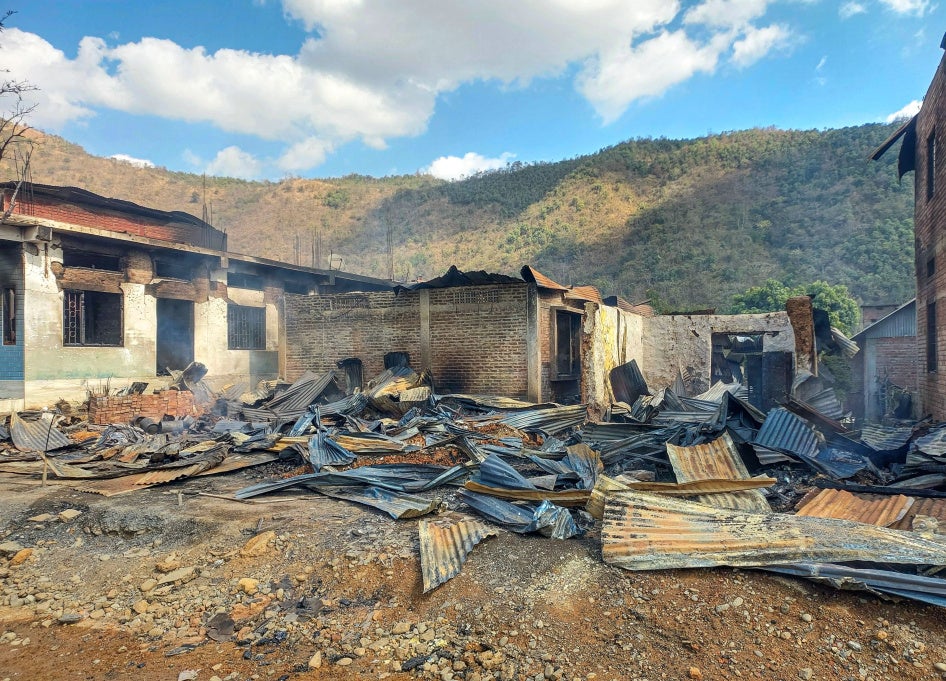
(New York, September 4, 2026) – Indian authorities should urgently address renewed violence between ethnic communities in the northeastern state of Manipur, Human Rights Watch said today. At least seven people were killed in late August 2026 in violence between the Naga and Kuki-Zo tribal communities in the state’s hill districts, leaving 34 dead since the current violence between the communities began in February.
The recent clashes between the Naga and Kuki-Zo communities have expanded the ethnic violence that had earlier involved the predominant, mostly Hindu, Meitei community and the mostly Christian Kuki-Zo communities since May 2023, causing more than 260 deaths and more than 60,000 to be displaced. Since February, armed militant groups from both the Naga and Kuki-Zo communities have burned down homes in villages, taken hostages, blocked highways and engaged in gunfire. The Bharatiya Janata Party-led state government which came to office in February on the promise of peace and reconciliation, has taken inadequate measures to end the violence and provide security for both populations.
“The Manipur government has failed to stop the escalating ethnic violence in the state,” said Elaine Pearson, Asia director at Human Rights Watch. “The authorities need to take urgent and effective steps to end the killings, protect communities, and ensure justice for abuses.”
The current violence between the Naga and Kuki-Zo communities began in February with a minor altercation in Ukhrul district as tensions simmered over decades-old territorial disputes. It escalated after three Kuki church leaders were killed after their meeting with Naga pastors in May to find a resolution to the hostilities. The violence spiraled that month as armed groups on both sides reportedly abducted a total of 48 people and held them hostage. The police found six Naga hostages dead a day after the Naga groups released 14 Kuki hostages.
Naga groups blocked a national highway in May, choking the supply of essential commodities, food, fuel, and medical aid to the Kuki-Zo majority Kangpokpi district. Kuki-Zo groups responded with a counterblockade in July, restricting the access of goods from Imphal to the Naga-majority Ukhrul district through two Kuki-Zo settlements. They lifted the blockade three days later after Chief Minister Yumnam Khemchand Singh called for the resumption of free movement on the state’s highways.
However, the authorities have yet to resume transportation of goods to Kangpokpi district as
armed Naga groups continue to block the highway. The Supreme Court on August 14 directed the Kuki and Naga groups to plan for reopening the highways.
The blockades have also led to an increase in prices of food and cooking gas cylinders. Residents say fuel shortages have made it increasingly difficult to reach district hospitals at a time when seasonal illnesses, such as scrub typhus, dengueand typhoid, are widespread. Manipur authorities should restore the free movement of vehicles and dismantle unofficial checkpoints, Human Rights Watch said.
A 32-year-old Kuki man whose 3-month-old baby died from a high fever, vomiting, and breathing difficulties on August 18 said he was unable to take her for treatment to the Kangpokpi district hospital 32 kilometers away. “We are so helpless,” the man told Human Rights Watch. “There is a shortage of medicine in each and every village. We feel like the government is neglecting us. There are so many sick patients in villages, but we don’t know where to take them.”
A pastor from the Naga community who suffered a gunshot injury on September 1 in Old Tapon village, Kangpokpi district, alleged that security forces were slow to respond when suspected Kuki militants opened gunfire and burned down homes, including his. “Everything is gone,” Luithuibou Newmai told Human Rights Watch. “There is nothing. No documents. Nothing is recovered.”
An inquiry by the Ministry of Home Affairs the 2023 violence, set up in June 2023, has yet to submit its reportIn February 2026, three months before the most recent deadline, the retired judge leading the commission resignedIn August, the Supreme Court directed a committee it appointed in 2023 to oversee relief efforts to verify claims that several affected communities had yet to receive rehabilitation and welfare benefits. Local authorities should ensure adequate humanitarian aid reaches affected communities.
In accordance with the United Nations Guiding Principles on Internal Displacement, all internally displaced people should be provided with adequate food, shelter, clean water, appropriate clothing, essential medical services, sanitation, education for children, and other basic assistance and protection services, irrespective of religion, ethnicity, or citizenship status.
Indian authorities should continue to demobilize and disarm militant groups, ensure prompt reparation for victims and survivors of abuses, and provide for impartial justice and accountability measures, Human Rights Watch said.
“Indian authorities need to tackle the sources of the violence between the Naga and Kuki-Zo communities before more lives are shattered,” Pearson said. “The authorities should restore security for affected populations, ensure justice for crimes committed by all sides, and work to rebuild trust between communities.”