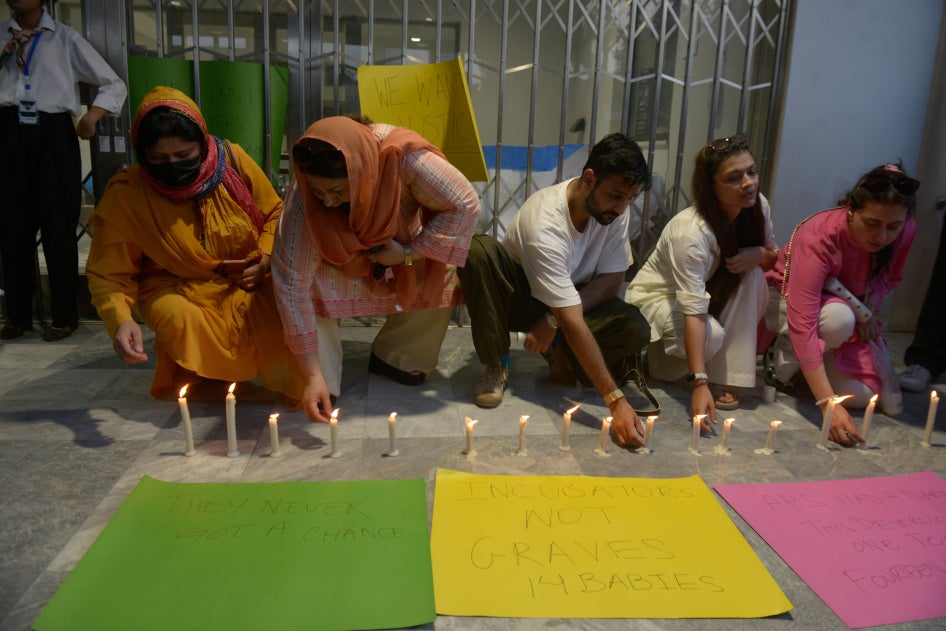
Fourteen newborns died in a fire on August 26 at one of Pakistan’s largest public hospitals, and their shattered families are asking how this could have happened.
The preliminary inquiry report found that the neonatal ward at the Pakistan Institute of Medical Sciences in Islamabad, Pakistan’s capital, had no fire alarm or sprinkler system, and that emergency procedures were inadequate. The fire engulfed the nursery within two minutes. Even more troubling, the hospital had experienced another fire just seven weeks earlier, on July 6. That earlier inquiry had already identified problems with fire detection, alarms, evacuation preparedness, electrical inspections, and emergency response. But nothing was done.
While the inquiry is at a preliminary stage and does not establish individual responsibility, it makes it clear that the hospital was shockingly unprepared in the event of a fire.
Human Rights Watch has documented Pakistan’s chronic underinvestment in health care: patients and families pay out of pocket for most health care, while more than 50 percent of Pakistanis lack access to basic primary health care and 42 percent have no health coverage. Pakistan ranked 176th of 189 countries for government health spending as a share of GDP in 2021, the most recent year available, and 170th for health spending as a share of the national budget.
Human Rights Watch has also documented severe gaps in prison health care, including shortages of medicines, medical staff, equipment, and emergency care.
Pakistan is party to the International Covenant on Economic, Social and Cultural Rights, which recognizes the right to the highest attainable standard of health. That obligation requires governments to take steps to ensure functioning, quality health facilities and services. Patient safety is part of that right. Merely providing a hospital bed is not enough if the hospital cannot protect patients from foreseeable emergencies.
The Pakistan government should enforce existing safety regulations and institute independent fire and emergency-safety audits of every hospital. They should also publish the findings and set firm deadlines for reform.
Accountability for the tragedy at the Pakistan Institute of Medical Sciences can only come about through an independent, prompt, and transparent investigation. The government also has a responsibility to ensure that more patients do not die from unsafe conditions before they can rectify these systemic failures.