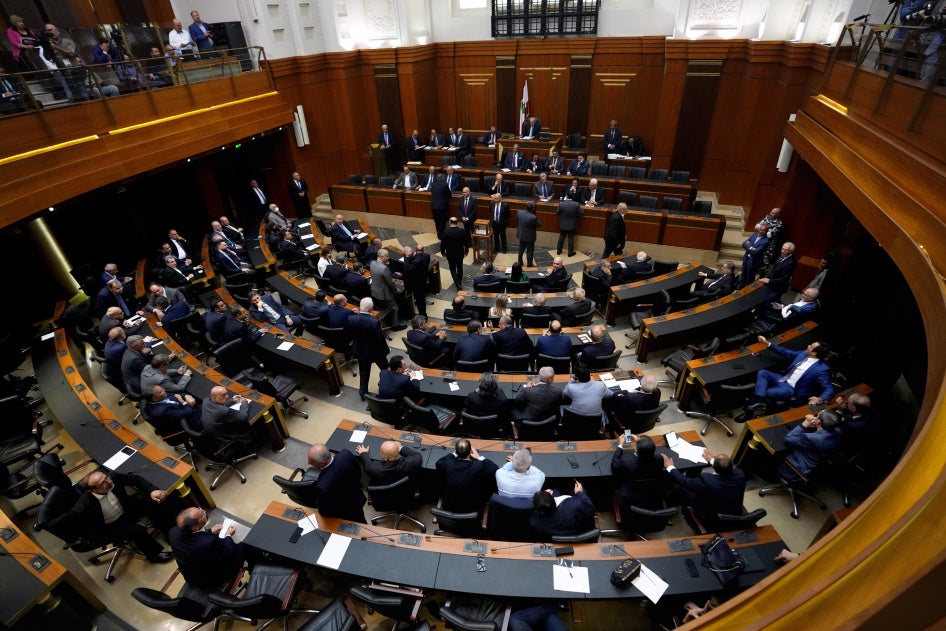
(Beirut) – Members of three parliamentary committees in Lebanon jointly approved a draft law abolishing the death penalty on July 9, 2026, putting Lebanon on the precipice of becoming the first country in the Middle East region to formally end capital punishment, Human Rights Watch said today.
The draft law requires approval by the parliament’s general assembly to become law. Lebanese lawmakers meeting on July 15 and 16 to discuss and vote on this draft law, among others, should pass the law and cement this monumental advance for human rights and criminal justice in Lebanon.
“Despite an unofficial moratorium on the use of the death penalty for the past two decades, Lebanon needs to go a step further and declare a firm break from this cruel practice,” said Ramzi Kaiss, Lebanon researcher at Human Rights Watch. “Parliament should ensure that this law is enacted and the death penalty is removed from all provisions of Lebanese law.”
Lebanon has an unofficial moratorium on the death penalty and has not carried out an execution since 2004. In 2020, 2022, and 2024, Lebanon voted in favor of a United Nations General Assembly resolution calling upon “all states to establish a moratorium on executions, with a view towards abolishing the death penalty.” The Lebanese Association for Civil Rights (LACR), which prepared the draft law, estimates that about 84 prisoners are facing death sentences in Lebanon.
Human Rights Watch spoke to Michel Moussa, the head of the Parliamentary Human Rights Committee; Halime Kaakour, one of seven members of parliament who submitted the draft law to parliament; and Ogarit Younan, the head of the LACR and founder of the National Campaign to Abolish the Death Penalty in Lebanon, in addition to an adviser to the justice minister. Human Rights Watch also reviewed the version of the draft law originally submitted to parliament, the versions approved by the Parliamentary Human Rights Committee and the Administration and Justice Committee, the latest version of the law approved by three parliamentary committees in a joint session, and the government’s advisory opinion on the draft law.
In its latest form, the draft law abolishes the death penalty “wherever it is mentioned under Lebanese laws” and replaces it with a newly created penalty, “life imprisonment with aggravated hard labor.” It amends article 37 of the Penal Code to read that way and annuls article 43 of Lebanon’s Penal Code and articles 420 to 424 of Lebanon’s Code of Criminal Procedure, which set out the procedures for carrying out death sentences. In its analysis of the law, Lebanese rights group Legal Agenda said that “this amounts to the creation of a new criminal penalty, […] even though this innovation has no practical effect,” given that Lebanon does not enforce hard labor provisions.
Under the UN Standard Minimum Rules for the Treatment of Prisoners, “Prison labour must not be of an afflictive nature.”
Seven members of parliament had endorsed the version of the law drafted by the National Campaign to Abolish the Death Penalty in Lebanon and submitted it to parliament on October 7, 2025, according to Younan and a copy of the submitted draft law Human Rights Watch reviewed. Younan said that parliament’s General Secretariat subsequently sent the law to the cabinet, seeking an advisory opinion.
The cabinet discussed the draft law during a November 20 session and endorsed it, noting the need to also annul article 43 of the penal code, based on a copy of the government’s advisory opinion seen by Human Rights Watch.
The draft law was subsequently amended and reviewed by Lebanon’s Parliamentary Human Rights Committee, the Administration and Justice Committee, and by a joint session of three parliamentary committees, also including the Communications Committee. After its approval by the committees on July 9, it was sent to parliament’s General Assembly to be discussed and voted on during the July 15 and 16 sessions, based on its agenda.
“In Lebanon, people are dying every day because of the war,” Younan said. “I would have hoped that this law would pass at a different time, so that we could celebrate, but it is happening in a difficult situation. Congratulations to Lebanon. We can finally consider it one of the countries that has abolished the death penalty. This is no small achievement […] Our fight continues, this law should be developed and amended to remove these insulting provisions, including on aggravated hard labor.”
Lebanon’s move to abolish the death penalty comes amid backsliding on the issue in neighboring countries. On March 30, the Israeli Knesset passed a discriminatory bill expanding use of the death penalty, whose wording makes clear that it would be primarily, if not exclusively, applied to Palestinians. On June 21, 2026, Jordanian authorities executed six men by hanging in its first executions since 2017.
Human Rights Watch opposes capital punishment in all countries and under all circumstances. Capital punishment is unique in its cruelty and finality and is plagued with arbitrariness, prejudice, and error. Most countries have abolished the practice outright, while dozens have adopted a de facto moratorium.
Human Rights Watch found in 2017 that Lebanon’s military courts, which have broad jurisdiction over civilians and retain the death penalty, do not guarantee due process rights. In 2024, Lebanon’s military court sentenced two individuals to death, according to Together Against the Death Penalty (Ensemble contre la peine de mort, ECPM). Those who have stood trial in military court describe the use of confessions extracted under torture, decisions issued without an explanation, seemingly arbitrary sentences, and a limited ability to appeal.
In addition to passing a law abolishing the death penalty, Lebanon should remove civilians from the jurisdiction of military courts and consider ratifying the Second Optional Protocol to the International Covenant on Civil and Political Rights, aiming at the abolition of the death penalty. Lebanon’s parliament should further remove hard labor as an additional form of punishment under Lebanon’s law, Human Rights Watch said.
“With the adoption of this law, Lebanon would finally be able join the majority of countries around the world that have recognized the death penalty as a cruel and arbitrary sentence that should never be imposed,” Kaiss said. “It is now up to members of parliament to make that happen.”