
As debates over gender-affirming care intensify across many countries, lawmakers, physicians, and human rights advocates risk becoming trapped in the wrong question. Public discussion often revolves around whether there is enough evidence to justify treatment, as though medicine can proceed only once certainty has been achieved. But as a physician, I know that certainty is rarely available in medicine. The more important question is what frameworks we employ when evidence is incomplete and uncertainty is unavoidable.
This is where evidence-based medicine and human rights law become relevant. They share a common purpose: helping decision-makers make principled decisions under conditions of uncertainty. Neither demands perfect knowledge before action can be taken. Neither assumes that uncertainty can be eliminated. Instead, both provide essential principles for navigating it.
This perspective is largely absent from current debates. Discussions often become mired in claims about "gender ideology," appeals to "child protection," or disputes about evidentiary thresholds — while striking contradictions go unexamined. Almost all laws banning gender-affirming interventions for transgender adolescents contain an exception permitting the exact same procedures on intersex children, who are typically too young to consent.
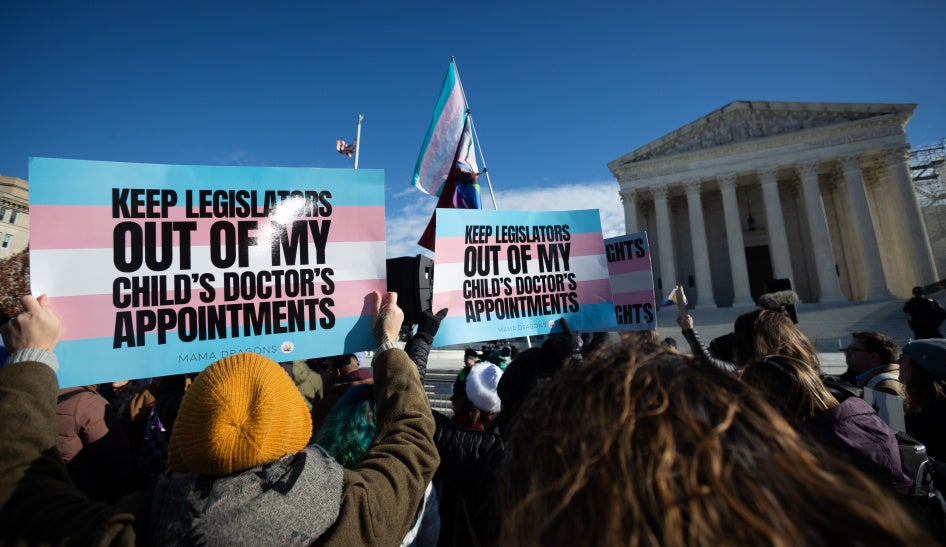
This contradiction is not rhetorical. It shows that the policy debate is driven less by coherent medical or human rights principles than by partisan politics, deep suspicion, and normative ideas about rigid binary sex and gender norms. Across the United States and elsewhere, legislators have enacted or proposed restrictions on gender-affirming care, exposing physicians and parents to legal penalties, removing treatment decisions from the clinical settings where they belong.
Research consistently shows that evidence-based gender-affirming care is associated with reduced rates of depression, self-harm, and thoughts of suicide among transgender youth. Acknowledging these benefits doesn't mean dismissing good-faith concerns about evolving standards of care for gender-diverse children. But we need to do so within frameworks that balance the best available evidence with every individual’s right to the highest attainable standard of health — not within a polarized discourse that treats the health care of a marginalized group as an incendiary political talking point.
Rights set the goal: equitable, dignified, and quality care for all. Evidence charts the path.
Evidence-based medicine is the backbone of modern clinical practice. At its core, it constitutes a hierarchy of evidence: randomized controlled trials at the top; expert opinion at the bottom. It is often misunderstood to require certainty before intervention can be provided. In reality, it helps address uncertainty by integrating the best available research with clinical expertise and, critically, patient values.
In practice, medicine routinely operates under conditions of imperfect knowledge. Physicians prescribe drugs off-label every day. Emergency physicians who treat a patient with signs of sepsis must decide very quickly whether to start aggressive antibiotics — often before a definitive diagnosis is confirmed, and before the causal bacteria (if any) is identified. GnRH agonists — the same drugs used for gender-affirming care — have been used since the 1980s to delay early-onset puberty in cisgender youth for several years, even though their long-term evidence base is limited.
In each of these situations, physicians weigh the risks of intervention against the risks of inaction, making careful specialist assessments, and engage in shared decision-making with patients and families.
But here is what evidence-based medicine does not say: that the absence of perfect evidence is grounds for prohibition.
The evidence base for youth gender-affirming care spans more than 20 years. Studies have consistently shown that this type of intervention reduces mental health concerns and enhances overall well-being and quality of life. Current clinical guidelines recommend care by expert multidisciplinary teams of physicians and mental health professionals. As with any area of medicine, physicians and patients weigh any potential side effects against not intervening. Some end up deciding to use medication, while others do not.
It is true that the evidence base for gender-affirming care lacks data from randomized controlled trials. But that absence is itself ethically required. Designing a study in which some patients are knowingly denied care with established benefits would violate a core principle of modern research ethics — the principle of beneficence, born from the racist atrocities of the Tuskegee Syphilis Study, in which care was deliberately withheld from African-American men to study the disease. But the absence of randomized trials does not mean the absence of evidence. As in other areas of medicine, physicians are required to make decisions on the basis of the best available evidence rather than “perfect evidence.”
Many contemporary restrictions on gender-affirming care effectively transform uncertainty into a justification for categorical bans. That approach is difficult to reconcile with how medicine operates in most other areas of clinical practice. Where “perfect evidence” is lacking, the ethical obligation is to ensure that patients and their parents understand what is known, what the risks are, what remains uncertain, and then make decisions together. It is not to withhold care altogether.
As the evidence base for youth gender-affirming care continues to develop, clinical guidelines should evolve with it. Uncertainty is a constant condition that physicians are trained to navigate. It is not a justification for undermining medical expertise, weaponizing fear, or imposing blanket legislative bans.
Evidence-based medicine helps answer questions about what we know. Human rights law helps answer questions about what governments should do when knowledge is incomplete.
The right to health is recognized in a range of international human rights treaties and national constitutions. It is not a “right to be healthy.” Rather, among other things, it requires governments to take reasonable steps to ensure that health services, goods and information are available, accessible, acceptable, of good quality, and are provided without discrimination on the basis of gender identity or any other grounds.
Human rights law therefore adds a crucial dimension that evidence-based medicine alone cannot answer: who bears the burden of uncertainty?
Transgender and gender-diverse people have long been underrepresented in medical research, which is precisely why the evidence base for their care is thinner than for other populations. Children also frequently face a thinner evidence base for care because of ethical restrictions on pediatric research, the relative rarity of some conditions, limited funding, and the difficulty of following long-term outcomes over decades. This is not unique to transgender youth; it is how pediatric medicine works. We do not respond to thin evidence by denying children care.
To treat those evidentiary gaps as reason for prohibition would be to transform past exclusion into present-day discrimination. The appropriate, rights-respecting response to gaps in knowledge is better research, careful clinical oversight, and informed decision-making. It is not the categorical denial of care with demonstrated benefits to those whose needs have been historically neglected.
Here is the nuance that is lost in the current debate: evidence-based medicine and human rights frameworks are complementary, not oppositional. Evidence-based medicine helps determine what constitutes responsible clinical practice. Human rights law helps guide governments in ensuring that uncertainty is managed fairly, proportionately, and without discrimination.
This complementarity is reflected in international standards. The right to health explicitly encompasses not only access to care, but also quality care as part of what states are obligated to ensure. For youth gender-affirming care, that means care delivered in line with appropriate standards of care: multidisciplinary and age-appropriate, based on informed consent, and responsive to evolving scientific evidence.
For some young people and families, this process can feel frustratingly slow. But that is precisely the point. High-quality gender-affirming care is designed to be careful, individualized, and incremental. It is meant to ensure that decisions are made thoughtfully, on the best available evidence, rather than under pressure or in haste.
The case of Fox Varian, frequently cited by proponents of bans as proof of harm, actually illustrates this: Varian said she was harmed by care that failed to follow clinical guidelines, after receiving a rushed double mastectomy at age 16 after only nine months of overall care. Her case puts forward a heart-wrenching allegation of medical malpractice, not evidence that there is something wrong with gender-affirming care as it is meant to be practiced.
Neither framework suggests that current standards should be immune from scrutiny. On the contrary, evidence-based medicine requires constant evaluation and revision as new knowledge emerges. Human rights law similarly demands ongoing efforts to improve the quality and accessibility of care. But neither framework suggests that uncertainty, by itself, warrants blanket prohibitions imposed through legislation.
What is at stake, beneath all the noise, is the well-being of a marginalized and increasingly targeted group of young people. And a broader principle about medicine, rights, and democratic governance: that decisions about health care belong to patients, their families, and their physicians, guided by evidence and constrained by respect for human dignity. That is not an ideological position. It is rights-respecting and foundational to good clinical practice.