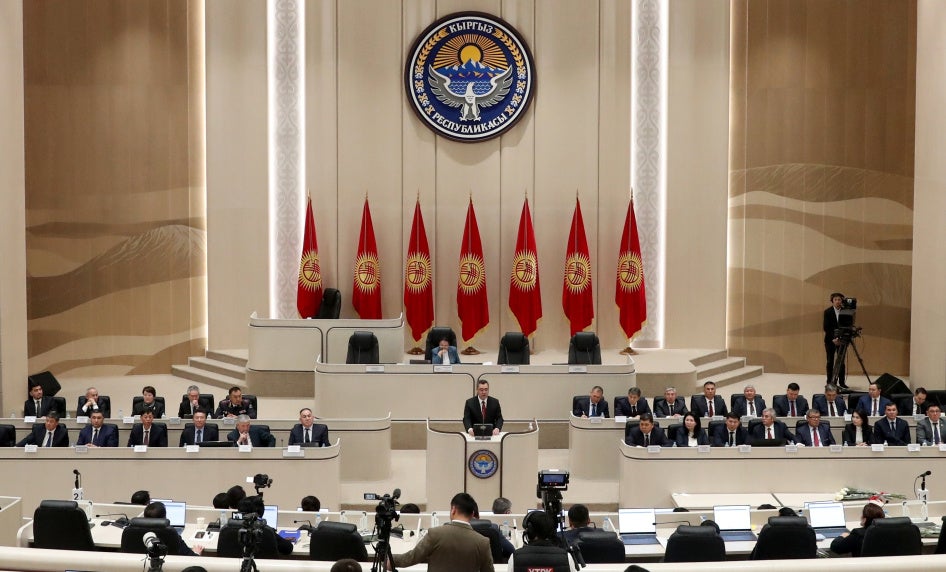
(Bishkek, June 15, 2026) – A harmful draft law before the Kyrgyzstan parliament would prohibit legal gender recognition, ban gender-affirming health care, and restrict information about gender diversity and the possibility of transitioning for children, Human Rights Watch said today.
The bill, which passed its first reading on June 4, 2026, still requires approval at the second and third readings and then the president’s signature to be signed into law. Rights advocates are concerned that the parliament could fast-track the legislation through its remaining readings before the session ends on June 30, leaving little time for meaningful debate or scrutiny.
“This bill is built on dangerous myths about transgender people and would cause immediate, serious harm to people’s lives,” said Syinat Sultanalieva, Central Asia researcher at Human Rights Watch. “The law would strip people of the possibility of legal recognition, push them further into the margins of society, and expose them to discrimination and violence. The parliament should reject it outright.”
If adopted, the bill would eliminate the last remaining pathway for legal gender recognition in Kyrgyzstan and impose a blanket ban on gender-affirming health care, with a narrow exception for “congenital anomalies.” The exception appears to refer to medically unnecessary nonconsensual surgeries on children born with intersex variations.
The bill not only requires parents to raise children strictly according to their “biological sex” but also prohibits “any actions aimed at changing sex self-awareness in minors.” As a result, children would be denied not only mental health support but also information about gender identity. Kyrgyzstan had permitted administrative legal recognition of a person’s affirmed gender but required a medical diagnosis of “transsexualism” until August 2020, when parliament removed the procedure from civil status legislation. Since then, trans people who wished to modify their gender markers on official documents have had to pursue civil lawsuits. In 2024, the government restricted access to gender-affirming health care to those age 25 and older. The new bill would close the remaining avenue for gender recognition and prohibit gender-affirming care altogether.
Forcing transgender people to carry documents that do not reflect their gender identity can expose them to a heightened risk of discrimination in employment, housing, health care, and education, as well as to increased risks of harassment, violence, and extortion, Human Rights Watch said. The UN independent expert on sexual orientation and gender identity has found that the absence of legal gender recognition is linked to elevated rates of physical violence, psychological harm, arbitrary detention, and torture.
The draft law’s provisions affecting children are incompatible with protections guaranteed under both the Kyrgyz Constitution and the UN Convention on the Rights of the Child (UNCRC). The convention’s requirement to prioritize the best interests of the child in all decisions and policies affecting them cannot be reconciled with blanket legislative prohibitions on access to health care and related information. The draft law risks criminalizing psychological support, age-appropriate comprehensive sexuality education, and access to information for transgender and gender-diverse children and youth on their rights.
The proposed ban on legal gender recognition violates rights protected under the International Covenant on Civil and Political Rights (ICCPR), including the rights to recognition before the law and to privacy and family. The Human Rights Committee, the treaty body responsible for overseeing implementation of the ICCPR, has specifically recommended on multipleoccasions that governments provide accessible procedures for legal gender recognition based on self-identification and to abolish abusive and disproportionate requirements.
The UN Committee on Eliminating all forms of Discrimination Against Women (CEDAW) has twice raised concerns with Kyrgyzstan specifically on this issue. In 2015, it expressed concern at the absence of a formal procedure for transgender women to amend the gender marker in their identity documents. In 2021, it said that Kyrgyzstan should restore that right and repeal the August 2020 amendments that had eliminated it.
The blanket prohibition on the provision of gender-affirming care, including hormone therapy and surgical procedures, violates the right to the highest attainable standard of physical and mental health under Article 12 of the International Covenant on Economic, Social and Cultural Rights (ICESCR).
In 2024, the Committee on Economic, Social and Cultural Rights (CESCR), which oversees states’ compliance with the treaty, expressed concern to Kyrgyzstan about discriminatory restrictions on the health autonomy of transgender people in Kyrgyzstan and said that the government should remove disproportionate legal and administrative barriers to gender-affirming health care.
In February 2025, Kyrgyzstan claimed before the UN Human Rights Council that the rights of transgender people in the country are respected, including the right to medical care. On May 15, 2026, UN human rights experts issued a communication warning that the draft law's objectives and key provisions are incompatible with Kyrgyzstan's international human rights obligations, including specific treaty obligations.
Kyrgyzstan’s international partners should raise these concerns in bilateral relations, particularly the European Union, given that implementation of core UN treaties and respect for human rights are among the commitments undertaken by Kyrgyzstan as a step to creating closer economic and political ties.
“Kyrgyzstan has an opportunity to demonstrate its commitment to human rights nationally and internationally by rejecting this bill,” Sultanalieva said. “Instead of rushing through legislation that would harm people, Kyrgyz lawmakers should engage meaningfully with affected communities to develop policies that genuinely protect everyone’s dignity and rights.”