Five years after President Kais Saied seized extraordinary executive powers on July 25, 2021, Tunisia's human rights situation has deteriorated dramatically. What began as a slide back into authoritarianism has hardened into systematic repression of civil society organizations, journalists, political opponents, independent lawyers, and migrants.
Shrinking Civic Space and Crackdown on Civil Society
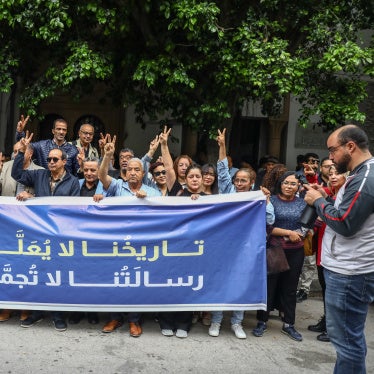
President Saied has repeatedly accused civil society organizations of serving foreign interests, calling them "traitors" and "mercenaries." Since May 2024, Tunisian authorities have systematically targeted civil society organizations through arbitrary arrests, detentions, financial and criminal investigations, and administrative suspensions. This campaign threatens to collapse one of the last remaining pillars of democracy in the country.
- Arbitrary Arrest, Detention, and Criminal Prosecution of NGO Workers
Authorities have prosecuted at least 46 people connected to NGOs, using vague provisions of the 1975 Law on Passports and Travel Documents, the 1968 Law on the Status of Foreigners, the 2015 Counterterrorism and money laundering law, and financial crimes legislation to criminalize their ordinary work. At least eight NGO workers have been arbitrarily detained in connection with their organizations’ legitimate activities, seven of whom were held in pretrial detention beyond the 14-month legal maximum. Since January 2026, at least nine NGO workers have been sentenced to prison in connection with their legitimate work.
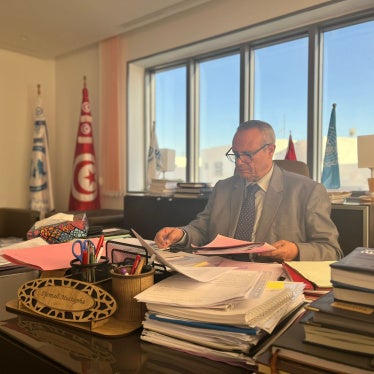
Tunisian Council for Refugees founder Mustapha Djemali, 81, and project manager Abderrazak Krimi were arrested in May 2024 and charged based solely on their work providing accommodation and emergency assistance to registered refugees in partnership with UNHCR. After 19 months in pretrial detention, they were convicted in November 2025 and released.
Three staff members of the French NGO Terre d'Asile Tunisie were also arrested in May 2024 for assisting refugees and migrants. After more than 20 months in detention, they received suspended sentences in January 2026.
Saadia Mosbah, a prominent Black Tunisian anti-racism activist and head of Mnemty Association, was arrested in May 2024 and charged with money laundering and illicit enrichment. On March 19, 2026, she was sentenced to eight years in prison—the harshest sentence yet for an NGO worker.
Saloua Ghrissa, Executive Director of the Association for the Promotion of the Right to Difference (ADD), was detained in December 2024 and held for 13 months before being provisionally released. Her trial on charges of money laundering and foreign exchange violations, which appear to relate solely to the association's foreign funding, is ongoing.
- Financial and Criminal Investigations against CSOs:
Tunisian authorities have launched arbitrary financial and criminal investigations against at least a dozen associations or NGOs. In October 2024, Tunisia's Tax Evasion Investigation and Prevention Brigade opened preliminary investigations into at least a dozen organizations, including Amnesty International's regional office and the election monitors I Watch and Mourakiboun. Investigators demanded ten years of financial records, summoned staff and partners en masse, and froze bank accounts—halting operations and generating significant debt for targeted groups.
The widespread and systematic use of such investigations against a large number of civil society organizations raises serious concerns over the government’s weaponization of such processes and suggests a pattern of deliberate intimidation of civil society organizations.
Tunisian authorities have not publicly provided material evidence for the claims of improper financing against civil society organizations and their employees. Human Rights Watch’s review of the charges found them to be consistently unfounded and overwhelmingly abusive.
- Administrative Sanctions and Banking Restrictions:
Between July and April 2026, a Tunis court ordered the temporary suspension of at least 25 associations—including the Tunisian Association of Democratic Women (ATFD), Aswat Nissa, the Tunisian office of the World Organization Against Torture (OMCT), I Watch, Nawaat journalists' association, and the Tunisian Forum for Economic and Social Rights (FTDES).
These suspensions were marred by serious procedural irregularities: several associations received no prior formal warning as required by law, others responded to warnings but received no reply. Under Tunisian law, suspension is the penultimate step before permanent dissolution. The organizations whose appeals against suspension were dismissed are all one court decision away from being permanently dissolved.
- Attempts to Restrict the Association Law
Since President Kais Saied’s extraordinary seizure of executive power in July 2021, the Tunisian authorities have twice attempted to replace the 2011 Decree-Law 88 on associations with more restrictive framework, which could grant the government pervasive control and oversight over the establishment, activities, operations, and funding of independent groups.
Attacks on Judicial Independence
President Saied dismantled the independent High Judicial Council in 2022 and replaced it with a provisional body under executive control. Through two decree-laws, he granted himself extensive powers to dismiss judges and intervene in their careers.
Since then, courts have ordered the suspension of civil society associations at the request of the Government Secretary General and issued politically motivated convictions within a justice system under executive influence. Pretrial detention—which international and Tunisian law treat as an exceptional measure—has become routine.
Defense lawyers have come under direct attack for the legitimate exercise of their profession. On April 19, 2025, a Tunis court sentenced 37 people—including lawyers, academics, journalists, and opposition figures—in the "Conspiracy Case," issuing sentences of between 4 and 66 years in a mass trial that concluded after just three sessions. Ahmed Souab, a lawyer who defended clients in the "Conspiracy Case" and a former administrative judge, was arrested on April 21, 2025, following comments questioning the independence of the judiciary. He was sentenced to five years in prison before the appeals court reduced his sentence to 10 months and an additional two-year suspended sentence. Other defense lawyers in the "Conspiracy Case" have been subjected to criminal prosecution and judicial harassment.
Freedom of Expression and the Press
Tunisia's media landscape is shrinking rapidly due to the government crackdown. The government has used Decree-Law 54 on Cybercrime as a primary instrument of repression against journalists, bloggers, and activists. Authorities have used its vague prohibition on "spreading fake news" against government critics, resulting in one death sentence.
The government targeted independent media outlet Nawaat with financial investigations, summoning more than thirty people, and issuing a one-month court suspension in October 2025. Three journalists, Mourad Zeghidi, Borhen Bsaises, and Zied el-Heni, remain behind bars. Lawyer and media commentator Sonia Dahmani was released on November 27, 2025, after 18 months in prison but continues to face charges, and journalist Chadha Hadj Mbarek was released on January 14, 2026, after 30 months in prison.
In August 2025, the authorities shut down the National Authority for Access to Information, an independent body established in 2016 to guarantee the right to access public information.
Migration
Migrants, asylum seekers, and refugees from various African countries, including Cameroon, Senegal, Mali, Côte d’Ivoire, Guinea, Sierra Leone, and Sudan, have faced serious violations by security forces, including arbitrary arrests and detention, collective expulsions to the borders with Algeria and Libya, ill-treatment, torture, and sexual violence.
The European Union has continued to provide financial support for migration control in Tunisia with little meaningful accountability. In July 2023, the European Union and Tunisia signed a Memorandum of Understanding including €105 million in EU support for "migration management" in Tunisia. In practice, it has provided EU resources to security forces with documented records of serious human rights violations.
Recommendations to the Tunisian government:
- End the crackdown on civil society and respect and protect space for civic groups to operate fully and freely. Stop restricting freedom of association and end abusive investigations, judicial harassment, and criminalization of civil society groups’ work and members.
- Release all NGO workers, activists, and human rights defenders arbitrarily detained in connection with their legitimate work and overturn unjust convictions.
- Stop using preventive detention to keep peaceful NGO workers and human rights defenders behind bars. Stop using abusive laws to prosecute people for their legitimate work with associations or solidarity with refugees, asylum seekers, and migrants.
- Ensure associations can operate freely, including by withdrawing draft associations laws that would violate the right to freedom of association and repealing all decree-laws which undermine the independence of the judiciary.
Recommendations to donors and other states:
- Conduct a serious review of cooperation with Tunisian authorities to ensure it is tied to compliance with human rights obligations.
Privately and publicly urge Tunisian authorities to release all NGO workers, human rights defenders, activists, and others arbitrarily detained, overturn convictions in connection with legitimate work of associations, and end the crackdown on civil society.
ANNEX - Statements by UN human rights experts and bodies on the human rights situation in Tunisia from February 2025 to June 2026
UN High Commissioner for Human Rights, Volker Türk:
| 07.05.2026 | Statement calling on Tunisia to end its pattern of widening repression targeting civil society organisations, journalists, human rights defenders, opposition figures and members of the judiciary, through the imposition of criminal proceedings and administrative impediments. |
| 24.04.2025 | Statement condemning the harsh and lengthy prison sentences against 37 individuals in Tunisia in the “conspiracy case”. |
| 18.02.2025 | Statement calling on Tunisian authorities to end to the arrests, arbitrary detentions and imprisonment of dozens of human rights defenders, lawyers, journalists, activists and politicians. |
UN Special Procedures mandate holders:
| 02.04.2026 | Statement by three Special Rapporteurs expressing grave concern over the reported sentencing of Anas Hmedi, a judge at the Monastir Court of Appeal and president of the Tunisian Judges Association. |
| 02.01.2026 | Statement by three Special Rapporteurs expressing alarm at the new criminal proceedings initiated against Judge Anas Hmedi, President of the Association of Tunisian Magistrates, based on media statements he made in defence of judicial independence. |
| 08.12.2025 | Statement by four Special Rapporteurs expressing shock at the conviction of Ayachi Hammami, lawyer and human rights defender, solely for his work defending those accused in the “conspiracy against state security.” |
| 14.07.2025 | Statement by two Special Rapporteurs expressing alarm at the situation of lawyers in Tunisia, noting a serious deterioration in the last year. |
| 05.02.2025 | Statement by three Special Rapporteurs expressing great concern at the rapidly deteriorating health of Sihem Bensedrine, the former president of the Truth and Dignity Commission, and calling for her immediate and unconditional release. |
UN Treaty Bodies:
| 05.12.2025 | Concluding Observations by the UN Committee on the Elimination of All Forms of Discrimination (CERD) underscoring its concern: over the suspension of several local and international human rights organizations that protect the rights of ethnic minority groups; the growing intimidation, surveillance, harassment, reprisals, and arbitrary arrests targeting human rights defenders, civil society members, activists, lawyers, and journalists; that the situation of sub-Saharan migrants has sharply worsened. |