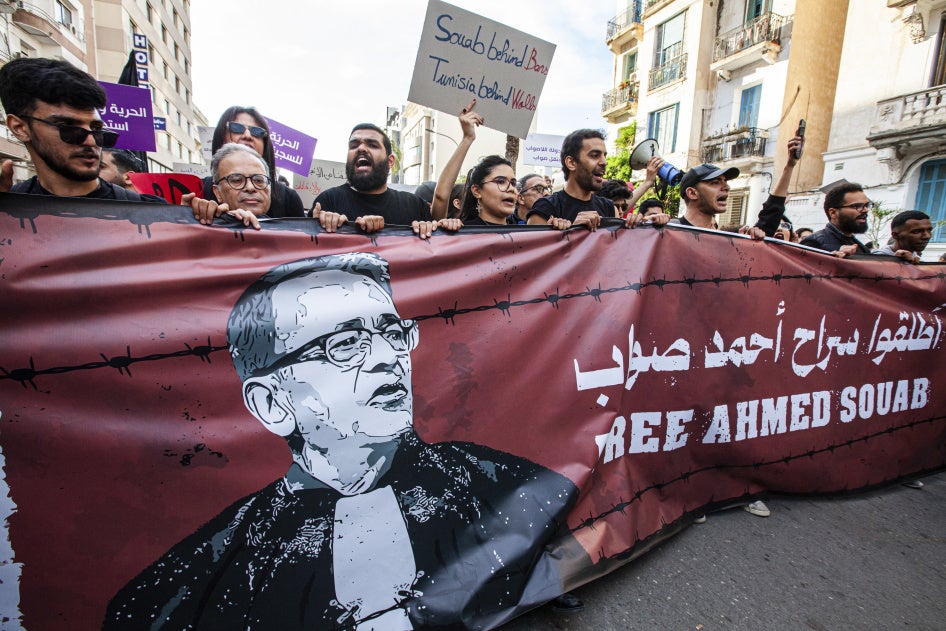
Updated March 4, 2026: On February 23, 2026, the appeals court reduced Souab’s sentence to 10 months in prison and an additional two-year suspended sentence. He was released the same day for time served.
(Beirut) – A Tunisian lawyer and human rights defender, Ahmed Souab, who was sentenced to prison on terrorism-related charges, will face a new trial on appeal on February 12, 2026, Human Rights Watch said today. The Tunisian authorities should immediately drop the unfounded charges and release him, and stop retaliating against critics and the lawyers defending them.
Tunisian authorities prosecuted Souab, 69, for statements he made outside of court while representing defendants in a notorious case of “conspiracy against state security.” On October 31, 2025, a Tunis anti-terrorism court sentenced him to five years in prison and three years of administrative supervision. His trial lasted just minutes; Souab was not present, and journalists were reportedly barred from attending.
“Ahmed Souab, a lawyer, former administrative judge, and fierce advocate for judicial independence, is behind bars simply for his defense work and outspoken views,” said Bassam Khawaja, deputy Middle East and North Africa director at Human Rights Watch. “His abusive prosecution for defending others from abusive prosecution shows the sheer extent of the Tunisian authorities’ crackdown on any dissent.”
Anti-terrorism agents arrested Souab in his home on April 21, following comments he made after the “conspiracy case” verdict on April 19. That day, 37 people, including lawyers, activists, and opponents, were sentenced after a sham trial for terrorism and security-related offenses to prison terms ranging from 4 to 66 years.
Standing outside the headquarters of Tunis Bar Association, Souab reportedly said: “It seems that it is not the detainees who have a knife turned on them, but rather, it’s the president of the chamber who has a knife [at his throat].” Video excerpts of his statement circulated widely on social media. Souab’s defense committee explained that he was referring to pressure exerted on judges.
Human Rights Watch has documented the authorities’ repeated attacks on the judiciary in Tunisia, including President Kais Saied’s dismantling of the High Judicial Council in February 2022. The attacks have severely undermined the rule of law, allowed the executive to weaponize the judiciary for political ends, and jeopardized Tunisians’ right to a fair trial, Human Rights Watch said.
Judicial authorities charged Souab under the 2015 Counterterrorism Law, the Penal Code, the Telecommunication Code, and Decree-Law 54 on Cybercrime, including for allegedly “forming a terrorist organization,” “supporting terrorist acts,” “threatening to commit terrorist acts,” and “spreading fake news.” He was held in pretrial detention for more than six months before trial.
The court decided to hold Souab’s trial remotely, claiming a “real danger” without providing further details. Souab refused to attend remotely to protest the lack of fair-trial guarantees.
The Tunisian authorities are increasingly relying on remote trials for terrorism cases, especially for politically motivated trials against dissidents. The practice of remote trial by video is inherently abusive, including by undermining detainees’ right to be brought physically before a judge to assess their well-being and the legality and conditions of their detention.
On October 31, Souab was convicted of “endangering the lives of people entitled to protection by deliberately disclosing information that could reveal their identities” and of “making threats in connection with a terrorist offense,” his family told Human Rights Watch.
Souab’s family said he has a history of cardiac conditions and experienced a deterioration in his health in prison. He has suffered several nosebleeds, the cause of which was not determined, they said.
Over the past three years, the authorities have increasingly relied on an aggressive legal toolbox, including unfounded security and terrorism charges under the penal code and 2015 Counterterrorism Law, to target critics and lawyers with judicial harassment, abusive criminal prosecution, arbitrary detention, and travel bans for the legitimate exercise of their profession.
Tunisian authorities should stop prosecuting individuals for exercising their human rights, guarantee fair trials, and release all those arbitrarily detained, Human Rights Watch said.
The United Nations Basic Principles on the Role of Lawyers state that lawyers must operate independently without undue interference from authorities and explicitly prohibit retaliation against lawyers for fulfilling their professional responsibilities.
Tunisia is a state party to the International Covenant on Civil and Political Rights and the African Charter on Human and Peoples’ Rights, which guarantee the right to freedom of expression and assembly, to a fair trial, and to not be subject to arbitrary arrest or detention.
“Souab’s trial showcased a litany of fair-trial failures that are becoming common in prosecuting dissidents in Tunisia,” Khawaja said. “The authorities should end both their practice of abusive prosecutions and interference in judicial proceedings.”