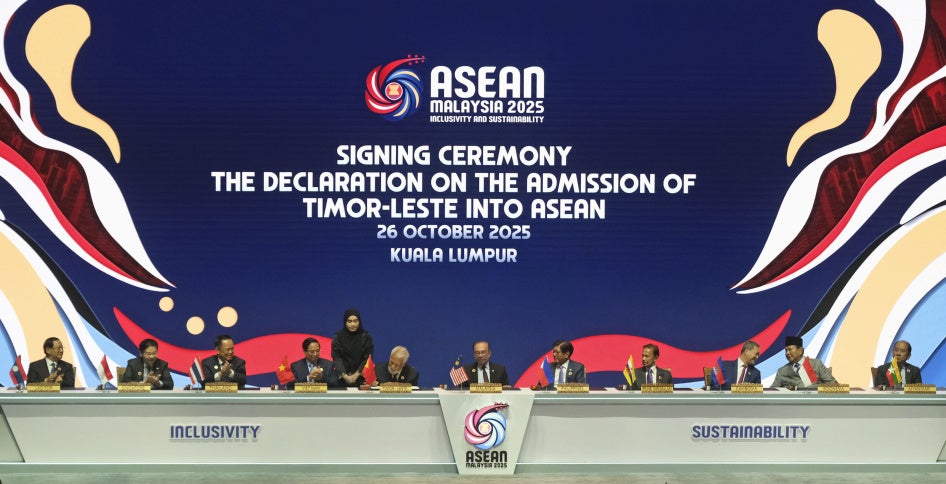
Timor-Leste joined the Association of Southeast Asian Nations (ASEAN) last year, bringing into the regional bloc a country shaped by its hard-won struggle for independence and its strong commitment to democracy and human rights.
Timor Leste’s values are reflected in its constitution, governance, and foreign policy. Its strong record on civil and political rights places the country in a distinctive position among Southeast Asian countries. Its admission as the group’s newest member provides ASEAN an opportunity it has so far failed to seize as the bloc grapples with the deepening human rights and humanitarian crisis in Myanmar.
Since the military coup in Myanmar five years ago, ASEAN’s response has been feeble and ineffectual. Leaders have deferred to non-interference and consensus as a convenient cover for inaction, even as the junta’s atrocities in Myanmar escalate.
The conflict has displaced millions, including across borders. The military has killed thousands of civilians; jailed tens of thousands of political prisoners; and imposed repressive laws while falsely claiming it is restoring peace and security. Myanmar’s recent sham national elections were designed to legitimize and entrench military rule, not end it.
Now Myanmar’s coup leader, Min Aung Hlaing, has shed his military uniform after 15 years overseeing grave conflict abuses to assume the presidency through this manufactured process. In 2024, the International Criminal Court prosecutor requested an arrest warrant for Min Aung Hlaing for alleged crimes against humanity against the Rohingya in 2017. And in 2025, an Argentinian court issued an arrest warrant against him for alleged genocide and other serious crimes against the Rohingya.
ASEAN leaders often point to the group’s Five Point Consensus with Myanmar in 2021 as proof of their engagement. Yet the junta has repeatedly flouted those commitments without facing meaningful consequences. ASEAN has excluded Myanmar’s top leaders from attending ASEAN summits, but engagement continues at working levels, blunting the effect of the ban.
Against this backdrop, Timor-Leste has taken a clear and principled position. Before the country joined ASEAN, President José Ramos Horta and Prime Minister Xanana Gusmão publicly expressed solidarity with Myanmar’s people. In January, that support took a more concrete form when Timorese prosecutors opened legal proceedings against senior Myanmar military officials for alleged war crimes and crimes against humanity in a case filed by the Chin Human Rights Organization.
The Myanmar junta’s reaction exposed the stakes. It denounced the case as a breach of ASEAN’s noninterference principle and expelled Timor-Leste’s chargé d’affaires. But instead of continuing to take a strong stand, Gusmão seems to want the case to disappear, saying, “We hope that the court or the Public Prosecutor’s Office will archive the case.”
To be sure, cases concerning international crimes are always difficult and require specialized expertise, adequate resources, and resilience in the face of pressure. The prosecutors in this case should be able to carry out an independent assessment, free from political interference.
Meanwhile, the need for ASEAN to address abuses by the Myanmar military remains critical. The United Nations Security Council, European Union, Australia, and Japan repeatedly point to the bloc to lead on Myanmar. ASEAN documents explicitly commit members to respect human rights but impose no credible consequences for non-compliance.
Some ASEAN states have grown increasingly uncomfortable with the junta’s intransigence. Malaysia, Indonesia, Singapore, and the Philippines have adopted firmer positions and rhetoric. Courts in Indonesia and the Philippines are also considering cases brought against the Myanmar military under universal jurisdiction – including one filed on March 30 in Jakarta.
These governments should work with Timor-Leste to push to shift ASEAN’s center of gravity — coordinating diplomatic messages with sanctioning governments, supporting accountability initiatives and stronger U.N. Security Council action, and resisting efforts to normalize the junta through sham polls and the new proxy parliament.
This comes at a critical time. The junta released some political prisoners recently in an amnesty, including the country’s democratically elected president, U Win Myint, imprisoned following the 2021 coup. Thailand praised that move, and this week Thai Foreign Minister Sihasak Phuangketkeow is visiting Nyapyidaw in an effort to normalize Myanmar’s relationship with ASEAN, giving Min Aung Hlaing the legitimacy he has been seeking. But many other political prisoners, including Aung San Suu Kyi, remain behind bars and there has been no accountability for the litany of war crimes and crimes against humanity.
Timor-Leste’s accession has created a rare opening for ASEAN to clarify whether it stands for anything more than procedural restraint. The bloc should draw clear red lines: continue to bar Min Aung Hlaing and other junta leaders from ASEAN summits; urge unfettered access for humanitarian aid, including across borders; and press for the release of political prisoners. ASEAN and its partners should also support accountability efforts rather than treating justice as an obstacle to diplomacy.
Timor-Leste has shown that ASEAN membership need not require moral reticence. By standing firm, it can help steer the bloc toward a more credible and principled role – one grounded not in abstractions about non-interference, but in concrete commitments to human rights, accountability, and regional security. The alternative is continued paralysis, dressed up as caution, while repression and violence in Myanmar deepen. That is a course neither Timor-Leste nor ASEAN should accept.