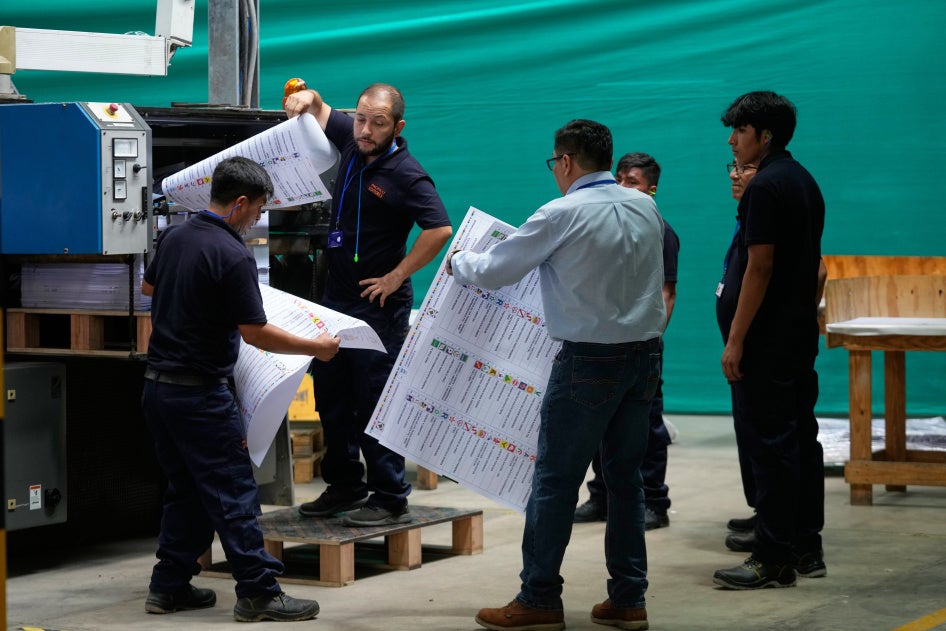
Peru has made the headlines for its political instability. But as the country heads into general elections on April 12, another aspect of the country’s institutional landscape requires urgent international attention: its slow but steady democratic backsliding.
The last time Peru had elections, in 2021, Fuerza Popular, the leading political party, tried to unlawfully overturn the results and questioned Pedro Castillo’s victory without evidence. Peru’s judicial and electoral institutions put a stop to those efforts, ensuring that the will of the people was respected. Five years later, these same institutions are much weaker and require stronger international support.
Congress has taken steps to undermine the independence and capacity of courts, prosecutors, and key government institutions. These moves appear designed to limit accountability for members of Congress, many of whom face criminal investigations for corruption and other serious crimes.
In 2022, Congress carried out an inappropriate process to appoint members of the Constitutional Tribunal, the country’s highest court. That court has since issued several widely-criticized rulings that favored Congress and its leading political figures.
Congress also appointed a former congressman with no experience in human rights as ombudsman. Historically, the ombudsman’s office has played an important role in protecting human rights and democracy, including after the 2021 elections.
However, since the new ombudsman took office in 2023, the office has ceased to fulfil that role. Instead, the office has defended Congress' decisions that run counter to human rights. It has also overseen an unfair process to appoint new members to the National Board of Justice, a body charged with naming and dismissing prosecutors and judges.
Since its appointment last year, the new Board of Justice has investigated judges who rule against members of Congress or against legislation congress has approved. It has also removed prosecutors investigating high-level corruption, as well as Attorney General Delia Espinoza. She was replaced by Tomas Galvez, an Attorney who had been investigated for an influence peddling scheme known as “Cuellos Blancos”. He has dismantled the teams charged with investigating major corruption cases, including many investigations against lawmakers.
Peru's democratic backsliding can feel labyrinthine. But Peruvians know its consequences well. As Congress goes unchecked, many Peruvians point to its role in weakening the rule of law as the reason for the expansion of organized crime in the country. As Congress makes it harder for judges and prosecutors to do their jobs, extortion and homicide rates have reached record highs.
The Peruvian Congress has also made it harder for civil society groups and independent journalists to protect human rights and keep the public informed. It passed an overbroad law that allows the executive branch to arbitrarily penalize groups that criticize its policies, including by suspending or eventually canceling their registration.
International attention will remain key amid this deteriorating scenario. Fortunately, the OAS, the EU, and the Carter Center will observe the elections. Their monitoring will be crucial to provide a credible version of the facts on the ground and protect the independence of electoral institutions. The OAS Permanent Council and the European Union’s leadership should stand ready to support the work of their missions and vigorously oppose any efforts to unlevel the playing field or undermine the electoral results.
Peruvians deserve to elect their new leader freely and fairly. Sustained support by the international community until the end of the electoral process is critical to ensure that Peruvians can make their choice.
Juanita Goebertus is the Americas Director at Human Rights Watch.