
On the night of June 12, 1963, Medgar Evers stepped out of his Oldsmobile parked in the driveway of his Jackson, Mississippi home, carrying t-shirts that read, "Jim Crow Must Go." He had returned from a civil rights meeting where he'd discussed voter registration strategies. A bullet struck him moments later, fired by a white man crouched in honeysuckle bushes across the street. This moment fueled the civil rights movement and represented the tactics some in Mississippi would deploy to ensure Black citizens did not have a political voice.
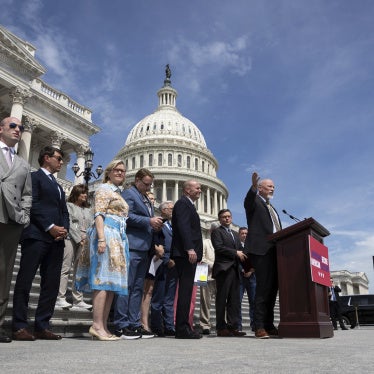
July 2025 would have marked Evers' 100th birthday. Jackson, the Mississippi capital, hosted a celebration, bringing together local and national politicians, community members, and activists in a city that has become ground zero for a new kind of rights struggle.
In Mississippi, 38 percent of residents are Black yet there are no Black statewide elected officials. The last time a Black person held statewide office in Mississippi was during Reconstruction, more than 140 years ago. This is the result of a political system built to ensure that demographics do not translate into political representation.
The mechanics of racial injustice in Mississippi have changed and grown more complex, but the present-day reality traces back to the ideas that fueled the violence Evers faced. Mississippi no longer uses lynch mobs, cross burnings, home bombings, poll taxes, and literacy tests. Now, divestment from public services and infrastructure, gerrymandering, felony disenfranchisement, and state takeovers serve to reinforce a racial hierarchy.
1890 Constitutional Convention
During the 12 years of Reconstruction after the end of chattel slavery, Mississippi elected more than 200 Black men to public office, more than any other state except South Carolina. This included statewide representatives: two United States senators, Hiram Revels and Blanche K. Bruce; lieutenant governor Alexander Davis; and secretary of state James Hill. Recently Emancipated Black people took their new freedom to vote seriously, and their political representation flourished. Until it didn’t. Reconstruction fell in 1877, when President Rutherford Hayes removed federal troops who had been warding off white supremacist violence. Across the South, white former Confederates regained power and made their first tasks to create a legal architecture to deny Black political power. In Mississippi, the 1890 Constitutional Convention was its blueprint.
When the all-white delegation gathered in Jackson to rewrite the state constitution, they made their ambitions clear. Solomon Saladin Calhoon, the convention's president, said, "We came here to exclude the Negro. Nothing short of this will answer." Because the recently enacted 13th, 14th, and 15th amendments to the U.S. Constitution forbid explicit racial hierarchy, legislators designed laws that could achieve the same results through seemingly neutral means.
A $2 poll tax to participate in elections, targeted Black people who still faced limited economic opportunity after centuries of forced labor and exclusion. After decades in which Black literacy was unlawful, literacy tests required voters to read, "any section of the state constitution" or demonstrate their understanding of it to the satisfaction of white registrars. They often asked Black applicants impossible questions such as, “how many gumballs are in this jar?”
One of the most durable tools developed during this period was felony disenfranchisement, which strips the right to vote for a felony conviction. Delegates chose a list of crimes that they thought were most likely to be committed by Black people – burglary, theft, and arson, crimes that included acts some recently emancipated people used to resist being held captive on their former plantations.
The results were devastating. Black voter registration dropped from 97 percent in 1868 to just 6 percent by 1892. Mississippi’s legal disenfranchisement model would spread across the South and hinder Black people’s enjoyment of human rights for generations.
Narrative of Black Incompetence
Mississippi needed a justification for these exclusionary mechanisms. White officials set about crafting a story that falsely characterized the brief period of Black political power during Reconstruction as evidence that Black people were unfit to govern, and unfit for democracy. This narrative was repeated in speeches, films, textbooks, and street conversations
President Andrew Johnson wrote to Congress in 1867, “It must be acknowledged that in the progress of nations Negroes have shown less capacity for government than any other race of people.”
President Woodrow Wilson, a scholar by training, believed historians who depicted Reconstruction as a disaster that required white “redemption.” He hosted the first film screening at the White House in 1915 – of D.W. Griffith's "Birth of a Nation," which portrayed the Ku Klux Klan as heroic saviors rescuing the South from Black people. The film's vast influence sparked increased Klan membership and a new wave of racial violence.
This narrative transformed racial exclusion into a logical course of action. If Black people were inherently unfit to govern, then making it harder for them to vote, elect candidates, and serve in elected office, was responsible.
“We’ve had to wear these lies about us for years,” said Frank Figgers, a Jackson community leader. “Since Reconstruction Black people have been told that we can't govern and we put up a fierce fight to reject that."
Black Participation Prevented with Violence
White Mississippians also used violence to crush Black people’s efforts to build political power. Between 1877 and 1950, mobs of white people lynched at least 654 Black men, women, and children in Mississippi. Reverend George W. Lee was shot in the head in 1955 for helping Black citizens register. Lamar "Ditney" Smith was gunned down in daylight on a courthouse lawn while carrying absentee ballots. Herbert Lee, who helped found his county's NAACP branch, was killed by a white state representative in 1961 for his voter registration efforts.
During 1964’s Freedom Summer, when college students from across the country traveled to Mississippi to challenge Jim Crow, the Klan murdered three young men for teaching Black Mississippians to read and vote. Michael Schwerner, James Cheney, and Andrew Goodman became national symbols of the state's commitment to maintaining its racial order through terror.
The assassination of Medgar Evers was especially remarkable. As the NAACP's first field secretary in the state, Evers had worked to desegregate the University of Mississippi, investigated the lynching of 14-year-old Emmett Till, and organized voter registration drives across a state where such activities could mean death.
When Byron De La Beckwith was finally convicted in 1994 for the murder, 31 years later, the delay itself sent a message. Mississippi would protect those who protected white supremacy, even when their methods were deadly and unlawful.
Black Participation Thwarted by Political System
More than a century later, Black disenfranchisement remains a defining feature of Mississippi’s political landscape.
Today, at least 43,700 Black Mississippians, over 5 percent of the state’s Black adult population, cannot vote, according to the Sentencing Project. Mississippi has an overall felony disenfranchisement rate of 3.08 percent. Black Mississippians represent over 60 percent of the disenfranchised population despite only making up 37 percent of the state’s population. Across the US, 1.7 percent of adult citizens cannot vote due to felony disenfranchisement.
Individuals seeking to regain voting rights in Mississippi must either receive a gubernatorial pardon, requiring public hearings and newspaper notices that can trigger community opposition, or convince two-thirds of both legislative chambers to pass individual bills." According to a report by the Advancement Project, Mississippi Votes, and OneVoice, between 2000 and 2015, only 335 people successfully navigated this gantlet out of 166,494 people who completed their sentences. The process ensures that disenfranchisement remains effectively permanent.
At the same time, racial gerrymandering continues. The federal government acknowledged Mississippi’s history of suppressing Black political power in the Voting Rights Act of 1965 by making the state seek federal permission to change voting laws and maps. Federal courts and the US Department of Justice have intervened on behalf of Black voters repeatedly.
As recently as 2024, a federal court ordered the state to redraw its legislative maps after finding they diluted Black voting power. The court wrote “that Mississippi has a long and dubious history of discriminating against blacks is indisputable.” It goes on to say that the legislature's history of map drawing since 1980 is a “continuation of official discrimination.” The court also found that despite Black voters remaining cohesive in their political choices, white voters had consistently opposed the candidate preferred by Black voters, creating a dynamic in which demographic change never translates into statewide power for Black Mississippians. While the court agreed that the state had weakened Black voting power, the voters won under the Voting Rights Act but lost their constitutional claim because they could not prove the state intended to discriminate. This outcome illustrates why the Voting Rights Act is a critical safeguard – it protects voters based on discriminatory outcomes rather than requiring the nearly impossible task of proving racist intent.
The Supreme Court's 2013 decision in Shelby v. Holder removed the federal oversight that had protected voting rights for nearly 50 years. Justice Ruth Bader Ginsburg's dissent forecasted that striking down the requirement was like "throwing away your umbrella in a rainstorm." According to the Brennan Center for Justice, the downpour came. It found that states have implemented over one hundred restrictive voting laws in the decade that followed.
White Flight Drains Jackson of Resources
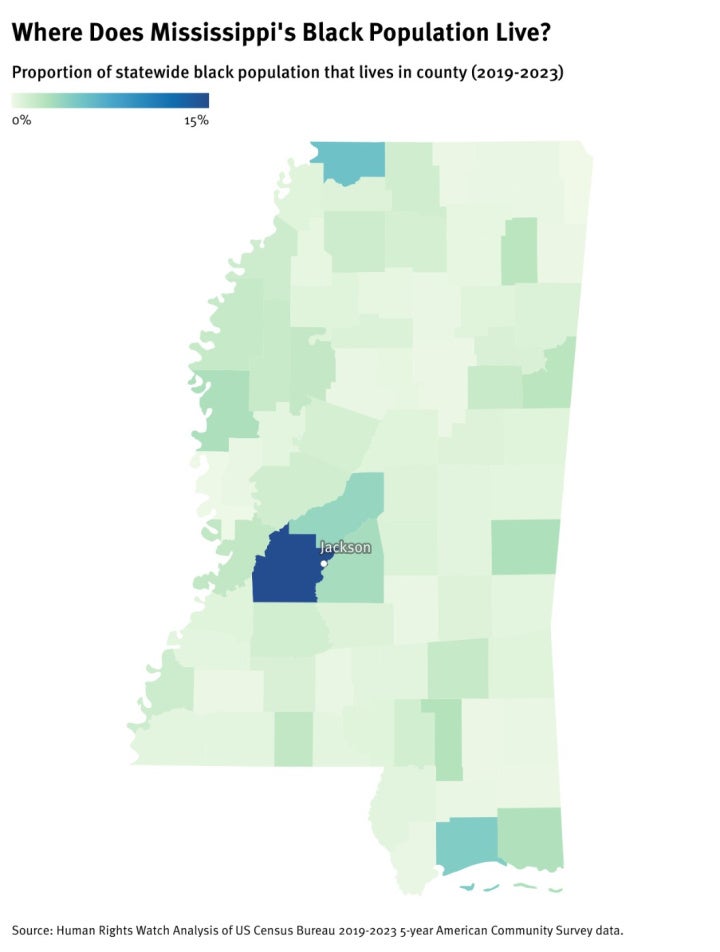
As Black Mississippians have found themselves locked out of statewide power, the city of Jackson has become an exception: a place where Black political participation could flourish. The city's transformation from majority-white to majority-Black created opportunities for meaningful representation that had been absent since Reconstruction. Jackson and the surrounding area account for almost 20 percent of the state’s Black population. About 14 percent of Mississippi’s Black population lives in Jackson compared with 7 percent of the total population of the state. Another 5 percent of the state’s Black population live within 10 miles of the city.
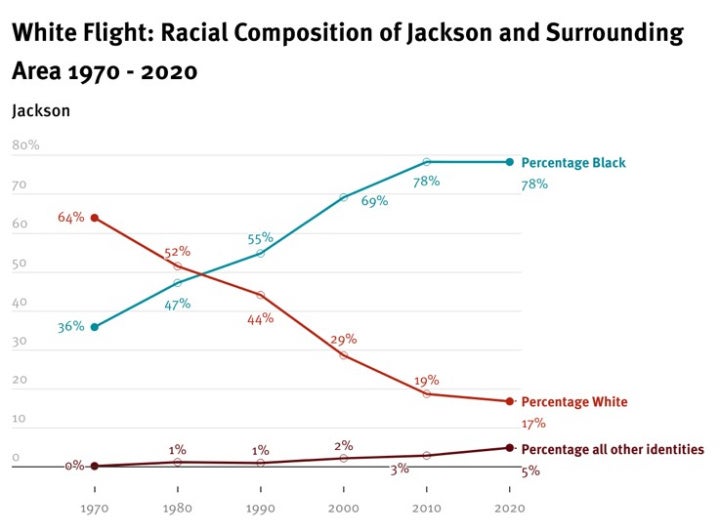
In the post-civil rights era, Jackson experienced dramatic white flight, partially encouraged by organizations like the White Citizens Council, which initiated a campaign to encourage white families to move to avoid integration. The group wrote about integration, “If we quit resisting, we will be committing cultural, and probably racial, suicide.” Jackson’s population over a few decades went from being two-thirds white to over three-quarters Black. The city eventually began electing Black representatives to lead the police and courts and manage municipal resources.
This included the 1997 election of Harvey Johnson Jr. as Jackson's first Black mayor. Looking back on that night of victory, Johnson recalled the overwhelming response: "We shut down the street outside of our campaign headquarters. Hundreds of people came to extend their well wishes. I felt an air of excitement there that night."
But soon after the celebration ended, Johnson would have to address stark reality. From 1990 to 2000, nearly 35,000 white residents departed Jackson for the surrounding counties of Madison and Rankin, taking their tax base with them. The city's population dropped from 250,000 in 1985 to fewer than 150,000 today, while the surrounding suburbs flourished.
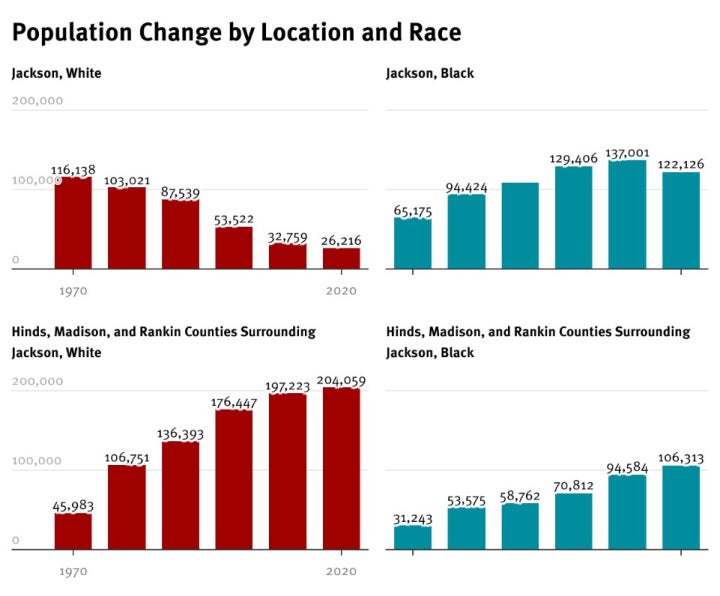
The exodus from Jackson was partially enabled by federal and state policies and funds that made suburban development popular and that had the effect of siphoning of resources that could have gone to the city.
“I've just watched millions and millions of dollars be directed to these new projects in suburban communities,” he said.
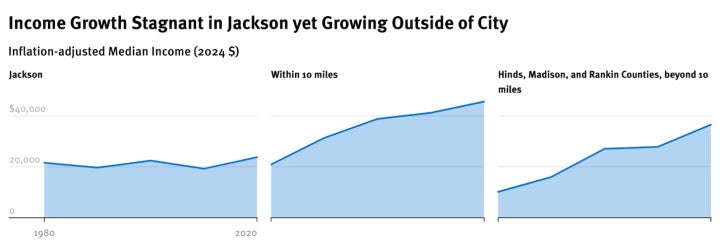
Johnson also wondered if his election was a manifestation of Black political power that would incite backlash. "I worry that the moment I became mayor was the beginning of the end of democracy in Jackson.”
Pluralism and Democracy at the State Legislature
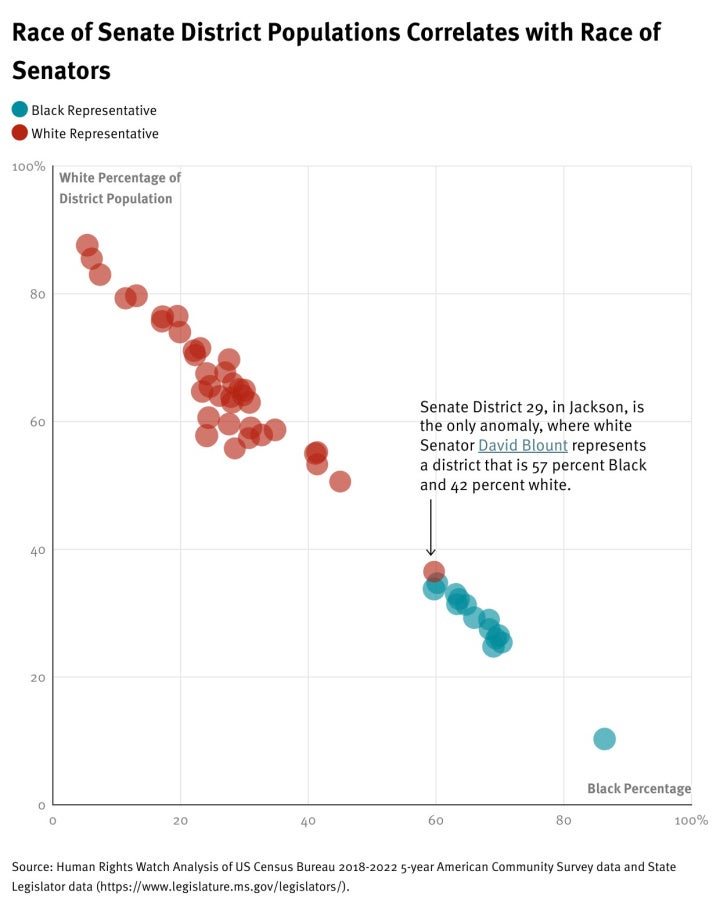
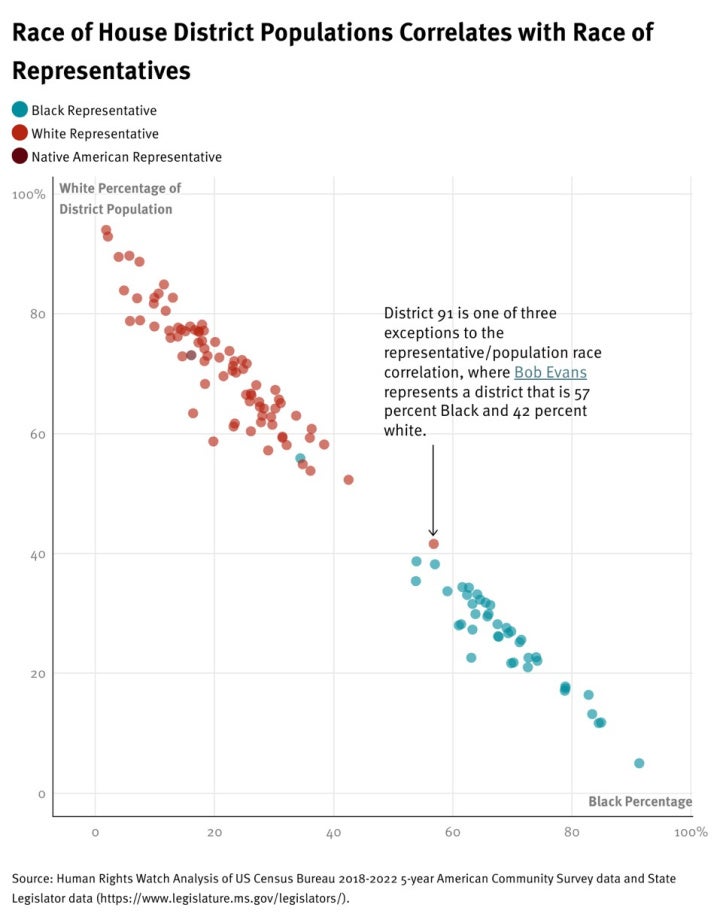
Almost every state representative or senator is of the same race as the majority of the population within their district boundary.
These state senate and house districts are artificial constructs, delineated with political outcomes at top of mind. Human Rights Watch compared their populations to those within two other sets of administrative boundaries, counties and census tracts, that are more representative of real communities and developed with different intentions.
State Senate and House boundaries are much less diverse and create more white majority units than counties or census tracts. Between 8.5 and 9.7 percent of census tracts and counties have no majority race, with both Black and white populations below 50 percent. Yet no Senate districts and only 1 house district are designed without a clear race majority.
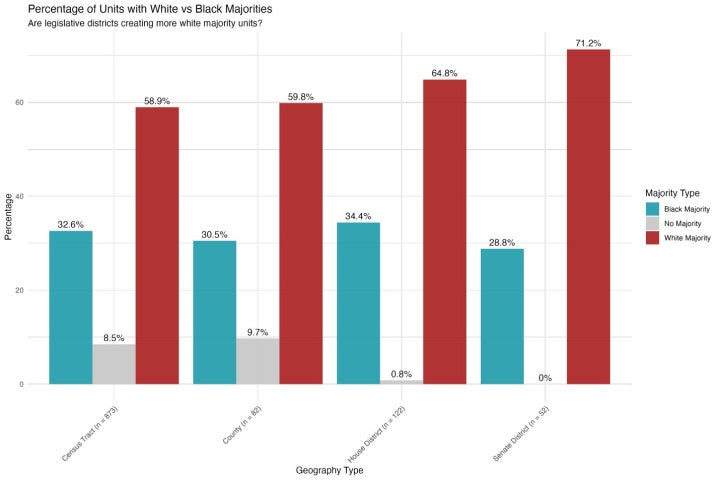
With few exceptions, political boundaries drawn in a way in which white representatives are rarely electorally accountable to Black voters and comprise the majority of the legislature.
State Control and 2023 Jackson Takeover Bills
In 2023, Mississippi's legislature passed two laws that radically altered Jackson's governance, stripping power from elected Black officials and transferring it to appointed bodies whose members are all white. House Bill 1020 created a new court system within the Capitol Complex Improvement District, a state-created economic zone that encompasses downtown and the city's predominantly white northeastern neighborhoods. Judges for this court are appointed by the state supreme court chief justice rather than elected. Senate Bill 2343 expanded the state-run Capitol Police Department's jurisdiction to cover nearly the entire city, a broad grant of authority to a law enforcement agency that is accountable to state officials rather than Jackson's elected mayor and city council.
State lawmakers defended the legislation by citing Jackson’s rising crime rates and court backlogs as urgent public safety concerns that the legislature was obligated to respond to because Jackson is the capital city. Rep. Trey Lamar argued that the separate court system would help address case delays in criminal proceedings, along with lawmakers who argued Capitol Police expansion would create additional law enforcement presence to deter crime and supplement the Jackson Police Department, which had been under-resourced.
The Improvement district court represented what some described as separate justice systems for white and Black residents within the same city.
Devin Branch, a community organizer in West Jackson discussing the impact of Capitol Police patrolling the city, said, “This felt like an occupation."
Zakiya Summers, who represents Jackson in the legislature, remembers being surprised that the bill was pushed through so quickly. She said, “I thought the Black and Jackson delegations would have a chance to engage,” but she suspects that, “Leadership didn't need our votes."
The legislative debate revealed the racial nature of the bills. White Republican legislators questioned whether Jackson possessed "the best and brightest" to serve as local judges, suggesting that the majority-Black city lacked adequate talent for self-governance. Representative Trey Lamar, the white legislator from Senatobia who sponsored the court takeover, lives three hours from Jackson and acknowledged that none of his constituents had requested the legislation. When Black legislators pointed to poverty and disinvestment as root causes of the city's challenges, Lamar suggested the real problem was "a lack of somebody at home to steer young people in the right direction" – a dog whistle that echoed racist stereotypes about Black people dating back to Reconstruction.
The legislative debate not only had racial undertones; it showed selective application of the state’s concerns. Lawmakers continually pointed to public safety and court reform as justifications for the changes, but they did not provide answers for why similar interventions were not proposed in other Mississippi cities dealing with similar challenges. For instance, the city of Tupelo was exempt from a state-led commission overseeing its tax expenditure, which was required of Jackson to pass its 1 percent sales tax. The state also created new elected judge positions across Mississippi but failed to add judges in Hinds County, even though its caseload had grown more than other areas. In another example, lawmakers did not explain why Northeast Jackson, a wealthier area with a large white population and lower crime rates, was included in the new court district. This drove the belief among some that Jackson was being singled out because of its racial demographics.
Longer Pattern of State Takeovers in Jackson
The 2023 legislation was the latest in a broader pattern of state intervention disempowering Jackson's Black political leadership.
Jackson residents voted in 2014 for a 1 percent sales tax to raise funds to improve the city’s aging infrastructure, which suffers from decades of disinvestment. The state responded by creating a new commission that would oversee the funds, with Jackson officials appointing a minority of members. The majority-white city of Tupelo, the only other city Mississippi allowed to implement a local sales tax, was not subject to state oversight. More recently, state legislators considered a measure to restrict city leadership to only spend revenue from the tax on the city’s water system, rather than a broader set of infrastructure improvements.
Mayor Johnson said, “With Jackson's enactment of the sales tax, the legislature put on a commission to basically oversee not the collection of the money, but the expenditure of the money. And I consider that an affront to local elected officials here in the city and an affront to the political gains made over the years by Black citizens in Jackson.”
The 2022 water crisis provided another opportunity for state intervention. After decades of disinvestment in Jackson's water system, flooding at the city's treatment plant left 170,000 residents without safe water for weeks. Jackson’s leaders had warned about the danger of disinvestment in the water system and requested state assistance for years. The shrinking tax base, a problem with its origins in the pattern of white flight that started in the 1970s, made raising funds for infrastructure a difficult task for local leaders.
The lack of state financial support was one of the main causes of the water crisis, a 2024 report from the Office of the Inspector General at the U.S. Environmental Protection Agency found. The report notes the Mississippi State Department of Health received nearly $265 million in federal funds in the form of loans, to be distributed at the local level. Jackson received $51 million of the $265 million, which the report found to be inadequate to address the city’s repair needs. Reports by the EPA and the Project on Government Oversight noted that Mississippi’s practice of sending federal funds to local governments in the form of loans, rather than grants, burden the city’s low- and middle-income residents.
“States have a responsibility in creating systems that don't leave depopulating municipalities vulnerable… [Mississippi has shown] reticence to create solutions for Jackson that is inextricably tied to race and racism,” said Professor Andre Perry of the Brookings Institution in a 2022 interview with the American Society of Engineers.
International human rights law also speaks to this responsibility. The International Covenant of Economic, Social, and Cultural Rights (ICESCR) guarantees the rights to health, education, and an adequate standard of living. The Covenant recognizes that resources are a limiting factor but obliges governments to work towards the progressive realization of these rights “to the maximum of [their] available resources.” Furthermore, governments can only take deliberately “retrogressive” steps, often represented by patterns of disinvestment, in very limited circumstances. The United States has not ratified the treaty, but it still offers strong practical guidance as to how officials at all levels of government should work to realize the rights it codifies.
When federal courts appointed an outside manager to oversee the water system, Governor Tate Reeves blamed the issues on local incompetence. He said, “I don't think it's very likely that the city is going to operate the water system anytime soon, if ever.”
The latest battle is over the of Jackson-Medgar Wiley Evers International Airport, which generates millions in revenue and creates thousands of jobs in the Jackson area. In 2016, Mississippi’s majority-white legislature passed a law that would abolish Jackson’s majority-Black elected airport authority and replace it with an appointed board, selected by state officials who are all white.
Jackson sued the state legislature, arguing the state takeover of the airport would violate the equal protection clause of the US Constitution. A federal judge ruled in May 2025 that Jackson had legal standing to make its case in court. Judge Carlton Reeves wrote the city has been singled out for treatment to which no other cities in Mississippi are subject. Jackson is now preparing to argue the 2016 airport takeover law is a form of racial discrimination, even though it is seemingly race-neutral. The city will rely on the US Constitution’s equal protection clause, which the court noted was created in the aftermath of the Civil War to protect newly emancipated Black Americans from discrimination.
The city has levied similar allegations about the Jackson baseball stadium, which the state attorney general demanded Jackson surrender in September 2024, arguing the city violated the 1944 deed that required the land be used for parks. The litigation is ongoing.
"It hurts democracy, it hurts the psyche of Black people,” Rep. Summers said. “We assume Black people can't govern and white people need to be in charge and control resources."
Community activists Oleta Fitzgerald and Phaedra Robinson said this pattern causes fatigue. "We're fighting battle after battle so our community, our kids, our old people can survive," they said in an interview with Human Rights Watch. "Courts are stacked, the legislature is stacked. it's always been a fight for us in Mississippi, and it feels like they want to go back to the good old days."
Mississippi has cited public safety, government efficiency and reform, scarcity of resources as justification for takeovers. These are race-neutral motivations. However, the pattern of selective intervention exclusively targeting Mississippi’s majority-Black capital city, combined with the exclusion of local Black officials from decision-making processes, means that these “neutral” policies have discriminatory effects.
The Cost, Violation of International Human Rights Law
Mississippi's actions implicate not just the US constitution but US obligations under international human rights law. The International Covenant on Civil and Political Rights, ratified by the United States in 1992, guarantees that elected representatives must "exercise governmental power" and remain "accountable through the electoral process." Mississippi's pattern of stripping authority from Black-elected officials is at odds with the spirit and perhaps the letter of these obligations.
The Convention on the Elimination of All Forms of Racial Discrimination, ratified by the U.S. in 1994, prohibits state actions that have racially discriminatory effects, even if they appear to have race-neutral intent. Mississippi's takeover of Jackson clearly may amount to a violation of US obligations under that treaty.
Under both treaties, the federal government and states must take effective steps to protect people against violations of their rights and to provide effective remedies for human rights violations that do occur. In Jackson, historical violations have metastasized, creating new mechanisms of exclusion for a new century.
Peyton McCrary, a historian with the U.S. Department of Justice Civil Rights Division, believes the Voting Rights Act should have prevented state officials from engaging in various forms of political takeover in Jackson. "It would have been rejected soundly," he told reporters. "I have no doubt that it would have been rejected. It would pretty much have been an open-and-shut case."
Medgar Evers Legacy + Contemporary Activism
Kelcy Higgins grew up in the Mississippi Delta, shaped by her grandmother's civic involvement and her own early encounters with racism. Higgins has worked for Planned Parenthood in one of the most restrictive states for reproductive rights, and for political campaigns in a state where Black candidates rarely win statewide. She remains involved in efforts to ensure her community can gain adequate representation and be governed by officials who meet the needs of their constituents.
Higgins participated in the Jackson Undivided Coalition, a group of community organizations that opposed the 2023 Jackson takeover bills. She remembers worrying when the laws passed could ripple beyond Mississippi. "Whatever they'll do to Jackson, they'll do to somebody else. The state's approach to the city of Jackson, with the court and the Capitol Police, that's not something they came up with on their own. They talk to their peers, and they share the same advice and consultants all across the country."
Higgins said that the most noticeable change since the laws have gone into effect is the increased presence of state police across Jackson. She said she and her friends see the Capitol Police as “the state's surveillance team.” Community groups are still monitoring the implementation of the new state run court and police presence, looking to ensure local residents still have pathways to hold CCID officials accountable.
Activists across the state like Higgins, continue to work daily to improve the conditions of life for Black people in Mississippi, driven by the legacy of social movements. Keenon Walker, an organizer with Mississippi Votes, said, “I have the pleasure of having met the children of Medgar Evers and Vernon Dahmer,” referring to another Mississippi civil rights leader, “and when I sit down and listen to them talk it’s empowering. It makes me want to keep fighting. To know that I'm so close to this history, I feel a sense of duty to keep the work going.”
One hundred years after his birth, sixty-two years after his death, Medgar Evers’ fight continues. The price of political participation in Mississippi remains high for Black citizens. Kelcy Higgins holds on to a better future, saying, “it isn’t going to be like this forever.”