Reports

Obstetric Violence in Sierra Leone

The 75-page report, “No Money, No Care: Obstetric Violence in Sierra Leone,” documents cases of verbal abuse, medical neglect, and abandonment of women and girls facing serious obstetric complications, practices that experts interviewed say are common. Many women interviewed said they were shamed and mistreated by healthcare providers for expressing pain, needing help, or for not having enough money to pay fees. Others described humiliating experiences in which healthcare providers treated them brusquely or withheld important health information. Some cases documented constitute obstetric violence, a largely unaddressed form of gender-based violence prevalent across the world.

Pregnant women sit in the waiting area at the pre-natal clinic of the Princess Christian Maternity Hospital
A woman looks out of the window of a damaged building

Search

  • October 29, 2025

    The Harms of State-Mandated Parental Notification for Abortion and Judicial Bypass in the United States

    The 89-page report, “Whose Abortion Is It? The Harms of State-Mandated Parental Notification for Abortion and Judicial Bypass in the United States,” documents how state-mandated parental notification laws in six US states threaten young people’s health and safety and undermine their human rights. Most young people considering abortion involve a parent in their decision. Those who do not often have no access to a parent or fear that parental involvement will lead to severe consequences, such as physical abuse, loss of housing, family alienation, or forced continuation of a pregnancy against their wishes. The alternative to notifying a parent involves petitioning a judge for a court order in an invasive, stressful, and often traumatizing process called “judicial bypass.”

    report cover in English
  • April 7, 2025

    Increasing Barriers to Accessing Sexual and Reproductive Health Care in Romania

    The 73-page report, “‘It’s Happening Even Without You Noticing’: Increasing Barriers to Accessing Sexual and Reproductive Health Care in Romania,” documents that, although these rights are partially protected under Romanian law, in practice women and girls are regularly and systematically thwarted in their efforts to exercise these rights.

    Report cover in English
  • March 24, 2025

    Poverty and Gender in Germany’s Social Security System

    The 81-page report, “‘It Tears You Apart’: Poverty and Gender in Germany’s Social Security System”, documents increasing poverty and the failure of the German social security system to ensure the right to an adequate standard of living for many people. In particular, the lack of adequate support affects single mothers raising young children and older women living alone on low incomes.

    Report cover in English
  • February 18, 2025

    Sexual Violence against Girls in Guatemala

    The 85-page report, “‘Forced to Give Up on Their Dreams’: Sexual Violence against Girls in Guatemala,” documents the numerous barriers that girls who are survivors of sexual violence face accessing essential health care, education, social security, and justice. Guatemalan law classifies any sexual activity involving a child under 14 as sexual violence. Guatemala’s National Registry of Persons (RENAP) reported that between 2018 and 2024, 14,696 girls under 14 gave birth and became mothers, in many cases against their will.

    English report cover
  • January 29, 2025

    Inadequate Cervical Cancer Prevention and Care for Black Women in the United States Mississippi Delta

    The report, “No Excuse: Inadequate Cervical Cancer Prevention and Care for Black Women in the United States Mississippi Delta,” documents that state and federal policies and a lack of investment in prevention are failing to ensure Black women in the rural Mississippi Delta—a region with some of the worst health indicators and highest rates of poverty in the entire United States—have access to comprehensive, affordable, and equal reproductive healthcare services and information. Mississippi has the highest rate of cervical cancer deaths in the United States and Black women in the state are almost 1.5 times as likely to die of the disease as white women. Black women living in the largely rural Mississippi Delta area in the southern United States have an even greater risk of dying from the disease.

    English report cover
  • January 28, 2025

    Violations of Pregnant Women’s Rights Amid Israel’s Assault on Gaza

    The 50-page report, “‘Five Babies in One Incubator’: Violations of Pregnant Women’s Rights Amid Israel’s Assault on Gaza,” finds that Israeli forces’ unlawful blockade of the Gaza Strip, its severe restrictions on humanitarian aid, and attacks on medical facilities and healthcare personnel have directly harmed women and girls during pregnancy, childbirth, and the postpartum period. The Israeli government, as the occupying power in Gaza, has violated the right to the highest attainable standard of health and other rights of pregnant women and girls, including the right to dignified, respectful health care throughout pregnancy, childbirth, and postpartum, as well as the right to newborn care.

    video content
    Report cover in English
  • December 9, 2024

    Labor Abuses & Sexual Exploitation in Colombian Webcam Studios

    The 175-page report, “‘I Learned How to Say No’: Labor Abuses & Sexual Exploitation in Colombian Webcam Studios,” exposes working conditions in webcam studios in Bogotá, Cali, Medellín, and Palmira, where models record content that is broadcasted by adult platforms and streamed around the world. Webcamming is a global industry in which studies estimate that platforms keep between 50 and 65 percent of what viewers pay. People interviewed said that studios retain as much as 70 percent of what is paid out by the platform, reducing the pay of workers. Adult webcam platforms based in the United States and Europe should immediately address labor abuses and sexual exploitation in Colombian webcam studios.

    Report cover in English
  • October 16, 2024

    Doula Care for Justice in Maternal Health in Florida

    The 62-page report, “Witness, Ally, Advocate, Climate Worker: Doula Care for Justice in Maternal Health in Florida,” found that the state provides inadequate financial and programmatic support for doula care, including under state-based Medicaid plans on which almost half of all women who are pregnant or give birth in the state rely. Doulas are non-clinical health workers who provide expert support during birth and provide individualized information about health care options, rights, and resources. Academic and US government research suggests that doula services can help improve the availability, accessibility, and quality of health care services for pregnant people. One multi-country analysis of evidence found continuous labor support by doulas may reduce rates of cesarean delivery and improve Apgar scores (indications of good health in newborns) and women’s ratings of the experience.

    English report cover
  • October 10, 2024

    Abuses against Afghan Policewomen, Past and Present

    The 26-page report, “Double Betrayal: Abuses against Afghan Policewomen Past and Present,” documents threats from Taliban authorities since August 2021 that have forced many former policewomen to go into hiding out of fear of being identified.

    report cover in English
  • August 21, 2024

    Insights From Health Workers in Oregon State

    The 78-page report, “Reproductive Rights in the US Wildfire Crisis: Insights from Health Workers in Oregon State,” finds that the US government needs to do more to address the growing threat wildfires pose to maternal and newborn health, particularly in marginalized communities. The organizations documented the impacts of recent wildfires on maternal and newborn health in the state of Oregon, drawing on the experiences of community health workers and maternal health providers, among others.

    Report cover in English
  • August 13, 2024

    Abortion Access in the State of Mexico

    The 44-page report, “Navigating Obstacles: Abortion Access in the State of Mexico,” found that the state’s abortion law does not guarantee access to this essential service, even for legally eligible cases. Barriers to access include healthcare providers denying or delaying services, withholding necessary information, questioning the veracity of sexual violence survivors' statements, subjecting women to mistreatment, and imposing arbitrary requirements for access that contradict existing law and regulations.

    Report cover in English
  • July 28, 2024

    Sexual Violence against Women and Girls in Sudan’s Capital

    The 88-page report, ““Khartoum is Not Safe for Women”: Sexual Violence against Women and Girls in Sudan’s Capital,” documents widespread sexual violence, as well as forced and child marriage during the conflict, in Khartoum and its sister cities. Service providers treating and supporting victims also heard reports from women and girls of being held by the RSF in conditions that could amount to sexual slavery. The research also highlights the devastating health and mental health consequences for survivors and the destructive impact of warring parties’ attacks on health care and the Sudanese Armed Forces’ (SAF) willful blocking of aid.

    Report cover in English
  • March 28, 2024

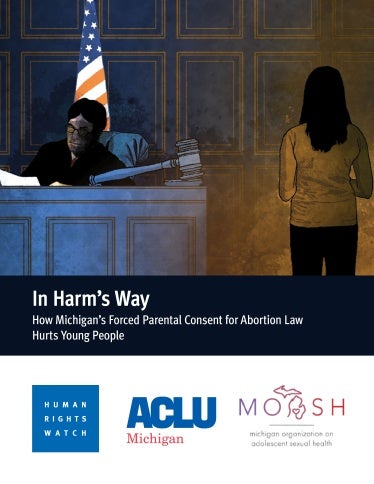
    How Michigan’s Forced Parental Consent for Abortion Law Hurts Young People

    The 36-page report, “In Harm’s Way: How Michigan’s Forced Parental Consent for Abortion Law Hurts Young People” examines the impact of a Michigan law that requires people under age 18 seeking an abortion to have a parent or legal guardian’s written consent or get approval from a judge in a process known as “judicial bypass.”

    English report cover
  • March 3, 2024

    The Impact of Unregistered Marriages on Women’s and Children’s Rights in Iraq

    The 40-page report, “‘My Marriage was Mistake after Mistake’: The Impact of Unregistered Marriages on Women’s and Children’s Rights in Iraq,” documents the impacts of unregistered marriages on women and girls who enter them, and the downstream effects on their children. The unregistered marriages function as a loophole around legal restrictions on child marriage and have disastrous effects on women and girls’ ability to get government services and social services linked to their civil status, obtain birth certificates for their children, or claim their rights to dowry, spousal maintenance, and inheritance.

    English report cover
  • February 13, 2024

    Pregnant Girls’ and Adolescent Mothers’ Struggles to Stay in School in Mozambique

    The 52-page report, “‘Girls Shouldn’t Give Up On Their Studies’: Pregnant Girls’ and Adolescent Mothers’ Struggle to Stay in School in Mozambique,” documents numerous barriers faced by adolescent girls and women who are pregnant or parenting, and the problems they face when trying to stay in school. Students also lack or are denied access to sexual and reproductive health information, especially comprehensive sexuality education, as well as adolescent-responsive sexual and reproductive health services, including a wide range of contraceptive options and safe, legal abortion to the fullest extent allowed by law.

    Mozambique pregnant girls education report cover