Systemic Age and Gender Discrimination Against Women at Work in South Korea
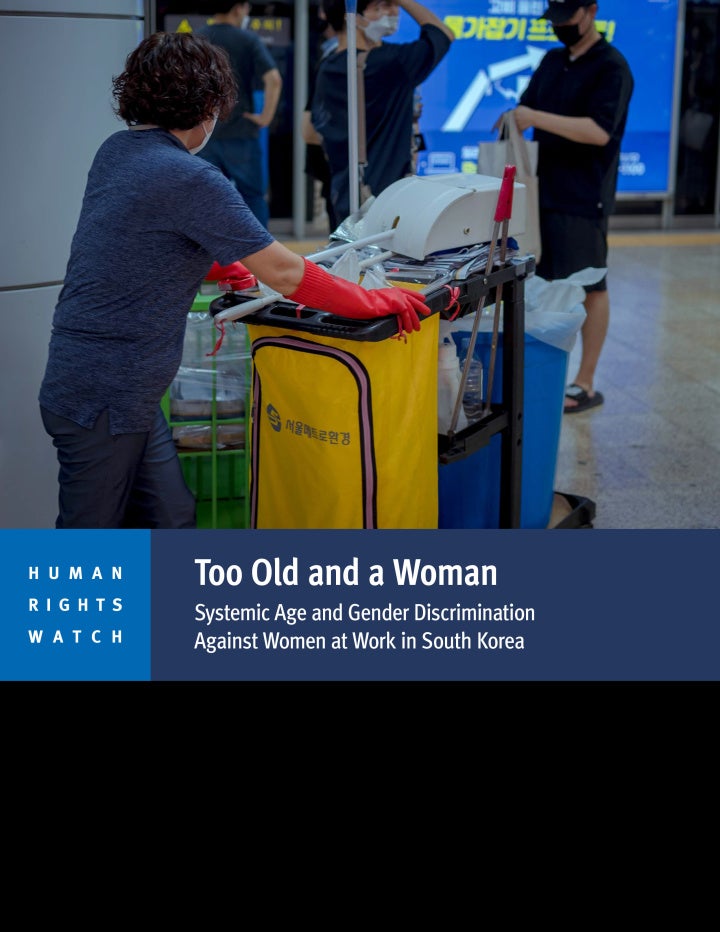
The 92-page report, “Too Old and a Woman: Systemic Age and Gender Discrimination Against Women at Work in South Korea,” documents that social attitudes toward education, unfair treatment in hiring, disrupted careers due to family responsibilities, limited promotion opportunities, glass ceilings, and sexual harassment create a disadvantage for South Korean women throughout their working lives. As women get older, their work opportunities narrow to a handful of low-paid, insecure jobs, and the gender pay gap increases. By the time they are eligible for pensions, women face a significant gender pension gap.
Turkey’s public universities are still emerging from more than twenty years of military influence and centralized ideological and operational controls.
Human Rights Watch submitted a number of requests to the U.S. government for documents relating to trafficking in persons in Bosnia pursuant to the Freedom of Information Act. Two years after our initial request, we obtained a limited number of documents.
This 37-page report documents the killings and attempted murders of women by male family members who claim they are defending family "honor." The report also details the cases of women, threatened with "honor" crimes, who languish in prison for years while held in protective custody.
South Africa's Efforts to Prevent HIV in Survivors of Sexual Violence
This 73-page report documents how government inaction and misinformation from high-level officials have undermined the effectiveness of South Africa’s program to provide rape survivors with post-exposure prophylaxis (PEP) — antiretroviral drugs that can reduce the risk of contracting HIV from an HIV-positive attacker.
Despite significant changes in the political environment over the past six months, most notably the August 2003 signing of a peace agreement, the departure into exile of president Charles Taylor and the establishment of a newly-mandated United Nations peacekeeping mission, the plight of civilians in Liberia remains dire.
Tens of thousands of girls in El Salvador work as domestics, a form of labor that makes them particularly vulnerable to physical abuse and sexual harassment. This 35-page report calls on the Salvadoran government to include domestic workers, who are almost exclusively girls and young women, in its program to address hazardous child labor.
A Call for Action on HIV/AIDS-Related Human Rights Abuses Against Women and Girls in Africa
Violence and discrimination against women and girls is fueling Africa's AIDS crisis. African governments must make gender equality a central part of national AIDS programs if they are to succeed in fighting the epidemic.
Discrimination Against Women in the Ukrainian Labor Force
Gender discrimination in Ukraine is cutting women out of the work force while the Ukrainian government is doing nothing to stop the problem. This 52-page report describes how Ukrainian employers discriminate against women job seekers in the way they announce vacancies and interview applicants.
Domestic Violence and Women's Vulnerability to HIV in Uganda
The Ugandan government's failure to protect women from domestic violence and discrimination increases women's risk of contracting HIV. This 77-page report documents widespread rape and brutal attacks on women by their husbands in Uganda, where a specific domestic violence law has not been enacted and where spousal rape is not criminalized.
Sexual Violence and Abduction of Women and Girls in Baghdad
The insecurity plaguing Baghdad and other Iraqi cities has a distinct and debilitating impact on the daily lives of women and girls, preventing them from participating in public life at a crucial time in their country's history. Human Rights Watch interviewed rape and abduction victims and witnesses, Iraqi police and health professionals, and U.S.
Human Rights Watch urged Bhutan and Nepal to implement a screening and repatriation process that protects the human rights of more than one hundred thousand refugees of Nepalese ethnicity who were arbitrarily stripped of their citizenship and forced to flee Bhutan in the early 1990s.
West African governments are failing to address a rampant traffic in child labor that could worsen with the region’s growing AIDS crisis, Human Rights Watch charged in a new report released today. The 79-page report, “Borderline Slavery: Child Trafficking in Togo,” highlights Togo as a case study of trafficking in the region.
Women throughout Kenya lose their homes, land, and other property due to discriminatory laws and customs, Human Rights Watch said in a new report released today. Human Rights Watch said property rights abuses in sub-Saharan Africa perpetuate women's inequality, doom development efforts, and undermine the fight against HIV/AIDS.
A ceasefire signed on December 3, 2002 by the government of Burundi and the rebel movement, the National Council for the Defense of Democracy-Forces for the Defense of Democracy (Conseil National pour la Défense de la Democratie-Forces pour la Défense de la Democratie, CNDD-FDD) raised hopes for an end to nine years of war in Burund
The 75-page report, “'We’ll Kill You If You Cry:' Sexual Violence in the Sierra Leone Conflict,” presents evidence of horrific abuses against women and girls in every region of the country by the rebel Revolutionary United Front (RUF), as well as other rebel, government and international peacekeeping forces.