US Expulsions of Third-Country Nationals to Countries in Africa
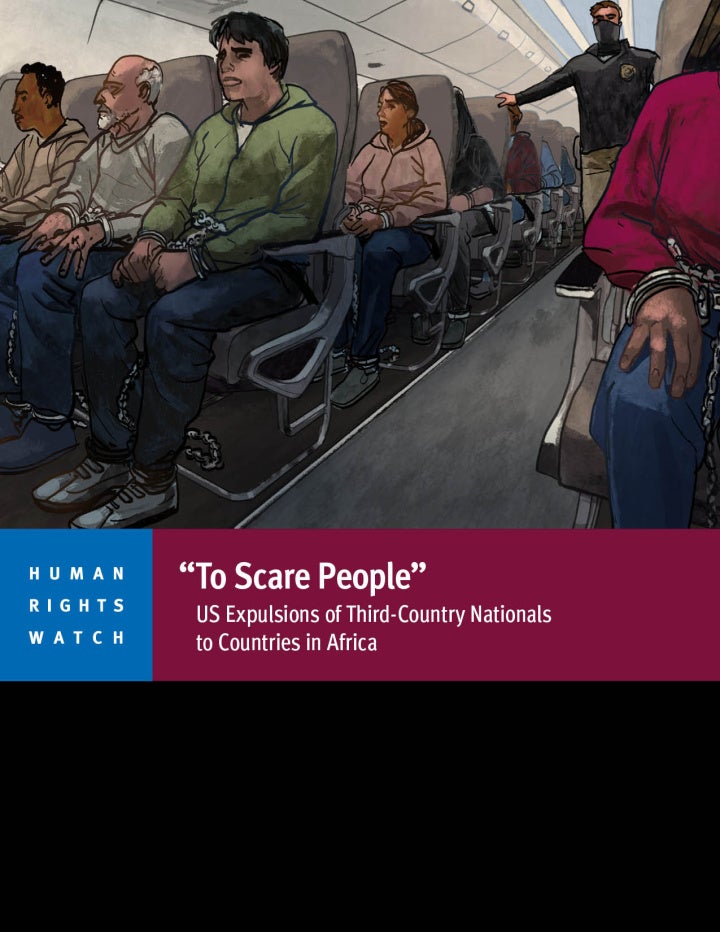
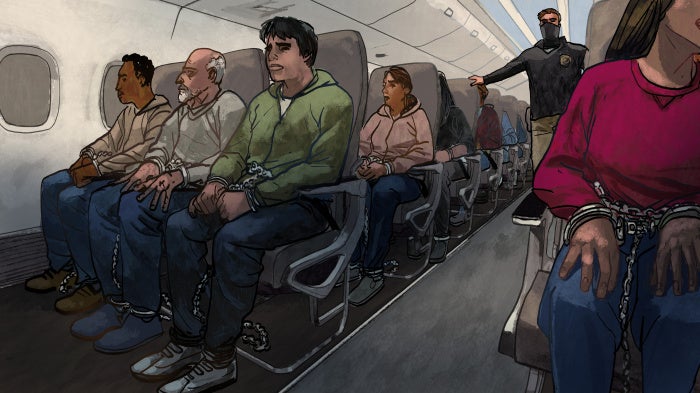
The 125-page report, “‘To Scare People’: US Expulsions of Third-Country Nationals to Countries in Africa,” documents that US authorities denied the more than 500 people transferred to third countries a meaningful chance to contest their removals or to articulate their fears of being removed to these countries. Some countries arbitrarily detained people they had accepted, and some have sent people onward to the risk of persecution or torture in their home countries, violating the international law principle of nonrefoulement.
Trafficking of Women and Girls To Post-Conflict Bosnia and Herzegovina for Forced Prostitution
Traffickers who have forced thousands of women and girls into prostitution in Bosnia and Herzegovina are not being apprehended for their crimes. Local corruption and the complicity of international officials in Bosnia have allowed a trafficking network to flourish, in which women are tricked, threatened, physically assaulted and sold as chattel, the report said.
Refoulement, Militarization of Camps, and Other Protection Concerns
The United Nations Security Council should extend the arms embargo on Liberia to all rebel groups, and closely monitor the compliance of the Guinean government with that embargo, Human Rights Watch said today. The Guinean government’s close relationship with Liberian rebel groups is posing a serious threat to refugees’ security and protection in Guinea.
Refugees Living Without Protection In Nairobi And Kampala
"Hidden in Plain View," is based on 150 in-depth interviews with refugees from Ethiopia, the Democratic Republic of Congo (DRC), Rwanda, Somalia, Sudan and elsewhere. Refugees described being subjected to beatings, sexual violence, harassment, extortion, arbitrary arrests and detention.
"There were four men standing there and one of them held a knife up to my throat. I tried to fight him off with my hands. He was 'hanging' [choking] me. He pushed me down and pulled up my dress. They were all going to rape me - but I refused to open my legs. So, then he took his knife and sliced my thigh. [...] They started raping me. I passed out eventually."
Each year, hundreds of young men in Moscow and St. Petersburg are detained and forcibly conscripted into the Russian armed forces, Human Rights Watch said in a new report today.
China must end the forcible return of North Korean asylum-seekers and the arrest and harassment of aid workers who assist them, Human Rights Watch said in a new report released today.
Hate Crimes Against Arabs, Muslims,and Those Perceived to be Arab or Muslim after September 11
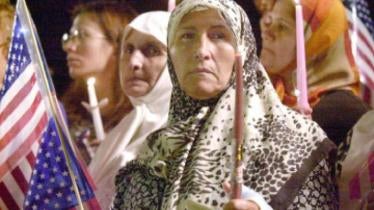
Public officials tried vigorously to contain a wave of hate crimes in the United States after September 11, Human Rights Watch said in a report released today. Nevertheless, anti-Muslim hate crimes in the United States rose 1700 percent during 2001. The report documents anti-Arab and anti-Muslim violence and the local, state and federal response to it.
The Record of the Colombian Attorney General's Office
Colombia’s Attorney General has seriously undermined the investigation and prosecution of major human rights cases. The 14-page report “A Wrong Turn: The Record of the Colombian Attorney General’s Office,” documents how the attorney general's office has failed to make progress on critical human rights investigations.
The U.S.-led coalition forces are actively backing a warlord in western Afghanistan with a disastrous human rights record, Human Rights Watch said in a new report released today.
In recent weeks civilians have once again paid the price of local and international struggles to control the resource-rich eastern and northeastern Democratic Republic of Congo (DRC). Hundreds have been killed and injured and tens of thousands have fled their homes to join about two million others previously displaced.
Free trade alone cannot ensure greater respect for workers' rights nor prevent millions of people from being excluded from the benefits of globalization. Human Rights Watch believes that measures to protect workers' rights should be built into trade agreements to ensure that globalization does not come at the expense of human rights.
The Turkish government, security forces and paramilitaries are obstructing the return of hundreds of thousands of displaced villagers to their homes in the formerly war-torn southeast.
In recent months, the conflict between the northern Ugandan rebel group, the Lord’s Resistance Army (LRA), and the Ugandan government has significantly escalated, with resulting serious human rights abuses against civilians not only in northern Uganda but also in southern Sudan.
Less than a year after the signing of the 2001 Declaration on the TRIPS Agreement and Public Health in Doha, Qatar, parties to the proposed thirty-four-country Free Trade Area of the Americas (FTAA) are revisiting the relationship between intellectual property rights and access to essential medicines.
Turkey's parliamentary elections scheduled for November 3 will present an important test for the country, just one month before the European Union's Copenhagen summit, at which the E.U. is expected to give Turkey a signal about its prospects for membership in the Union.