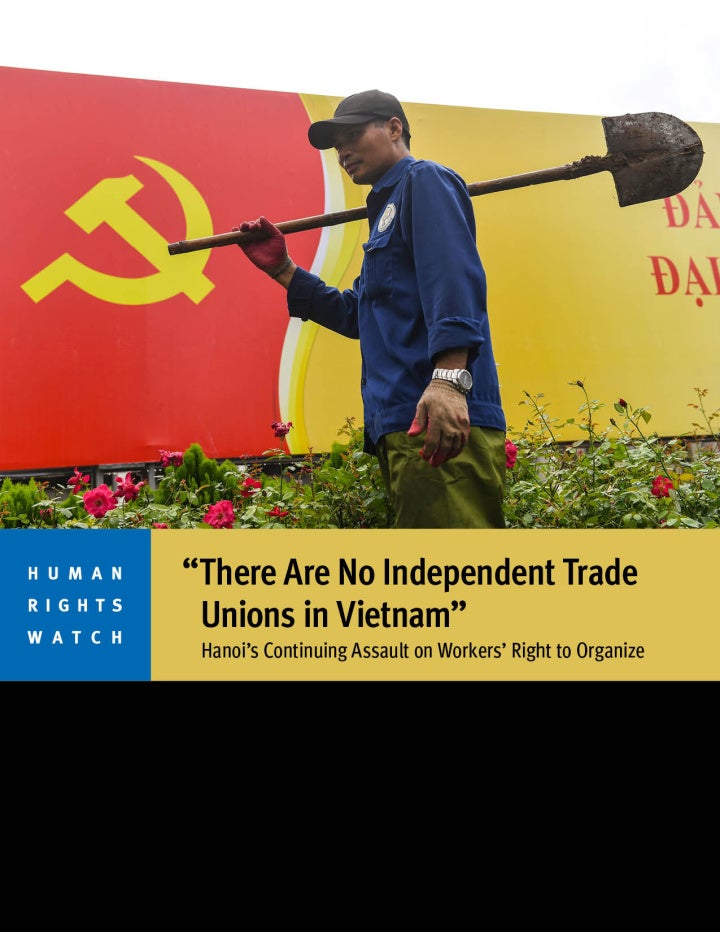
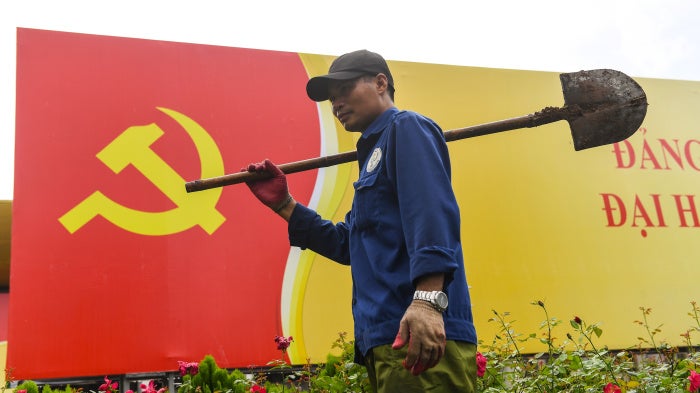
Hanoi’s Continuing Assault on Workers’ Right to Organize
The 49-page report, “There Are No Independent Trade Unions in Vietnam: Hanoi’s Continuing Assault on Workers’ Right to Organize,” documents the Vietnamese governments’ continuing useof vague, overbroad criminal laws to suppress the activities of human rights and labor rights defenders, while maintaining an atmosphere of repression to thwart independent labor organizing. The government has issued decrees and articles in state-run media that reaffirm that all labor organizations in Vietnam are under the government’s authority, and portray independent trade unions as dangerous, anti-state entities.
The Impact of the September 11 Attacks on Refugees, Asylum Seekers and Migrants in the Afghanistan Region and Worldwide
The backlash against refugees, asylum seekers and migrants throughout the world is a serious side effect of the September 11 attacks. While governments have legitimate security concerns, there must be a balance with human rights and refugee protection standards.
The horrific attacks of September 11, 2001 on the World Trade Center and the Pentagon that claimed the lives of thousands of civilians constituted criminal acts under both United States and international law.
Afghanistan is one of the most heavily mined countries in the world. Landmines pose an ever-present danger to civilians now attempting to flee the country or areas of conflict.
Egypt has long been a key country for U.S. strategy in the Middle East and will soon host some 23,000 U.S. troops for long-scheduled military exercises, Operation Bright Star. The Cairo West airbase could be an important forward-supply base for attacks on Afghanistan.
Ethnic tensions in Afghanistan have been exacerbated by nearly a decade of conflict between armed factions rooted in different ethnic, religious, and tribal groups. Human Rights Watch has reported on widespread and serious violations of international human rights by all sides in the ongoing civil war in Afghanistan.
To respond to the attacks on the World Trade Center and Pentagon on September 11, 2001, the United States government has begun to put together what it calls a coalition against terrorism.
Tajikistan shares a 1,200 kilometer border with Afghanistan and is one of the countries identified by military planners as a possible base of U.S. military and humanitarian operations in the region. Tajikistan has been a low priority for U.S. foreign policy makers since its independence from the Soviet Union in 1991.
Military-paramilitary Ties and U.S. Policy in Colombia
The "Sixth Division" is a phrase used in Colombia to refer to paramilitary groups. These groups are responsible for most human rights violations, including massacres and forced displacement. Both paramilitaries and leftist guerrillas primarily target civilians, meaning that terror has become a way of life for many.
Uganda's parliament is due to consider a new draft law proposed by the government that aims to increase state control over the country's non-governmental organizations (NGOs), whose existence and activities are already subject to stringent legal restriction.
Amidst the intensive coverage of the terrorist attacks on New York and Washington and the west’s preparations for a military response, there have been suggestions in the media that Osama Bin Laden’s Al Qaida organisation may have recruited and trained children for military actions.
The Commission's April 20 resolution on Chechnya rejected the notion, now espoused by some, that fighting terrorism could ever justify sacrificing human rights protections. Resolution 2001/24 condemned terrorist attacks related to the Chechnya conflict and breaches of humanitarian law perpetrated by Chechen forces, as well as certain methods often used by Russian federal forces in Chechnya.
The debate over military assistance should be informed by a close examination of Indonesia's human rights practices. Indonesia remains in a state of political and economic uncertainty. Its transition from authoritarianism to democracy is not at all secure.
(September 2001)-- On September 19, 2001, Indonesian President Megawati Sukarnoputri will meet U.S. President George Bush. Support from Indonesia, the country with the world's largest Muslim population, for a U.S. "war against terrorism" is likely to be high on the agenda. U.S.
The human rights situation in Colombia has deteriorated markedly over the past year. Underlying the worsening conditions is the Colombian government's continued failure to break ties between its security forces and the country's abusive paramilitary groups.