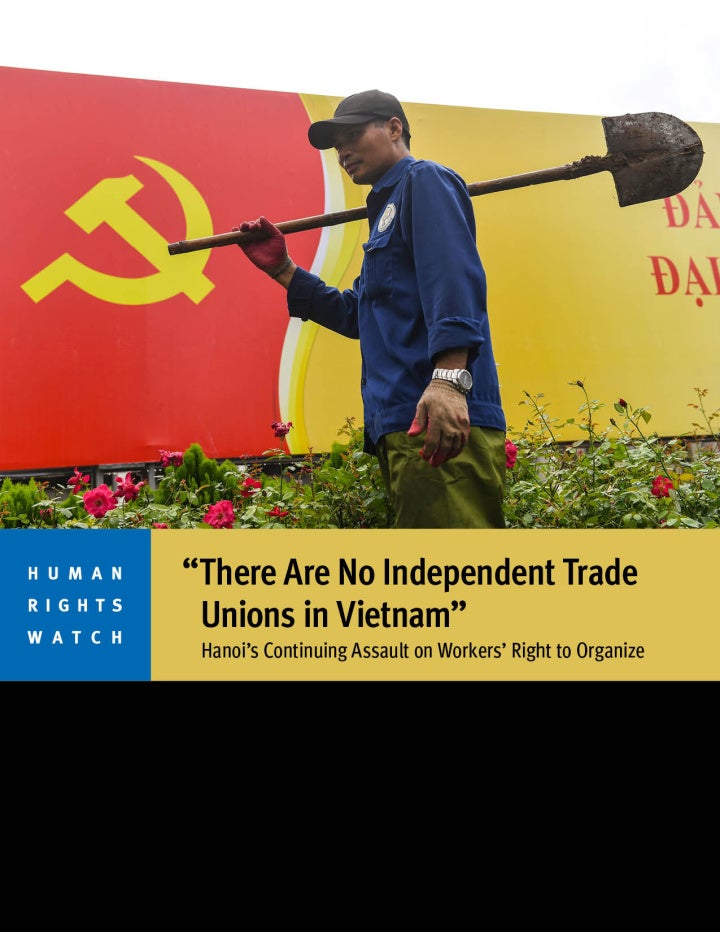
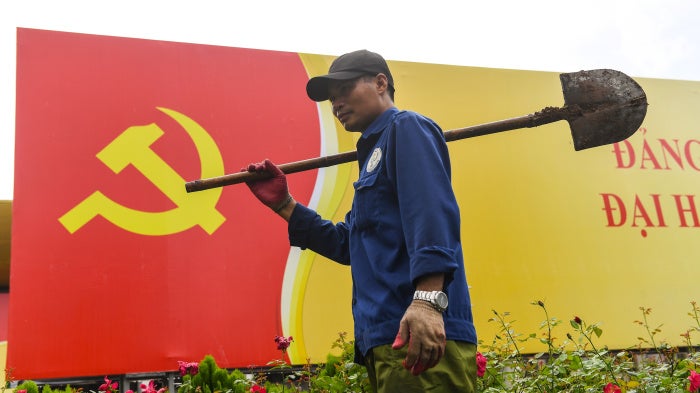
Hanoi’s Continuing Assault on Workers’ Right to Organize
The 49-page report, “There Are No Independent Trade Unions in Vietnam: Hanoi’s Continuing Assault on Workers’ Right to Organize,” documents the Vietnamese governments’ continuing useof vague, overbroad criminal laws to suppress the activities of human rights and labor rights defenders, while maintaining an atmosphere of repression to thwart independent labor organizing. The government has issued decrees and articles in state-run media that reaffirm that all labor organizations in Vietnam are under the government’s authority, and portray independent trade unions as dangerous, anti-state entities.
Turkey's parliamentary elections scheduled for November 3 will present an important test for the country, just one month before the European Union's Copenhagen summit, at which the E.U. is expected to give Turkey a signal about its prospects for membership in the Union.
When a civilian government was reinstated in Nigeria in 1999, many of those living in the Niger Delta region, the source of Nigeria's oil wealth, hoped that a "democratic dividend" would end decades of neglect they had suffered under successive military regimes.
Burma is believed to have more child soldiers than any other country in the world. The overwhelming majority of Burma's child soldiers are found in Burma's national army, the Tatmadaw Kyi, which forcibly recruits children as young as eleven. These children are subject to beatings and systematic humiliation during training.
The people responsible for planning and carrying out suicide bombings that deliberately target civilians are guilty of crimes against humanity and should be brought to justice, Human Rights Watch said in a new report today.
In 2002, steps were taken by the administration to ensure that the military could control the current electoral process and its outcome, principally by restricting the activities of opposition political parties while providing increasingly transparent support for pro-Musharraf parties.
The countries of Central and Eastern Europe, including several that are candidates for European Union (E.U.) membership, have long been a major source of weapons flows to human rights abusers, conflict regions, and clients suspected of diverting weapons to unauthorized destinations. There has been some recent progress to tighten controls, but serious problems remain.
Backgrounder on the European Union Regular Report on Turkey
The European Union's (E.U.) Regular Report on Turkey, scheduled for release October 9, will provide the E.U.'s assessment of recent reforms in Turkey and an early indication of whether the E.U. intends to move forward on Turkey's membership application at its December summit.
The Bush Administration is attempting to negotiate bilateral impunity agreements with numerous countries around the globe. The goal of these agreements is to exempt U.S. military and civilian personnel from the jurisdiction of the ICC. The U.S. argues that such agreements are contemplated under Article 98(2) of the Rome Statute.
Why the International Community Should Reject Australia's Refugee Policies
The government of Australia has taken increasingly aggressive measures in recent years to prevent unauthorized asylum seekers from reaching its shores. One year ago, on September 26, 2001, it enacted new legislation that extended the legal basis for its policies, which are among the most restrictive in the developed world.
Akaev won the presidency of independent Kyrgyzstan in 1991 and consolidated power through a presidential referendum in 1994. Akaev was re-elected to his second term of office in 1995. Despite a constitutional provision limiting the head of state to two terms in office, Akaev ran for president again in 2000.
For much of the 1990's Kyrgyzstan was described as an "island of democracy" in a region with corrupt and repressive political leaders. But after the country's first decade of independence following the breakup of the Soviet Union, its government, under President Askar Akaev, appeared to tighten its grip on power at the expense of fundamental rights.
HIV/AIDS, Human Rights And Federally Funded Abstinence-Only Programs In The United States
Programs teaching teenagers to "just say no" to sex before marriage are threatening adolescent health by censoring basic information about how to prevent HIV/AIDS, Human Rights Watch charged in a new report released today.
Human Rights Watch recently returned from a research and advocacy mission to Guatemala. During the mission, Human Rights Watch representatives met with President Alfonso Portillo, government ministers, and human rights defenders, among others.
The Response of Rwandan-backed Rebels to the May 2002 Mutiny
In mid-May of 2002, soldiers and police officers in Kisangani, the third largest city in the Democratic Republic of Congo (DRC), mutinied against their commanding officers and the local authorities of the Congolese Rally for Democracy, Goma faction (RCD).1 The RCD depends on the military and political support of neighboring Rwanda to exercise control over some thirty to forty percent of eastern Co