Reports

China’s Use of Preschools to “Integrate” Tibetans

The 72-page report, “Start with the Youngest Children: China Uses Preschools to ‘Integrate’ Tibetans,” documents that a 2021 Ministry of Education directive—the Children’s Speech Harmonization plan—mandates the use of standard Mandarin Chinese for all preschool instruction in ethnic minority areas. While the kindergartens in theory can still offer supplementary sessions for minority children in their own language, minorities no longer have the legal authority to do so. By severely limiting Tibetan-language education in early childhood, a stage critical for language acquisition and identity formation, the Chinese government is speeding up its erasure of Tibetan language and culture.

A security guard outside the Shangri-La Key School in Kardze Tibetan Autonomous Prefecture, Sichuan province, China, September 5, 2023.
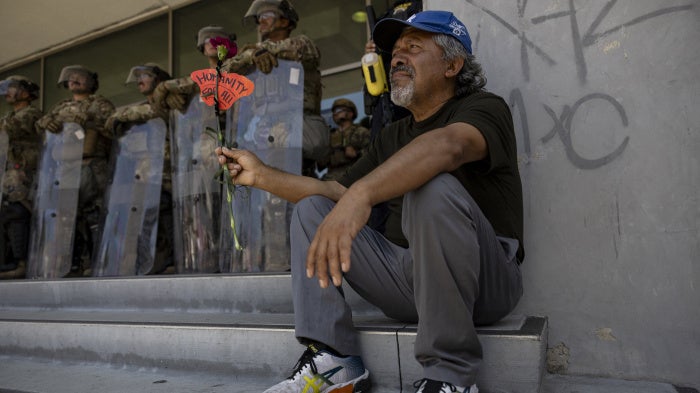
A man holds a flower and the message "Humanity for All" in front of a line of soldiers

Search

  • June 2, 2006

    Chronology of the case against Zhao Yan, the Chinese assistant at the New York Times Beijing bureau who has been accused of leaking state secrets and of lesser fraud charges. The trial is expected to begin June 8.
  • May 29, 2006

    The Continuing Failure to Address Accountability in Kosovo Post-March 2004

    This 74-page report focuses on the criminal justice response to the March 2004 violence in the province. At that time, widespread rioting across the province, involving more than 50,000 people, left hundreds of minorities injured and thousands displaced from their homes.
  • May 25, 2006

    The Price of Continuing Impunity in Côte d’Ivoire

    This 36-page report documents human rights abuses against civilians that were committed by state security forces, their allied militias and the rebel New Forces (Forces Nouvelles) between November and March. These armed groups have preyed on civilians through intimidation and outright force.
  • May 19, 2006

    In this brief initial paper, Human Rights Watch seeks to contribute to the ongoing discussions about how the Human Rights Council should function and develop its work. The first year of the Council will be one of transition, but also a unique occasion to build a principal human rights organ that delivers results in the short, medium, and long term.
  • May 16, 2006

    Bold Ambitions, Limited Results for Human Rights Under Fox

    This 150-page <a href="http://hrw.org/reports/2006/mexico0506/"&gt; report </a> documents the successes and failures of Fox’s human rights policies. The report offers detailed recommendations for his successor —who will be chosen in the July presidential election —on how to build upon the Fox agenda, while avoiding its significant shortcomings.

  • May 14, 2006

    Street Children Illegally Detained in Kigali, Rwanda

    This paper documents life at the unofficial detention center in the Gikondo neighborhood of the Rwandan capital Kigali.
  • May 8, 2006

    The Sudanese government and rebel groups in Darfur are hindering humanitarian agencies from reaching hundreds of thousands of civilians dependent on international aid in many areas of Darfur. Human Rights Watch called on all the warring parties to cease attacks on civilians, including aid workers, and immediately facilitate access of humanitarian assistance to civilians.
  • May 3, 2006

    The North Korean Government’s Control of Food and the Risk of Hunger

    This 34-page report examines recent worrisome developments in North Korea’s food policies, its marginalization of the World Food Programme (WFP), its refusal to allow adequate monitoring of food aid, and the implications of the government’s new policies.
  • May 1, 2006

    Discrimination, Denial, and the Fate of Binational Same-Sex Couples under U.S. Law

    <table cellpadding="3" cellspacing="0"><tr><td><img src="http://hrw.org/images/home/2006/100/usdom13290.jpg&quot; align="left" border="0" /></td> <td valign="top">This report documents how U.S immigration law and federal policy discriminate against binational same-sex couples.</td></tr></table>

  • April 25, 2006

    Findings of the Detainee Abuse and Accountability Project

    This 27-page report presents findings of the Detainee Abuse and Accountability Project, a joint project of New York University’s Center for Human Rights and Global Justice, Human Rights Watch and Human Rights First. The project is the first comprehensive accounting of credible allegations of torture and abuse in U.S. custody in Iraq, Afghanistan and Guantánamo.
  • April 25, 2006

    Government Discrimination Against “Non-Indigenes” in Nigeria

    This 64-page report documents the harmful impact of discriminatory policies against those citizens defined as "non-indigenes" in Nigeria. These policies have a harmful impact on the human rights of many Nigerians and are in violation of the Nigerian constitution and international human rights law.
  • April 24, 2006

    Options for Hissène Habré to Face Justice

    This paper examines Senegal’s legal obligations as well as the different options for bringing Mr. Habré to justice. It notes that—whatever the outcome of the A.U. review—Senegal is under an obligation to prosecute or to extradite Hissène Habré. It concludes that Mr. Habré’s extradition to Belgium is the most efficient, realistic, and timely option for ensuring that Mr.
  • April 23, 2006

    Lethal Injections in the United States

    This 65-page report reveals the slipshod history of executions by lethal injection, using a protocol created three decades ago with no scientific research, nor modern adaptation, and still unchanged today. As the prisoner lies strapped to a gurney, a series of three drugs is injected into his vein by executioners hidden behind a wall.
  • April 21, 2006

    This briefing paper addresses the need for the U.N. Security Council to authorize the proposed United Nations mission in Darfur to use force as necessary to protect civilians.