The Inhumane Effects of White Phosphorus Munitions and the Need for Stronger Law
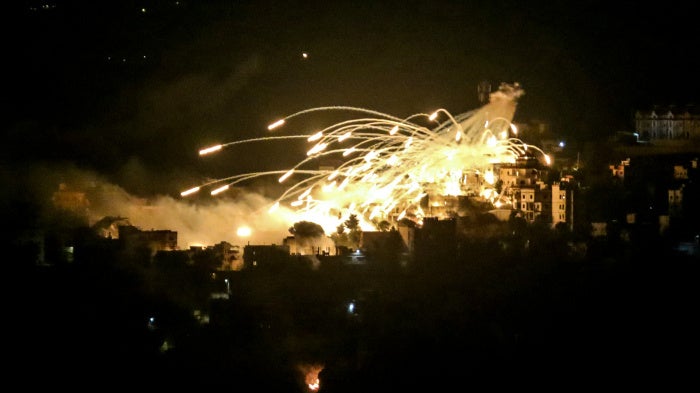
The 45-page report, “Uncontrolled Burn: The Inhumane Effects of White Phosphorus Munitions and the Need for Stronger Law,” documents 23 verified incidents of Israeli use in southern Lebanon between March and May 2026. The report also details the horrific harm the munitions have caused in armed conflicts in recent years. White phosphorus munitions, which produce fire when their payload is exposed to oxygen, are not currently regulated by a specific treaty.
The United Nations Security Council should maintain the arms embargo against the Liberian government, Human Rights Watch said in releasing a new report about abuses in Liberia today. Human Rights Watch also called for the arms embargo to be extended to cover the rebel Liberians United for Reconciliation and Democracy (LURD), and for an end to Guinea’s support for the LURD. The U.N.
The Cambodian government should take immediate steps to investigate and prosecute perpetrators of political violence committed during commune-level elections held in February 2002, Human Rights Watch said in a report released today. Action to end impunity should be a pre-condition for any aid to prepare for next year's national elections, Human Rights Watch said.
State Participation and Complicity in Communal Violence in Gujarat
State officials of Gujarat, India were directly involved in the killings of hundreds of Muslims since February 27 and are now engineering a massive cover-up of the state's role in the violence, Human Rights Watch charged in a new report released today.
A partial power-sharing pact reached on April 19 at the end of the Inter-Congolese Dialogue between the government of the Democratic Republic of Congo, the rebel Movement for the Liberation of Congo (MLC) and most members of the unarmed opposition and civil society groups excluded the mainstream rebel Congolese Rally for Democracy-Goma (RCD-Goma) and failed to secure peace with Rwanda.
Child Labor and Obstacles to Organizing on Ecuador's Banana Plantations
Banana workers in Ecuador are the victims of serious human rights abuses, Human Rights Watch charged in a new report released today. In its investigation, Human Rights Watch found that Ecuadorian children as young as eight work on banana plantations in hazardous conditions, while adult workers fear firing if they try to exercise their right to organize.
Conflicts over Land and Religion in Vietnam's Central Highlands
Vietnam should cease its persecution of indigenous Montagnards in the Central Highlands, and Cambodia should continue to offer sanctuary to those fleeing across the border, Human Rights Watch said in this new report.
Turkey's human rights record is marred by its severe restrictions on the right to freedom of expression. Individuals in Turkey face prosecution and prison terms merely for using forbidden minority languages or expressing opinions on certain taboo subjects.
This report documents the Israeli Defense Forces (IDF) practice of coercing civilians to assist military personnel and operations, a serious violation of international humanitarian law (IHL). The report is the result of investigations carried out regarding four IDF raids in late 2001 and early 2002 into the Palestinian towns of Beit Rima, Salfit, Artas, and Tulkarem.
Afghanistan began the process of choosing its next government. Over the next few weeks, Afghans across the country will take part in meetings and elections culminating in mid-June with the convening of a consultative body known as the loya jirga.
The January 2001 Attack on Peaceful Demonstrators in Zanzibar
In a welcome step, in January 2002, Tanzania's President Benjamin Mkapa announced the creation of an independent commission of inquiry to investigate human rights violations committed by Tanzanian security forces in Zanzibar a year before.
Abuses Against Ethnic Pashtuns in Northern Afghanistan
Since the collapse of the Taliban regime in northern Afghanistan in November 2001, ethnic Pashtuns throughout northern Afghanistan have faced widespread abuses including killings, sexual violence, beatings, extortion, and looting.
Haitians And Dominico-Haitians In The Dominican Republic
Over the past decade, the Dominican government has deported hundreds of thousands of Haitians to Haiti, as well as an unknown number of Dominicans of Haitian descent.
Haitians and Dominico-Haitians in the Dominican Republic
Over the past decade, the Dominican government has deported hundreds of thousands of Haitians to Haiti, as well as an unknown number of Dominicans of Haitian descent.
On October 22 to 24, 2001, several hundred soldiers of the Nigerian army killed more than two hundred unarmed civilians and destroyed homes, shops, public buildings and other property in more than seven towns and villages in Benue State, in central-eastern Nigeria.The killings in Benue State constitute clear cases of extrajudicial executions by the Nigerian military, contravening Nigeria's obligat