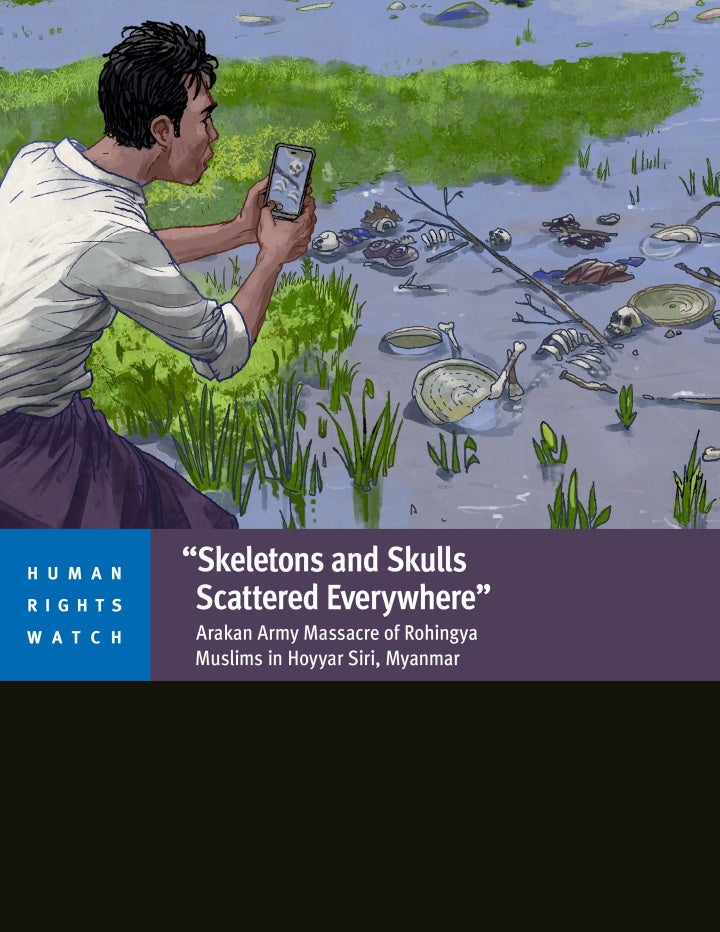
Arakan Army Massacre of Rohingya Muslims in Hoyyar Siri, Myanmar
The 56-page report, “‘Skeletons and Skulls Scattered Everywhere’: Arakan Army Massacre of Rohingya Muslims in Hoyyar Siri, Myanmar,” documents the May 2, 2024 attack, in which Arakan Army fighters deliberately fired on unarmed villagers who were seeking safety after the armed group advanced on two Myanmar military bases in the vicinity. Details of the massacre only began emerging more than a year later, after some survivors fled to Bangladesh and Malaysia.
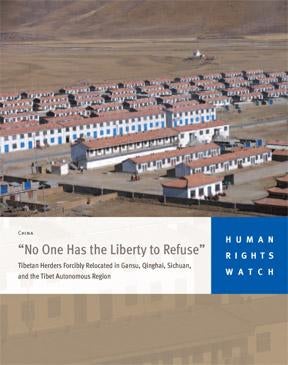
Tibetan Herders Forcibly Relocated in Gansu, Qinghai, Sichuan, and the Tibet Autonomous Region
This 79-page report documents how the government’s policy of forced resettlement has violated the economic and social rights of Tibetan herders. It draws on interviews conducted between July 2004 and December 2006 with some 150 Tibetans from the areas directly affected.
U.S. Responsibility for Enforced Disappearances in the “War on Terror”
This 21-page briefing paper, published by six leading human rights organizations, includes the names and details of 39 people who are believed to have been held in secret US custody abroad and whose current whereabouts remain unknown. The briefing paper also names relatives of suspects who were themselves arrested and detained, including children as young as seven.
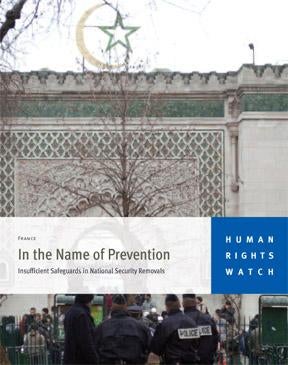
Insufficient Safeguards in National Security Removals
This 92-page report examines administrative expulsions of imams and others deemed to foment extremism. It also documents the criminal deportation of persons convicted of terrorism-related offenses. Based on 19 case studies, the report concludes that the procedures lack the necessary guarantees to prevent serious violations of France’s obligations under international human rights law.
On May 10, 2007, congressional leaders and the US Trade Representative (USTR) reached an historic agreement on a “new trade policy template” (template) that has the potential to be an important step towards ensuring that workers’ rights are better protected in US trade accords.
In this backgrounder, Human Rights Watch said that although Khadr was just 15 when he was arrested, the United States has completely ignored his juvenile status throughout his detention. The US government incarcerated him with adults, reportedly subjected him to abusive interrogations, failed to provide him any educational opportunities, and denied him any direct contact with his family.
A Briefing Paper by the Egyptian Initiative for Personal Rights and Human Rights Watch
In this 13-page briefing paper, Human Rights Watch and the EIPR said that Egypt’s terrible human rights record made that country a poor choice for membership. They nevertheless welcomed the Egyptian government’s public pledges to improve its practices domestically and to strengthen the capacity of the council.
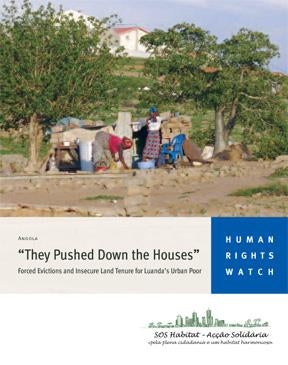
Forced Evictions and Insecure Land Tenure for Luanda’s Urban Poor
This 103-page report documents 18 mass evictions in Luanda that the Angolan government carried out between 2002 and 2006. In these evictions, which affected some 20,000 people in total, security forces destroyed more than 3,000 houses, and the government seized many small-scale cultivated land plots.
Analysis of Belarus’ Assertions on its Suitability for UN Rights Council Membership
General Assembly resolution 60/251 requires that states “take into account the contribution of candidates to the promotion and protection of human rights and their voluntary pledges and commitments made thereto” in voting to elect members of the Human Rights Council (HRC).
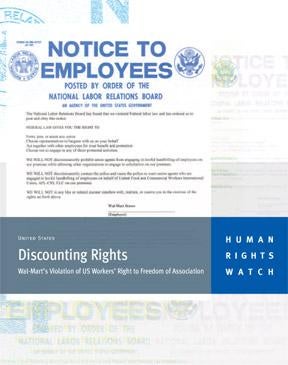
Wal-Mart's Violation of US Workers’ Right to Freedom of Association
In this 210-page report, Human Rights Watch found that while many American companies use weak US laws to stop workers from organizing, the retail giant stands out for the sheer magnitude and aggressiveness of its anti-union apparatus. Many of its anti-union tactics are lawful in the United States, though they combine to undermine workers’ rights. Others run afoul of soft US laws.
Briefing Paper Prepared for the ICRC Experts Meeting on Cluster Munitions
This presentation is an introduction to the wide variety of cluster munitions currently available. The functional characteristics of these munitions as well as estimates of the numbers in current stockpiles are included in the presentation.
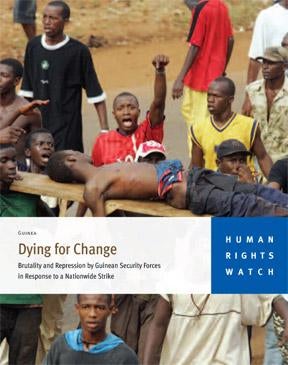
Brutality and Repression by Guinean Security Forces in Response to a Nationwide Strike
This 64-page report documents how Guinean security forces brutally repressed demonstrations across the country. It details how security forces abused, intimidated and arbitrarily arrested journalists and members of civil society. The report also shows how security forces were responsible for excessive use of force, as well as reckless and undisciplined fire.
In this 10-page briefing paper, Human Rights Watch articulates how the European Union should make respect for human rights an integral part of its new Central Asia strategy. The strategy, an initiative of the German EU Presidency, replaces years of an uncoordinated approach by the European Union to the five Central Asian countries, which were once part of the Soviet Union.
Neighboring States Stop Iraqis Fleeing War and Persecution
Iraq’s neighbors are refusing entry, imposing onerous new passport and visa requirements, and building barriers to keep refugees out. In certain cases, they are also expelling Iraqis back to Iraq.This briefing paper focuses on new restrictive measures taken by Jordan and Egypt to prevent more refugees from coming.