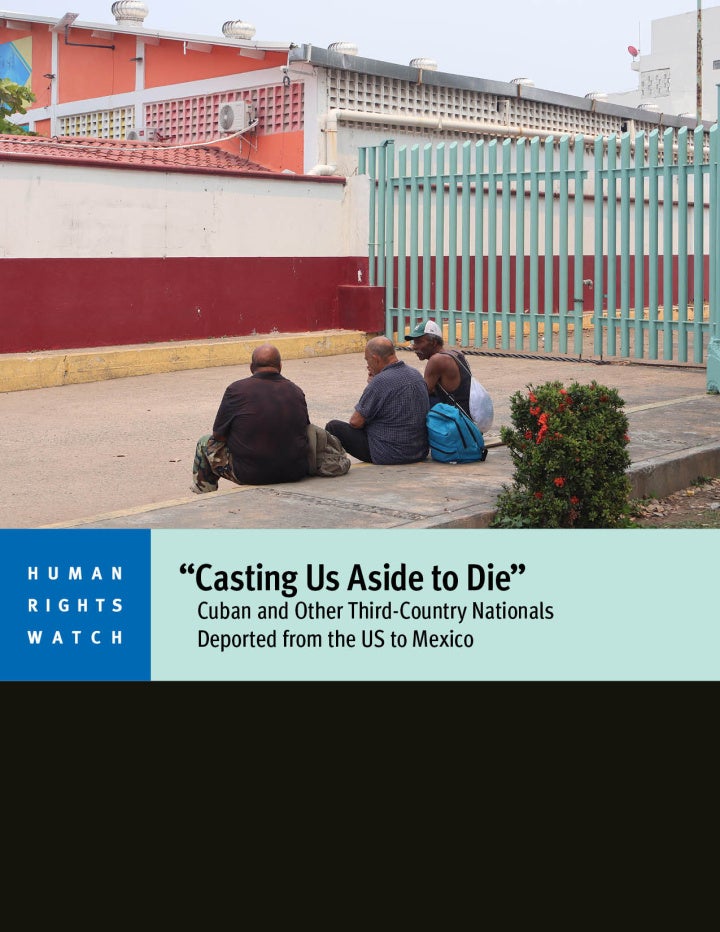
Cuban and Other Third-Country Nationals Deported from the US to Mexico
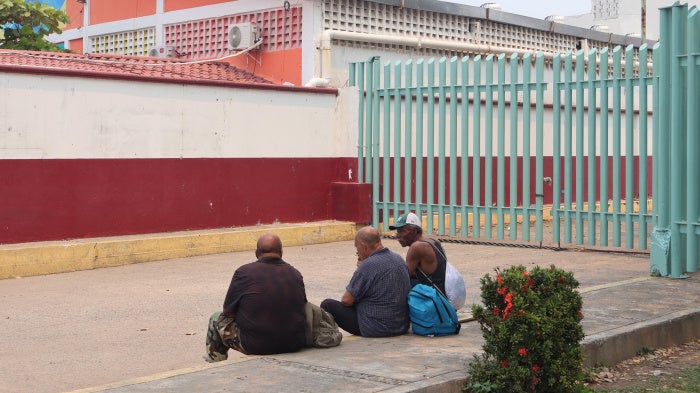
The 66-page report, “‘Casting Us Aside to Die:’ Cuban and Other Third-Country Nationals Deported from the US to Mexico,” documents US government abuses against Cubans and other third-country nationals deported to Mexico between January 2025 and March 2026. With no other recourse to obtain permanent residency in Mexico, many Cuban deportees, whose home government refuses to take them back, are trapped in a legal limbo. Since arriving in Mexico, they have received little if any government support, and many are without access to shelter, food, or health care.
Human Rights and Russian Military Involvement in the “Near Abroad”
The Russian Federation is engaged in military policies in several armed conflicts in the “near abroad” — the countries of the former Soviet Union — that simultaneously protect and violate human rights.
On-Site Investigations Document that Practice Continues
What has been documented in our previous reports remains true today: in the inaccessible forests of the central and western states of Brazil, large estate owners use forced labor to cut and burn enormous tracts of land for the purpose of turning the forest into cattle pasture.
The regime of President Hafez al-Asad, which has ruled in authoritarian fashion since 1970, continues to merit the ignominious distinction of holding some of the world’s longest-serving political prisoners, detained without charge or trial for over twenty years.
While human rights violations continued throughout the APEC region, the major story during the year and described in this report was not so much the nature of the abuses, but the debate over how to address them. Two factors had a major impact on this debate: the increased visibility of Asian nongovernmental organizations and the growing economic power of East Asia.
President Daniel arap Moi of Kenya confidently predicted that the return of his country to a multiparty system would result in an outbreak of tribal violence that would destroy the nation. His prediction has been alarmingly fulfilled. One of the most disturbing developments in Kenya over the last two years has been the eruption of violent clashes between different ethnic groups.
The province of North Sumatra continues to be plagued by human rights abuses committed by security forces. Two cases are highlighted in this report: the ongoing military interference in a leadership dispute within a Protestant church group, and the treatment of villagers in a land dispute in Sei Lapan, an area about eighty miles north of Medan, the provincial capital.
A Report Prepared for the Free Media Seminar Commission on Security and Cooperation in Europe
The Free Media Seminar of the Commission on Security and Cooperation in Europe is taking place at a critical time. First, because developments throughout the region suggest that protection for media freedoms fall well short of international standards.
U.S. Policymakers Should Hold President Mubarak Accountable
President Hosni Mubarak of Egypt is scheduled to meet with members of Congress and the Administration, including President Bill Clinton, in Washington, D.C. This will be the Egyptian leader's second visit since April.
Freedom of expression on campus in Indonesia became a major issue in mid-1993 with national attention focused on three court cases and the banning of a student newspaper. All of the cases illustrate the tight limits that the Indonesian government places on written and spoken criticism.
Citing violations of core political rights in Mexico — freedom of expression, freedom of association, freedom of assembly, and the right to vote — this report calls for the Clinton administration to address these and other human rights issues as it engages the Mexican government in trade negotiations.
While the “zero-option” approach — the granting of citizenship equally to all who were permanent residents at the time the state in question gained independence — was rejected in Estonia, we uncovered no systematic, serious abuses of human rights in the area of citizenship.
Highlighting some of the human rights abuses of the previous five years, this report examines the structures of the judicial system and archaic statutes that permit the denial of due process; these include aspects of the military justice system as well as inefficiency in the civilian courts and a lack of transparency in internal police disciplinary procedures.
Beginning in late 1991, wide-scale atrocities committed by the Burmese military, including rape, forced labor, and religious persecution, triggered an exodus of ethnic Rohingya Muslims from the northwestern Burmese state of Arakan into Bangladesh. This report warned of the possible repatriation of nearly 240,000 refugees, housed in nineteen camps in and around the Bangladeshi town of Cox's Bazar.
In this investigation of the application of the 1991 Latvian law “On the Registration of Residents,” our findings indicate that the Department of Citizenship and Immigration has targeted certain non-citizen groups and denied them registration as legal residents of Latvia.