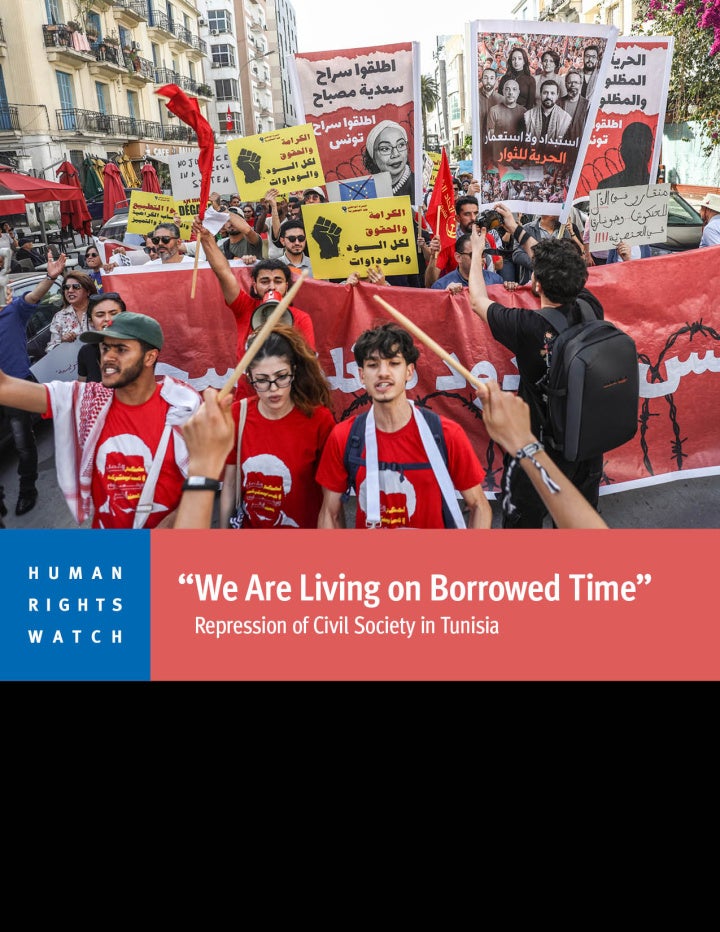
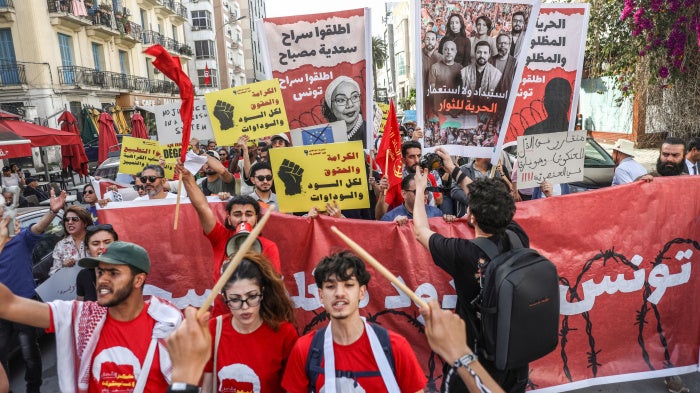
The 49-page report, “‘We Are Living on Borrowed Time’: Repression of Civil Society in Tunisia” documents the Tunisian authorities’ escalating repression of local and international civil society groups, workers, members, and affiliates through the weaponization of abusive prosecutions, arbitrary arrests, detention, financial and criminal investigations, mass suspensions, and threats of dissolution.
On September 13, 1993, as Israel and the Palestine Liberation Organization met in Washington to sign an interim self-rule accord for Gaza and Jericho, protestors against this agreement were killed and injured in Beirut by Lebanese Army troops. The demonstration was held in defiance of an indefinite Lebanese government ban against all assemblies and processions.
Since the fall of the Ceausescu regime in 1989, Romania has experienced a dramatic increase in xenophobia and racist propaganda characterized by an increasingly vocal press and right-wing political parties.
On April 21, 1993, the Bolivian Supreme Court delivered a historic verdict, sentencing a former military dictator and forty-seven collaborators to lengthy prison terms for human rights violations, the disruption of a democratic government, and other offenses. This report reviews the verdict of the Bolivian Supreme Court.
Government efforts to Islamicize Pakistan's civil and criminal law, which began in earnest in the early 1980s, have dangerously undermined fundamental rights of freedom of religion and expression, and have led to serious abuses against the country's religious minorities.
The Misguided Use of In-Country Refugee Processing in Haiti
The Clinton Administration's efforts toward achieving a political solution in Haiti can be favorably contrasted to his predecessor's inaction. Nevertheless, this progress is diminished by the continuation and promotion of a refugee policy that is inhumane and illegal and ultimately calls into question the U.S. government's commitment to human rights and a democratic regime in Haiti.
The U.N. peace-keeping period in Cambodia was marked by major human rights violations, among them the slaughter of ethnic Vietnamese residents of Cambodia, abuse of prisoners and incidents of politically-motivated murder, assault and intimidation that accelerated in the months leading up to the May 1993 elections.
On July 18, 1992, nine students and a professor were disappeared from the Enrique Guzmén y Valle University outside Lima, widely known as “La Cantuta,” in circumstances that suggest the participation of the Peruvian army and a secret death squad operated by the National Intelligence Service.
One Party State in KwaZulu Homeland Threatens Transition to Democracy
In examining the human rights record of the government of the KwaZulu homeland in Natal province of South Africa, we found that it does not support Chief Buthelezi’s claim that he is a democrat. KwaZulu is a one-party state, in which the institutions of Inkatha and those of the homeland administration are virtually indistinguishable.
The Report of the United Nations Commission on the Truth for El Salvador
The Salvadoran peace process, fostered and shepherded by the United Nations, has been unique in the central place afforded human rights. A comprehensive human rights accord signed in July 1990 was a stepping-stone on the path to a broader agreement, and set the stage for United Nations verification of the peace process.
The apparent intensity of public debate, variety of publications and the wealth of artistic achievements in the Islamic Republic of Iran create an illusion of unrestricted discourse. The limits on expression are defined, however, in complex and often arbitrary ways by a government beset by internal power struggles and intolerance.
Racism and racially motivated violence against the Rima (Gypsy) minority in Bulgaria has escalated dramatically since 1994. The violence ranges from police torture to mob attacks — including violent attacks by guards employed by private security firms.
Under the anti-terror law, which was introduced in 1991, many left-wing and pro-Kurdish journalists, writers and publishers continue to be tried, and many go on to be sentenced to prison terms and fines. Penal Code provisions that make it a crime to insult Ataturk, secularity, Islam, the security forces and the president continue to be used to restrict free expression.