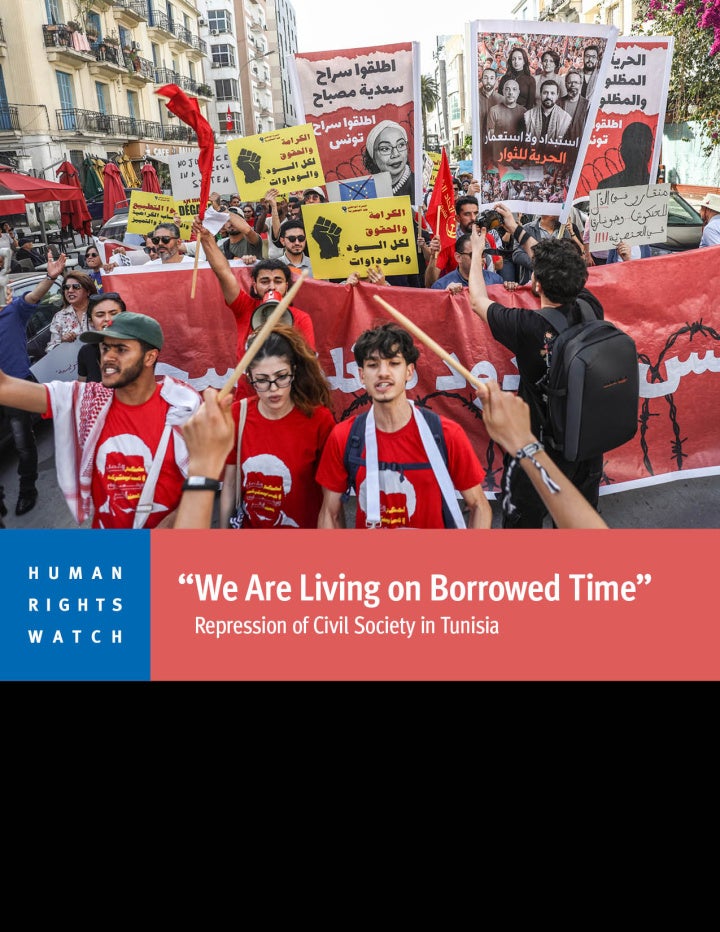
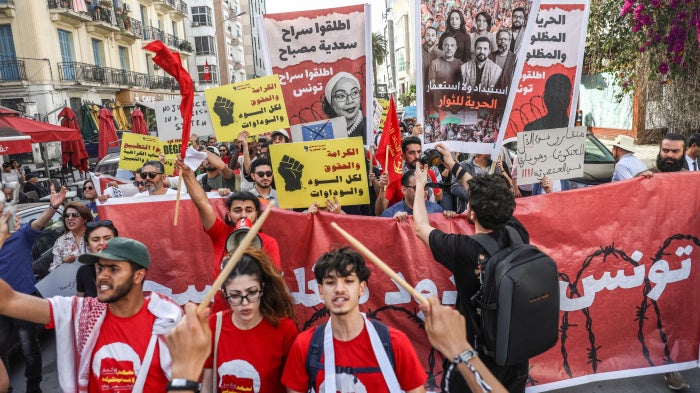
The 49-page report, “‘We Are Living on Borrowed Time’: Repression of Civil Society in Tunisia” documents the Tunisian authorities’ escalating repression of local and international civil society groups, workers, members, and affiliates through the weaponization of abusive prosecutions, arbitrary arrests, detention, financial and criminal investigations, mass suspensions, and threats of dissolution.
In two separate shipments in May 1992 and August 1993, eighteen tons of official Iraqi state documents captured by Kurdish parties in the 1991 uprising arrived in the U.S. for safekeeping and analysis. Our team has conducted research on these documents and catalogued a large percentage.
On February 22, 1993, the U.N. Security Council promised to create an international tribunal to try accused war criminals in the former Yugoslavia, but a year later the tribunal appeared to be part of a pattern of empty threats and broken promises.
This report provides an update on the human rights situation in Cuba. Again this last year, Human Rights Watch/Americas (formerly Americas Watch) has been handicapped in monitoring Cuba because of the regime's refusal to allow us to visit the country, to conduct inquiries and talk to victims, and to engage in a dialogue with the authorities.
Facing serious problems, the Former Yugoslav Republic of Macedonia is making the difficult transition from communism to democracy and a free market economy. It also faces the possibility of the Bosnian war overtaking the region.
Even as the Indonesian government repealed a controversial decree and stated it's concern for the welfare of workers, we continued to receive reports of labor rights violations. These violations include the harassment of union members and reports of bonded labor in Irian Jaya.
A Report on U.S. Compliance with the International Covenant on Civil and Political Rights
Last year, the United States formally adopted the International Covenant on Civil and Political Rights (ICCPR), undertaking a commitment to ensure the covenant's protections for "all individuals within its territory." the American Civil Liberties Union and Human Rights Watch have prepared this report - the first of its kind -covering race and sex discrimination, prisoners' rights, police brutality
Twenty-one people died in suspicious circumstances while in police custody in 1993. These deaths took place in police or gendarmarie stations throughout Turkey during the interrogation phase of investigations. They follow on the deaths of at least 17 people who died while under interrogation in police custody in 1992.
The Arms Trade and Human Rights Abuses in the Rwandan War
On October 1990, the Rwandese Patriotic Front launched an invasion from neighboring Uganda, aimed at overthrowing the Rwandan government. While the war has stopped in an uneasy peace, an estimated 4,500 people died in the conflict and nearly one million civilians are refugees.
Describing prison conditions under an acute crisis, this report covers not only decayed facilities, poor sanitation and overcrowding, but also prisons facing the economic and political disintegration of the state. Since 1990, a pattern of neglect and corruption has given way to complete abandonment.
Human Rights and Russian Military Involvement in the “Near Abroad”
The Russian Federation is engaged in military policies in several armed conflicts in the “near abroad” — the countries of the former Soviet Union — that simultaneously protect and violate human rights.
Political Violence and Counterinsurgency in Colombia
On November 8, 1992, Colombian President César Gaviria Trujillo adopted a series of emergency decrees restricting civil liberties, granting additional powers to the military, and punishing contact or dialogue with insurgent groups. The decrees marked a reversion to authoritarian patterns of rule supposedly left behind with the passage of the 1991 Constitution.
Trafficking of Burmese Women and Girls into Brothels in Thailand
Thousands of Burmese women and girls are trafficked into Thai brothels every year where they work under conditions tantamount to slavery. Subject to debt bondage, illegal confinement, various forms of sexual and physical abuse, and exposure to HIV in the brothels, they then face wrongful arrest as illegal immigrants if they try to escape or if the brothels are raided by Thai police.
While human rights violations continued throughout the APEC region, the major story during the year and described in this report was not so much the nature of the abuses, but the debate over how to address them. Two factors had a major impact on this debate: the increased visibility of Asian nongovernmental organizations and the growing economic power of East Asia.