US Civil Rights Enforcement Under the Trump Administration
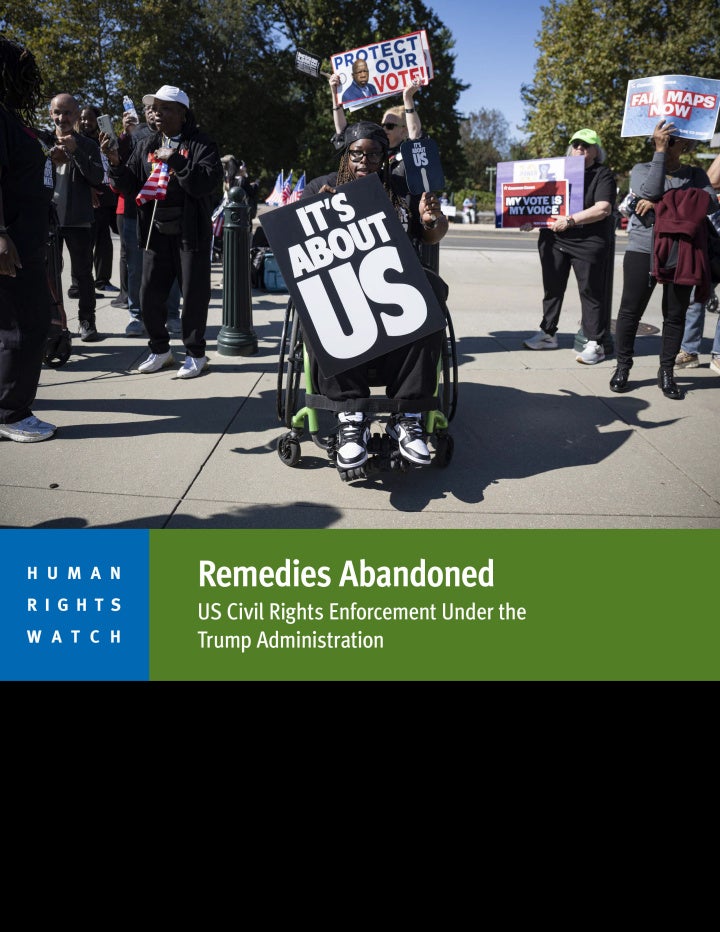
The 112-page report, “Remedies Abandoned: US Civil Rights Enforcement Under the Trump Administration,” documents the administration’s efforts to unravel the work of four key agencies between January 2025 and the spring of 2026: the Justice Department’s Civil Rights Division, which lost about 75 percent of its attorneys; the Education Department’s Office of Civil Rights, which moved to lay off nearly half its staff in one day and closed 7 of its 12 regional offices; the Housing and Urban Development Department’s Fair Housing Office, which shrank dramatically; and the Equal Employment Opportunity Commission, which reached its lowest staffing levels in over 40 years.
As the multinational force prepared to turn over operations to the U.N. Mission in Haiti (UNMIH) on March 31, 1995, political tensions increased and far from having brought stability, the U.S.-led force pointed only to a fragile security that impending parliamentary and presidential elections may rupture.
Economic and political changes in Russia have left many Russians staggering under the burdens of rising unemployment, high rates of inflation, disappearing social services and the encroaching threats of corruption and organized crime.
Human Rights Watch opposes the imposition of the death penalty on all criminal offenders in all circumstances because of its inherent cruelty. In addition, Human Rights Watch is concerned that the death penalty is most often carried out in a discriminatory manner on racial, ethnic, religious or political grounds.
Prisoners in Japan face routine violations of human rights from the moment of arrest through the end of their prison term. After being apprehended, Japanese suspects are placed in police detention (daiyo-kangoku) where they face severe pressure, often involving physical abuse, in order to obtain confessions.
Tens of thousands of Guatemalans, both civilians and combatants, were disappeared by government forces over the past 3 decades. One of the fundamental tasks assumed by the government and guerrillas through the ongoing U.N.-mediated peace process is to end the impunity with which such crimes have been committed.
The human rights situation in Burma has not improved with the passing of each new U.N. resolution condemning abuses; if anything, it is worse. This report documents the gross violation of human rights of the civilian population during the Burmese offensive against the KNU from November 1994 to February 1995.
Tens of thousands of Guatemalans have been forcibly "disappeared" by government forces over the past three decades, many of them civilians and some of them combatants. One of the fundamental tasks assumed by the government and guerrillas through the ongoing U.N.-mediated peace process is to end the impunity with which such crimes have been committed.
Although the United Nations peacekeeping mission in Cambodia has been hailed as one of the mostsuccessful ever, the country was back at war even before the last of the peacekeepers left. The civilian population now faces a wide range of abuses from both the Khmer Rouge and the Royal Cambodian Armed Forces.
There has been a marked deterioration in relations between Albania and Greece since 1993. At the center of the dispute is the treatment of the Greek minority living in Albania and this report documents their situation.
Forced Resettlement, Suppression of Dissent and Labor Rights Concerns
In April 1992, China’s National People’s Congress (NPC) formally approved the “Resolution on the Construction of the Yangtze River Three Gorges Project,” marking the conclusion of decades of controversy within the Chinese leadership in favor of supporters of the world’s biggest-ever river dam project.
This is the first report by a human-rights organization about Egyptian prisons based on on-site inspections. Beginning on February 12, 1992, Middle East Watch inspected six prisons in an eight-day period. These facilities housed approximately 9,800 inmates, over twenty-seven percent of Egypt's prison population.
Abuses in East Timor, involving possible extrajudicial executions, torture, disappearances, unlawful arrests and detentions and denials of freedom of association, assembly and expression, continue unabated. The perpetrators are the police and army, as well as a group operating in civilian dress, locally known as “ninjas,” who operate as masked gangs reportedly organized by the military.
This report is the third in a series on the conflict in Chechnya. As the war in the breakaway republic enters its third month, Russian forces continue to commit gross abuses against the civilian population.
The perilous state of human rights in the Palestinian self-rule areas is among the key factors — along with continuing political violence, Jewish settlement activity and economic development — that will determine the long-term success of any peace process in the region.
This report is an urgent update on violations in a criminal trial of 19 men charged with crimes carrying the penalty of death, and was issued as the trial drew to a close after 16 months in court. In a detailed report released in August 1994 (see D611), we compiled the evidence that some, and likely all, of the defendants in case no.