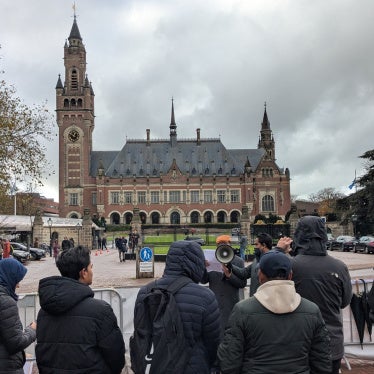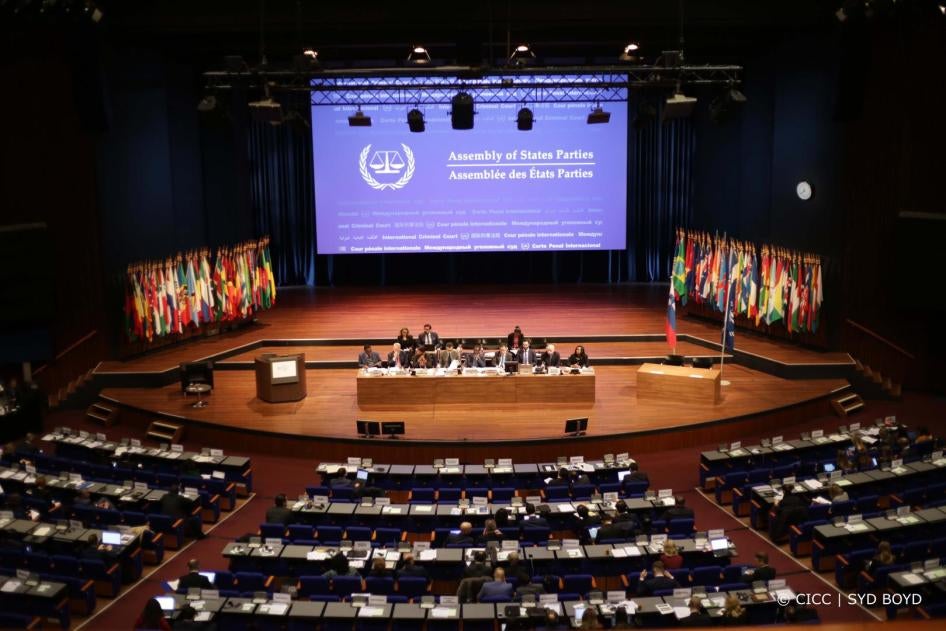
The states parties to the Rome Statute of the International Criminal Court (ICC) will meet from November 30 to December 7, 2026, in The Hague, for the annual session of the Assembly of States Parties (ASP).[1] This year’s session was scheduled to be held in New York, but the Assembly’s Bureau—its leadership body—decided to relocate the meeting to The Hague citing concerns including the US government’s sanctioning of elected officials and visa restrictions.[2]
The upcoming session will take place at a time of extreme pressure on the ICC and the broader international justice system. In October, the US government sanctioned the court and has demanded states parties seek damaging changes to the court’s legal framework, escalating its attack on the ICC and adding to existing sanctions on ICC judges and prosecutors, three Palestinian nongovernmental organizations, and a United Nations human rights expert. The United States—with the stated aim of dismantling the ICC “brick by brick”—is also placing extreme pressure on ICC states parties to withdraw from the Rome Statute. Since June, seven countries have decided to leave the court; while not all these decisions to withdraw can be linked to US pressure, they undermine efforts to achieve the Rome Statute’s global adoption.
In December 2025, a Russian court convicted in absentia eight of the court’s judges and the then- prosecutor and sentenced them to up to 15 years in prison. The US and Russia seek to thwart cases before the court that each government opposes.
On July 24, 2026, the Assembly removed the court’s prosecutor, Karim Khan, from office for serious misconduct and serious breach of duty.
The ICC has nonetheless continued to advance its critical work for justice, with key trials scheduled to begin in the coming weeks and months. The trial of former Philippine President Rodrigo Duterte, for the crimes against humanity of murder and attempted murder, arising from the Philippine government’s so-called “war on drugs,” is scheduled to begin on November 30.
States parties should make the most of the upcoming Assembly session as a critical opportunity to stand firmly behind the court, take concrete steps to protect it from ongoing attacks on its global mandate, and focus on merit and the most-qualified candidates as they make decisions in and about elections that will shape the future of the court.
This briefing note sets out recommendations to states parties in the following priority areas: 1) defending the court and international justice; 2) addressing and preventing non-cooperation; and 3) electing the most qualified candidates to key leadership positions.
I. Defending the court and international justice
On July 13, 2026, US Secretary of State Marco Rubio announced an escalated campaign to dismantle the ICC “brick by brick” in a stated effort to protect US citizens from being arrested and prosecuted by the court.[3] While the US claims that ICC investigation of American citizens is a threat to US sovereignty, US nationals who commit crimes abroad may already be prosecuted by foreign courts where the crimes took place, a well-established principle of international law.[4] US claims also ignore that the ICC is a court of last resort, stepping in only where national authorities do not conduct genuine proceedings.
The US campaign against the ICC includes an increased use of sanctions as a pressure tool to secure immunity for whomever the Trump administration chooses and widespread diplomatic pressure on ICC states parties to leave the court.
A. Protecting the court against US sanctions
On February 6, 2025, US President Donald Trump issued Executive Order 14,203, which authorizes a sanctions regime targeting the ICC’s work.[5] The order makes clear that the Trump administration seeks to shield US and Israeli officials from facing charges before the ICC. The US is not a state party to the Rome Statute.
Since then, the US government has used Executive Order 14,203 to impose sanctions on the former ICC prosecutor and his two deputies, a senior trial lawyer, nine of the court’s judges— including the ICC president—the UN Special Rapporteur on the situation of human rights in the Palestinian Territory occupied since 1967, Francesca Albanese, and three leading Palestinian human rights organizations—Al-Haq, Al Mezan Center for Human Rights, and the Palestinian Centre for Human Rights.[6]
On October 9, the US government sanctioned the ICC as a whole.[7]
To date, seven lawsuits have been brought in US federal court against Executive Order 14,203, on behalf of individuals and organizations who support the work of the court, a prosecutor working at the ICC, three of the designated judges, and the family of Special Rapporteur Albanese.[8]
On August 11, Human Rights Watch, together with the American Friends Service Committee, the Center for Constitutional Rights, and the Open Society Institute filed one of these lawsuits in US federal court seeking to have the sanctions regime struck down.[9] The lawsuit argues that the sanctions exceed the US president’s powers and are based on a pseudo “national emergency” that has no basis in fact.[10] It also asserts that the sanctions force them to curtail a wide range of human rights and legal work in violation of their First and Fifth Amendment rights under the US Constitution and under the Religious Freedom Restoration Act.[11] Human rights organizations, other experts, and former US government officials have filed amicus (friend of the court) briefs in support of the suit.[12] The case is pending.
Since Executive Order 14,203 was issued, states parties and other stakeholders have repeatedly spoken out against the sanctions. The court and states parties have also taken important steps to insulate the court from the potential impact of sanctions. But greater public support and action is needed to protect the court’s independence and critical global mandate, and those supporting its work, particularly among nongovernmental organizations.
Protecting the court’s ability to continue its work
Over the past year, the ICC has actively sought to limit the effects of potential US sanctions on its operations. This has reportedly included shifting the court’s information technology systems from Microsoft to a European provider, changing the court’s insurance, ensuring that any transactions with the court do not have a “US-nexus” (i.e., no US person, company, or currency is involved in the transactions), and paying staff in advance.[13]
Meanwhile, states parties—including the Netherlands as the court’s host country—have taken important measures to support efforts to strengthen the court’s resilience. These have included direct engagement with service providers, early payment of their assessed contributions—where possible—and support to their nationals working at the court.[14]
The US government issued four “general licenses” alongside the sanctions against the court, authorizing certain transactions that would otherwise be prohibited. Three authorize specified transactions involving the ICC related to IT services, pensions, and the continued detention of nine people held by the court. These licenses have no expiration dates.[15] The fourth license authorizes transactions necessary to maintain or wind down “operations, contracts, or other agreements involving the ICC” for a period of six months, ending April 7, 2027.[16]
While the general licenses may blunt the full impact of the sanctions on the court, the six-month period does not amount to delaying the sanctions—they are already in effect. The licenses do not cover transactions related to individuals and other organizations already sanctioned under Executive Order 14,203.
The US sanctions call for urgent, decisive action from all states parties.
In its October 16 conclusions, the European Council—the European Union institution comprised of the heads of states of the 27 EU members—“request[ed] the [European] Commission to take all appropriate initiatives contributing to the protection of the Court and the mitigation of sanctions, specifically towards EU companies so that they can continue providing services to the Court.”[17] This request led to the Commission sending a notice, on October 23, to EU operators calling on them to “continue providing services to the ICC as before, enabling the court to continue carrying out its mandate in full,” while diplomatic efforts to reverse the sanctions continue.[18]
While welcome, the EU needs to do more to provide the legal clarity banks and other European service providers require to continue their legitimate work with the court, now and beyond the six-month period.
Critical is the immediate activation of the EU Blocking Statute. The statute prohibits EU entities from complying with extraterritorial sanctions programs listed in its annex, and the European Commission has the power to add the US sanctions targeting the ICC to it.[19] While not a silver bullet, the EU Blocking Statute remains the only available legal tool to provide clear guidance to EU-based operators, a unified EU response to the US sanctions and, in concert with other measures, could contribute to limiting the sanctions’ effects on both the court and those cooperating with it.
In addition, many of the measures taken to date are focused on guaranteeing the ICC’s ability to continue to operate and do not include efforts to protect civil society.[20] The EU Blocking Statute could provide a comprehensive framework of legal protection for both the ICC and civil society organizations affected by the sanctions.
Over the last year, a growing chorus of voices has been calling for the swift activation of the EU Blocking Statute, including EU member states, the EU Parliament, UN human rights experts, civil society organizations, academics, the court itself and others directly affected by the US sanctions.[21] However, the Commission has yet to act.
Ensuring dialogue does not compromise access to justice
When announcing the sanctions against the ICC, Rubio said that the US government “structured this action to provide an opportunity for States Parties to negotiate and present a solution to address our concerns,” an apparent reference to the six-month period contained in one of the general licenses.[22] The State Department further noted that the six-month period is intended “to provide time for States Parties to demonstrate meaningful progress on diplomatic and legal resolutions,” and can be adjusted in “response to the success or failure of such efforts to address our concerns.”[23]
Based on this, some ICC states parties have called for “constructive and inclusive” dialogue with the United States as part of the multitiered response to the sanctioning of the ICC.[24]
It is critical for this engagement to remain principled. At its last session, the Assembly agreed that any dialogue with non-states parties should take place “with full respect for the Rome Statute and the independence, impartiality and integrity of the Court.”[25] These principles should remain front and center of any state party engagement with the US government.
That engagement should focus on expressing support for the court and registering opposition to the sanctions targeting it; it should not result in attempts to make concessions to the Trump administration that could, even indirectly, put pressure on the court’s judicial and prosecutorial independence. Steps that would directly undermine core Rome Statute principles—including around issues of immunities, the court’s jurisdiction over nationals of non-states parties, and complementarity—should be strictly off the table. Offering the US government solutions that would hollow out the court’s mandate, curtail victims’ access to justice, or guarantee impunity for certain powerful individuals would severely undermine the legitimacy and credibility of the ICC and the international justice system.
Dialogue with the US government should not be an excuse for inaction or delay in taking measures to strengthen the court’s resilience, including the activation of the EU Blocking Statute, the use of national-level blocking legislation, and ratification of the Agreement on Privileges and Immunities of the ICC.
On November 18, states parties met in The Hague for an ambassadorial retreat to discuss both concrete measures to safeguard the court’s operations as well as the parameters of the dialogue with the United States. The outcome of the retreat may be reflected in a standalone resolution or declaration for adoption at the upcoming Assembly session.
Ensuring robust political support
Sustained political support is another essential element in the multifaceted strategy needed to protect the ICC and those who make its critical work possible.
Following the sanctioning of the ICC president in August, and of the whole court in October, some states parties, the Assembly’s presidency and Bureau, the EU, UN human rights experts, the UN secretary-general, the UN high commissioner for human rights, and civil society organizations across the globe swiftly issued statements supporting the court and condemning the sanctions.[26] The EU high representative for foreign affairs and security policy and Nobel Peace Prize laureate Navi Pillay visited the ICC premises to show their support for the court, its officials and staff.[27]
On October 22, the European Parliament awarded the renowned Sakharov Prize for Freedom of Thought to the ICC and its officials.[28] The October 16 European Council conclusions contain stand-alone language on the ICC, including deeply regretting the sanctioning of the court and urging the US government to revoke those measures.[29]
On November 2, the ICC president presented the annual report on the court’s activities to the UN General Assembly.[30] In light of the sanctions against her, President Tomoko Akane took the unprecedented step of briefing the General Assembly remotely. In the debate that followed her presentation, several states parties delivered statements—both individually and through regional groupings—expressing support for the court, regretting that the president could not address the General Assembly in person, and opposing the US sanctions.[31]
At the same time, however, six states parties voted against[32] and eight abstained[33] from the annual General Assembly resolution on the ICC. While not all of these can be attributed to US pressure, it is clear that for some it has played a role. Meanwhile, the US was successful in eliminating longstanding references to the ICC in the latest UN Security Council resolution renewing the mandate of the UN peacekeeping mission in the Central African Republic.[34] This, together with ongoing statements by some states parties insisting on the need for “dialogue” with the US government, contributes to creating the impression that the unprecedented US attack on the ICC and the rule of law is being met with insufficient resistance and condemnation from the court’s states parties.
Expressions of political support should be increased and expand beyond the court. It is crucial that states parties recognize the US sanctions as an attack not only on the ICC but on civil society and the rule of law. Civil society is a critical pillar of the Rome Statute system, and nongovernmental organizations play a key role in advancing justice before the ICC, often being the primary link between victims and the court. Political signals of support from governments are essential to protect the civic space necessary to animate the international justice system.
The sanctions have significantly harmed civil society groups. The three sanctioned Palestinian organizations have described, among other effects, the closing of their bank accounts, the loss of funding from US donors, the closing of social media and online platform accounts—with the permanent loss of the information saved there—and the inability to retain US staff.[35]
For other organizations, the sanctioning of the three Palestinian groups, court officials, and a UN rights expert has severely chilled their engagement with the designated individuals and entities. It has “fragment[ed] transnational civil society and advocacy networks … and impede[d] a wide variety of collaborations essential to international justice.”[36] Civil society organizations have halted activities including the legal representation of victims before the ICC, collective research, strategizing, advocacy, and attending and participating in certain meetings and events where designated individuals or entities were in attendance, including in the context of the annual Assembly session.[37] While it is too early to have a complete picture of the full scope of the impact of the institutional sanctioning of the ICC on civil society, the court’s designation is magnifying the effects of the previous sanctions.
The upcoming Assembly session is an important platform for states parties to publicly show their support for the court and civil society.
A cross-regional group of states parties have made a series of language proposals for this year’s Omnibus resolution to reflect the gravity of the current situation vis-à-vis the US sanctions and to project a strong, principled position in support of the court. These include condemning and strongly rejecting sanctions against the court, its officials, and those cooperating with it, and calling for their immediate lifting. Some states parties are opposing these proposals, favoring instead “less confrontational” language. Instead, they should make the most of the Omnibus resolution to send a message of steadfast and unyielding support for the court and civil society.
Another critical way for states parties to show political support for the court is to visibly promote the execution of its global mandate and the full realization of the Rome Statute system. These practical steps are more important than ever; to reinforce the value of international law, the court needs to deliver and be seen to deliver on the mandate entrusted to it by its states parties.
Recommendations to ICC states parties
- Send ministerial-level representation to participate in the General Debate and other relevant sessions.
- In General Debate statements and all other relevant opportunities:
- Express support for the ICC’s crucial work across all situations, and commit to providing the court with the consistent financial, political, and practical support needed to fulfill its global mandate;
- Strongly condemn the US sanctions and other coercive measures against the court, its officials, and those cooperating with it, and call for the swift revocation of Executive Order 14,203;
- Emphasize that any dialogue with the United States should respect the mandate and independence of the court and the integrity of the Rome Statute;
- Speak out in support of the critical work that civil society does on behalf of victims of serious crimes and call for enhanced protection of civil society organizations and human rights defenders at risk due to their advocacy for justice;
- Commit to taking concrete actions to limit or, where possible, nullify the effects of the US sanctions against the court, its officials, and those cooperating with it. EU member countries should vocally support the prompt activation of the EU Blocking Statute in relation to US sanctions targeting the ICC. All states parties that have not yet done so should pledge to ratify the Agreement on Privileges and Immunities of the ICC.
- Commit to taking any other steps to support the execution of the court’s global mandate and the full realization of the Rome Statute system. These should include:
- Signing voluntary cooperation agreements with the court, including for the enforcement of sentences; and
- Adopting the necessary national legislation, or other steps, to implement the Rome Statute and cooperate with the court, particularly when it comes to arrest operations.
- Use all available public information tools, including press comments and social media posts, to publicize support for the court’s impartial and independent work across all situations in the lead up to and during the Assembly session.
- Adopt Omnibus resolution language:
- Strongly condemning the US sanctions against the court, its officials, and those cooperating with it;
- Urging states parties and other stakeholders to take, without delay, concrete measures to ensure the court can continue its operational activities and to support its staff and those cooperating with it;
- Calling for the immediate revocation of Executive Order 14203; and
- Ensuring that any dialogue with non-states parties takes place with full respect for the Rome Statute and the independence, impartiality, and integrity of the court.
- Ensuring that any potential standalone resolution or declaration stemming from the November 18 ambassadorial retreat prioritizes state party commitments to safeguard the court’s functioning and that any reference to dialogue with the United States emphasizes the need for such engagement to respect the mandate and independence of the court and the integrity of the Rome Statute.
Related Human Rights Watch materials
- “US: Trump Authorizes International Criminal Court Sanctions,” Human Rights Watch news release, February 7, 2025, https://www.hrw.org/news/2025/02/07/us-trump-authorizes-international-criminal-court-sanctions
- “Rights Groups Sue Trump Administration Over Targeting ICC,” Human Rights Watch news release, April 11, 2026, https://www.hrw.org/news/2026/08/11/rights-groups-sue-trump-administration-over-targeting-icc
- Joint statement marking International Justice Day, “Support the ICC as a Vital Court of Last Resort for Victims of Grave International Crimes,” July 17, 2026, https://www.hrw.org/news/2026/07/17/support-the-icc-as-a-vital-court-of-last-resort-for-victims-of-grave-international
- Human Rights Watch question-and-answer document, “Lawsuit Challenging Executive Order 14,203 and ICC-Related Sanctions,” August 11, 2026, https://www.hrw.org/news/2026/08/11/lawsuit-challenging-executive-order-14203-and-icc-related-sanctions
- “Array of Experts Back Lawsuit Challenging Trump’s ICC Sanctions Regime,” Human Rights Watch news release, September 25, 2026, https://www.hrw.org/news/2026/09/25/array-of-experts-back-lawsuit-challenging-trumps-icc-sanctions-regime
- Human Rights Watch Letter to Australian Foreign Minister Penny Wong, “Supporting the ICC Amid US Attacks,” October 22, 2026, https://www.hrw.org/news/2026/10/22/letter-to-australian-foreign-minister-penny-wong
- Joint NGO Letter to Japanese Foreign Minister Toshimitsu Motegi, “Call for Support for the International Criminal Court in the Face of US Attacks” (米国の攻撃にさらされる国際刑事裁判所(ICC)への支持の要請 茂木外務大臣宛てNGO共同書簡), October 28, 2026, https://www.hrw.org/ja/news/2026/10/28/394512
- Alice Autin and Maria Elena Vignoli, “The EU should wield its blocking statute to protect the ICC,” commentary, Centre for European Policy Studies, November 16, 2026, https://www.hrw.org/news/2026/11/16/the-eu-should-wield-its-blocking-statute-to-protect-the-icc
B. Safeguarding and advancing Rome Statute membership
On April 3, 2025, then-Hungarian Prime Minister Viktor Orbán announced his government’s intention to leave the ICC during Israeli Prime Minister Benjamin Netanyahu’s visit to Budapest, despite an ICC warrant against Netanyahu for serious crimes in Gaza.[38] On June, 2025, Hungarian authorities formally notified the UN secretary-general that Hungary was withdrawing from the Rome Statute.[39] Following a change in government, on May 29, 2026—just before the withdrawal was set to take effect—the new Hungarian authorities notified the UN secretary-general about Hungary’s intention to remain part of the Rome Statute.[40]
Over the last year, seven more countries—Niger, Burkina Faso, Mali, Venezuela, Chad, Naoero and, most recently, Tajikistan— took the decision to withdraw from the court.[41]
The US government, which welcomed the first six withdrawals, continues to call on all ICC members to leave the court.[42]
Pressure from the United States appears to have played a role in Chad’s decision. Four days before the withdrawal announcement, the US undersecretary of state for African affairs called on the Chadian minister of foreign affairs, over a phone call, to reexamine Chad’s accession to the Rome Statute.[43] While the formal announcement of withdrawal does not mention the US, a Chadian government press release explicitly mentions that Chad would consider the US’ request.[44]
Such direct link between US pressure and the decision to withdraw from the Rome Statute is not evident in the other instances. Notably, the three Sahel countries announced their intention to withdraw in September 2025, and the Venezuelan parliament started the domestic process of withdrawal in December 2025; all of these steps were taken before the US government launched its campaign of diplomatic pressure.[45] Since the United States carried out a military assault on Venezuela on January 3, 2026, and apprehended its president, Nicolas Maduro, the US has exercised considerable influence over the Venezuelan government.[46]
Common threads across the announcements of these withdrawals include accusations of selectivity, politicization, and weaponization of the court.[47] However, the US is attacking the ICC and pressuring states parties to leave the Rome Statute precisely at a time when the court is finally making progress in bringing senior government officials to justice. That the ICC has issued arrest warrants now for the current or former heads of state and/or government of Sudan, Russia, the Philippines, and Israel is evidence of progress in building a global system that ensures no one is above the law, and no victim is ignored by the law.
The states parties that have withdrawn or begun the process to withdraw from the Rome Statute should reconsider their decision. Meanwhile, all states parties should discuss strategies to counter US pressure and discourage future withdrawals. They should also continue to work toward the universality of the Rome Statute. This is particularly important in regions such as the Asia Pacific that remain underrepresented in the Assembly.
Recommendations to ICC states parties
- In ASP General Debate statements and all other relevant opportunities:
- Welcome Hungary’s decision to remain a state party to the Rome Statute;
- Regret the withdrawal notifications of Niger, Burkina Faso, Mali, Venezuela, Chad, Naoero, and Tajikistan, and call on them to reconsider their decisions and remain states parties to the Rome Statute;
- Strongly condemn the diplomatic campaign by the US government to pressure states parties to withdraw from the Rome Statute; and
- Commit to continue working toward the universality of the Rome Statute.
- Engage with other ICC states parties to develop strategies to counter US pressure and promote a unified community of states parties.
- Adopt Omnibus resolution language strongly condemning efforts by the United States to encourage withdrawals from the Rome Statute.
Related Human Rights Watch materials
- Alice Autin, “Hungary’s Road Back to the Rule of Law Runs through the ICC,” commentary, Human Rights Watch dispatch, April 24, 2026, https://www.hrw.org/news/2026/04/24/hungarys-road-back-to-the-rule-of-law-runs-through-the-icc
- Alice Autin, “EU Should Build on Hungary’s Recommitment to ICC,” commentary, Human Rights Watch dispatch, June 16, 2026, https://www.hrw.org/news/2026/06/16/eu-should-build-on-hungarys-recommitment-to-icc
- Tamara Aburamadan, “Sahel Countries’ Withdrawal From ICC Betrays Victims,” commentary, Human Rights Watch dispatch, July 2, 2026, https://www.hrw.org/news/2026/07/02/sahel-countries-withdrawal-from-icc-betrays-victims
- Human Rights Watch Letter to Australian Foreign Minister Penny Wong, “Supporting the ICC Amid US Attacks,” October 22, 2026, https://www.hrw.org/news/2026/10/22/letter-to-australian-foreign-minister-penny-wong
- Joint NGO Letter to Japanese Foreign Minister Toshimitsu Motegi, “Call for Support for the International Criminal Court in the Face of US Attacks” (米国の攻撃にさらされる国際刑事裁判所(ICC)への支持の要請 茂木外務大臣宛てNGO共同書簡), October 28, 2026, https://www.hrw.org/ja/news/2026/10/28/394512
II. Securing arrests
Since January, ICC judges referred to the Assembly two instances of non-cooperation by ICC states parties in the context of a failure to execute the court’s arrest warrants:
- On January 19, 2025, Italian authorities arrested Osama Elmasry Njeem, wanted by the ICC for war crimes and crimes against humanity allegedly committed in Libya, only to then release him two days later on “procedural grounds,” and send him back to Libya aboard an Italian state aircraft without informing the ICC.[48] On October 17, 2025, ICC judges found that Italy failed to comply with its cooperation obligations when it released Njeem and sent him back to Libya.[49] At the time, the judges deferred the decision to refer the situation to the Assembly and/or the UN Security Council, asking Italy to provide any additional information on relevant domestic proceedings. On January 26, 2026, after receiving such information, however, the judges proceeded with a referral to the Assembly.[50]
- On October 9, 2025, Russian President Vladimir Putin entered Tajikistan, an ICC member, to attend a Russia-Central Asia summit and a meeting of the Commonwealth of Independent States and did not face arrest.[51] On March 19, 2026, ICC judges found that Tajikistan failed to comply with its cooperation obligations and referred the situation to the Assembly.[52] Notably, on November 19-20, Putin visited Tajikistan again and was not arrested; Tajikistan officially deposited its notification of withdrawal from the Rome Statute to the UN secretary-general on November 20.[53]
The Assembly presidency announced that steps were being taken to address these referrals based on the Assembly’s official procedures related to non-cooperation, including inviting Italian and Tajik representatives to discuss the referrals in Bureau meetings in April and May respectively.[54] The non-cooperation procedures, adopted in 2011 and amended subsequently, provide for a number of possible steps including, when it comes to Assembly sessions, the discussion in a plenary session of action taken by the Bureau in relation to a specific finding of non-cooperation and a possible resolution containing concrete recommendations.[55] To date, no steps have been taken to advance towards a resolution containing concrete recommendations with regard to the non-cooperation referrals pending before the Assembly.
The Assembly did decide in 2024 to include a standing agenda item in its annual sessions for a discussion focused on “non-cooperation issues arising during the intersessional period.”[56] The first such discussion was held at the last Assembly session in December 2025.[57] On that occasion, states parties did not focus on specific instances of non-cooperation, but on preventing non-cooperation through consultations between the court and a state that is faced with a cooperation request. However, the participation of civil society representatives in the discussion meant that survivors of war crimes in Libya, through their statements to the Assembly, were able to raise the issue of Italy’s shielding of Njeem, and to challenge its justifications before its fellow states.[58]
This year the plenary will focus on the Assembly’s non-cooperation procedures and the toolkit adopted by the Assembly to implement the informal dimension of the procedures.[59] It will be an important opportunity for states parties to share lessons learned on the implementation of the procedures and discuss ways to strengthen them. Unfortunately, while the current non-cooperation procedures outline a clear, if only permissive, process for responding to formal findings of non-cooperation, they stop short of prescribing specific steps the Assembly can take collectively.
On June 9, 2026, ICC judges responded to a request submitted by a state party for consultations with the court under article 97 of the Rome Statute in relation to the situation in Ukraine.[60] The request focused on the question of “whether the statutory framework provides any legal basis for the Court to defer or suspend a request for cooperation concerning the arrest and surrender of a suspect participating in peace negotiations particularly where the suspect is a sitting Head of State or Government.”[61]
In their response, ICC judges recalled the court’s jurisprudence finding that the binding state party obligation created by article 27 of the Rome Statute “cannot be displaced by interstate immunity principle or obligation” and that “personal immunity of officials, including Heads of State or Government of third States, is not opposable in proceedings before the Court.”[62] The judges noted that the only available means for states parties to suspend court proceedings, including the execution of related arrest warrants, is through a UN Security Council deferral under article 16 of the Rome Statute.[63] They also found that, should the peace talks be convened by the United Nations on the territory of a state party, the court may consider conflicting obligations under the UN Charter, when assessing a potential finding of non-cooperation against the relevant state party; this would not apply to peace talks not convened by the UN.[64]
Following the court’s response, some states parties have proposed including language in this year’s Omnibus resolution encouraging states parties to continue to support peace and justice, including by facilitating peace negotiations. The proposal also includes the caveat that this should be consistent with the objectives and obligations of the Rome Statute.
Recommendations to ICC states parties
- In General Debate statements:
- Condemn Tajikistan’s latest instance of non-cooperation with the ICC and commit to providing the court with the practical support it needs to fulfill its mandate across situations, including through the execution of all pending arrest warrants, regardless of whom they target; and
- Note the judicial findings of non-cooperation against Italy and Tajikistan.
- Mandate the Bureau to appoint a facilitator to consult states parties, the court, and civil society on concrete recommendations for both the Assembly and states parties to enforce the non-cooperation findings against Italy and Tajikistan. The facilitator should report back to the Bureau, the Assembly, and states parties within the first quarter of 2027.
- Use the non-cooperation plenary to discuss the issue of enforcement of findings of non-cooperation through the current Assembly procedures, including by:
- Acknowledging the poor track record of the Assembly and states parties to adequately respond to judicial findings of non-cooperation and share lessons learned from the implementation of the non-cooperation procedures to date;
- Highlighting what concrete steps could be taken by states parties individually, and by the Assembly as a whole, to prevent and respond to non-cooperation, including through the enforcement of judicial findings, and how the non-cooperation procedures should be strengthened to achieve that goal; and
- Calling for a further review of the procedures by the non-cooperation focal points.
- Include language in the Omnibus resolution mandating the non-cooperation focal points to further review the non-cooperation procedures, in light of lessons learned to date, and recommend possible revisions, including the eventual identification of concrete steps that can be taken by the Assembly.
III. Electing the most qualified judges and prosecutor
At the upcoming Assembly session, states parties face crucial decisions on the election of six new judges and in relation to the process for the election of the court’s next prosecutor, presently expected to be held in December 2027. The merit-based election of highly qualified court officials is among the most important elements of state party stewardship of the Rome Statute system.
States parties are also due to elect a new Bureau, along with the president and two vice presidents of the Assembly.
Judicial elections
At its upcoming session, states parties will elect six new judges—a third of the ICC’s 18-member bench—each for a term of nine years.
On August 5, 2026, the Advisory Committee on Nominations (ACN) issued its report with the assessment of each candidate.[65] The ACN’s assessment is based on:
- The candidate’s qualifications and experience set out in the required statement of qualifications and any supporting material;
- The candidate’s answers to a standard questionnaire and declaration;[66] and
- Interviews the ACN carried out with each candidate.[67]
Of the now 11 judicial candidates, the ACN found one to be not qualified, three to be formally qualified, four to be well qualified, and three to be highly qualified. [68]
Notably, this was the first judicial election process that implemented the permanent due diligence procedure for ICC elected officials, long advocated for by civil society and adopted by the Assembly in 2023.[69] This due diligence process is carried out by the Independent Oversight Mechanism (IOM) and it includes a confidential channel to receive potential allegations of misconduct against the candidates, a review by the IOM of these allegations, and in-depth background checks.[70]
However, the timing of the due diligence process for this judicial election did not align with that of the ACN assessment. The ACN noted that while the IOM’s preliminary report on the due diligence process, submitted on July 11, was an important contribution to the interviews, the Committee was unable to make a conclusive determination as to the candidates’ statutory requirement for “high moral character” because the IOM’s final report was not yet available at the time it completed its assessment.[71] The ACN recommended this be addressed in future elections to ensure the Committee has all the necessary information to form a comprehensive assessment of the candidates.[72] The final IOM report was shared with the ACN and the Assembly presidency and, relevant excerpts were shared with states parties.
On November 4-6, the judicial candidates participated in public roundtables moderated by representatives of states parties and civil society.[73] The roundtables, initially scheduled to take place in person in New York, were held online to ensure equality among the candidates as one of them, who currently works as a trial lawyer in the Office of the Prosecutor, was sanctioned by the US government and unable to travel to the United States.[74]
The candidates also responded to a questionnaire formulated by the Coalition for the ICC, which is meant to complement the ACN’s assessment and provide states parties and other stakeholders with additional information on each candidate.[75]
ICC judicial elections have been marked in the past by vote trading, in which states agree to support one another’s candidates with minimal regard to the individual’s qualifications. At the Assembly session, states parties should commit to refraining from this practice and elect judges solely based on merit.
Process for the election of the next prosecutor
On July 24, 2026, the Assembly removed ICC Prosecutor Karim Khan from office for serious misconduct and serious breach of duty.[76] This was the conclusion of almost two years of disciplinary proceedings against Khan for alleged sexual misconduct.[77]
Following initial consultations with states parties and other stakeholders, the Bureau of the Assembly, in October, launched the procedure for the election of the next prosecutor.[78] Candidates for the position will be able to apply directly, in addition to applications submitted on behalf of individuals by states parties, through January 31, 2027.[79]
Qualified candidates will be assessed by the existing ACN, which will serve as the “Advisory Committee on the Election of the Prosecutor” with specific terms of reference.[80] They will also undergo the IOM’s due diligence procedure, as mandated by the Assembly in 2023.[81] After receiving the IOM’s report on the outcome of the due diligence procedure, the Advisory Committee on the Election of the Prosecutor will interview the candidates and submit a report with its assessment of each candidate.[82] Following public roundtables with the candidates, the Assembly president will lead a process to try to reach consensus around a candidate.[83] The current timetable for the process indicates that the election is estimated to take place at the twenty-sixth session of the Assembly, in December 2027, but that may change depending on how the process unfolds.[84]
At the upcoming session, the Assembly will adopt the Terms of Reference for the Advisory Committee on the Election of the Prosecutor. The current members of the ACN were initially selected for a process requiring relevant expertise for the assessment of judicial candidates. As the Committee is now tasked with this new, ad hoc role, states parties should ensure it is equipped with the necessary expertise to effectively carry it out. Particular attention should be given to experience in domestic and international criminal investigations and prosecutions; working with affected communities and victims; leadership and management of complex organizations; and understanding of the environment in which the Office of the Prosecutor and the ICC operate.
States parties could consider appointing additional members to complement the Committee’s existing expertise. In light of the lessons learned from the process for the election of the court’s third prosecutor, states parties should include any potential new members as part of the Committee on the same footing as the current members, rather than giving them a separate, purely advisory role.[85]
Recommendations to ICC states parties
- Elect the most highly qualified judicial candidates based on merit and publicly commit to avoiding vote trading.
- Appoint a facilitator to carry out a lessons-learned exercise on the disciplinary proceedings against the former prosecutor, and report to the Assembly at its twenty-sixth session.
- Pledge to avoid vote trading in the process for the election of the next prosecutor.
- Adopt Terms of Reference for the Advisory Committee on the Election of the Prosecutor that contain the necessary elements to support a merit-based, transparent, and depoliticized election process. These should include:
- Designing a procedure to ensure that the current members of the Committee benefit from the additional expertise required for the Committee to adequately execute its new mandate. This could include adding potential new members to the Committee;
- Providing the Committee with enough time to properly carry out its functions. This should include adequate time to process the information received from the IOM’s due diligence process and factor it into the Committee’s assessment of the candidates; and
- Requiring the Committee to disqualify candidates who do not meet the necessary requirements based on the outcome of the IOM’s due diligence process and the Committee’s assessment.
--
[1] The Assembly of States Parties (ASP) is a management oversight and legislative body, and it is composed of representatives of the countries that have ratified the Rome Statute, the court’s founding treaty. See “Assembly of States Parties to the Rome Statute,” ASP website, accessed November 19, 2026, https://asp.icc-cpi.int/.
[2] “Twenty-fifth session of the Assembly of States Parties to be held in The Hague,” ICC news release, September 29, 2026, https://www.icc-cpi.int/news/twenty-fifth-session-assembly-states-parties-be-held-hague (accessed November 19, 2026).
[3] Marco Rubio, “Marco Rubio: Why We’re Dismantling the International Criminal Court,” Wall Street Journal, July 13, 2026, https://www.wsj.com/opinion/why-were-dismantling-the-icc-0af0a8a6 (accessed November 19, 2026); US Secretary of State Marco Rubio’s (@SecRubio) post to X, July 13, 2026, https://x.com/SecRubio/status/2076671740407652582?lang=en (accessed November 19, 2026); “State Department Launches Campaign to Dismantle International Criminal Court’s Threat to American Sovereignty,” US Department of State press release, July 13, 2026, https://www.state.gov/releases/office-of-the-spokesperson/2026/07/state-department-launches-campaign-to-dismantle-international-criminal-courts-threat-to-american-sovereignty (accessed November 19, 2026).
[4] Tom Dannenbaum and Eliav Lieblich, “In Context: Analyzing Secretary Rubio’s International Criminal Court Op-Ed,” Just Security, July 16, 2026, https://www.justsecurity.org/147437/international-law-response-rubio-icc/ (accessed November 19, 2026).
[5] The White House, “Imposing Sanctions on the International Criminal Court,” February 6, 2025, https://www.whitehouse.gov/presidential-actions/2025/02/imposing-sanctions-on-the-international-criminal-court/ (accessed November 19, 2026).
[6] “ICC Sanctions,” US Department of State website, accessed November 19, 2026, https://www.state.gov/icc-sanctions.
[7] “Imposing Sanctions on the International Criminal Court,” US Department of State press release, October 9, 2026, https://www.state.gov/releases/office-of-the-spokesman/2026/10/imposing-sanctions-on-the-international-criminal-court/ (accessed November 19, 2026); “Imposing Sanctions on the International Criminal Court,” US Department of State fact sheet, October 9, 2026, https://www.state.gov/releases/office-of-the-spokesman/2026/10/imposing-sanctions-on-the-international-criminal-court-2 (accessed November 19, 2026).
[8] “Gabor Rona and Lisa Davis v. Donald J. Trump et al.,” Open Society Justice Initiative website, accessed November 19, 2026, https://www.justiceinitiative.org/litigation/gabor-rona-and-lisa-davis-v-donald-j-trump-et-al; “Smith v. Trump,” American Civil Liberties Union website, accessed November 19, 2026, https://www.aclu.org/cases/smith-v-trump; “Human Rights First Sues Trump Administration Over Sanctions Threatening U.S. Prosecutor at International Criminal Court,” Human Rights First press release, May 5, 2025, https://www.humanrightsfirst.org/library/human-rights-first-sues-trump-administration-over-sanctions-threatening-u-s-prosecutor-at-international-criminal-court (accessed November 19, 2026); “Family of UN rapporteur Albanese sues Trump administration over sanctions,” Al Jazeera, February 26, 2025, https://www.aljazeera.com/news/2026/2/26/family-of-un-rapporteur-albanese-sues-trump-administration-over-sanctions (accessed November 19, 2026); “Kimberly Prost et al. v. Donald J. Trump et al.,” Open Society Justice Initiative website, accessed November 19, 2026, https://www.justiceinitiative.org/litigation/kimberly-prost-et-al-v-donald-j-trump-et-al; “U.S. Groups Sue Trump Admin Over ICC Sanctions That Muzzle Palestine Advocacy,” DAWN press release, July 15, 2026, https://dawnmena.org/u-s-groups-sue-trump-admin-over-icc-sanctions-that-muzzle-palestine-advocacy/(accessed November 19, 2026); “Rights Groups Sue Trump Administration Over Targeting ICC,” Human Rights Watch news release, August 11, 2026, https://www.hrw.org/news/2026/08/11/rights-groups-sue-trump-administration-over-targeting-icc.
[9] “Rights Groups Sue Trump Administration Over Targeting ICC,” Human Rights Watch news release, August 11, 2026, https://www.hrw.org/news/2026/08/11/rights-groups-sue-trump-administration-over-targeting-icc.
[10] “Lawsuit Challenging Executive Order 14,203 and ICC-Related Sanctions,” Human Rights Watch questions-and-answers document, August 11, 2026, https://www.hrw.org/news/2026/08/11/lawsuit-challenging-executive-order-14203-and-icc-related-sanctions.
[11] Ibid.
[12] “Array of Experts Back Lawsuit Challenging Trump’s ICC Sanctions Regime,” Human Rights Watch news release, September 25, 2026, https://www.hrw.org/news/2026/09/25/array-of-experts-back-lawsuit-challenging-trumps-icc-sanctions-regime.
[13] Suzi Ring, “International Criminal Court is insulated against US sanctions, says deputy prosecutor,” Financial Times, September 25, 2026, https://www.ft.com/content/702d053a-0100-4160-9996-0b5d8502d512?syn-25a6b1a6=1 (accessed November 19, 2026); Giovanna Faggionato, “Top ICC official urges EU to act ‘as soon as possible’ on US sanctions,” Politico, October 23, 2026, https://www.politico.eu/article/icc-top-official-urges-eu-reassert-sovereignty-as-soon-as-possible/ (accessed November 19, 2026); “Top ICC official urges Europe to shield court from US sanctions,” Financial Times, November 4, 2026, https://www.ft.com/content/4e02a663-9e21-4464-866d-0287ede02cc1?syn-25a6b1a6=1 (accessed November 19, 2026).
[14] “Kabinet al weken op zoek naar oplossing sancties Strafhof” (“The Cabinet has been searching for a solution to the sanctions against the International Criminal Court for weeks,”), NOS, February 7, 2025, https://nos.nl/nieuwsuur/artikel/2554904-kabinet-al-weken-op-zoek-naar-oplossing-sancties-strafhof (accessed November 19, 2026); Republic of Slovenia, “Joint Letter from Prime Minister and President of the Republic in support of International Criminal Court and Judge Beti Hohler,” March 13, 2026, https://www.gov.si/en/news/2026-03-13-joint-letter-from-prime-minister-and-president-of-the-republic-in-support-of-international-criminal-court-and-judge-beti-hohler/ (accessed November 19, 2026); Bureau of the ASP, “Sixth meeting,” March 12, 2025, https://asp.icc-cpi.int/sites/default/files/asp_docs/2025-Bureau6-Agenda-Decisions.pdf (accessed November 19, 2026), p. 3.
[15] Office of Foreign Assets Control (OFAC), “International Criminal Court-Related Sanctions Regulations 31 CFR part 528, GENERAL LICENSE NO. 14, Authorizing Certain Transactions Related to Telecommunications and Enterprise Software Involving the International Criminal Court,” October 9, 2026, https://ofac.treasury.gov/media/937191/download?inline (accessed November 19, 2026); OFAC, “International Criminal Court-Related Sanctions Regulations 31 CFR part 528, GENERAL LICENSE NO. 15, Authorizing Transactions Related to Pension Payments Involving the International Criminal Court,” October 9, 2026, https://ofac.treasury.gov/media/937196/download?inline (accessed November 19, 2026); OFAC, “International Criminal Court-Related Sanctions Regulations 31 CFR part 528, GENERAL LICENSE NO. 16, Authorizing Certain Transactions Related to Certain International Criminal Court Detainees,” October 9, 2026, https://ofac.treasury.gov/media/937201/download?inline (accessed November 19, 2026).
[16] OFAC, “International Criminal Court-Related Sanctions Regulations 31 CFR part 528, GENERAL LICENSE NO. 13, Authorizing Certain Transactions Involving the International Criminal Court,” October 9, 2026, https://ofac.treasury.gov/media/937186/download?inline (accessed November 19, 2026).
[17] “European Council meeting (15 and 16 October 2026) – Conclusions,” EUCO 14/26, October 16, 2026, en-20261016-european-council-conclusions.pdf (accessed November 19, 2026), para. 78.
[18] European Commission, “Commission Notice to EU operators,” October 23, 2026, https://finance.ec.europa.eu/eu-and-world/commission-notice-eu-operators_en (accessed November 19, 2026).
[19] “Extraterritoriality (Blocking statute),” European Commission website, accessed November 19, 2026, https://finance.ec.europa.eu/eu-and-world/open-strategic-autonomy/extraterritoriality-blocking-statute_en.
[20] See, for example, Suzi Ring, “International Criminal Court is insulated against US sanctions, says deputy prosecutor,” Financial Times, September 25, 2026, https://www.ft.com/content/702d053a-0100-4160-9996-0b5d8502d512?syn-25a6b1a6=1 (accessed November 19, 2026); Giovanna Faggionato, “Top ICC official urges EU to act ‘as soon as possible’ on US sanctions,” Politico, October 23, 2026, https://www.politico.eu/article/icc-top-official-urges-eu-reassert-sovereignty-as-soon-as-possible/ (accessed November 19, 2026); “Top ICC official urges Europe to shield court from US sanctions,” Financial Times, November 4, 2026, https://www.ft.com/content/4e02a663-9e21-4464-866d-0287ede02cc1?syn-25a6b1a6=1 (accessed November 19, 2026); Marlise Simons, “No Amazon, No Gmail: Trump Sanctions Upend the Lives of I.C.C. Judges,” New York Times, January 10, 2026, https://www.nytimes.com/2026/01/10/world/europe/icc-judges-us-sanctions-trump.html (accessed November 19, 2026).
[21] Alice Autin and Maria Elena Vignoli (Human Rights Watch), “The EU should wield its blocking statute to protect the ICC,” commentary, Centre for European Policy Studies, November 16, 2026, https://www.hrw.org/news/2026/11/16/the-eu-should-wield-its-blocking-statute-to-protect-the-icc (accessed November 19, 2026).
[22] “Imposing Sanctions on the International Criminal Court,” US Department of State press release, October 9, 2026, https://www.state.gov/releases/office-of-the-spokesman/2026/10/imposing-sanctions-on-the-international-criminal-court/ (accessed November 19, 2026).
[23] “Imposing Sanctions on the International Criminal Court,” US Department of State fact sheet, October 9, 2026, https://www.state.gov/releases/office-of-the-spokesman/2026/10/imposing-sanctions-on-the-international-criminal-court-2 (accessed November 19, 2026).
[24] “Joint statement on support for the International Criminal Court,” United Kingdom Foreign, Commonwealth & Development Office press release, October 9, 2026, https://www.gov.uk/government/news/joint-statement-on-support-for-the-international-criminal-court (accessed November 19, 2026); Government of the Netherlands, “Statement by Minister of Foreign Affairs Tom Berendsen on the announced sanctions against the ICC,” October 9, 2026, https://www.government.nl/documents/2026/10/09/statement-by-minister-of-foreign-affairs-tom-berendsen-on-sanctions-against-icc (accessed November 19, 2026); European Commission, “Statement on the International Criminal Court following announcement of US sanctions,” October 9, 2026, https://ec.europa.eu/commission/presscorner/detail/en/statement_26_2127 (accessed November 19, 2026).
[25] ASP, “Strengthening the International Criminal Court and the Assembly of States Parties,” ICC-ASP/24/Res.6, December 5, 2025, https://asp.icc-cpi.int/sites/default/files/asp_docs/ICC-ASP-24-Res.6-ENG.pdf (accessed November 19, 2026), para. 177. See also ASP, “Declaration of the Assembly of States Parties at the twenty-fourth session of the Assembly,” ICC-ASP/24/Decl.1, December 3, 2025, https://asp.icc-cpi.int/sites/default/files/asp_docs/ICC-ASP-24-Decl.1-ENG.pdf (accessed November 19, 2026), para. 4.
[26] “Reactions to US imposing sanctions on International Criminal Court,” Reuters, October 9, 2026, https://www.reuters.com/world/reactions-us-imposing-sanctions-international-criminal-court-2026-10-09/ (accessed November 19, 2026); Spanish Ministry of Foreign Affairs (@SpainMFA) post to X, October 9, 2026, https://x.com/SpainMFA/status/2108624621725467135 (accessed November 19, 2026); “Statement by Minister McEntee on US Announcement of Sanctions on the International Criminal Court,” Ireland Department of Foreign Affairs and Trade press release, October 9, 2026, https://www.gov.ie/en/department-of-foreign-affairs/press-releases/statement-by-minister-mcentee-on-us-announcement-of-sanctions-on-the-international-criminal-court/ (accessed November 19 2026); “Statement attributable to the Spokesperson for the Secretary-General – on the International Criminal Court,” statement from the UN secretary-general, October 9, 2026, https://www.un.org/sg/en/content/sg/statements/2026-10-09/statement-attributable-the-spokesperson-for-the-secretary-general-the-international-criminal-court?_gl=1*1rkxf1j*_gcl_au*MTc2Nzc2Mzc3Ni4xNzkxMzU4OTMz*_ga*MTUyMDIzNTQ4Ny4xNzQ3MTI2MTM3*_ga_S5EKZKSB78*czE3OTE3OTQyMjQkbzE5JGcxJHQxNzkxNzk0MjQ5JGozNSRsMCRoMA (accessed November 19, 2026); “The ICC strongly rejects US sanctions against the institution,” ICC press release, October 9, 2026, https://www.icc-cpi.int/news/icc-strongly-rejects-us-sanctions-against-institution (accessed November 19, 2026); “The Bureau of the Assembly of States Parties regrets sanctions against the ICC as an institution,” ICC press release, October 10, 2026, https://www.icc-cpi.int/news/bureau-assembly-states-parties-regrets-sanctions-against-icc-institution (accessed November 19, 2026); “New US sanctions against International Criminal Court unacceptable – Türk,” OHCHR press release, October 9, 2026, https://www.ohchr.org/en/press-releases/2026/10/new-us-sanctions-against-international-criminal-court-unacceptable-turk (accessed November 19, 2026); Ministry of Foreign Affairs of Japan, “The Sanctions against International Criminal Court (ICC) (Statement by Press Secretary KITAMURA Toshihiro),” August 19, 2026, https://www.mofa.go.jp/press/statement/pageite_000001_00009.html (accessed November 19, 2026); “The ICC strongly rejects new US sanctions designations,” ICC press release, August 19, 2026, https://www.icc-cpi.int/news/icc-strongly-rejects-new-us-sanctions-designations (accessed November 19, 2026).
[27] “Nobel Peace Prize laureate Navi Pillay visits International Criminal Court,” ICC press release, October 12, 2026, https://www.icc-cpi.int/news/nobel-peace-prize-laureate-navi-pillay-visits-international-criminal-court (accessed November 19, 2026); “High Representative/Vice-President Kaja Kallas visits the International Criminal Court,” ICC press release, October 23, 2026, https://www.icc-cpi.int/news/high-representative/vice-president-kaja-kallas-visits-international-criminal-court (accessed November 19, 2026).
[28] “The International Criminal Court and its officials awarded the Sakharov Prize,” European Parliament press release, October 22, 2026, https://www.europarl.europa.eu/news/en/press-room/20261018IPR48263/the-international-criminal-court-and-its-officials-awarded-the-sakharov-prize (accessed November 19, 2026).
[29] “European Council meeting (15 and 16 October 2026) – Conclusions,” EUCO 14/26, October 16, 2026, en-20261016-european-council-conclusions.pdf (accessed November 19, 2026), para. 77.
[30] President of the International Criminal Court Judge Tomoko Akane, “Presentation of the Court’s Annual Report to the United Nations,” November 2, 2026, https://www.icc-cpi.int/news/icc-president-speech-united-nations-general-assembly-02112026 (accessed November 19, 2026); UN General Assembly, “Report of the International Criminal Court,” A/81/329, August 14, 2026, https://www.icc-cpi.int/news/annual-report-international-criminal-court-united-nations-general-assembly-2026 (accessed November 19, 2026).
[31] “General Assembly Condemns Threats to International Criminal Court, as Tribunal’s Presidents Warns of Unprecedented Challenges to Its Independence,” United Nations press release, November 2, 2026, https://press.un.org/en/2026/ga12804.doc.htm (accessed November 19, 2026).
[32] Argentina, Burkina Faso, Mali, Niger, Paraguay, and Tajikistan, see “Report of the International Criminal Court : resolution / adopted by the General Assembly - 2026,” UN Digital Library website, accessed November 19, 2026, https://digitallibrary.un.org/record/4131775?ln=en. In last year’s resolution, five voted against (Argentina, Burkina Faso, Niger, Paraguay), see “Report of the International Criminal Court : resolution / adopted by the General Assembly – 2025,” UN Digital Library website, accessed November 19, 2026, https://digitallibrary.un.org/record/4092605?ln=en.
[33] Colombia, Costa Rica, Cote d’Ivoire, El Salvador, Fiji, Republic of Korea, Trinidad and Tobago, and Uganda, see “Report of the International Criminal Court : resolution / adopted by the General Assembly - 2025,” UN Digital Library website, accessed November 19, 2026, https://digitallibrary.un.org/record/4131775?ln=en. In last year’s resolution, four abstained (Cote d’Ivoire, Fiji, Gambia, Hungary, see “Report of the International Criminal Court : resolution / adopted by the General Assembly – 2025,” UN Digital Library website, accessed November 19, 2026, https://digitallibrary.un.org/record/4092605?ln=en.
[34] United Nations Security Council, Resolution 2836 (2026), S/RES/2836 (2026), November 12, 2026, https://docs.un.org/en/S/RES/2836(2026) (accessed November 19, 2026). It should be noted that despite US efforts to delete references to the ICC across UN resolutions, references to the court have remained in several resolutions routinely adopted by the General Assembly, where the US lacks veto power. See Louis Charbonneau and Widad Franco (Human Rights Watch), “US Tries but Fails to Dilute UN Human Rights Resolutions: Teams Up with Russia, Others to Target Women’s Rights, ICC References,” commentary, Human Rights Watch dispatch, November 20, 2026, https://www.hrw.org/news/2026/11/20/us-tries-but-fails-to-dilute-un-human-rights-resolutions (accessed November 23, 2026).
[35] Coalition for the International Criminal Court, “Criminalising Accountability: The US lawfare against the international justice system,” 2026, https://coalitionfortheicc.org/sites/default/files/cicc_documents/Criminalising%20Accountability%20-%202026_0.pdf (accessed November 19, 2026), pp. 48-53; American Friends Service Committee et al., v. Trump et al., District Court, S.D. New York, “Brief of Amnesty International, Fédération Internationale pour les Droits Humains, and Thirty-Six Other Civil Society Organizations as Amici Curiae in Support of American Friends Service Committee et al.,” 1:26-cv-06830, September 22, 2026, https://ccrjustice.org/sites/default/files/attach/2026/09/52_9-22-26_Amnesty-FIDH-CSO-Amicus_w.pdf (accessed November 19), 2026, pp. 6-9.
[36] American Friends Service Committee et al., v. Trump et al., District Court, S.D. New York, “Brief of Amnesty International, Fédération Internationale pour les Droits Humains, and Thirty-Six Other Civil Society Organizations as Amici Curiae in Support of American Friends Service Committee et al.,” 1:26-cv-06830, September 22, 2026, https://ccrjustice.org/sites/default/files/attach/2026/09/52_9-22-26_Amnesty-FIDH-CSO-Amicus_w.pdf, (accessed November 19), 2026, p. 6.
[37] Coalition for the International Criminal Court, “Criminalising Accountability: The US lawfare against the international justice system,” 2026, https://coalitionfortheicc.org/sites/default/files/cicc_documents/Criminalising%20Accountability%20-%202026_0.pdf (accessed November 19, 2026), pp. 56-59; American Friends Service Committee, et al. v. Trump et al., District Court, S.D. New York, “Brief of Amnesty International, Fédération Internationale pour les Droits Humains, and Thirty-Six Other Civil Society Organizations as Amici Curiae in Support of American Friends Service Committee et al.,” 1:26-cv-06830, September 22, 2026, https://ccrjustice.org/sites/default/files/attach/2026/09/52_9-22-26_Amnesty-FIDH-CSO-Amicus_w.pdf (accessed November 19), 2026, pp. 11-15.
[38] Jon Henley, “Hungary to pull out of ‘political’ ICC as Netanyahu visits Budapest,” The Guardian, April 3, 2025, https://www.theguardian.com/world/2025/apr/03/hungary-to-pull-out-of-icc-as-netanyahu-visits-hungary (accessed November 19, 2026).
[39] United Nations, “Rome Statute of the International Criminal Court, Rome, 17 July 1998, Hungary: Withdrawal,” C.N.225.2025.TREATIES-XVIII.1, June 3, 2025, CN.225.2025-Eng.pdf (accessed November 19, 2026).
[40] United Nations, “Rome Statute of the International Criminal Court, Rome, 17 July 1998, Hungary: Withdrawal of Notification of Withdrawal,” C.N.180.2026.TREATIES-XVIII.10, May 29, 2026, https://treaties.un.org/doc/Publication/CN/2026/CN.180.2026-Eng.pdf (accessed November 19, 2026).
[41] United Nations, “Rome Statute of the International Criminal Court, Rome, 17 July 1998, Niger; Withdrawal,” C.N.251.2026.TREATIES-XVIII.10, June 22, 2026, https://treaties.un.org/doc/Publication/CN/2026/CN.251.2026-Eng.pdf (accessed November 19, 2026); United Nations, “Rome Statute of the International Criminal Court, Rome, 17 July 1998, Burkina Faso: Withdrawal,” C.N.263.2026.TREATIES-XVIII.10, June 30, 2026, https://treaties.un.org/doc/Publication/CN/2026/CN.263.2026-Eng.pdf (accessed November 19, 2026); United Nations, “Rome Statute of the International Criminal Court, Rome, 17 July 1998, Mali: Withdrawal, C.N.264.2026.TREATIES-XVIII.10, June 30, 2026, https://treaties.un.org/doc/Publication/CN/2026/CN.264.2026-Eng.pdf (accessed November 19, 2026); United Nations, “Rome Statute of the International Criminal Court, Rome, 17 July 1998, Venezuela (Bolivarian Republic of), C.N.298.2026.TREATIES-XVIII.10, August 6, 2026, https://treaties.un.org/doc/Publication/CN/2026/CN.298.2026-Eng.pdf (accessed November 19, 2026); United Nations, “Rome Statute of the International Criminal Court, Rome, 17 July 1998, Chad: Withdrawal, C.N.291.2026.TREATIES-XVIII.10, July 31, 2026, https://treaties.un.org/doc/Publication/CN/2026/CN.291.2026-Eng.pdf (accessed November 19, 2026); United Nations, “Rome Statute of the International Criminal Court, Rome, 17 July 1998, Naoero: Withdrawal,” C.N.378.2026.TREATIES-XVIII.10, September 25, 2026, https://treaties.un.org/doc/Publication/CN/2026/CN.378.2026-Eng.pdf (accessed November 19, 2026). United Nations, “Rome Statute of the International Criminal Court, Rome, 17 July 1998, Tajikistan: Withdrawal,” C.N.506.2026.TREATIES-XVIII.10, November 20, 2026, https://treaties.un.org/doc/Publication/CN/2026/CN.506.2026-Eng.pdf (accessed November 23, 2026).
[42] “Venezuela Withdraws from the ICC,” US Department of State press release, July 25, 2026, https://www.state.gov/releases/office-of-the-spokesman/2026/07/venezuela-withdraws-from-the-icc (accessed November 19, 2026); US Department of State Bureau of African Affairs (@AsstSecStateAF) post to X, July 27, 2026, https://x.com/AsstSecStateAF/status/2081826152994287746 (accessed November 19, 2026); Amarana Malga, “Les États-Unis saluent la décision du Mali d'engager son retrait de la CPI,” Anadolu Ajansi, July 18, 2026, https://www.aa.com.tr/fr/monde/les-%C3%A9tats-unis-saluent-la-d%C3%A9cision-du-mali-dengager-son-retrait-de-la-cpi/4002062 (accessed November 19, 2026); “As Trump squeezes the International Criminal Court, more countries are leaving,” PBS, September 11, 2026, https://www.pbs.org/newshour/world/as-trump-squeezes-the-international-criminal-court-more-countries-are-leaving (accessed November 19, 2026); Johnny Blades, “US congratulates Naoero on ICC withdrawal decision,” RNZ, September 28, 2026, https://www.rnz.co.nz/news/pacific/1629208/us-congratulates-naoero-on-icc-withdrawal-decision (accessed November 19, 2026).
[43] Mark Hallam, “Chad's government says it's withdrawing from the ICC,” Deutsche Welle, September 27, 2026, https://www.dw.com/en/chads-government-says-its-withdrawing-from-the-icc/a-78132322 (accessed November 19, 2026); “Renforcement des liens Tchad-USA : entretien diplomatique de haut niveau” (Strengthening Ties Between Chad and the U.S.: High-Level Diplomatic Meeting), Alwihda Info, July 24, 2026, https://www.alwihdainfo.com/renforcement-des-liens-tchad-usa-entretien-diplomatique-de-haut-niveau/ (accessed November 19, 2026).
[44] Mark Hallam, “Chad's government says it's withdrawing from the ICC,” Deutsche Welle, September 27, 2026, https://www.dw.com/en/chads-government-says-its-withdrawing-from-the-icc/a-78132322 (accessed November 19, 2026).
[45] “Cour pénale internationale : Les trois pays de l’AES se retirent du Statut de Rome avec « effet immédiat »” (International Criminal Court: The three AES countries withdraw from the Rome Statute “effective immediately”), Lefaso.net, September 22, 2025, https://lefaso.net/?page=impression&id_article=140984 (accessed November 19, 2026); “AN sanciona Derogatoria de Ley Aprobatoria del Estatuto de Roma de la CPI” (AN Approves the Repeal of the Act Enacting the Rome Statute of the ICC), Asamblea Nacional press release, December 11, 2025, https://www.asambleanacional.gob.ve/noticias/an-sanciona-derogatoria-de-ley-aprobatoria-del-estatuto-de-roma-de-la-cpi (accessed November 19, 2026).
[46] See Independent International Fact-Finding Mission on the Bolivarian Republic of Venezuela, Report of the independent international fact-finding mission on the Bolivarian Republic of Venezuela, A/HRC/63/57, August 17, 2026, https://www.ohchr.org/sites/default/files/documents/hrbodies/hrcouncil/sessions-regular/session63/a-hrc-63-57-auv.pdf(accessed November 19, 2026), para 16.
[47] Tamara Aburamadan, “Sahel Countries’ Withdrawal From ICC Betrays Victims,” commentary, Human Rights Watch dispatch, July 2, 2026, https://www.hrw.org/news/2026/07/02/sahel-countries-withdrawal-from-icc-betrays-victims; “Wave of Withdrawals and New US Campaign Threaten Victims’ Access to Justice: The International Criminal Court Needs Immediate Action from Its States Parties,” FIDH press release, August 25, 2026, https://www.fidh.org/en/issues/international-justice/international-criminal-court-icc/wave-of-withdrawals-and-new-us-campaign-threaten-victims-access-to (accessed November 19, 2026).
[48] “Situation in Libya: ICC arrest warrant against Osama Elmasry Njeem for alleged crimes against humanity and war crimes,” ICC press release, January 22, 2025, https://www.icc-cpi.int/news/situation-libya-icc-arrest-warrant-against-osama-elmasry-njeem-alleged-crimes-against-humanity (accessed November 19, 2026).
[49] Situation in Libya, ICC, ICC-01/11-209, “Decision on Italy’s non-compliance with a request for cooperation,” October 17, 2025, https://www.icc-cpi.int/sites/default/files/CourtRecords/0902ebd180ccfde4.pdf (accessed November 19, 2026); Note that Judge Flores Liera partially dissented, stating that in her view there were no reasons to delay the referral of the situation to the Assembly and/or the UN Security Council; Situation in Libya, ICC, ICC-01/11-209-OPI, “Partially Dissenting Opinion of Judge Maria del Socorro Flores Liera,” October 17, 2025, https://www.icc-cpi.int/court-record/icc-01/11-209-opi (accessed November 19, 2026).
[50] Situation in Libya, ICC, ICC-01/11-224, “Decision to refer Italy’s non-compliance with a request for cooperation to the Assembly of States Parties,” January 26, 2026, https://www.icc-cpi.int/sites/default/files/CourtRecords/0902ebd180d97892.pdf (accessed November 19, 2026).
[51] “Russia's Putin arrives for summit meetings in Tajikistan in Central Asia,” Reuters, October 9, 2025, https://www.reuters.com/world/asia-pacific/russias-putin-arrives-summit-meetings-tajikistan-central-asia-2025-10-08/ (accessed November 19, 2026); “Situation in Ukraine: ICC judges issue arrest warrants against Vladimir Vladimirovich Putin and Maria Alekseyevna Lvova-Belova,” ICC press release, March 17, 2023, https://www.icc-cpi.int/news/situation-ukraine-icc-judges-issue-arrest-warrants-against-vladimir-vladimirovich-putin-and (accessed November 19, 2026).
[52] Situation in Ukraine, ICC, ICC-01/22-143, “Finding under article 87(7) of the Rome Statute on the non-compliance by Tajikistan with the request by the Court to cooperate in the arrest and surrender of Vladimir Vladimirovich Putin and referral to the Assembly of States Parties,” March 19, 2026, https://www.icc-cpi.int/sites/default/files/CourtRecords/0902ebd180e05738.pdf (accessed November 19, 2026).
[53] “Tajikistan: Statement by the Spokesperson on the visit of Vladimir Putin to Tajikistan,” EEAS press release, November 22, 2026, https://www.eeas.europa.eu/eeas/tajikistan-statement-spokesperson-visit-vladimir-putin-tajikistan-0_en?channel=eeas_press_alerts&date=2026-11-22&newsid=0&langid=en&source=mail (accessed November 23, 2026); United Nations, “Rome Statute of the International Criminal Court, Rome, 17 July 1998, Tajikistan: Withdrawal,” C.N.506.2026.TREATIES-XVIII.10, November 20, 2026, https://treaties.un.org/doc/Publication/CN/2026/CN.506.2026-Eng.pdf (accessed November 23, 2026).
[54] “Referral by the Presidency of the International Criminal Court of Italy’s non-compliance to the Assembly of States Parties,” ICC press release, April 2, 2026, https://www.icc-cpi.int/news/referral-presidency-international-criminal-court-italys-non-compliance-assembly-states-parties (accessed November 19, 2026); “Referral by the Presidency of the International Criminal Court of Tajikistan’s non-compliance to the Assembly of States Parties,” ICC press release, May 7, 2026, https://www.icc-cpi.int/news/referral-presidency-international-criminal-court-tajikistans-non-compliance-assembly-states (accessed November 19, 2026).
[55] ASP, “Strengthening the International Criminal Court and the Assembly of States Parties,” Resolution ICC-ASP/17/Res.5, December 12, 2018, https://asp.icc-cpi.int/sites/asp/files/asp_docs/ASP17/RES-5-ENG.pdf#page=24 (accessed November 19, 2026).
[56] ASP, “Strengthening the International Criminal Court and the Assembly of States Parties,” Resolution ICC-ASP/23/Res.1, December 6, 2024, https://asp.icc-cpi.int/sites/default/files/asp_docs/ICC-ASP-23-Res.1-ENG.pdf (accessed November 19, 2026), para. 36.
[57] ASP, “Non-cooperation plenary session – Concept Note,” December 3, 2025, https://asp.icc-cpi.int/sites/default/files/asp_docs/Non-cooperation_ConceptNote.25Nov25.1050b.pdf (accessed November 19, 2026).
[58] David Yambio, post on LinkedIn, December 5, 2025, https://www.linkedin.com/feed/update/urn:li:activity:7402054547453440000/ (accessed November 19, 2026).
[59] Secretariat of the ASP, “Concept Note: Twenty-fifth session of the Assembly of States Parties: Non-cooperation plenary session,” November 5, 2026 unpublished document on file with Human Rights Watch.; ASP, “Strengthening the International Criminal Court and the Assembly of States Parties,” ICC-ASP/17/Res.5, https://asp.icc-cpi.int/sites/asp/files/asp_docs/ASP17/RES-5-ENG.pdf#page=24 (accessed November 19, 2026), Annex II; ASP, “Report of the Bureau on non-cooperation,” ICC-ASP/17/31, November 28, 2018, https://asp.icc-cpi.int/sites/asp/files/asp_docs/ASP17/ICC-ASP-17-31-ENG.pdf#page=14 (accessed November 19, 2026), Annex III.
[60] Situation in Ukraine, ICC, ICC-01/22-146-Red, “Public redacted version of ‘Response to submissions of a State Party under article 97 of the Rome Statute’,” June 9, 2026, https://www.icc-cpi.int/sites/default/files/CourtRecords/0902ebd180eafed0.pdf (accessed November 19, 2026).
[61] Ibid., para. 23.
[62] Ibid., para. 24.
[63] Ibid., para. 27.
[64] Ibid., paras. 30-31.
[65] ASP, “Report of the Advisory Committee on Nominations of Judges on the work of its eleventh session,” ICC-ASP/25/8, August 5, 2026, https://asp.icc-cpi.int/sites/default/files/asp_docs/Report%20ACN.05Aug26.1000.pdf (accessed November 19, 2026).
[66] “Questionnaire and Declaration 2026,” ASP website, accessed November 19, 2026, https://asp.icc-cpi.int/elections/judges/2026/Questionnaire-Declaration.
[67] ASP, “Report of the Advisory Committee on Nominations of Judges on the work of its eleventh session,” ICC-ASP/25/8, August 5, 2026, https://asp.icc-cpi.int/sites/default/files/asp_docs/Report%20ACN.05Aug26.1000.pdf (accessed November 19, 2026), para. 10.
[68] ASP, “Report of the Advisory Committee on Nominations of Judges on the work of its eleventh session,” ICC-ASP/25/8, August 5, 2026, https://asp.icc-cpi.int/sites/default/files/asp_docs/Report%20ACN.05Aug26.1000.pdf (accessed November 19, 2026), Annex II. Colombia, Tanzania and Malawi withdrew their candidates’ nominations, see “ICC Judicial Elections 2026”, Coalition for the International Criminal Court website, accessed November 19, 2026, https://coalitionfortheicc.org/icc-judicial-elections-2026.
[69] ASP, “Strengthening the International Criminal Court and the Assembly of States Parties,” Resolution ICC-ASP/22/Res.3, December 13, 2023, https://asp.icc-cpi.int/sites/default/files/asp_docs/ICC-ASP-22-Res3-AV-ENG.pdf (accessed November 19, 2026), para. 81 and Annex II. See Human Rights Watch, Briefing Note for the Twenty-Second Session of the International Criminal Court Assembly of States Parties, November 20, 2023, https://www.hrw.org/news/2023/11/20/human-rights-watch-briefing-note-twenty-second-session-international-criminal-court (accessed November 19, 2026).
[70] ASP, “Strengthening the International Criminal Court and the Assembly of States Parties,” Resolution ICC-ASP/22/Res.3, December 13, 2023, https://asp.icc-cpi.int/sites/default/files/asp_docs/ICC-ASP-22-Res3-AV-ENG.pdf (accessed November 19, 2026), Annex II.
[71] ASP, “Report of the Advisory Committee on Nominations of Judges on the work of its eleventh session,” ICC-ASP/25/8, August 5, 2026, https://asp.icc-cpi.int/sites/default/files/asp_docs/Report%20ACN.05Aug26.1000.pdf (accessed November 19, 2026), paras. 18-20.
[72] Ibid., Annex III, recommendation 1.
[73] “Public roundtables with judicial candidates: composition,” ASP website, accessed November 19, 2026, https://asp.icc-cpi.int/elections/judges/2026/Roundtables.
[74] New York Working Group of the Bureau of the Assembly of States Parties, “Modalities for 2026 Public Roundtables for Judicial Candidates,” September 29, 2026, https://asp.icc-cpi.int/sites/default/files/asp_docs/Modalities%20for%202026%20Public%20Roundtables%20for%20Judicial%20Candidates.29Sept26.1030.cln_.pdf (accessed November 19, 2026).
[75] “ICC Judicial Elections 2026, Coalition for the International Criminal Court website, accessed November 19, 2026, https://coalitionfortheicc.org/icc-judicial-elections-2026.
[76] “Assembly of States Parties concludes its special session on disciplinary proceedings involving an elected official,” ICC press release, July 24, 2026, https://www.icc-cpi.int/news/assembly-states-parties-concludes-its-special-session-disciplinary-proceedings-involving (accessed November 19, 2026); “Statement of the ASP President following the conclusion of disciplinary proceedings involving Prosecutor Karim Khan,” ICC press release, July 24, 2026, https://www.icc-cpi.int/news/statement-asp-president-following-conclusion-disciplinary-proceedings-involving-prosecutor (accessed November 19, 2026).
[77] “Statement by the President of the Assembly of States Parties on investigation into alleged misconduct by an ICC elected official,” ICC press release, November 11, 2024, https://www.icc-cpi.int/news/statement-president-assembly-states-parties-investigation-alleged-misconduct-icc-elected (accessed November 19, 2026); “Statement by the ASP Presidency concerning the assignment of the OIOS fact-finding report on alleged misconduct by ICC Prosecutor to an external judicial expert Panel,” ICC press release, June 24, 2025, https://www.icc-cpi.int/news/statement-asp-presidency-concerning-assignment-oios-fact-finding-report-alleged-misconduct-icc (accessed November 19, 2026); “Statement by the ASP Presidency concerning the receipt of the OIOS fact-finding report on alleged misconduct by the ICC Prosecutor,” ICC press release, December 12, 2025, https://www.icc-cpi.int/news/statement-asp-presidency-concerning-receipt-oios-fact-finding-report-alleged-misconduct-icc (accessed November 19, 2026); “Statement by the ASP Presidency concerning the receipt of the external judicial expert Panel report on alleged misconduct by the ICC Prosecutor,” ICC press release, March 10, 2026, https://www.icc-cpi.int/news/statement-asp-presidency-concerning-receipt-external-judicial-expert-panel-report-alleged (accessed November 19, 2026); “Decision of the Bureau concerning the outcome of disciplinary proceedings involving the Prosecutor of the International Criminal Court,” ICC press release, June 8, 2026, https://www.icc-cpi.int/news/decision-bureau-concerning-outcome-disciplinary-proceedings-involving-prosecutor-international (accessed November 19, 2026).
[78] “Bureau of the Assembly of States Parties launches procedure for the election of the fourth Prosecutor of the ICC,” ICC press release, October 27, 2026, https://www.icc-cpi.int/news/bureau-assembly-states-parties-launches-procedure-election-fourth-prosecutor-icc (accessed November 19, 2026); Bureau of the ASP, “Procedure for the election of the fourth Prosecutor of the International Criminal Court,” October 26, 2026, https://asp.icc-cpi.int/sites/default/files/asp_docs/Procedure%20for%20election%20of%20the%20Prosecutor%2027Oct26.1530.pdf (accessed November 19, 2026).
[79] ICC, “Vacancy Announcement, Job Title: Prosecutor (Under-Secretary General equivalent)," https://asp.icc-cpi.int/sites/default/files/asp_docs/Prosecutor%20vacancy%20announcement%20ENG%2027Oct2026.1730.pdf (accessed November 19, 2026).
[80] Bureau of the ASP, “Procedure for the election of the fourth Prosecutor of the International Criminal Court,” October 26, 2026, https://asp.icc-cpi.int/sites/default/files/asp_docs/Procedure%20for%20election%20of%20the%20Prosecutor%2027Oct26.1530.pdf (accessed November 19, 2026), paras. 2 and 6.
[81] Ibid., paras. 2, 10-11.
[82] Ibid., paras. 2 and 12.
[83] Ibid., paras. 3, 13-14.
[84] Ibid., paras. 3 and 15.
[85] ASP, “Report by the facilitators on the third election of the Prosecutor of the ICC – Lessons learnt” (ASP lessons learnt report), ICC-ASP/21/16, October 25, 2022, https://asp.icc-cpi.int/sites/asp/files/2022-10/ICC-ASP-21-16-ENG.pdf (accessed November 19, 2026), paras. 59-77, 130-133. See also, Open Society Justice Initiative, “2020–2021 International Criminal Court Prosecutor Election: Process Insights and Recommendations for Future Elections” (OSJI report), November 2021, https://www.justiceinitiative.org/publications/2020-2021-international-criminal-court-prosecutor-election-process-insights-and-recommendations-for-future-elections (accessed November 19, 2026), pp. 7-8, 12-20.