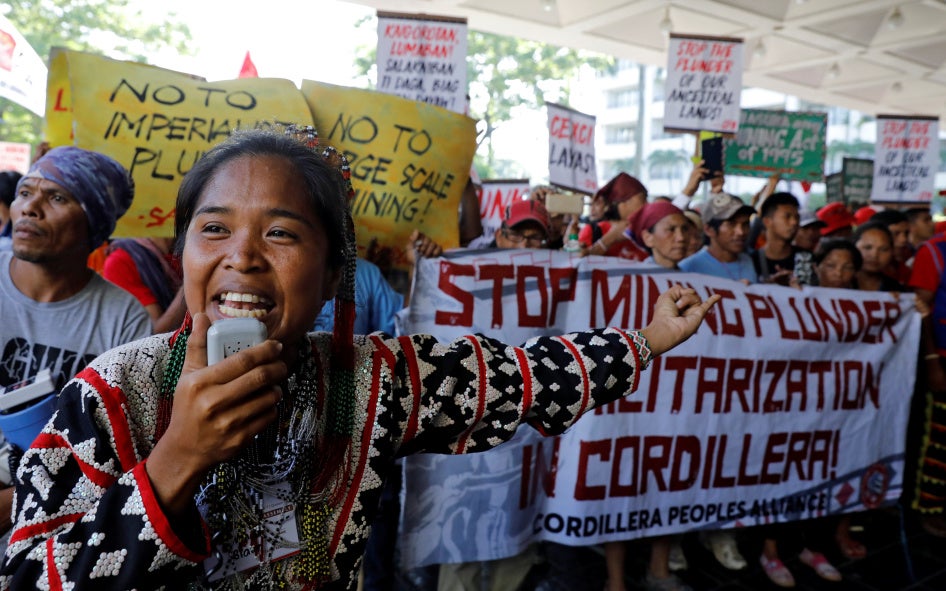
(Manila) – The Philippine government’s revised national guidelines on free, prior, and informed consent (FPIC) threaten the rights of Indigenous communities, Human Rights Watch said today. Philippine authorities should align these guidelines with international human rights standards.
On May 1, 2026, the Philippine National Commission on Indigenous Peoples (NCIP), which issues rules and regulations related to the 1997 Indigenous Peoples Rights Act, announced that it had approved revised guidelines for projects affecting Indigenous communities. The guidelines were first issued in 2012 to ensure that Indigenous peoples could make decisions in accordance with their customary traditions about laws, policies, and projects that affect them.
“The National Commission on Indigenous Peoples’ revised guidelines would severely undermine the ability of Indigenous communities to provide free, prior, and informed consent for company projects in the Philippines,” said Lian Buan, Southeast Asia researcher at Human Rights Watch. “The Philippine government has a duty to ensure that private corporations cannot bulldoze through the rights of Indigenous people.”
After the commission’s May 1 announcement, Indigenous groups and members of Congress urged the Commission to make publicly available its proposed revisions to the guidelines. Human Rights Watch has a copy on file.
The 2026 revised guidelines focus on the requirements of Indigenous communities to consider whether they will provide free, prior, and informed consent for private businesses activities. They impose shortened periods for Indigenous communities to build consensus for decisions, contrary to the Indigenous Peoples Rights Act, which puts primacy on customary traditions for reaching such decisions.
Under the 2012 guidelines, Indigenous communities have no stringent deadline for holding community assemblies. After community assemblies, they had up to two months to build consensus on their conditions for assent. The 2012 guidelines also do not impose a timeframe for negotiations over the memorandum of agreement to be signed with a company, which includes details on benefit-sharing and redress mechanisms.
The 2026 revised guidelines would require them to hold the assembly within 10 days after notification and 30 days to build consensus for large-scale projects. They provide only 4 days to hold a community assembly, and 7 for consensus building for small-scale projects. In some cases, the 2026 guidelines specify the format for decision-making, putting pressure on Indigenous communities and disregarding customary processes that may reasonably require more time.
“Indigenous communities have major disagreements with the new 2026 FPIC version,” said Raymond Marvic Baguilat, head of the Indigenous Peoples Law and Policy Program at the University of the Philippines Institute of Human Rights. “Did the government really give us our right to self-determination if the government set the standards and timelines?”
The 2012 guidelines also provided more safeguards to protect ancestral domain—a designation under Philippine law for territory used by Indigenous communities since time immemorial—and to assess possible effects on proposed projects on Indigenous peoples.
Previously, the Commission was required to conduct a field-based investigation to ensure that a proposed project area “patently and publicly” falls outside of ancestral domain and that the proposed activity is “determined not to affect” an ancestral domain, whether a title had already been granted to the community or not. Only then could the Commission issue a Certificate of Non-Overlap, a document that private businesses must have before starting activities in an area with Indigenous communities.
Under the revised guidelines, the Commission will consider property rights that existed prior to the enactment of the Indigenous Peoples Rights Act and may issue a Certificate of Non-Overlap without carrying out a field-based investigation to verify possible impacts on ancestral domain. These changes mean that the Commission can issue a certificate on the basis of documents showing vested property rights, without visiting the community and even if the project overlaps with an ancestral domain, Human Rights Watch said.
The Legal Rights and Natural Resources Center, a Philippine nongovernmental organization, stated that under the revised guidelines, “[a] mining permit holder may assert that the land is privately owned, obtain a [certificate] on the basis of that claim, and proceed with operations. By the time the affected community is able to establish that the area falls within their ancestral domain, mining activities may already be under way.”
The 2026 revised guidelines also remove avenues for redress for Indigenous communities who want to dispute permits and certificates for activities and projects that affect them.
The Commission is required to consult Congress before publishing and enforcing new rules and regulations. It should promptly discuss with Congress holding committee hearings on the revised guidelines, Human Rights Watch said.
Indigenous activists said that their communities were deeply concerned by the proposed changes and do not feel they were meaningfully consulted about the content or timeline for the adoption of these revisions.
Meaningful consultation would have involved facilitated discussion in every ethnographic region in languages that Indigenous communities understand, said Giovanni Reyes, president of the Philippine branch of Indigenous Peoples Community/Conserved Areas consortium. There was no such undertaking of “this full and effective participation … by the NCIP,” he said.
The Philippine government has obligations under international human rights law to protect the rights of Indigenous people.
The United Nations Declaration on the Rights of Indigenous Peoples states that Indigenous peoples have the right to participate in decision-making in matters that would affect their rights, and that governments shall obtain their free, prior, and informed consent before adopting measures that may affect them. Additionally, the declaration provides that Indigenous peoples shall not be forcibly removed from their lands or territories. Although the declaration is not a binding treaty, the Philippines supported the declaration when the UN General Assembly adopted it in 2007.
In 2018, the UN Expert Mechanism on the Rights of Indigenous Peoples published a study on free, prior, and informed consent, based on an assessment of how the concept had been interpreted and applied by domestic courts, regional human rights courts, and UN human rights bodies. This assessment noted that among the concrete, constitutive elements needed, “[c]onsultation and participation should be undertaken at the conceptualization and design phases and not launched at a late stage in a project’s development, when crucial details have already been decided.”
The Philippine government should enable Indigenous communities to develop and enforce their own free, prior, and informed consent protocols, and provide avenues for redress when these protocols are not adhered to, including by government agencies, Human Rights Watch said.
“The National Commission on Indigenous Peoples should go back to the drawing board and ensure the participation of Indigenous peoples in the revision process,” Buan said. “The government needs to amend the rules so that Indigenous peoples have a genuine voice in decision-making.”