President Claudia Sheinbaum has recently reiterated that “there's no agreement” with the United States for its deportation of thousands of people who aren’t Mexican to Mexico. By the president’s account, Mexico has accepted over 13,000 deported non-Mexicans because “we are a humanitarian country, so in the event that people of other nationalities arrive, they aren't turned away.”
A 66-year-old Cuban man who had lived in Arizona for 45 years before being deported to Mexico last September might beg to differ. Now destitute, without his medications in the southern state of Tabasco, where he has no connections or support, he has not seen his US citizen wife or his two US citizen children for nearly a year. He called his deportation “an undeserved punishment.”
This man whose name is withheld for his safety, one of 41 we interviewed for a recent Human Rights Watch report, is not unique. Between January 2025 and March 2026, over 4,300 Cubans were deported to Mexico. Many are over 60 years old and had lived in the US for decades. They didn’t simply stroll into the country; they were forcibly transported across the southern border into the hands of the Mexican National Institute of Migration, which bused them to the southern states of Chiapas and Tabasco. By describing these deportations as “arrivals,” President Sheinbaum minimizes the Trump administration’s third-country removals and Mexico’s cooperation.
This process is tainted by cruelty at every stage. The man I spoke to said that when he refused to sign his deportation order, “officers told me they were going to put me in a room with four or five thugs, and that they would force me to sign.”
The Trump administration seeks to legitimize its campaign by assuring the public it is deporting “the worst of the worst.” Yet the man I spoke to, like 84 percent of the Cubans recently deported to Mexico, had not been convicted of any violent offense. After a judge dismissed charges of possession of a controlled substance against him on June 6, 2025, immigration officers arrested him as he left the courthouse. They never informed his family of his arrest; when his defense attorney tried to find him in the government’s detainee locator, no record appeared. “They disappeared me,” he said. “It was as if I had never existed.”
Despite the secrecy shrouding the deportation arrangement with Mexico, one thing is clear: US immigration authorities have shown no consideration for the devastating impact of deportation on older people and those with health conditions, and Mexican officials have been passive, at best, in meeting their needs.
Like many other deported people, this Cuban man had health issues: his thyroid had been removed years ago. Stranded in Mexico, he can no longer rely on Medicare and Medicaid, the US insurance programs for older people and people with low incomes; Mexico does not give deported people subsidized medication.
“I’m going to have to choose between paying my rent and paying for the medication,” he said.
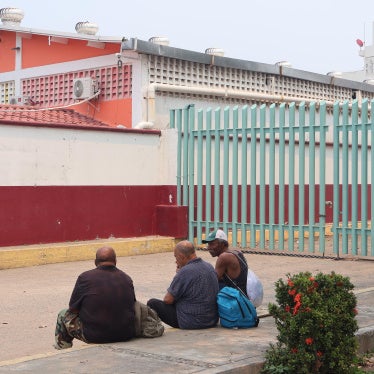
Mexico also doesn’t give deported people legal status or employment. Anyone walking around Miguel Hidalgo Park in Tapachula will see recently deported non-Mexicans living on the streets.
When President Sheinbaum said, “We see whether they want to return to their country of origin or whether they want to stay in Mexico, and under what conditions they can stay,” she indicated a choice that does not, in fact, exist. Many Cubans cannot return to their country of origin because Cuba refuses to take them back. Since the US has rejected them, they have no choice but to stay in Mexico.
That leaves just one real question—under what conditions they can stay. All the people we interviewed told us that Mexican migration authorities only told them that they had limited permission to stay in Mexico—generally, for 10 days—and advised them to request asylum, essentially to try their luck with a dysfunctional asylum system.
And try they did. But most of the people we spoke to encountered significant obstacles accessing the government’s agency for examining asylum claims. In part due to recent US funding cuts to the United Nations refugee agency, Mexico’s asylum program’s processing capacity has been drastically weakened. Asylum claims must, by law, be resolved within 45 days, but the whole process now takes well over a year, if asylum seekers can even access the Mexican asylum procedure.
Asylum or refugee status should not be the Cubans’ only available option for regularizing status. The Cubans stranded now in southern Mexico are essentially de facto stateless people—men without a country. Knowing fully that their country of origin refuses to accept them, Mexico should offer them a pathway to regularize their status whether or not they qualify as refugees, authorize them to work legally, and provide access to basic services so they can live with dignity.
That is what “a humanitarian country” would do.