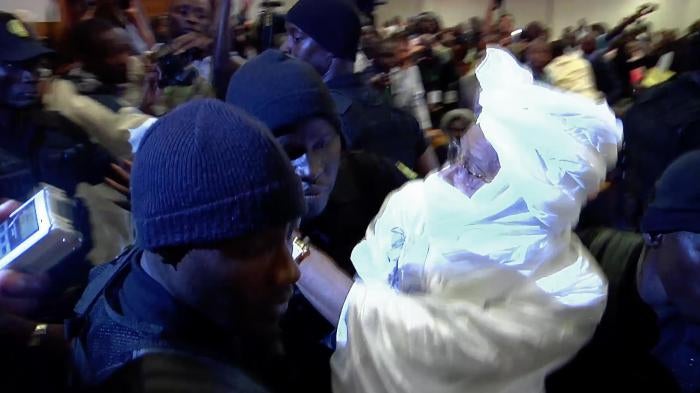
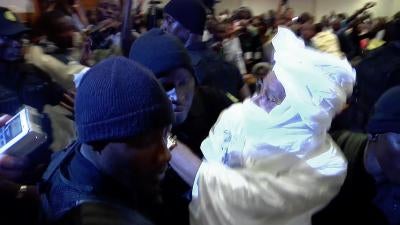
The long-awaited trial of Hissène Habré, was adjourned almost as soon as it was opened, as an outburst from the former dictator of Chad caused a scene in the courtroom.
The long-awaited trial of Hissène Habré, was adjourned almost as soon as it was opened, as an outburst from the former dictator of Chad caused a scene in the courtroom.
The government of the Democratic Republic of Congo and United Nations peacekeepers should urgently take steps to arrest and transfer Sylvestre Mudacumura, military commander of the Democratic Forces for the Liberation of Rwanda (FDLR), to the International Criminal Court.
Victims Bring Dictator Hissène Habré to Trial: The inauguration of a special court in Senegal marks a turning point in the long campaign to bring to justice the former dictator of Chad. Habré is accused of thousands of political killings and systematic torture during his presidency, from 1982 to 1990.
Alma D. Isais Aguilar, a Catholic nun, works with the Kino Border Initiative, a group that provides food and shelter to migrants in the border town of Nogales, Mexico. Sister Alma reports that until recently, the migrants she encountered were typically heading north for the first time, but that increasingly they are long-term US residents, newly deported and desperate to return to families north of the border.
Alina Diaz, a farmworker advocate, with Lidia Franco, Gisela Castillo and Marilu Nava-Cervantes, members of the Alianza Nacional de Campesinas, a national organization that mobilizes farmworker women around the country to engage with policymakers about workplace abuses, including unpaid wages, pesticide exposure, and sexual harassment. Once an undocumented immigrant herself, Diaz is now a US citizen. For her, the farmworkers in her community are "already great citizens" in all but name. She dreams that one day they will go to Washington, not to "demand and scream and march," but to commemorate victory, to say, "Thank you, because you are giving me dignity, because you are treating me as a human being."
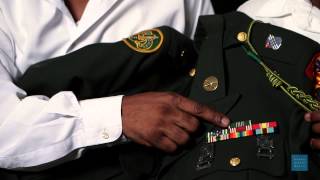
Hilarion Warren Joseph, 46, a decorated veteran of the first Gulf War and a longtime lawful permanent resident, with his 13-year-old son, Japeri, who wears the jacket from Joseph's US Army uniform. After the war, Joseph said he suffered from post-traumatic stress disorder and attempted suicide three times. He was eventually convicted of transporting guns without a license, which ultimately led the US government to seek to deport him for an "aggravated felony." After three years of immigration detention and litigation, Joseph was able to fight deportation, and now lives with his son Japeri in Brooklyn, New York. But he knows many veterans are not so fortunate and end up exiled from the country they served.