US Expulsions of Third-Country Nationals to Countries in Africa
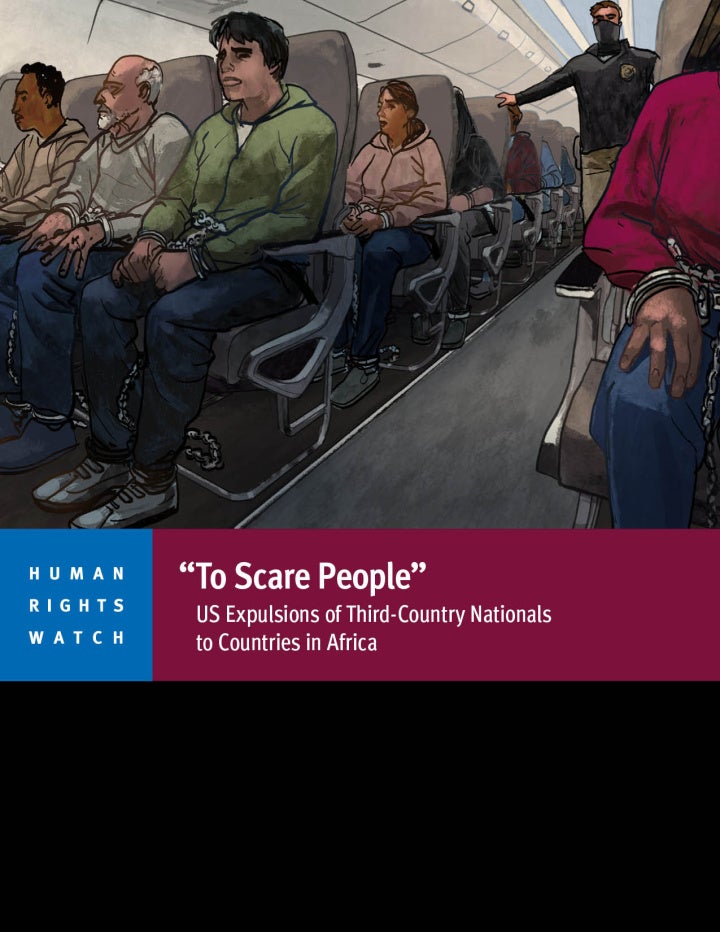
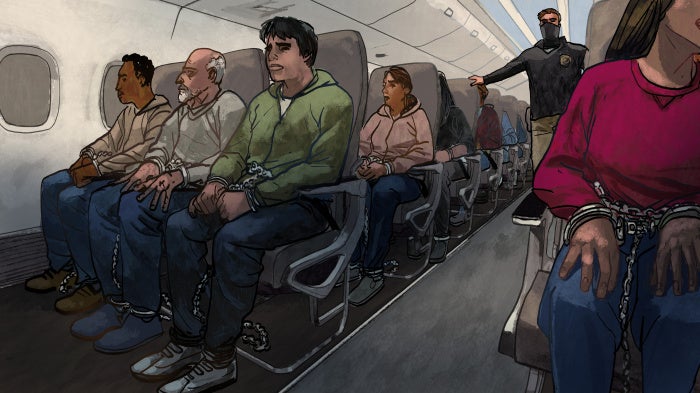
The 125-page report, “‘To Scare People’: US Expulsions of Third-Country Nationals to Countries in Africa,” documents that US authorities denied the more than 500 people transferred to third countries a meaningful chance to contest their removals or to articulate their fears of being removed to these countries. Some countries arbitrarily detained people they had accepted, and some have sent people onward to the risk of persecution or torture in their home countries, violating the international law principle of nonrefoulement.
The Rwandan government has violated the basic rights of tens of thousands of people by forcing them to abandon their homes in rural areas and move to makeshift dwellings in government-designated sites, Human Rights Watch charges in this report.
The Greek Government should as a matter of urgency take measures to alleviate the extreme overcrowding and otherappalling conditions of detention for foreigners held in police facilities in Greece.
How countries treat those who have been forced to flee persecution and human rights abuse elsewhere is a litmus test of their commitment to defending human rights and upholding humanitarian values.
The November 24-25 summit in Zagreb, with the participation of fifteen European Union (E.U.) states and Albania, Bosnia and Herzegovina, Croatia, Federal Republic of Yugoslavia, the former Yugoslav Republic of Macedonia and Slovenia, provides a unique opportunity for the E.U.
Although the government of Burundi has promised Nelson Mandela that it will close its squalid "regroupment" camps, that promise has not yet been fulfilled, Human Rights Watch charged in this report. The former South African president is leading a new round of the Burundi peace talks, opening tomorrow.
Every recognized country in the world, except for the United States and the collapsed state of Somalia, has ratified the Convention on the Rights of the Child, pledging to uphold its protections for children. Today the convention stands as the single most widely ratified treaty in existence.
Sierra Leonean refugee children in Guinea are among the most vulnerable children in the world. They have lived through an extremely brutal war -most have witnessed or suffered unspeakable atrocities including widespread killing, mutilation, and sexual abuse.
Tens of thousands of refugees, some of whom have lived in Tanzania for more than two decades, have been rounded up by the Tanzanian army and confined to camps for the past year in the western part of the country, Human Rights Watch charges in this report.
Over the past forty years, Cuba has developed a highly effective machinery of repression. The denial of basic civil and political rights is written into Cuban law. In the name of legality, armed security forces, aided by state-controlled mass organizations, silence dissent with heavy prison terms, threats of prosecution, harassment, or exile.
With the disintegration of the rule of law in Congo and elsewhere in the region, Congo has become the battle ground for the interests of its neighbors and a Congolese political and military elite—all at the expense of Congolese civilians.
Children in the Custody of the U.S. Immigration and Naturalization Service
In this report, Human Rights Watch charges the U.S. Immigration and Naturalization Service (INS) with violating the rights of unaccompanied children in its custody.
Violations of international humanitarian law -- the laws of war -- are not abstract concepts in Colombia, but the grim material of everyday life. War bursts into the daily activities of a farm, a village, a public bus, or a school with the speed of armed fighters arriving down a path or in four-wheel drive vehicles. Sometimes, armed men carefully choose their victims from lists.
At almost no time since Burmese asylum seekers started arriving on Thai soil in 1984 has the need for protection of this group been greater. Human rights violations inside Burma continue almost a decade after the State Law and Order Restoration Council (SLORC) seized power in Burma in September 1988
In a report released today, Human Rights Watch condemns the war of terror now underway against civilians in Sierra Leone, and calls on the international community to take emergency measures to end the killings, amputations, and abductions taking place in that civil war.
Abuse of Undocumented Migrants, Asylum Seekers, and Refugees in South Africa
Unpunished attacks on foreigners in South Africa are disturbingly common; and foreigners are regularly victimized by the South African police,the army, and by guards at detention facilities. Detention conditions for migrants awaiting deportation are substandard and overcrowded. South Africa's treatment of refugees is also troubling, and fails to conform with international standards.