US Expulsions of Third-Country Nationals to Countries in Africa
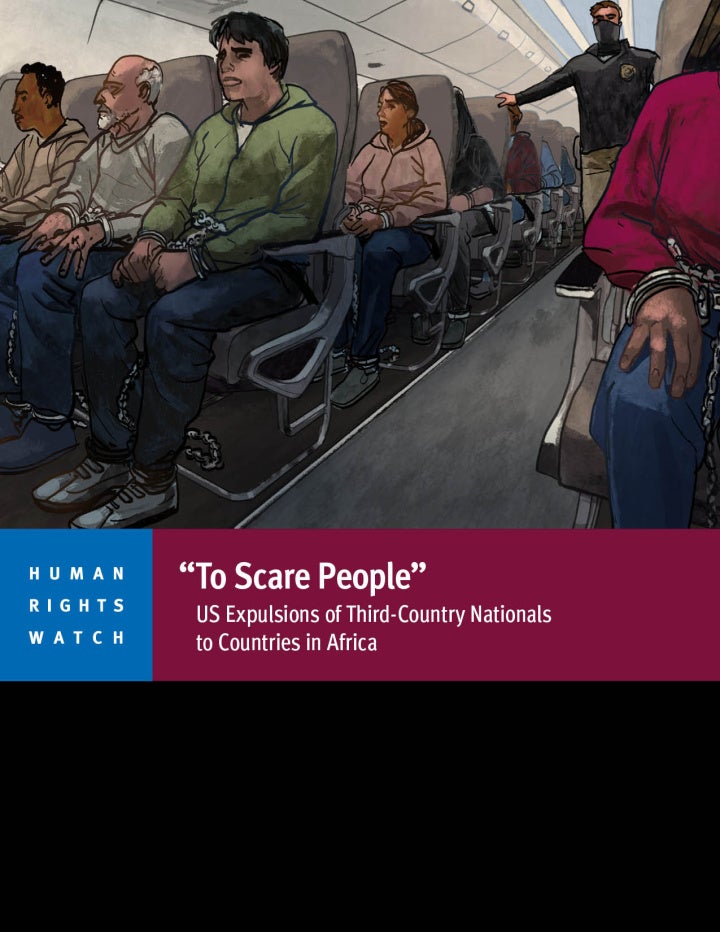
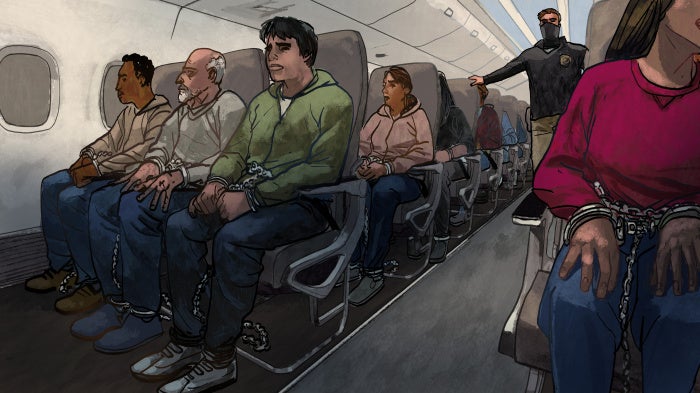
The 125-page report, “‘To Scare People’: US Expulsions of Third-Country Nationals to Countries in Africa,” documents that US authorities denied the more than 500 people transferred to third countries a meaningful chance to contest their removals or to articulate their fears of being removed to these countries. Some countries arbitrarily detained people they had accepted, and some have sent people onward to the risk of persecution or torture in their home countries, violating the international law principle of nonrefoulement.
This briefing paper describes the current humanitarian and security conditions faced by hundreds of thousands of Iraqi residents, refugees, and displaced persons, and examines priority concerns and potential humanitarian consequences in the event of war.
Repression of Women and Girls in Western Afghanistan
Afghan women and girls have suffered mounting abuses, harassment and restrictions of their fundamental human rights during 2002, Human Rights Watch said in a new report.
Many refugees who come uninvited to Australia are compelled to do so because they cannot find effective protection anywhere else, Human Rights Watch said in a new report released to mark International Human Rights Day.
Refoulement, Militarization of Camps, and Other Protection Concerns
The United Nations Security Council should extend the arms embargo on Liberia to all rebel groups, and closely monitor the compliance of the Guinean government with that embargo, Human Rights Watch said today. The Guinean government’s close relationship with Liberian rebel groups is posing a serious threat to refugees’ security and protection in Guinea.
China must end the forcible return of North Korean asylum-seekers and the arrest and harassment of aid workers who assist them, Human Rights Watch said in a new report released today.
The Turkish government, security forces and paramilitaries are obstructing the return of hundreds of thousands of displaced villagers to their homes in the formerly war-torn southeast.
Why the International Community Should Reject Australia's Refugee Policies
The government of Australia has taken increasingly aggressive measures in recent years to prevent unauthorized asylum seekers from reaching its shores. One year ago, on September 26, 2001, it enacted new legislation that extended the legal basis for its policies, which are among the most restrictive in the developed world.
The Arbitrary Application of Spanish Immigration Law
The Human Rights Watch report, "Discretion Without Bounds: The Arbitrary Implementation of Spanish Immigration Law," criticizes the Spanish authorities' uncoordinated and ad hoc application of Spanish Law 8/2000.
State Abuses of Unaccompanied Migrant Children by Spain and Morocco
Moroccan migrant children in Spain are frequently beaten by police and abused by staff and other children in overcrowded, unsanitary residential centers, Human Rights Watch charged in this report. Spain also summarily expels children as young as eleven to Morocco, where Moroccan policebeat and ill-treat them and then abandon them to the streets.
Women in Guatemala's largest female-dominated labor sectors face persistent sex discrimination and abuse, Human Rights Watch charges in this report. The 147-page report examines two sectors, export processing and private households, which employ tens of thousands of women sewing clothes for sale in the United States and working as live-in domestic workers.
The Impact of the September 11 Attacks on Refugees, Asylum Seekers and Migrants in the Afghanistan Region and Worldwide
The backlash against refugees, asylum seekers and migrants throughout the world is a serious side effect of the September 11 attacks. While governments have legitimate security concerns, there must be a balance with human rights and refugee protection standards.
Backgrounder for the World Conference against Racism, Racial Discrimination, Xenophobia and Related Intolerance
Throughout the world, refugees, asylum seekers, migrants and internally displaced persons are the victims of racial discrimination, racist attacks, xenophobia and ethnic intolerance. Racism is both a cause and a product of forced displacement, and an obstacle to its solution.
Proposed Amendments to the 12 July 2001 Draft Programme of Action For Equality and Non-Discrimination Against Racism, Racial Discrimination, Xenophobia, and Related Intolerance (A/CONF.189/PC.3/8) and the Draft Declaration (A/CONF.189/PC.3/7).
Hundreds of thousands of Sierra Leonean and Liberian refugees along Guinea's border were relocated from the embattled border area in early 2001 to camps in the interior of the country. While the organized movement from the border is a welcome and long overdue step, the long-term safety of the refugees is still under threat.