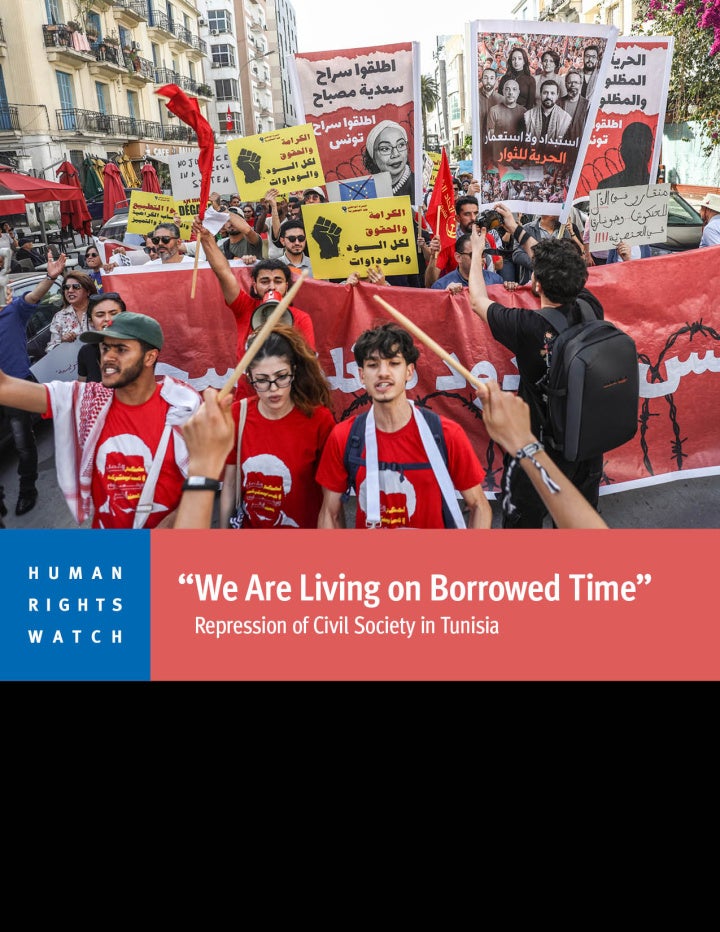
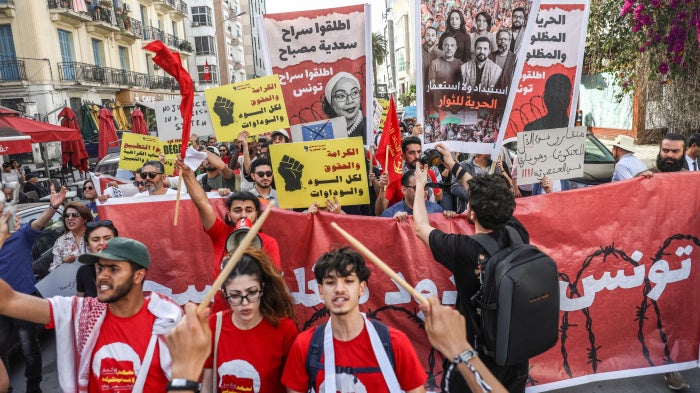
The 49-page report, “‘We Are Living on Borrowed Time’: Repression of Civil Society in Tunisia” documents the Tunisian authorities’ escalating repression of local and international civil society groups, workers, members, and affiliates through the weaponization of abusive prosecutions, arbitrary arrests, detention, financial and criminal investigations, mass suspensions, and threats of dissolution.
Under the anti-terror law, which was introduced in 1991, many left-wing and pro-Kurdish journalists, writers and publishers continue to be tried, and many go on to be sentenced to prison terms and fines. Penal Code provisions that make it a crime to insult Ataturk, secularity, Islam, the security forces and the president continue to be used to restrict free expression.
Poland's transition to democracy is endangered by government and private restrictions on freedom of expression. In a distressing series of arrests and prosecutions for "slandering" the state, President Walesa has relied upon a repressive Communist-era law to punish government critics.
In Greece, some citizens are paying a heavy price for their government's hard line on Macedonia. In particular, freedom of expression has been abrogated through an intensive campaign which combines propaganda and a series of extraordinary criminal prosecutions for dissenters.
Between April 29 and May 28, in a move unprecedented since Lebanon’s civil war, the Hrawi government shut down 4 news organizations and filed criminal charges against 4 journalists for violating Lebanon’s restrictive press regulation. The recent measures recall the fall of 1976, when the newly-arrived Syrian troops forcibly shut down 5 newspapers in Beirut.
Dismissals from the workplace as a means of punishing and discouraging critical speech, particularly levelled at members of the political opposition, are occurring all too frequently in Uzbekistan. The administration's attitude toward the opposition has been articulated thus: “It is necessary to straighten out the brains of 100 people in order to preserve the lives of thousands.”
Two Indonesian college students who emceed a rock concert in Yogyakarta, Central Java, were sentenced to two a half years on charges of blasphemy and insulting a group in public for a brief exchange in front of a student audience in which they punned on several phrases from the Quran.
The military forces that overthrew Haiti’s first freely elected president, Jean-Bertrand Aristide, have consolidated their rule by ruthlessly suppressing Haiti’s once diverse and vibrant civil society — the range of civic, popular and professional organizations that had blossomed since the downfall of the Duvalier dictatorship seven years ago.
Britain has historically been a society with great respect for the tradition of freedom of the press. In recent years, however, there has been a significant increase in restrictions on liberty. Not only have press freedoms been threatened with greater restrictions, but broadcasting has faced similar challenges, and the right to protest has been limited.
During the period of Ethiopian rule in Eritrea (1962-91), a systematic policy of denying educational freedoms to Eritreans was followed. This ranged beyond stifling freedom of thought to a sustained attempt to dismantle the educational system and block the emergence of a university serving Eritreans.
New Communications Technologies and Traditional Civil Liberties
Since the personal computer ushered in a communication revolution about 15 years ago, the accompanying technology has been likened to everything from the printing press to Hyde Park Corner, from the postal system to talk radio. Pungent as these analogies are, their limitations point up the essential uniqueness of computer-mediated communication.
36 writers from 16 countries receive funds from the estates of Lillian Hellman and Dashiell Hammett
The Italian translator of The Satanic Verses, who was the victim of a knife attack last summer; a Peruvian journalist arrested during the recent coup; and numerous Burmese and Chinese writers imprisoned for their roles in their nations' pro-democracy movements are among the writers recognized this year by the Fund for Free Expression for their courage in the face of political persecution.
In February, the Dominican Republic's telecommunications chief suspended the Creole-language news program of a popular Dominican radio station based in the southwest region of the country, near the Haitian border. After receiving complaints from Haiti's de facto military rulers, the Dominican authorities barred Radio Enriquillo from transmitting its news program in Creole, the Haitian language.
On August 6, 1993, the Kuwaiti government ordered the dissolution of all unlicensed organizations. Especially targeted were groups tracking the fate of Kuwaitis disappeared during the Iraqi occupation and believed held in Iraq, as well as human rights groups, including the Kuwaiti Association to Defend War Victims, Kuwait’s main human rights organization.
he Arab Women's Solidarity Association (AWSA), headed by Dr. Nawal El-Saadawi, a well-known writer and leading figure in the Arab women's movement, has been ordered dissolved by the Egyptian authorities. AWSA will contest the dissolution order in legal proceedings scheduled to begin on October 31 before the State Council Court.