Cuban and Other Third-Country Nationals Deported from the US to Mexico
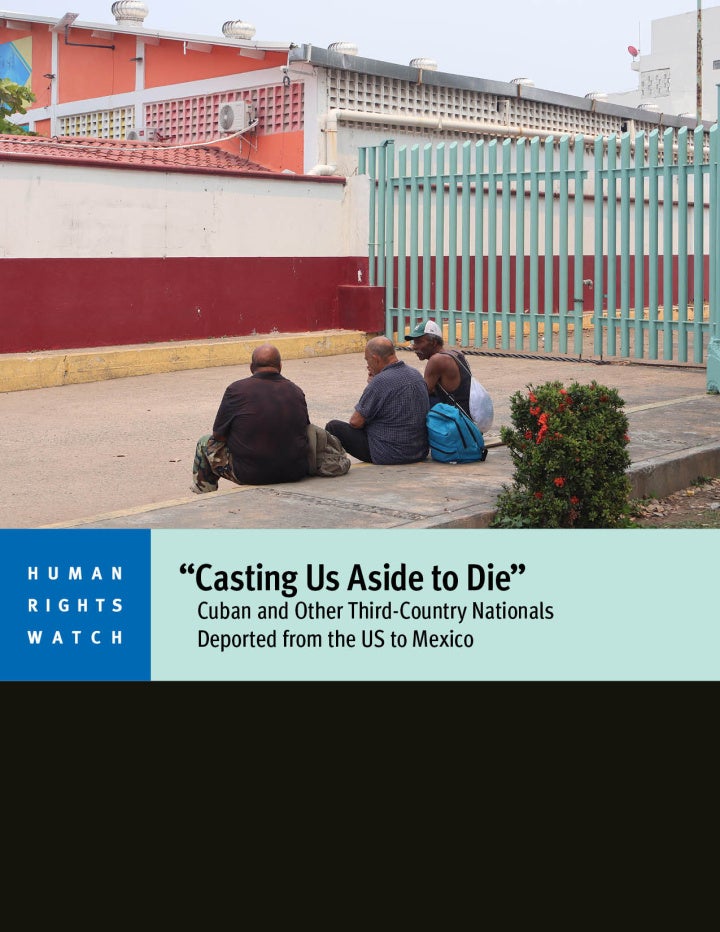
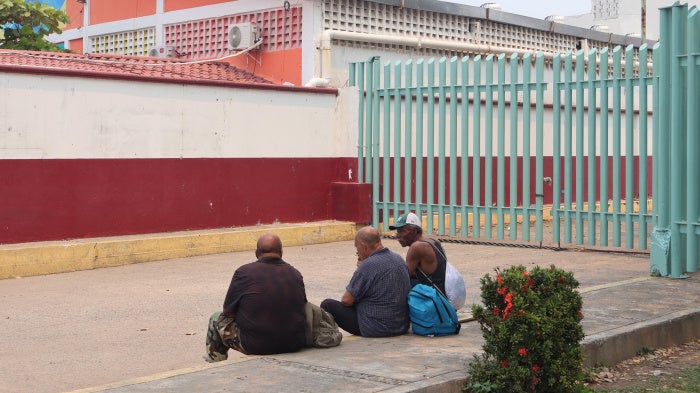
The 66-page report, “‘Casting Us Aside to Die:’ Cuban and Other Third-Country Nationals Deported from the US to Mexico,” documents US government abuses against Cubans and other third-country nationals deported to Mexico between January 2025 and March 2026. With no other recourse to obtain permanent residency in Mexico, many Cuban deportees, whose home government refuses to take them back, are trapped in a legal limbo. Since arriving in Mexico, they have received little if any government support, and many are without access to shelter, food, or health care.
Weeks before the opening of the Asia-Pacific Economic Cooperation summit in Jakarta on November 15,1994, the Indonesian government tightened controls on nongovernmental organizations (NGOs) and the press and took harsh anti-crime measures involving what appeared to be extrajudicial executions of suspected criminals.
Every day in Jamaica, children as young as ten years of age are locked in dark, overcrowded, filthy cells which they share with rodents and insects. Sometimes they are held with adults charged with serious crimes. While in the cells, the children are subjected to physical and mental abuse from police and other inmates and are often denied appropriate medical care if they are injured or ill.
The massive proliferation of small arms and light weapons in South Asia is directly linked to the Soviet invasion of Afghanistan in 1979, and the subsequent creation by the United States of a system, commonly known as the Afghan pipeline, to funnel weapons covertly to the Afghan resistance.
Discrimination Against Women Under Botswana’s Citizenship Act
Recent events indicate that the government of Botswana is continuing to enforce provisions of the Botswana Citizenship Act that discriminate on the basis of sex, in defiance of a 1992 Botswana Court of Appeal decision holding those provisions unconstitutional and contrary to international human rights standards.
For the last few years, the watchword of the Indonesian government has been “openness.” It was both a policy — the Indonesian equivalent of letting a hundred flowers bloom — and a prescription, from President Soeharto himself, for a dynamic, developing society.
Political Rights and the 1994 Presidential and Congressional Elections
Demands for an overhaul of the Mexican political system acquired renewed political force following an armed uprising by Indian peasants in the southern state of Chiapas on January 1, 1994. The fairness of these elections was a litmus test of the government’s willingness to achieve a genuinely representative democracy and give ordinary Mexicans the right to hold their representatives accountable.
Like their enslaved ancestors more than two centuries ago, tens, if not hundreds, of thousands of Haitians are on the run, fleeing the murderous military regime that sent their elected president into exile after the September 30, 1991 coup d'etat.
In recent years, it has become increasingly evident that executed prisoners are the principal source of supply of body organs for medicaltransplantation purposes in China.
Abuses Rise as International Pressure on India Eases
As the conflict in Kashmir continues into its fifth year, the government of India appears to have stepped up its catch-and-kill campaign against Muslim insurgents, resulting in an escalation of human rights abuses since early 1994. Civilians continue to bear the brunt of the casualties, falling victim both to government forces and to the various factions, collectively known as “militants.”
Between May and October 1992, nineteen men were arrested in Georgia on a variety of criminal charges; by September, their cases were united into one - Case No. 7493810 - along with the case against former President of Georgia Zviad Gamsakhurdia for abuse of power and related political crimes.
The military coup d'état against President Jean-Bertrand Aristide on September 30, 1991, plunged Haiti into a maelstrom of state-inflicted and state-sanctioned human rights abuses. These abuses have included numerous political assassinations, arbitrary arrests and detentions, and the torture of prisoners.
The Preliminary Report on Disappearances of the National Commissioner for the Protection of Human Rights in Honduras
Battalion 3-16, a clandestine military death squad originally trained and equipped by the CIA, is synonymous with torture, murder and disappearance in Honduras. The nightmare began in August 1980, when twenty-five Honduran army officers were flown to a desert air strip in the southwestern U.S. to spend six months learning interrogation techniques.
The White House conference on Africa came at a time when the Clinton Administration’s cautious response to the monstrous crime of genocide in Rwanda was increasingly under attack at home and abroad and offered an opportunity for it to adopt a much-needed change of course. This report offers a summary of human rights developments and U.S. human rights policy in ten African countries.
Continuing Rural Violence and Restrictions on Freedom of Speech and Assembly
After winning the first multiparty election since 1963 in December of 1993, the government of Daniel arap Moi has increased its harassment of the political opposition, bringing spurious criminal charges against opposition politicians, forcing unwarranted restrictions on their freedom of association, and arresting them without charge.