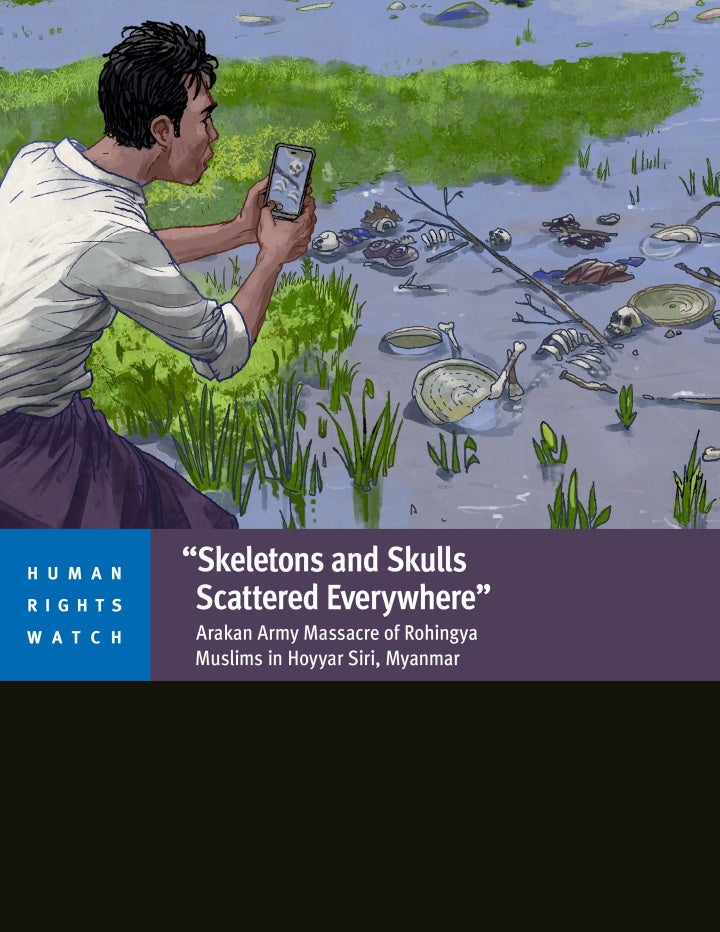
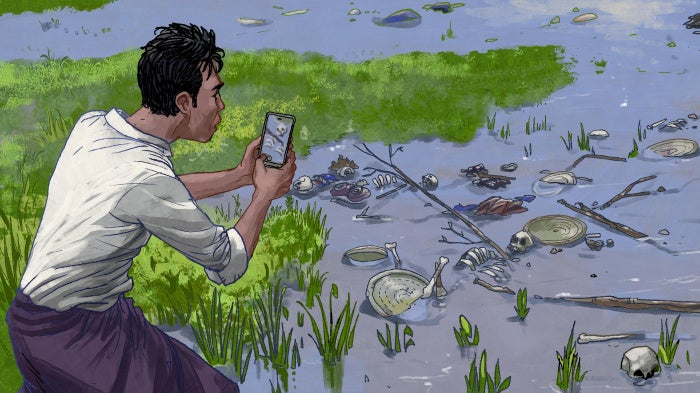
Arakan Army Massacre of Rohingya Muslims in Hoyyar Siri, Myanmar
The 56-page report, “‘Skeletons and Skulls Scattered Everywhere’: Arakan Army Massacre of Rohingya Muslims in Hoyyar Siri, Myanmar,” documents the May 2, 2024 attack, in which Arakan Army fighters deliberately fired on unarmed villagers who were seeking safety after the armed group advanced on two Myanmar military bases in the vicinity. Details of the massacre only began emerging more than a year later, after some survivors fled to Bangladesh and Malaysia.
Between 1993 and 1995, the United Nations Development Program (UNDP) administered a program to return an estimated 300,000 persons who were driven off their land by state-sponsored “ethnic” violence.
Algerians went to the polls on June 5, 1997 in the first parliamentary elections since the military-backed government canceled elections in January 1992. That measure, taken to prevent a victory by the Islamic Salvation Front (Front Islamique du Salut, or FIS), plunged the country into endemic violence that continues today and has claimed more than 60,000 lives, most of them civilians.
The New Amendments to the Press and Publications Law
Since Jordan signed a peace treaty with Israel in 1994, there has been growing tension between the Jordanian government and the independent press, particularly the kingdom's small-circulation weekly newspapers. Journalists and editors have been arrested, detained and prosecuted for violations of both the penal code and provisions of the press and publications law of 1993.
An unknown number of Lebanese citizens and stateless Palestinians are imprisoned in Syria: some of them “disappeared” in Lebanon as long ago as the 1980s. In two cases we documented, Palestinian families learned only recently through information brought to them by released prisoners, that their loved ones may still be alive and in Syrian custody.
Police Abuse and Detention of Street Children in Kenya
In addition to the hazards of living on the streets, street children in Kenya are subject to frequent beatings, extortion, and sexual abuse by police. In violation of international law, they are rounded up and held for days or weeks in police lockups under deplorable physical conditions, commingled with adults and often beaten.
On May 23, 1997, Iranians went to the polls for the seventh time to elect a president of the Islamic Republic. The incumbent, Hashemi Rafsanjani, served the two consecutive four-year terms permitted by law. The transfer of power by way of elections was a notable event in a region in which most leaders do not voluntarily leave power or subject themselves to any type of open electoral process.
Policing, Human Rights, and Accountability in Northern Ireland
Police conduct throughout the long conflict in Northern Ireland has given rise to serious allegations of human rights abuses. The emergency regime imposed on Northern Ireland by the British government invests the Royal Ulster Constabulary (RUC) with expansive police powers to stop, question, search, arrest, detain, and interrogate persons merely suspected of terrorist activity.
The level of racist incidents reported to the police in the U.K. has increased dramatically over recent years. Between 1989 and 1996 the number rose more than 275 percent, from 4,383 to 12,199.
Eastern Slavonia, the only remaining Serb-held region of Croatia, is scheduled to revert to Croatian control by July 15, 1997. Some 120,000 to 150,000 Serbs living in that region will then come under the authority of their bitter opponent during the war.
Lebanon's airwaves had long been unregulated, with scores of unlicensed private broadcasters that ranged in political diversity from the radio station of the Lebanese Communist Party to the television station of Hizballah. The broadcasting community included 52 television stations and over 120 radio stations for a population of three million.
Nearly seven years ago, on April 24, 1990, President Mobutu Sese Seko ostensibly gave in to mounting pro-democracy pressure by announcing the end of the one party state and the beginning of transition to multiparty democracy in Zaire. Seven years into the transition, there have been at least ten different governments but no transition.
Unaccompanied Children Detained by the U.S. Immigration and Naturalization Service
The U.S. Immigration and Naturalization Service (INS) violates the rights of hundreds of unaccompanied children each year, some as young as eight, contrary to international law as well as INS regulations. Children are arrested, imprisoned, and deported, all by the same agency charged with protecting their rights.