US Civil Rights Enforcement Under the Trump Administration
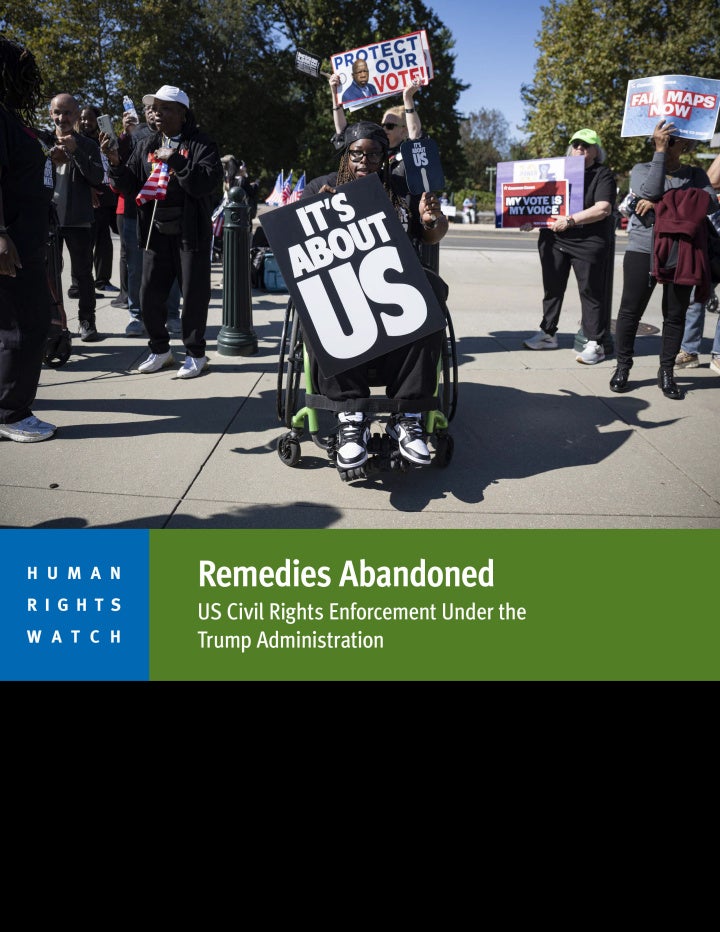
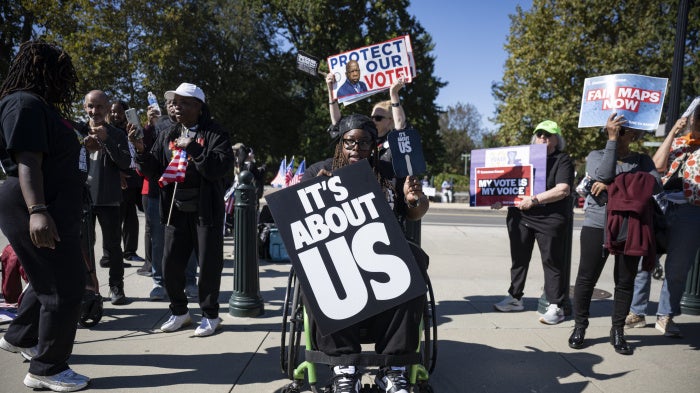
The 112-page report, “Remedies Abandoned: US Civil Rights Enforcement Under the Trump Administration,” documents the administration’s efforts to unravel the work of four key agencies between January 2025 and the spring of 2026: the Justice Department’s Civil Rights Division, which lost about 75 percent of its attorneys; the Education Department’s Office of Civil Rights, which moved to lay off nearly half its staff in one day and closed 7 of its 12 regional offices; the Housing and Urban Development Department’s Fair Housing Office, which shrank dramatically; and the Equal Employment Opportunity Commission, which reached its lowest staffing levels in over 40 years.
Tensions between Georgians and Ossetians began in late 1989 and by 1991 took the form of armed conflict between paramilitary groups. At the root of the conflict is South Ossetia's desire to separate from Georgia and be part of Russia. The armed conflict included the shelling (by both sides) of Georgian and Ossetian villages, blockades and hostage taking.
Haitianos Y Domínico-Haitianos En La República Dominicana
Durante la última década, el gobierno dominicano ha deportado a cientos de miles de haitianos a Haití, así como a un número desconocido de dominicanos de ascendencia haitiana.
Despite a series of promising political reforms in 1990 and 1991, the government of President César Gaviria Trujillo has been unable to stem the violence that accounts for more political murders in Colombia than any country in the hemisphere, with the possible exception of Peru.
The Human Cost of the Conflict & The Struggle for Relief
"The worst humanitarian disaster in the world today," were the words used to describe Somalia by Andrew Natsios, the former director of the U.S. Office of Foreign Disaster Assistance (OFDA).1 The International Committee of the Red Cross (ICRC), which is spending 20% of its entire worldwide budget on assistance to Somalia, has come to the same conclusion.
With the negotiated cease-fire agreement signed on January 16, 1992, in Mexico City, the twelve-year-old conflict in El Salvador has formally come to an end.
The Greek community in Turkey is dwindling, elderly and frightened. Its population has declined from about 110,000 at the time of the signing of the Lausanne Treaty in 1923 to about 2,500 today. Its fear stems from an appalling history of pogroms and expulsions suffered at the hands of the Turkish government.
Israel's Supreme Court to Rule on Legality of Interrogation Guidelines
The death of Palestinian detainee Mustafa Akawi on February 4 illustrates the untenable nature of Israel's claim that its use of "moderate physical pressure" during interrogation does not lead to torture. This claim is being challenged in an important Israeli Supreme Court case that is scheduled for argument next month.
Middle East Watch (MEW) conducted a fact-finding mission to Egypt in January and February 1992, to investigate arrest and detention practices and allegations of torture of individuals held in the custody of the security forces. Participating in the mission were Virginia N. Sherry, associate director of MEW, and John Valery White, an attorney and Orville Schell Fellow with Human Rights Watch.
This report provides an overview of human rights developments since the declation of a 12-month state of emergency on February 9, 1992, after factions of the Algerian participated in a military coup of the government.
As the international community condemned the massacre in East Timor on November 12, 1991 and pressed the Indonesian government to account fully for the killings, other human rights abuses attributed to the Indonesian military went largely ignored.
Across northern Iraq, Kurds, freed for now from President Saddam Hussein's grip, have begun revealing the horrors of nearly a quarter of a century of repressive rule. In former Iraqi police stations and prisons, Kurdish officials have discovered torture chambers and execution sites where they say thousands of political prisoners died under torture or were shot in the 1980s.
New lists of prisoners supplied by former inmates and smuggled out of the Tibet Autonomous Region substantially increase the known number of political prisoners in Tibet. In this report, Asia Watch and the Tibet Information Network present the cases of some 275 prisoners with all extant biographical material.
Abuse of the Legal System Under the PNDC Government
Soon after it came to power, Ghana's ruling Provisional National Defence Council (PNDC) established a "revolutionary" court system. Consisting of Public Tribunals which operate within the country's judicial system, this parallel system for the administration of justice has shown a cavalier disregard for normal judicial procedures.
Major human rights violations go far to explain the ouster of Georgian President Zviad Gamsakhurdia. Helsinki Watch hopes that the new rulers of Georgia are mindful of these violations as they consolidate power and establish a new government. There are, however, several disturbing incidents which suggest that this may not be the case.
Over 60 East Timorese, many of them students, remain in detention in Jakarta and Dili, capital of East Timor in the aftermath of the November 12 massacre in Dili in which upwards of 75 demonstrators were killed when Indonesian troops opened fire. All are facing trial, some on criminal charges, some on charges of subversion.