US Civil Rights Enforcement Under the Trump Administration
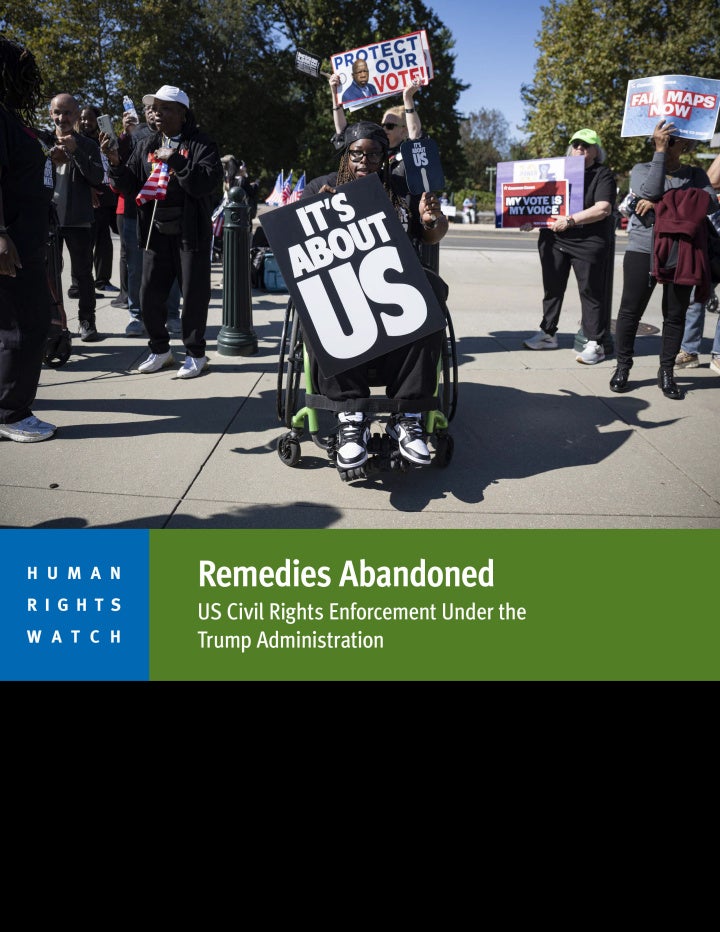
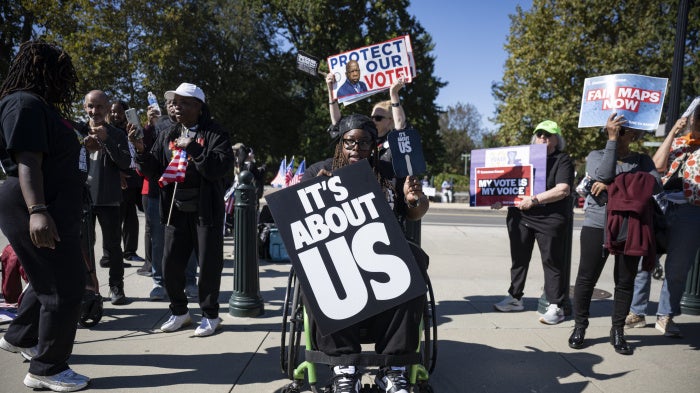
The 112-page report, “Remedies Abandoned: US Civil Rights Enforcement Under the Trump Administration,” documents the administration’s efforts to unravel the work of four key agencies between January 2025 and the spring of 2026: the Justice Department’s Civil Rights Division, which lost about 75 percent of its attorneys; the Education Department’s Office of Civil Rights, which moved to lay off nearly half its staff in one day and closed 7 of its 12 regional offices; the Housing and Urban Development Department’s Fair Housing Office, which shrank dramatically; and the Equal Employment Opportunity Commission, which reached its lowest staffing levels in over 40 years.
Unaccompanied Children Detained by the U.S. Immigration and Naturalization Service
The U.S. Immigration and Naturalization Service (INS) violates the rights of hundreds of unaccompanied children each year, some as young as eight, contrary to international law as well as INS regulations. Children are arrested, imprisoned, and deported, all by the same agency charged with protecting their rights.
In this document, Human Rights Watch seeks to raise concerns about some disturbing trends in the protection of refugees it has observed in the course of researching human rights abuses.
This report documents a pattern of torture—according to internationally recognized definitions of the term—and mistreatment of security detainees by the Anti-Terror Branch (Teror 'le Mucadele Subesi) of the Security Directorate of Turkey’s Ministry of the Interior.
Disproportionate Sentences for New York Drug Offenders
In the past decade, the U.S. Congress and many state legislatures have established harsh criminal penalties for a wide range of drug offenses, often using the vehicle of mandatory minimum prison sentences. As a consequence, drug offenders in the United States face sentences that are uniquely severe among constitutional democracies.
A two-person Human Rights Watch delegation traveled to Guatemala in January 1997. The visit focused on reports of the discriminatory treatment of trade unionists at the assembly plants there of the U.S.-based corporation Phillips-Van Heusen (PVH), and allegations of obstacles posed by the company and the Guatemalan labor ministry to the union’s recognition for purposes of collective bargaining.
A two-person Human Rights Watch delegation traveled to Guatemala in January 1997. The visit focused on reports of the discriminatory treatment of trade unionists at the assembly plants there of the U.S.-based corporation Phillips-Van Heusen (PVH), and allegations of obstacles posed by the company and the Guatemalan labor ministry to the union's recognition for purposes of collective bargaining.
Human Rights Watch has uncovered evidence that the Yugoslav National Army (JNA) had an extensive and sophisticated chemical weapons program prior to the breakup of Yugoslavia in 1991; that the army of the Federal Republic of Yugoslavia (Serbia and Montenegro) inherited much of this program; and that the army of the Republic of Bosnia and Hercegovina produced crude chemical munitions during the Bos
China is increasingly exercising its authority over the territory of Hong Kong on a number of issues and has directed, for instance, that all the Vietnamese be cleared from Hong Kong before July 1. Such pressure has spurred the Hong Kong government to redouble its efforts to resolve the Vietnamese situation, which has embroiled the territory in controversy for over twenty years.
Nearly 100,000 people, most of them Rwandans once resident in the camps of eastern Zaire, have fled to a site near Ubundu, where their further flight is blocked by the Zaire River. Among them are thousands of unarmed noncombatants as well as soldiers of the former Rwandan army (ex-FAR, Forces Armées Rwandaises) and militia responsible for the genocide of Tutsi in Rwanda in 1994.
and Other Human Rights Obligations on the First Anniversary of its Accession to the Council of Europe
On February 28, 1996, the Russian Federation became a full member of the Council of Europe, an intergovernmental organization based in Strasbourg, France, which, among other goals, aims to protect human rights. Accession to the Council of Europe heightened expectations that the Russian Federation would take concrete steps to improve its poor human rights record in the year that has followed.
Between December 1996 and the beginning of March 1997, one of the worst outbreaks of communal violence in Indonesia in decades broke out in the province of West Kalimantan between indigenous Dayak people and immigrants from the island of Madura, off the coast of East Java.
This report examines the context within which children and their parents must struggle to exercise their rights and looks in detail at the legal provisions which deny them even the most basic rights and freedoms. It also reports on the current situation of children in Burma and the daily practices used by the military and other government agents which violate international law.