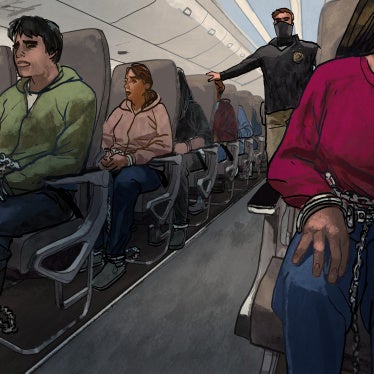
(Brussels) – Negotiations to set up an offshore deportation center in Rwanda, which has a shocking human rights record, is a particularly cruel departure from founding values of the European Union, Human Rights Watch said today.
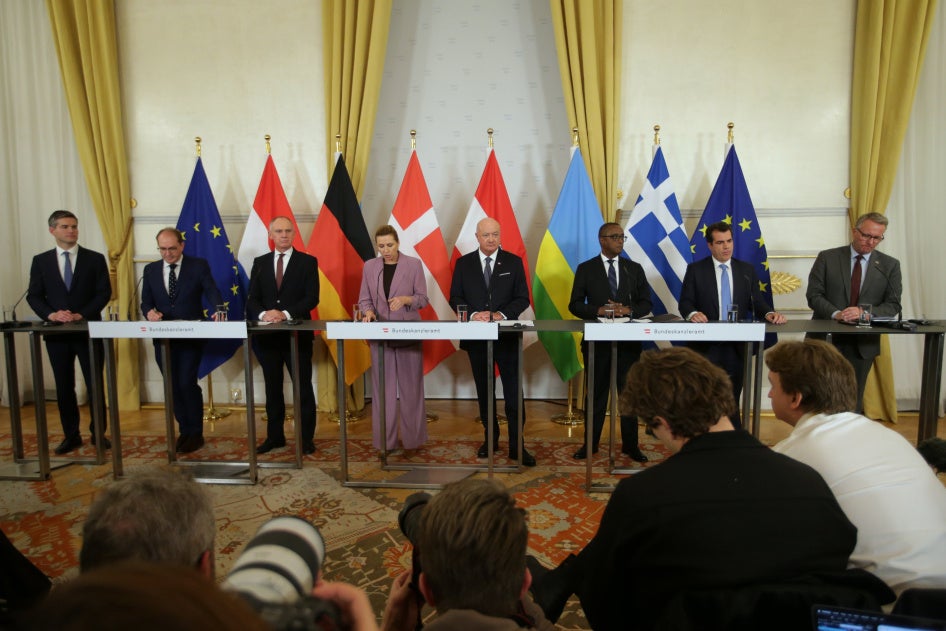
After months of speculation, Austria, Denmark, Germany, Greece, and the Netherlands, alongside Rwanda’s interior minister, confirmed the negotiations on November 16, 2026, on the sidelines of the Vienna Migration Conference organized by the International Centre for Migration Policy Development. The five EU countries confirmed their plan to send people whose asylum claims have been rejected in the EU to Rwanda starting in 2027.
“History has shown that third country transfers violate rights and cause suffering,” said Judith Sunderland, senior associate refugee and migrant rights director at Human Rights Watch. “The choice of a country that has an abysmal human rights record and resists international scrutiny tracks with that history and evokes deep skepticism that any nominal rights safeguards will be respected.”
The recently enacted EU Return Regulation allows member states to set up deportation centers, “return hubs,” in countries outside the EU where people, including families with children, will be sent if they cannot be deported directly to their country of origin. The regulation states that agreements should be reached only with countries that respect international human rights law. Rwanda does not meet this requirement, Human Rights Watch said, yet the five European countries did not provide any human rights or due diligence assessment during the announcement.
The Rwandan government has a well-established record of repressing dissent, including attacks on rights defenders. Its arrests of critics and dissidents, their ill-treatment in detention, and the government’s interference with the judiciary and failure to investigate suspicious deaths have contributed to a widespread climate of fear and self-censorship. In addition, the Rwandan military provides critical support to and exercises overall control over the M23 armed group in eastern Democratic Republic of Congo. Both Rwandan forces and the M23 are responsible for serious abuses and war crimes.
As recently as January, Germany, Greece, Denmark, and the Netherlands raised concerns about Rwanda at its UN human rights review. A similar UK-Rwanda deal raised serious human rights concerns before it was abandoned, an Israel-Rwanda deal led to documented abuse, and the situation of recent deportees from the United States to Rwanda remains largely unknown.
In addition to the threat of harm to those deported to Rwanda, the deal risks financing and giving political leverage to a government responsible for serious human rights abuses at home and abroad, Human Rights Watch said. It could lead the EU to downplay Rwanda’s problematic human rights record or shy away from pressing for measurable improvements.
Human Rights Watch has consistently found that deportations to third countries expose people to arbitrary detention, ill-treatment, destitution, and onward returns to harm in their home countries, as well as other serious human rights abuse. The United Nations special rapporteur on the rights of migrants, the Council of Europe commissioner for human rights, and the African Commission on Human and Peoples’ Rights have all cautioned against forcible third-country transfers. The EU countries involved in the deal with Rwanda are bound by the EU Charter of Fundamental Rights and the European Convention on Human Rights.
“Forcibly deporting people, including children, to a country where the evidence points to their rights being at risk, is a striking abdication of responsibility and humanity,” Sunderland said. “A deal with Rwanda is likely to cause real harm in addition to not achieving any defensible policy objective.”