
Summary
“Europeans signed contracts with Mauritania, Morocco – they’re buffer countries. It’s always the same, the suffering of migrants, the abuse of migrants in detention, the expulsions… Africans are doing the work for the EU, and they know it.”
– Malian aid worker in Nioro du Sahel, Mali, at the border with Mauritania, May 24, 2022
Racial and ethnic profiling, extortion, mass arrests, detention for days or weeks with little to no food, collective expulsions, beatings and torture: these are just some of the violations migrants, asylum seekers, and others have experienced over the past several years at the hands of security forces in the context of border and migration control in Mauritania, a country in northwest Africa. Meanwhile, those same forces have continued to receive financial and material support from the European Union (EU) and Spain.
Located south of Morocco, Mauritania is bordered by the Atlantic Ocean, Senegal, Mali, Algeria, and the Moroccan-occupied Western Sahara. Both a destination and transit country for mainly West and Central African migrants, Mauritania also hosts asylum seekers and refugees, the majority from Mali, where armed conflict and violence have worsened in recent years. With lighter-skinned Beidan Mauritanians, descendants of Arabs and Berbers, predominating in the security forces and upper levels of government, discrimination against Black Mauritanians – Haratine and Afro-Mauritanians – and Black migrants has persisted.
Due to the increasing migration pressures and insecurity in the Sahel, Mauritania has grown in geostrategic importance for the EU and Spain, whose Canary Islands are some 700 kilometers from Mauritania’s northernmost city, Nouadhibou.
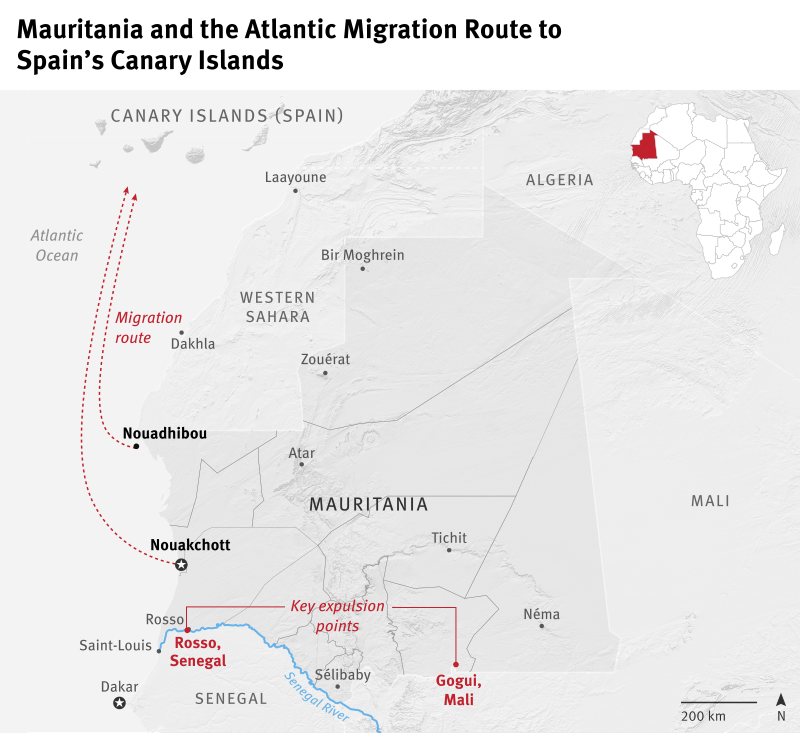
The sea migration route from northwest Africa to the Canaries, known as the “Atlantic Route” or “Northwest African Route,” has grown increasingly active since 2020, becoming one of the busiest and deadliest irregular routes to Europe. In 2024, a record 46,000 migrants and asylum seekers – mostly from West, Central, or North Africa, with Malians the most numerous – arrived in the Canaries in small boats. That year, the majority of departures along the route were from Mauritania. Others embarked from Senegal, The Gambia, Morocco, and the Western Sahara.
In total, more than 147,000 people arrived in the Canaries by boat between 2020 and 2024, with 11,300 more arriving during the first half of 2025. Estimates of how many people lost their lives en route during this period vary from 4,300 to 24,800. Tens to hundreds of thousands of others were rescued or intercepted at sea, or blocked from departing, by Mauritanian, Moroccan, Senegalese, and Gambian forces, supported by EU funds and Spanish forces deployed in Mauritania and Senegal.
In March 2024, the EU announced a new migration partnership with Mauritania and €210 million in funding for the Mauritanian government to reinforce border and migration management, counter-smuggling, and security, while addressing “root causes” of migration through support to refugees, job creation, infrastructure, and more. This is part of the EU’s ongoing “border externalization” approach in Africa: seeking to prevent irregular arrivals in Europe by outsourcing migration controls to countries of origin and transit. In Mauritania, the EU and Spain had been pursuing this strategy long before the 2024 partnership, despite ongoing violations of migrants’ rights by Mauritanian authorities.
This report focuses on the impacts of migration control along the Atlantic Route during the last five years, documenting abuses by Mauritanian security forces and revealing how EU border externalization disregarded and exacerbated human rights violations.
Mauritanian Security Officials’ Abuses
Between 2020 and early 2025, Human Rights Watch documented scores of human rights violations against men, women, and children from multiple West or Central African countries committed by Mauritanian authorities enforcing migration and border controls at sea and on land. Documented violations include torture, rape, and other physical abuse; sexual harassment; arbitrary arrests and detention; inhumane detention conditions; extortion; confiscation of money and valuables; and summary and collective expulsions. Perpetrators were members of the police, coast guard or navy, gendarmerie, and army; in a few cases, victims were unable to identify the security service.
During over four years of research, Human Rights Watch interviewed 223 people by phone and in person during visits to Mauritania, Mali, Senegal, and Belgium. These included 102 migrants and asylum seekers and 121 others – government, UN, and EU officials; members of non-governmental organizations (NGOs) and civil society groups; relatives of abuse victims; witnesses; and experts, lawyers, community members, and others.
Among those interviewed, 78 people were victims of documented human rights violations in Mauritania. They included one Mauritanian accused of migrant smuggling and 77 foreign nationals – 3 asylum seekers and 74 migrants, some with regular migration status and some irregular – from Senegal, Guinea, Mali, Cameroon, Sierra Leone, and Liberia.
Human Rights Watch examined scars and injuries sustained from alleged abuse and collected photos, videos, and legal documents corroborating interviewees’ accounts. We visited immigration detention centers in Nouakchott and Nouadhibou and Dar Naïm Prison in Nouakchott, observing conditions and interviewing people detained for immigration reasons or on smuggling charges.
As this report shows, Mauritanian security forces frequently subjected migrants and asylum seekers from African countries to harassment and arbitrary arrest. Authorities targeted individuals or groups based on information or assumptions that they were undocumented, planning irregular departures to North African countries or Spain, or involved in migrant smuggling – defined by the United Nations as the facilitation of irregular migration in exchange for financial or material benefit. Some used migration control as a pretext for extortion. Multiple migrants interviewed also alleged that security forces racially profiled them or demonstrated racist treatment because they were Black. Some said officers did not check their documents or allow them to retrieve their papers prior to arrest.
Human Rights Watch documented cases of physical abuse, ranging in severity from torture and rape to beatings and other mistreatment, against at least 43 people. Incidents occurred during or after boat interceptions and disembarkations; during arrests or interceptions on land; and during detention and expulsions. In a serious case in August 2022, police in Nouakchott tortured at least four men during interrogations related to migrant smuggling. “They removed my clothes…and beat me. …They shocked me with [electric] current…,” one man said. “They said I was helping people to go to Spain.”
Many people held in police-run immigration detention centers in Nouakchott and Nouadhibou described inhumane treatment and conditions, including lack of food, overcrowding, and sanitation issues, with adolescent children at times detained with adults.
Following detention, Mauritanian authorities have expelled tens of thousands of African foreigners to remote areas along the borders of Mali and Senegal, where limited available aid – and in Mali’s case, armed conflict – has put people at risk. Many such cases constituted collective expulsions – removals of groups of people without individual case assessments or due process – which are prohibited by international and African regional law. Some of those expelled to these land borders have included third-country nationals (who are neither Malian nor Senegalese), children, pregnant women, asylum seekers, refugees, and people with valid legal status in Mauritania.
Human Rights Watch interviewed 35 people who were expelled from Mauritania without due process between 2020 and April 2025. Other expulsions were reported by aid workers, UN officials, local media, and authorities. In early 2025, a spike in mass expulsions of migrants from Mauritania – which many attributed to increased EU funding and pressure to “manage” irregular migration – triggered political tensions with Mali and Senegal.
This report explores issues related to rescues and interceptions of migrant boats in the Atlantic and disembarkations in Mauritania, including inadequate search-and-rescue and the prioritization of “pullbacks” – forcibly returning people or preventing them from departing – which can violate the right to seek asylum and the right to leave any country. While Mauritanian authorities took some steps to improve post-disembarkation treatment of migrants between 2020 and 2024, they failed to consistently ensure screenings for medical and protection needs (such as for asylum seekers, trafficking victims, and children) after every disembarkation. However, in a positive step in May 2025, Mauritania formally adopted national standard operating procedures (SOPs) to regulate sea rescues, interceptions, disembarkations, and the management of migrants, outlining authorities’ obligations to respect rights and ensure protection and medical care.
The report also documents due process concerns in cases of people investigated or prosecuted for migrant smuggling in Mauritania, including alleged false charges; limited evidence of “financial or material benefit” (a key component of the UN definition of migrant smuggling); prolonged pretrial detention; limited access to legal aid; language barriers; and frequent penalization of lower-level “accomplices.” Human Rights Watch also heard allegations from multiple sources that some Mauritanian security force members colluded with smugglers.
Role of Spain and the EU
Human Rights Watch interviewed EU officials in Brussels, attended European Parliament hearings, and analyzed hundreds of articles, reports, and EU and Spanish documents related to migration management efforts in Mauritania and West Africa. This report investigates the myriad and complex ways in which the EU and Spain have pursued a deterrence-focused externalization agenda in Mauritania for two decades, culminating in the new 2024 migration partnership. This includes political agreements; funding, equipment, and other support provided to the Mauritanian government and security forces to bolster border control, migration management, and counter-smuggling; development aid linked to migration control; extraterritorial activities by Frontex, the EU’s Border and Coast Guard Agency; and Spanish security forces, boats, and aircraft deployed to Mauritania to assist Mauritanian authorities with surveillance, patrols, interceptions, and counter-smuggling operations.
A number of EU projects in Mauritania have focused on human rights, refugee and child protection, development, and other needed areas, including support to Mauritania’s development of SOPs for migrant boat disembarkations. However, EU projects between 2015 and 2023 worth at least €61 million took a securitization approach that prioritized support to Mauritania’s border and migration control forces, notably the police, coast guard, and gendarmerie, without adequate safeguards to address risks of human rights violations. This does not include €100 million in funding accorded to Mauritania in 2024, for which the EU published no disaggregated budget; nor does it include the millions of euros in EU support to Mauritania’s armed forces for security and “territorial integrity” purposes, which can overlap with border control. Bilaterally, Spain has also continued and increased border control support to Mauritanian forces, particularly the coast guard.
Ultimately, EU externalization over the years encouraged and financed repressive approaches to migration control in Mauritania, conflicting with African free movement objectives and contributing to human rights violations against migrants, asylum seekers, and refugees. “Since Europe put money into controlling migrants, we have become very tired… If [Mauritanian authorities] arrest us… we are mistreated,” said a Senegalese fisherman in Nouakchott.[1]
Progress Made and Actions Needed
Mauritania has the right to control its borders and regulate immigration, but authorities must respect Mauritania’s obligations under international human rights and refugee law.
This report recognizes positive steps the Mauritanian government has taken to enhance refugee and migrant rights since 2020, such as the SOPs for boat disembarkations, efforts to align national legislation with international law, increased openness to human rights monitoring and empowerment of national rights-focused mechanisms, a 2022 campaign to regularize migrants, increased attention to the protection of migrant children, and more.
However, the documented and ongoing violations of migrant rights indicate the need for increased vigilance and action to address persistent issues, notably with respect to detention, expulsions, due process, and oversight of security personnel. The Mauritanian government should hold to account any security personnel who commit violations against migrants, asylum seekers, or refugees.
The Mauritanian government replied on July 16, 2025 to a letter from Human Rights Watch that had set out our allegations and questions, “reiterat[ing] its commitment to constructive dialogue” and “to human rights, the protection of migrants, and strict compliance with international conventions.” The government stated that its “migration policies, based on respect for human dignity, will continue to evolve.”[2] We recognize and appreciate the government’s willingness to engage on human rights issues and have integrated responses and information from their letter throughout this report.
The Mauritanian government said that it “categorically reject[s] allegations of torture, racial discrimination, or systematic violations of migrants’ rights,” stating, “[N]o cases of torture have been formally established following internal investigations. All allegations are seriously examined, and if abuse is proven, sanctions are taken against the perpetrators in accordance with the law.” The government’s letter highlighted measures taken or in progress “to prevent violations of migrants’ rights,” notably since adoption of the SOPs in May 2025, including security force trainings, monitoring systems for disembarkations and detention, a “strict ban on collective expulsions” and expulsions of unaccompanied children, and other efforts, which are acknowledged in this report.[3]
The European Commission has also taken some recent positive steps by increasing focus on human rights, including planned monitoring and mitigation measures, within EU projects in Mauritania. For instance, a 2024 project document included a provision for suspension of financial support to Mauritanian migration management entities “in the event of a significant deterioration” in respect for refugee and migrant rights.
In its July 17, 2025 reply to Human Rights Watch, the European Commission wrote that “[EU] external actions are firmly rooted in a Human Rights-Based Approach (HRBA)” and that it had “recently strengthened its internal guidance on applying the HRBA to international partnerships,” including “formalised internal procedures for handling specific allegations of human rights abuses.” It said that “all contracts signed by the EU include human rights clauses,” which were updated to include “clearer obligations for its contractual parties’ respect of EU values, as well as to report [violations] within 30 days.”
The European Commission said it “has put in place several [human rights] monitoring tools for its programmes, including initial assessments, regular reports from implementing partners, on the spot verification missions, results-oriented monitoring exercises and external evaluations.” The Commission stated: “Mauritanian authorities, through EU funding support, are strengthening human rights safeguards and guarantees.”
In light of the violations documented in this report, the EU and Spain should urgently ensure that human rights monitoring systems and specific criteria for suspension of contracts are in place for all projects in Mauritania. The EU should also reduce deterrence and securitization approaches to its migration-related policies in Mauritania and Africa in general.
To save more lives, Mauritanian and Spanish authorities should redirect resources and personnel from migrant boat interceptions to expand search-and-rescue in the Atlantic, and the EU should also increase its support to that end.
Terminology and Acronyms
General
- Asylum seeker – A person who hopes to gain refuge in another country. If a refugee arrives in a country and formally seeks asylum – the right to stay in the country to avoid being sent back to danger in their homeland – that person remains an asylum seeker pending a decision on their case.
- Expulsion / deportation / removal – Measures taken by a state’s authorities to remove a non-national from the territory of that state (to the border, to their country of origin, or to a third country).
- Collective expulsion – Any measure compelling foreigners, as a group, to leave a country, without a prior reasonable and objective examination of the particular case of each individual in the group. This is explicitly prohibited in African and European regional human rights treaties and the International Convention on the Protection of the Rights of All Migrant Workers, and the prohibition on collective expulsion has been interpreted as a customary norm of human rights and refugee law.
- Externalization of migration controls (or, border externalization) – A strategy often implemented by wealthier countries/regions extraterritorially to prevent the irregular entry of migrants and asylum seekers by outsourcing migration controls to transit countries and migrants’ countries of origin, thereby shifting international protection responsibilities to other states. The strategy is pursued by policies and practices that can include interceptions, pushbacks, transfers, bilateral or multilateral political agreements, the enlistment of private actors, destination-state agents operating outside their territory, support to countries’ border control and migration management forces and systems, the conditioning of development aid or other benefits on migration control, and domestic policies, such as making newly arriving asylum seekers legally inadmissible because they could have sought asylum in a third country.
- IOM – International Organization for Migration, i.e. the United Nations migration agency.
- Irregular migration – People on the move across borders not in compliance with the laws, regulations, or international agreements governing entry/stay in, or exit from, a country. An “irregular migrant” can include a person who entered a country irregularly (e.g. without documents, with fraudulent or improper documents, without following legal procedures, or outside of authorized entry points), or who entered lawfully but overstayed their legal authorization to remain in a country.
- Nonrefoulement – As set out by the UN and based on international refugee and human rights law, the principle of nonrefoulement prohibits states from transferring or removing individuals from their jurisdiction or effective control when there are substantial grounds for believing that the person would be at risk of irreparable harm upon return, including persecution, torture, ill-treatment or other serious human rights violations. This principle applies to all migrants at all times, irrespective of migration status.
- Pullbacks – Measures taken by countries of origin or transit to 1) prevent people from physically leaving or 2) forcibly return (“pull back”) people to those territories before they can reach the jurisdiction of their destination countries. Pullbacks can take place on land or at sea, including the interception of departing boats, and the apprehension of people attempting to leave.
- Pushback – Measures that prevent people from reaching, entering, or remaining in a particular territory. Pushbacks can take place at land borders or at sea, and typically occur without allowing people to lodge asylum claims or otherwise access international protection.
- Protection screening – A process of identifying and assessing the needs or claims of individuals who may be in need of international protection or other special protections, such as refugees, asylum seekers, human trafficking victims, and children.
- Refugee – A person who has been forced to flee their country because of persecution, war, or violence. Under the 1951 UN Refugee Convention, a refugee is someone who is unable or unwilling to return to their home country because of a well-founded fear of persecution for reasons of race, religion, nationality, political opinion, or membership in a particular social group. The 1969 OAU (African) Refugee Convention’s expanded refugee definition also includes people fleeing external aggression, occupation, foreign domination, or events seriously disturbing public order in their country of origin or nationality.
- UNHCR – United Nations High Commissioner for Refugees, i.e. the United Nations refugee agency.
Mauritania and West Africa
- CDHAHRSC – The Commission for Human Rights, Humanitarian Action and Relations with Civil Society (Commissariat aux Droits de l'homme, à l'Action humanitaire et aux Relations avec la Société civile), i.e. the Mauritanian government’s human rights office.
- CFA / “francs CFA” – a West African currency used by Senegal, Mali, and other states (CFA = Communauté Financière Africaine, African Financial Community). US$1 = 500-600 CFA (value has fluctuated).
- CNDH – Mauritania’s National Human Rights Commission (Commission Nationale des Droits de l’Homme), an independent mechanism with government and civil society representatives.
- DST – Mauritania’s Directorate of Territorial Surveillance (Direction de la Surveillance du Térritoire) of the national police, in charge of immigration enforcement. In 2021, DST was renamed the Directorate of Air and Border Police (Direction de la Police de l’Air et des Frontières, DPAF), but reverted to DST in 2024.
- ECOWAS – Economic Community of West African States. Mauritania withdrew its membership in 2000.
- INLCTPTM – the National Authority for Countering Human Trafficking and Migrant Smuggling (Instance Nationale de lutte contre la traite des personnes et le trafic de migrants), under the Mauritanian government’s human rights office (CDHAHRSC).
- MRU (Ouguiya) – Mauritania’s monetary currency (US$1 = ~40 MRU). Though the Central Bank of Mauritania in 2017 redenominated its currency at a rate of 1:10, many migrants and others in working classes continued to quote amounts in the old currency. For example, a person who said they paid 1,000 “ouguiyas” (or “old ouguiyas”) often meant 100 MRU (or “new ouguiyas”).
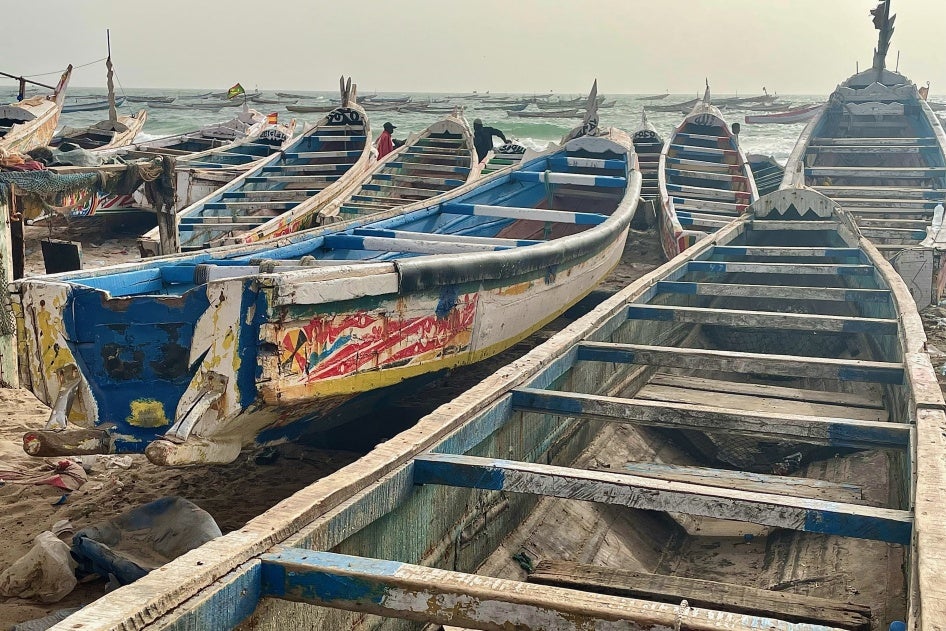
- Pirogue – A wooden dugout canoe, traditionally used for fishing in West Africa, also often used for cross-Atlantic migration. In Spain, these boats are also referred to as cayucos.
- SOPs – Standard Operating Procedures; in this report, referring to Mauritania’s SOPs for rescues/interceptions of migrant boats, disembarkations, and the management of migrants, adopted by the ministries of the interior, defense, and fishing and maritime infrastructure in May 2025, under Joint Regulations No. 00590/2025 and No. 00591/2025.
Europe
- EU – European Union
- Euros (EUR or €) – The EU’s monetary currency (US$1 = ~€1.13).
- EUTF / EUTFA – “EU Emergency Trust Fund for stability and addressing root causes of irregular migration and displaced persons in Africa” (EU Trust Fund for Africa): an EU external financial support instrument, active 2015-2021.
- Frontex – The European Border and Coast Guard Agency: an EU agency established in 2004 that manages the EU's external borders and fights cross-border crime.
- NDICI – EU Neighbourhood, Development and International Cooperation Instrument: an EU external financial support instrument, active since 2021.
Recommendations
To the Government of Mauritania
Increase training, monitoring and oversight of security forces responsible for border control and immigration enforcement, particularly the police, coast guard, and gendarmerie, with a view to combatting corruption and racism, preventing human rights violations against migrants, and ensuring accountability. In particular:
Establish independent oversight mechanisms to investigate alleged violations by security forces and to monitor deportations.
Ensure implementation of complaint mechanisms for migrants (as provided for in Joint Regulation No. 00591/2025 on Standard Operating Procedures for the Disembarkation and Management of Migrants) in all detention/reception centers and not just the two new reception centers for disembarked migrants (Centres d’Accueil Temporaire des Étrangers, CATEs); and ensure that migrants are protected from reprisals.
Create institutional mechanisms for accountability for abuse by guards or other authorities in detention facilities. This should include not only the complaint mechanisms for migrants, but also disciplinary measures, removal of staff in case of proven, serious wrongdoing, and, where appropriate, prosecution for wrongdoing, with respect to migrant holding centers, prisons, and other detention facilities.
Ensure victims of human rights violations have access to effective remedies, including access to complaint mechanisms against security forces and the possibility to participate in a transparent judicial process against perpetrators.
On deportations and border expulsions:
Cease collective expulsions of migrants and ensure individual case reviews and formal communication of deportation decisions, allowing people to appeal these decisions.
In light of the insecurity in Mali, temporarily halt all expulsions to Mali’s land borders.
Liaise with embassies and consulates to ensure deportations are conducted humanely and safely, with respect for due process rights and the principle of nonrefoulement, ensuring that third-country nationals are not left stranded in Mali or Senegal.
On immigration detention:
Halt all immigration-related detention of children, and foreign nationals with international protection needs or valid legal status in Mauritania. Ensure that all unaccompanied or separated migrant children (under age 18) receive appropriate care and protection through the family ministry, IOM, or other specialized services.
Ensure adequate budgeting for food, maintenance, healthcare and other needs.
Explore and implement alternatives to immigration detention, such as open reception facilities or community-based case management.
Ensure implementation by all relevant authorities, including all maritime security forces, of the standard operating procedures adopted in 2025 for migrant boat rescues, interceptions, and disembarkations, to ensure systematic medical and protection screenings of disembarked people.
Enable the National Authority for Countering Human Trafficking and Migrant Smuggling (INLCTPTM) to offer legal aid not only to trafficking victims, but to 1) migrants who are victims of smuggling-related abuses, and 2) foreign nationals accused of migrant smuggling who do not have state-provided lawyers.
Align migration management and border control practices with obligations and standards set out in the African Charter on Human and Peoples’ Rights, the African Charter on the Rights and Welfare of the Child (ACRWC), the AU Migration Policy Framework, and AU Guiding Principles on the Human Rights of All Migrants, Refugees, and Asylum Seekers.
To the Ministries of the Interior, Defense, and Fishing and Maritime Infrastructure
Instruct all security forces involved in border control or immigration enforcement, particularly the police, coast guard, and gendarmerie, to cease all violence, racial profiling, arbitrary detention, extortion, and other abuses against migrants in Mauritania, making clear that those responsible for violations will be held to account. Instruct personnel to return all documents, money, and belongings to foreign nationals upon their release from custody or prior to deportation.
Instruct police and other security officers to check individuals’ identity or immigration documents prior to any immigration-related arrests and to release all asylum seekers, refugees, or others with valid legal status in Mauritania, whether or not they are suspected of “preparing” to depart irregularly, which is not a lawful basis for arrest.
Ensure access to the UN refugee agency (UNHCR) and refugee status determination procedures for any foreign national expressing fears of return to their country.
Improve conditions of detention and ensure detained people are treated in accordance with human rights standards, including by enforcing the prohibition on torture or inhuman and degrading treatment and providing adequate food, water, sanitation, mattresses, mosquito nets, and medical care.
To Maritime Security Forces (Coast Guard, Navy, and Gendarmerie)
Implement the national standard operating procedures adopted in May 2025 for maritime search-and-rescue and migrant boat disembarkations, including by informing relevant services and agencies (IOM, UNHCR, the Mauritanian Red Crescent, health and family ministries, and others) of all intercepted, rescued, or shipwrecked migrant boats, regardless of location; ensuring that disembarked people are screened for medical and protection needs and provided immediate humanitarian aid; and ensuring that all unaccompanied or separated migrant children (under 18) receive appropriate protection and care through the family ministry, IOM, or other suitable agencies.
Redirect resources and personnel to prioritize search-and-rescue of vessels in distress in the Atlantic rather than interceptions and forced returns of boats carrying migrants.
To the Ministries of Justice and the Interior
Ensure individual case assessments, with appearances before a judge, for anyone administratively detained for immigration purposes, to prevent arbitrary detention or expulsion.
Uphold due process rights for anyone detained or prosecuted for immigration reasons or migrant smuggling, including by ensuring interpretation during legal proceedings; communicating case decisions formally, in a language the individual understands; ensuring access to legal counsel for anyone charged with a crime; and allowing people to appeal case decisions (including deportation).
Publicly clarify the mandate of the new Special Court for Countering Slavery, Human Trafficking, and Migrant Smuggling, and ensure that its role does not include penalizing migrants for irregular entry, stay, or exit. Publish regular public reports on the Court’s cases and rulings.
To the Government of Spain
Cease joint border/migration control operations with Mauritanian security forces focused on migrant interceptions and arrests.
Redirect Spanish security personnel (police and civil guard) in Mauritania to focus solely on maritime search-and-rescue, protection, and human rights trainings.
Instruct Spanish entities rescuing migrant boats in the Atlantic (Spanish Civil Guard, Salvamento Marítimo, or others) not to disembark migrants and asylum seekers in their known or presumed countries of origin, given the impossibility of fairly assessing nationalities and protection concerns while at sea.
Effectively monitor implementation of Mauritania’s new 2025 standard operating procedures on migrant boat disembarkations to assess consistent respect for human rights, so that a credible determination can be made: 1) whether there is a risk that migrants or asylum seekers will be exposed to inhuman or degrading treatment incompatible with article 3 of the European Convention on Human Rights; and 2) if Mauritania can be deemed a “place of safety” under international law for disembarkations of rescued migrants or asylum seekers.
Increase search-and-rescue capacity along the Atlantic Route commensurate with the need and in compliance with international maritime, human rights and refugee law, which require disembarkation in a place of safety including protection from exposure to inhuman and degrading treatment or persecution.
To the European Union, including the European Commission and Member States
Set out specific and public criteria on which the suspension of contracts in the implementation of EU-funded projects on border control and migration management in Mauritania would be based in response to human rights violations, particularly with respect to the provision of funding, equipment, or technical support to Mauritanian security forces. EU member states, including Spain, should also take these steps for bilaterally-funded projects in Mauritania.
Ensure that no EU projects or funding in Mauritania or immigration/visa benefits are tied to quotas of migrant boat interceptions or arrests of smugglers or irregular migrants, and ensure that these are never used as project indicators, given that this would increase incentives for arbitrary arrests.
End conditionality of development aid on migration cooperation, and remove migration-control objectives from development or humanitarian projects.
Conduct human rights impact assessments for all EU-funded projects (in Mauritania and elsewhere) prior to implementation, including through consultations with civil society groups in countries of origin and transit (including in Mauritania, Mali, and Senegal). Ensure continued human rights due diligence monitoring of all funding and projects. Make assessments and monitoring reports public.
Increase transparency of EU foreign aid disbursement in Mauritania and globally: make detailed budgets and information on institutions/organizations involved publicly available and accessible; create web pages that clearly lay out all EU funding streams/instruments and projects in every third (non-EU) country.
Reduce EU and bilateral (EU member state) deterrence and securitization approaches to migration policy in Mauritania and across Africa, and increase support to:
Search-and-rescue operations in the Atlantic with disembarkation in places of safety within the meaning of international maritime, human rights, and refugee law;
Human rights and protection, including support to groups and associations providing aid to migrants in Mauritania, Mali (particularly in Kayes region and Bamako), and Senegal (particularly in Rosso);
Locally designed and managed projects in Mauritania and other African countries focused on development, job creation, and reintegration support for returned migrants;
Humanitarian aid in Spain’s Canary Islands for migrants and asylum seekers;
Development of more equitable visa regimes (by EU member states), increased legal pathways to EU countries for migration and for international protection, and improved accessibility of these pathways (e.g. reduced fees, simplified requirements, and awareness-raising about processes); and,
In Mauritania and other North African countries:
Migrant regularization services and programs;
Legal aid services for migrants;
Independent, rights-focused monitoring of migrant smuggling prosecutions and trials.
To the African Union, including the African Union Commission
The African Union Commission should condemn abusive and collective expulsions of migrants; press Mauritania to ensure respect for migrants’ rights; and press African countries to seek to locate and provide assistance to their nationals through their diplomatic missions.
Establish an AU-led independent investigation into collective expulsions and other abuses against African migrants and asylum seekers in and by North African countries, including Mauritania, Morocco, Algeria, Libya, Tunisia, and Egypt.
Mandate the African Commission on Human and Peoples’ Rights and the AU Mechanism for Police Reform to investigate the impact of border security arrangements on migrants’ rights.
Promote regional cooperation on human rights-based migration governance, including by reviving and strengthening regional coordination through ECOWAS and the AU Horn of Africa Initiative on Migration, to ensure any migration agreements respect continental human rights standards.
Monitor and address the human rights impact of the externalization of border controls in Africa. Urge member states to ensure that migration-related agreements with external partners (e.g. the EU, EU member states, and the UK) do not undermine AU human rights obligations or continental free movement aspirations, as outlined in the AU Protocol on Free Movement of Persons.
Establish an AU-EU civil society dialogue mechanism (or support/expand any such existing mechanism), with representation from the AU Commission and human rights mechanisms (ACHPR, ACERWC) as well as civil society, to monitor the human rights impact of migration cooperation between African states and the EU or EU member states.
To the African Commission on Human and Peoples’ Rights (ACHPR)
Engage with Mauritania under its State reporting obligations. Request an update from Mauritania under Article 62 of the African Charter, focusing on the treatment of migrants and the implementation of safeguards against torture and arbitrary detention.
Use Special Mechanisms to respond to violations of migrants’ rights in Mauritania. The Special Rapporteur on Refugees, Asylum Seekers, Internally Displaced Persons and Migrants, and the Special Rapporteur on Prisons, Conditions of Detention and Policing in Africa, should issue appeals to the Mauritanian government and conduct a country visit to assess detention conditions and other abuses in line with their mandates.
To the African Committee of Experts on the Rights and Welfare of the Child (ACERWC)
Investigate child rights violations in the context of migration control across Africa. In Mauritania, initiate an inquiry under Article 45 of the ACRWC into the current situation with respect to the detention of migrant children, age-sensitive screening mechanisms, and expulsions of children/minors.
Issue recommendations to protect child migrants and asylum seekers. Recommend a moratorium on child immigration detention, the establishment of child protection units in all detention centers, and the implementation of child-sensitive migration screening and referral procedures.
Methodology
This report is based on interviews conducted between November 2020 and June 2025 by phone and during visits to Mauritania in June 2022 and August-September 2023 (to Nouakchott and Nouadhibou); Mali in November 2022 (Bamako); Senegal in November 2022 and August 2023 (Dakar, Saint-Louis, Rosso, Mbour, Nianing, Lompoul, and Kayar); and Belgium in April 2023 (Brussels). Others from Mali’s towns of Gogui, Nioro du Sahel, and Kayes were interviewed by phone. The researcher visited seven shelters hosting migrants, children, and other vulnerable groups (one in Nouakchott, one in Nouadhibou, five in Bamako) and three detention facilities (Dar Naïm Prison in Nouakchott, and immigration detention centers in Nouakchott and Nouadhibou). The researcher also attended three European Parliament human rights committee meetings in 2023 related to EU initiatives and policies in Mauritania and West Africa.
Human Rights Watch interviewed 223 people, including 102 current or former migrants and asylum seekers (92 migrants, 3 asylum seekers, and 7 migrant community leaders in Mauritania), of whom 84 were men, 11 were women, and 7 were boys aged 13-17; nationalities included 41 Senegalese, 25 Malians, 14 Guineans, 9 Sierra Leoneans, 5 Cameroonians, 2 Gambians, 2 Liberians, 2 Togolese, 1 Nigerien, and 1 Ivorian. We also interviewed 20 government officials (16 in Mauritania, 3 in Senegal, 1 in Mali); 3 officials from Mauritanian independent human rights mechanisms; 20 UN officials (10 in Mauritania, 5 in Senegal, 5 in Mali); 10 EU officials; 1 representative of the Spanish international cooperation foundation FIIAPP; 52 members of 31 non-governmental organizations, associations, or other civil society groups (24 in Mauritania, 12 in Mali, 16 in Senegal); 4 relatives of abuse victims; a Mauritanian man accused of migrant smuggling; and 10 others including experts, lawyers, diplomats, and community members in Mauritania. We attempted to meet with the Spanish Guardia Civil during our visit to Mauritania in 2023, but the Comandante in Nouakchott was unavailable at the time.
We conducted interviews in French or English, using interpreters for other languages.
Pseudonyms are used in the report for interviewees involved in sensitive cases, and we have withheld identifying details for others who faced security concerns or requested confidentiality.
Human Rights Watch informed all interviewees of the purpose of the research and our intention to publish a report with the information gathered. The researcher obtained oral consent for each interview and gave interviewees the opportunity to decline to answer questions. Interviewees did not receive material compensation for speaking with us, but were reimbursed for transport and communications expenses.
Human Rights Watch corroborated accounts where possible by obtaining evidence such as photos, videos, and documentation – court, identity, or asylum papers – and additional testimony from relatives, witnesses, or others with knowledge of the events.
When describing abuses that took place in Mauritania, interviewees often identified the security service of perpetrators (police, gendarmerie, coast guard, army, navy). However, some could not distinguish the specific service. Several used French terms for “the navy” or “naval officers” to refer generally to maritime security forces, which could include the coast guard or navy (who have similar uniforms) or gendarme maritime brigades.
Human Rights Watch also analyzed hundreds of EU and Spanish government documents and online content, as well as third-party reports and articles relating to European externalization in Africa and to EU or Spanish projects, agreements, and initiatives in Mauritania and West Africa.
Human Rights Watch sent letters on July 1, 2025 to authorities named in this report – the European Commission (DGs HOME, INTPA, and MENA), the Spanish government, and the Mauritanian government – presenting our findings, seeking responses, and posing questions, with assurances that answers would be reflected in the final report. Human Rights Watch received replies from the Mauritanian government on July 16 and the European Commission on July 17. Elements of these responses have been integrated into the report. No reply was received from the Spanish government.
I. Background and Current Context
Mauritania, with a population of just 5 million, has the 11th largest territory in Africa.[4] It borders the Atlantic Ocean to the west, with 754 kilometers of coastline,[5] Senegal to the south, Western Sahara to the north, Algeria to the northeast, and Mali to the east and southeast.
Arab and Berber tribes migrated to the territory that is now Mauritania in the late seventh century, bringing Islam, Arab culture, and the Arabic language. Following French colonization in the early 20th century and independence in 1960, Mauritania experienced recurrent coups and periods of military dictatorship. Its current presidential system has been in effect since 2009; however, the military still wields significant influence, and power is concentrated in the executive branch.[6]
Though culturally and politically part of the Arab world, Mauritania is multiethnic. Around 30 percent of the population are Beidan (“White Moors” of Arab-Amazigh/Berber descent), who predominate in higher levels of government, the armed forces, commerce, and business elite; 45 percent are Haratines (“Black Moors”), descendants of historically enslaved communities; 25 percent are other ethnic groups of West African origin.[7] The Beidan and Haratines speak the local Arabic dialect known as Hassaniya, while Afro-Mauritanians largely speak Fula, Wolof, and Soninké. Black Mauritanians (Afro-Mauritanian and Haratine communities) are more represented in the country’s manual labor, domestic work, fishing, and transportation sectors.[8] European colonization deepened Mauritania’s societal divides, as scholars have noted: “the French colonial administration codified tribal hierarchies by relying on tribal leaders as local relays, marginalizing the Haratines…and Afro-Mauritanians.”[9]
In 1981, Mauritania became the last country in the world to formally abolish slavery, criminalizing it in 2007.[10] Some Haratine and Afro-Mauritanian people remain exposed to hereditary slavery practices such as forced labor.[11] The government has taken steps to combat this and address ethnic disparities in government. However, racial divides and discrimination continue to impact Black Mauritanians and migrants in Mauritania, exacerbated by corruption and impunity within the predominantly Beidan-controlled security forces.[12]
As noted by Dr. Hassan Ould Moctar, an expert on migration and development in Mauritania, “the policing of migrants in Mauritania often dovetails with a broader social marginalisation of disenfranchised groups.” Police operations targeting irregular migrants, he said, “can involve harassment, detention and threats of deportation made against [Afro-Mauritanian and Haratine] communities as well,” as these groups often reside in the same neighborhoods, and racial and ethnic profiling persists in immigration enforcement.[13]
In addition to racial tensions and migration pressures, Mauritania has faced challenges of widespread poverty[14] and the threat of violent extremism, with non-state armed groups active in nearby Sahel countries.[15] Reports have also highlighted issues including government corruption, arbitrary arrests and detention, unlawful killings, harsh and life-threatening prison conditions, “extensive” gender-based violence, and violence against lesbian, gay, bisexual, or transgender (LGBT) people.[16]
However, Mauritania is party to numerous international human rights treaties,[17] has participated in global forums on migration and refugees,[18] maintains a government human rights office,[19] and has demonstrated openness to human rights organizations and scrutiny in recent years. Two independent national human rights bodies monitor and investigate a variety of rights issues, including through visits to detention facilities.[20]
Migrants and Refugees in Mauritania
Whether as a transit point for those seeking to reach North Africa or Europe or a destination country for employment, Mauritania has long attracted migrants from south of the Maghreb. Many seek jobs in the fishing and construction sectors, domestic work, or other manual labor. Most work informally, without contracts or residence permits.[21]
Mauritania’s two largest cities and migration hubs are Nouakchott, the capital, and Nouadhibou, its main commercial port, located near Mauritania’s northern border with Western Sahara. In September 2024, the Mauritanian interior minister said Nouakchott hosted 130,000 migrants, which he termed “frightening.”[22]
In recent years, the deteriorating security context across the Sahel, combined with the climate crisis and food insecurity, has fueled regional displacement (around 5 million people by late 2024) and contributed to movements to and through Mauritania.[23] Mali, Burkina Faso, and Niger have faced ongoing conflicts, widespread violence, military-led coups, and government crackdowns in recent years.[24]
Mauritania has received tens of thousands of refugees from neighboring Mali since 2012, with the number increasing from 2023 to 2024 due to worsening instability there.[25] The UN refugee agency, UNHCR, estimated there were 280,222 registered and unregistered refugees and asylum seekers in Mauritania as of November 2024.[26] As of May 2025, 176,152 were officially registered – mostly Malians (172,401), Guineans (563), Senegalese (496), Central Africans (415), and Syrians (379).[27] Over 159,000 registered refugees were located in Mauritania’s Hodh Chargui region bordering Mali, which hosts Mbera refugee camp, while the urban refugee and asylum seeker population included over 7,300 in Nouakchott and 2,600 in Nouadhibou in May 2025 – down from 13,000 and 4,000, respectively, in late 2024.[28]
Reactivation of the “Atlantic Route”
The “Atlantic Route” to Spain’s Canary Islands, also known as the “Northwest African Route,” encompasses boat departures from Morocco, Moroccan-occupied territory in Western Sahara, Mauritania, Senegal, and to a lesser extent, The Gambia. Sea crossings range from 100 kilometers (around a 24-hour journey) at the closest points from Morocco and Western Sahara, up to 1,700 kilometers from Senegal or The Gambia (often 5 to 11 days at sea for small boats). From Mauritania, boats can take up to 7 to 10 days to reach the Canaries.[29]
Those traveling from Mauritania, Senegal, and The Gambia often make the journey in “pirogues,” wooden dugout canoes traditionally used for fishing, with the largest able to hold more than 100 passengers. Due to the long distances, rough waters, and fragility of boats, the Atlantic Route is one of the world’s deadliest migration routes.[30]
From the 1990s to early 2000s, smaller numbers of Africans attempted this route. Crossings gradually increased, peaking at 31,678 arrivals in the Canaries in 2006.[31] The initial EU response included boat patrols and aerial deployments off West African coasts by the Spanish and Frontex, collaborating with African forces to intercept or rescue boats.[32] Arrivals to the Canaries decreased in the years after 2006, while other routes to Europe, notably the Central Mediterranean, saw increased movement.[33]
Since around 2018, movement along the Atlantic Route began to increase again: following around 4,000 arrivals to the Canaries in 2018 and 2019 combined,[34] over 23,000 arrived in 2020,[35] while 850 to 1,854 died or disappeared at sea.[36] After slight decreases in 2021 and 2022, the numbers rose again, reaching new records: 39,910 arrivals in 2023 and 46,910 in 2024,[37] with 1,652 to 15,764 dead or missing.[38]
Over this period, the Atlantic Route became “one of the busiest irregular migration routes to Europe.”[39] In total, over 147,000 people crossed between 2020 and 2024, while an estimated 4,100 to 23,400 people lost their lives at sea.[40] The majority of boat departures from 2020 to 2022 set off from Morocco and Western Sahara. Following Morocco’s renewed cooperation with Spain and toughened migration controls since 2022, departures shifted south, with boats increasingly leaving from Senegal in 2023 and increasingly from Mauritania in 2024.[41] Moroccan, Mauritanian, and Senegalese authorities continued to intercept or rescue boats, with support from the EU and Spain.
During the first half of 2025, around 11,300 migrants and asylum seekers arrived in the Canaries, and between 200 and 1,482 people died or disappeared at sea.[42]
Many migrants departing from Mauritania rely on smuggling networks that frequently include Mauritanians, Malians, and Senegalese in various roles. Mauritanian nationals often “manage relationships with local authorities,” which can involve complicity from Mauritanian security services.[43] Due to the prevalence of the fishing industry in Senegal, Senegalese fishermen with navigation experience often steer boats departing from Senegal or Mauritania, often receiving free passage in exchange. Though these individuals are usually migrants themselves, Mauritanian, Senegalese, and Spanish law enforcement refer to them as “captains,” often prosecuting them and others for complicity in smuggling. Smuggling network bosses are rarely caught.[44]
Drivers of Migration to Spain’s Canary Islands
People migrating or fleeing by boat to the Canaries have done so for a variety of reasons. Between 2020 and 2024, the top five countries of origin for all migrants and asylum seekers arriving at Spain’s Canaries were Morocco (around 35,800 people), Senegal (32,000), Mali (22,700), Guinea (7,400), and The Gambia (7,300).[45] However, arrivals of these groups fluctuated by year. Moroccans were the most numerous from 2020 to 2022, reportedly for economic reasons linked to the Covid-19 pandemic combined with movement restrictions blocking the Mediterranean route.[46] Senegalese outnumbered others in 2023, largely due to unrest leading up to the 2024 presidential election and frustrations with poverty and unemployment, particularly among youth and fishermen. The latter often cited the problem of overfishing by European and Chinese vessels in Senegalese waters.[47] In 2024 and early 2025, Malian arrivals surpassed others due to the country’s deteriorating security situation, overlapping with government repression and economic and environmental pressures.[48] As for Mauritanians, less than 4,000 arrived between 2020 and 2024; most – over 3,000 – in 2024, the year of Mauritania’s presidential election. Others departing from Mauritania have largely been nationals of various other West and Central African countries.[49]
With multiple countries in the region facing insecurity, political instability, and government repression, some of those attempting the Atlantic Route are asylum seekers or others in need of international protection, including people fleeing because they fear persecution, torture, widespread violence, human rights violations, or other threats to life. Some may belong to particular social groups at risk. For instance, LGBT people face abuses and criminalization in Mauritania and neighboring countries, including the death penalty.[50] Monitors reported that women and children have increasingly voyaged to the Canaries, including women and girls fleeing risks of female genital mutilation.[51]
Poverty and a perceived lack of economic opportunities have been among the top drivers of African migration to the Canaries, with many hoping to move onward to mainland Spain or elsewhere in Europe to find work. Economic pressures in West and Central Africa were worsened by the Covid-19 pandemic in 2020 and global inflation exacerbated by Russia’s 2022 invasion of Ukraine. The ongoing impacts of climate change, including reduced harvest yields, also play a role.[52]
Another factor for irregular migration has been the limited availability of safe, legal, and orderly migration pathways to Europe. According to UN surveys of people arriving in the Canaries, many “not only considered migrating regularly, but… tried multiple times to obtain the required documentation and submit applications” for EU visas; however, “requirements for applicants holding an African passport are demanding,” and many were not able to meet financial or sponsorship requirements.[53] A 2024 report found that African countries accounted for 7 of the top 10 countries with the highest Schengen visa rejection rates in 2022, of which 6 were West African.[54] In 2022, 30 percent of African applicants were rejected, compared to 17.5 percent of global applicants.[55] Schengen visa refusals in 2023 cost African nationals US$61 million in application fees, which were not reimbursed – another frustration pushing people to irregular routes.[56] Avenues to international protection outside Africa are also limited, despite dire humanitarian conditions or protection concerns facing many displaced within Africa. Most European countries resettle limited numbers of recognized refugees,[57] and many only accept asylum applications from people physically at or within their borders.
Many Africans from south of the Maghreb migrate to Mauritania or other North African countries for seasonal or other work without intending to go to Europe. However, some reported that discrimination and exploitative living and working conditions in North African countries, or harsh migration-control measures, fueled their decision to journey to the Canaries.[58] In Mauritania, migrant workers have faced delays in salary payments, sexual harassment, and other abuse by employers.[59]
Regularization has been difficult for migrant workers in Mauritania, particularly those on lower socio-economic rungs. During the decade prior to 2022, applying for a Mauritanian residency permit required employment and housing contracts and fees that many could not afford.[60] In 2022, the Mauritanian government organized a regularization campaign from July to November during which irregular migrants could apply for a residence permit free of charge. According to an interior ministry official, the government also “reduced the number of documents required, to encourage people to regularize,” and around 136,000 migrants regularized their status during the campaign.[61] While these were positive steps, residence permits were valid for one year only. Post-2022, migrants and a UN official highlighted the problematic “informality” of the system, with shifting requirements, procedures, or fees rarely detailed in writing.[62]
Abuses by security forces, as well obstacles to asylum and protection in Mauritania, may also contribute to irregular migration to the Canaries.
Mauritanian Laws on Asylum, Immigration, and Smuggling
Mauritania is party to the 1951 UN and 1969 African refugee conventions, and a 2022 decree (replacing a 2005 decree) provides for asylum in Mauritania, implementing both conventions.[63] In a positive step, the 2022 decree created a new category of “persons to protect” (complementary protection) to include “those at risk of torture or inhuman treatment in their country.”[64] Mauritania has an open-door policy towards refugees and asylum seekers and pledged at the 2020 and 2023 Global Refugee Forums to develop a national asylum law, provide refugees access to the labor market and social protection services on par with nationals, and include them in national health and education systems.[65] However, no national asylum law or system was in place by late 2024, and UNHCR continued to conduct refugee status determination.[66] Both UNHCR and the government issue refugee documentation.[67]
While UNHCR-registered refugees and asylum seekers legally enjoy freedom of movement in Mauritania, some still experience arbitrary arrest, detention, and expulsion. Additionally, “people who may have an asylum case to make” but are not registered with UNHCR “are often…detained and deported” in roundups of irregular migrants.[68] Authorities have generally granted UNHCR access to detained people upon request, but have not regularly and systematically ensured protection screenings in migrant detention facilities.[69]
Immigration laws and regulations: Mauritania’s immigration legislation dates to a 1964 decree and 1965 law criminalizing irregular entry and stay, irregular exit for certain categories of foreigners, and related offenses.[70] However, during the key research for this report between 2020 and 2024, migrants were generally not prosecuted in Mauritania for irregular entry, stay, or exit; most were detained and rapidly expelled without legal procedures.
In late 2024, Mauritania amended the 1965 immigration penalties law.[71] The original law already established penalties for irregular entry or stay as well as provision of “aid and assistance” to people entering or staying irregularly, including 2-6 months’ imprisonment and/or a fine.[72] The amended law (Law 2024-038 on immigration penalties) added reference to expulsion: “any foreigner who commits one of the offenses…is automatically expelled from the national territory,” with a ban on return for 1-10 years.[73] However, as Law 2024-038 addresses only irregular entry or stay, not irregular exit, its reference to expulsion should not be interpreted as applying to those who attempt to leave irregularly, such as boat departures or land border crossings outside of authorized entry points. A 2025 regulation further stated that “the expulsion of irregular migrants constitutes an administrative act, not subject to appeal.”[74]
In the 1964 immigration decree, irregular exit from Mauritanian territory is addressed only partially: certain categories, including “privileged immigrant foreigners” – those from counties with which Mauritania has had bilateral agreements (see below) – should not be penalized for leaving irregularly if their entry and stay up to that point was regular. Mauritanian law does not criminalize the irregular exit of Mauritanian nationals, nor the attempt by any person to depart irregularly from Mauritania. However, acts deemed to constitute assisting people to prepare for an irregular exit are often considered in Mauritania to fall in the scope of smuggling, addressed below.[75]
Mauritania withdrew from the Economic Community of West African States (ECOWAS) in 2000, so regional free movement protocols do not apply. However, bilateral agreements with Senegal, Mali, and The Gambia have, at least through 2024, permitted these nationals to enter and reside in Mauritania visa-free for up to three months, renewable.[76] A May 2025 Mauritania-Senegal agreement established a new requirement for Senegalese to apply for a residency permit after three months, with simplified procedures.[77] According to a Mauritanian government website, as of January 2025, mutual visa exemption agreements also existed with several other West African countries.[78]
Anti-smuggling and trafficking laws: Mauritania is a party to the 2020 UN Convention Against Transnational Organized Crime and its two protocols on migrant smuggling and human trafficking.[79] A 2020 law prohibits human trafficking,[80] while a 2010 law amended in 2020 criminalizes migrant smuggling, facilitating irregular stay, and related acts, as well as attempts or complicity, with penalties of 5 to 10 years imprisonment and fines.[81] A new law in late 2024 created a Special Court for Countering Slavery, Human Trafficking, and Migrant Smuggling, a “first degree” court in Nouakchott intended to focus on the aforementioned crimes and “related offences.”[82]
The establishment of the Special Court in 2024, the amended immigration penalties law with the addition of expulsion for immigration offenses, and increased government crackdowns on irregular migration were likely triggered by the 2024 EU-Mauritania agreement, according to a UN official, a Guinean migrant community representative, a migration expert, and an NGO worker providing legal aid to migrants in Mauritania.[83]
Migration and Border Control Forces
In Mauritania, multiple security forces are involved in migration and border management. These include the police (under the interior ministry); the coast guard (under the Ministry of Fisheries, Maritime and Port Infrastructure); and the navy and the gendarmerie (under the defense ministry). The coast guard, navy, and the maritime brigade of the gendarmerie operate at sea and may carry out rescues or interceptions of boats, though most are performed by the coast guard. Additionally, the Spanish have maintained an extraterritorial deployment of Civil Guard and police in Mauritania since the early 2000s, supporting Mauritanian authorities in border control and counter-smuggling.[84] Both the gendarmerie and police operate border posts, conduct counter-smuggling operations, and make immigration-related arrests. According to a police official, Mauritania had 53 border posts – 33 run by police and 20 by gendarmes – as of August 2023.[85]
The Mauritanian police are most involved in migration control, notably the Territorial Surveillance Directorate (Direction de la Surveillance du Térritoire, DST), also known for a time as the Air and Border Police Directorate (Direction de la Police de l’Air et des Frontières, DPAF), with its Central Office for the Suppression of Migrant Smuggling and Human Trafficking, established in 2021.[86] DST/DPAF is responsible for border surveillance; issuing passports, visas, and residence permits; counter-smuggling; immigration detention; and expulsions.[87] Police from other directorates (e.g. public security) may also carry out document checks and arrest migrants or suspected smugglers. In many such cases, people have been brought to police stations rather than immigration detention.
The gendarmerie, which has both law enforcement and national security responsibilities, carries out missions for operational territorial defense, road control, internal security, and control of irregular migration. It includes two maritime brigades, operating in Mauritanian waters through periodic joint patrols with the Spanish Civil Guard,[88] and three rapid action (“GAR-SI”) units for territorial and border control, established with EU funding.[89]
The coast guard, established in 2013, is responsible for surveillance and control of fishing activities; countering irregular migration at sea, smuggling, and terrorism; and search and rescue in Mauritanian territorial waters.[90] The navy, operating in Mauritanian and international waters, focuses primarily on security rather than border control; however, navy ships may rescue boats in distress or intercept migrant boats.[91]
Immigration Detention Facilities
Between 2020 and 2024, Mauritanian authorities largely used three police-run centers for the administrative detention of migrants: one in Le Ksar district of Nouakchott; one at the regional police directorate in Nouadhibou; the third, in Nouakchott’s Bagdad district, closed around 2021. To accommodate the increasing numbers of detained migrants in early 2025, police began using three additional centers in Nouakchott, in the Dar Naïm, Arafat and Sebkha districts.[92] As of July 2025, according to the government, the latter three centers were still operating in Nouakchott, along with the center at the Nouadhibou regional police directorate (which was undergoing “redevelopment” to improve conditions); the government said the Ksar center was “no longer used as a main detention center” and was “being renovated to meet the updated standards defined by the Standard Operating Procedures (SOPs) adopted in 2025.”[93]
Additionally, an EU-funded project, completed in 2024, renovated a facility in Nouakchott (reportedly the former Bagdad center) and another former center in Nouadhibou; the government said these “Centers for the Temporary Reception of Foreigners” (Centres d’Accueil Temporaire des Étrangers, CATEs), scheduled to open in September 2025, would be “reserved for the reception of smuggled migrants disembarked as part of maritime rescue or interception operations,” and “irregular migrants arrested as part of routine checks throughout the country will not be hosted in these centers.” The government said the two CATEs would be jointly managed by the police; the Mauritanian Red Crescent, “for medical screening, food and hygiene”; the National Authority for Countering Human Trafficking and Migrant Smuggling (Instance Nationale de lutte contre la traite des personnes et le trafic de migrants, INLCTPTM), under the government’s human rights office, for “protection of and assistance to victims”; and the National Human Rights Commission (Commission Nationale des Droits de l’Homme, CNDH), to ensure “independent monitoring” and operate a “complaints mechanism” for migrants.[94]
Positive Steps and Persistent Issues
The Mauritanian government has taken multiple positive steps with respect to refugee and migrant rights since 2020. These include:
Increased openness to human rights monitoring, including by allowing Human Rights Watch and independent national mechanisms such as the CNDH to visit immigration detention centers, with CNDH formally “empowered to conduct assessment missions and continuously monitor respect for human rights throughout the migration process”;[95]
The 2022 migrant regularization campaign;
The complementary protection provision in the 2022 asylum decree;
Increased police collaboration and information-sharing with migrant community leaders regarding migrants in detention since 2023;[96]
Increased referrals of unaccompanied migrant children to protective services;[97]
Efforts to assist trafficking victims by the INLCTPTM since it began operating in 2023;[98]
The development and partial implementation during 2021-2024, and official national adoption in May 2025, of standard operating procedures (SOPs) for migrant boat rescues/interceptions, disembarkations, and the management of migrants, which outline steps to address migrants’ medical and protection needs and ensure respect for rights;[99] and,
The reported May 2025 decision by the Higher Committee for Justice Reform to establish a team of interpreters and translators within the courts, which will help reduce language barriers for foreigners.[100]
The government’s July 2025 letter to Human Rights Watch also highlighted other steps taken or in progress to improve respect for migrants’ rights. These include “systematic and mandatory training of law enforcement and security forces” on international law, including the prohibition of torture and “techniques for detecting and protecting vulnerable people”; ongoing modifications to improve conditions in migrant detention centers; reported adherence to a 72-hour maximum for administrative detention; and “implementation of monitoring and transparency systems.” According to the government, these monitoring systems have included or will include, among others: surveillance cameras in detention centers and at boat disembarkation points; “guaranteed and systematic access for international organizations (UNHCR, IOM, ICRC) and the National Human Rights Commission (CNDH) in all places of detention”; a 24-hour hotline to report abuses, managed by the INLCTPTM; and a complaints mechanism for migrants, operated by the INLCTPTM or CNDH. The government did not specify if the complaints mechanism would be implemented in all immigration detention centers, or only in two new centers for disembarked migrants (the CATEs).[101]
With respect to expulsions, the government said that it had strengthened procedural safeguards since mid-2025, including “mandatory individual assessments before any expulsion decision”; a ban on collective expulsions or expulsions of unaccompanied children; and a planned administrative appeal mechanism that could allow migrants to challenge their deportation.[102]
Human Rights Watch recognizes and welcomes these efforts by Mauritanian authorities. However, the long duration, scale, and severity of the human rights violations against migrants and others in Mauritania documented in this report, including abuses in 2025, underscore the need for further, sustained action to address persistent issues.
II. Abuse, Detention, and Exploitation
Mauritanian security forces have committed numerous human rights violations against Black African migrants and asylum seekers – and in some cases against Black Mauritanian nationals – during immigration enforcement, border control, and counter-smuggling operations. Authorities have also frequently exploited migrants, highlighting the widespread corruption among the security forces, particularly the police.
Human Rights Watch interviewed 78 victims of violations in Mauritania: 77 people from Senegal, Mali, Guinea, Sierra Leonea, Cameroon, and Liberia, and one Mauritanian. Based on victims’ accounts, as well as interviews with witnesses and sources with knowledge of other cases, Human Rights Watch documented cases of violence and other physical abuse against at least 43 people, including the alleged torture of 5 people and alleged rape of 9 people. We also documented 62 cases of arbitrary arrest and/or detention; recurring inhumane conditions of detention; 30 cases of extortion; and 11 cases of confiscation of money or valuables. This chapter focuses on violations taking place on land during encounters with authorities, arrests, or detention.[103]
The findings also highlight that adolescent migrant children have faced violence, detention with unrelated adults, and other mistreatment including insufficient food in detention. Additionally, seven people said Spanish officers were present during their arrest or detention by Mauritanian police, mainly in Nouakchott and Nouadhibou; at least six of these cases involved human rights violations by Mauritanian authorities.[104]
While most documented abuses were committed by Mauritanian police, perpetrators in some cases included members of the coast guard, navy, gendarmerie, and in one case, army. Other than four documented cases between 2017 and 2019, the documented abuses took place between 2020 and early 2025, in a variety of locations – most commonly in Nouakchott, Nouadhibou, or in the desert close to Nouadhibou near Mauritania’s northern border with Western Sahara, where one official crossing point is controlled by Moroccan authorities.
All the victims interviewed were Black, and many claimed that racism or xenophobia played a role in their mistreatment by security forces, many of whom were Arabic-speaking Moors, mostly lighter-skinned Beidans, they said. “If you have Black skin, they don’t respect you, they insult you and take your papers,” said a returned migrant in Senegal.[105] “When they see me, a foreigner, it’s like they see something strange or shady,” said a Togolese woman in Nouakchott.[106]
Among the interviewees, 65 people, including 5 children, experienced arrests and/or detention in Mauritania for migration- or smuggling-related reasons (or pretexts); 37 were subsequently expelled. Ten people were intercepted at sea; the others were arrested on land in various cities and other locations. Police made most of the documented arrests, with smaller numbers by other security forces.
According to migrants, community leaders, witnesses, and officials, authorities often targeted migrants based on information or assumptions that they were undocumented or planning irregular departures, sometimes as a pretext for extortion. While police in Nouakchott arrested migrants for a variety of reasons, police in Nouadhibou said they prioritized those preparing for boat departures, caught near the Western Sahara border, or intercepted at sea, but said they generally “don’t search for people with expired visas.”[107]
Out of the 77 foreign nationals interviewed who experienced human rights violations in Mauritania, 3 men were asylum seekers and 74 were migrants (62 men, 6 women, 6 boys), including 19 with regular status, 33 irregular, and others with unknown statuses or special cases.[108] While many had intended to travel to the Canaries, others sought to live and work in Mauritania or transit to Morocco. Some had encountered obstacles to regularization in Mauritania.
Most interviewees experienced detention for between a day and several weeks: 42 were held in police-run immigration detention centers in Nouakchott or Nouadhibou; 26 were detained in police stations,[109] four in gendarme posts, and two in coast guard or navy posts. Five people were held in prisons for provisional detention of six to seven months or sentences of three to five years.
Among the 43 documented cases of violence or other physical abuse, 28 victims were interviewed by Human Rights Watch, while witnesses or other sources reported cases involving at least 15 people. Victims interviewed included 23 men, 4 boys, and 1 woman; 22 experienced violence (beatings or torture) and 6 experienced other forms of mistreatment. Some were transferred between agencies and abused by multiple perpetrators. Police committed most of the abuses; however, victims identified gendarmes in two cases, the coast guard or navy in two cases, and the army in one case. Physical abuse occurred in detention, during expulsions, near the northern border, during arrests or in the streets, and at sea or after disembarkations.
Torture
In June 2022, Human Rights Watch interviewed a 28-year-old Senegalese man in Dar Naïm Prison, where he was serving a sentence for migrant smuggling. The man, who claimed he was falsely accused, said police tortured him during arbitrary detention prior to his official pretrial detention. Around November 2021, he said, he and several Senegalese took a taxi to the beach, planning to set off in a boat: “We were getting ready to go, around 6 or 7 p.m. … the smuggler wasn’t with us. Police in Nouakchott caught us… I spent one month detained [in SNDE district]. I was tortured, beaten by police.”[110]
Human Rights Watch also documented the alleged torture of four people during interrogations related to migrant smuggling in Nouakchott in August 2022. We interviewed three victims (pseudonyms are used for their protection): “Mamadou Baldé” (M.B.), a Black Mauritanian man accused of smuggling; “Kemoh Sesay” (K.S.), a Sierra Leonean man and friend of M.B., living in Nouakchott; and “Dauda Momoh” (D.M.), a 21-year-old Sierra Leonean man arrested for irregular entry, detained, and expelled to Mali.[111] M.B. alleged that a Guinean man was also accused of smuggling and tortured at the same time as him.[112] To corroborate these accounts, Human Rights Watch reviewed photos of M.B.’s injuries and interviewed M.B.’s lawyer; three friends of M.B. and K.S., including two who visited them while in detention; and an aid worker in Mali who assists migrants expelled from Mauritania.[113]
In August 2022, Mauritanian police arrested M.B. in the outskirts of Nouakchott, just after arresting over a dozen Sierra Leonean migrants arriving in Mauritania irregularly, their driver, and the Guinean man.[114] M.B. said he had gone to meet the driver at the request of a Sierra Leonean friend. Officers in two different uniforms, black and khaki, brought the group to Arafat II police station, M.B. said. They questioned the migrants about their journey and reasons for coming: “[Police] asked them if they’d wanted to go to Spain… They said they didn’t come [to Mauritania] to go to Europe, but to work.”[115]
M.B. said the police told him he could be released on bail, so he called his Sierra Leonean friend K.S. “When [K.S.] brought the money, they arrested him and took the money,” M.B. said.[116] K.S. told Human Rights Watch he brought 15,000 MRU (US$375), but “The police didn’t even speak with me, they just arrested me.”[117] They did not release M.B.[118]
M.B. said police tortured him for around three days in Arafat II. The first day, he said five officers, in black and khaki, took him into a private room for an interrogation: “They started to flog me with cables on my back. They slapped my face.” He said the torture continued for about 30 minutes.[119] During the following days, two officers dressed in black tortured him:
They removed my clothes, tied my eyes with my T-shirt… and beat me. …They stood on my back for more than 30 minutes. …They had an electric cable… they shocked me with the current. They said I was helping people to go to Spain. …They said “if you don’t tell the truth, we will shock you...” … I told them I don’t know what they are talking about. After two hours they took me back to my cell.
[On the third day,] the same two guys… forced me back to the room. I refused, and they dragged me… I hurt my knee. …They said, “Tell us the truth and we’ll leave you; you are bringing these people and helping them to go to Spain.”… I said, “No, I don’t know these people… All I know is they are Sierra Leoneans...” They put me on a glass table and put [electric] current on my hand… I fell down, and the table fell and cut my hand. …After, they took me to the National Hospital.[120]
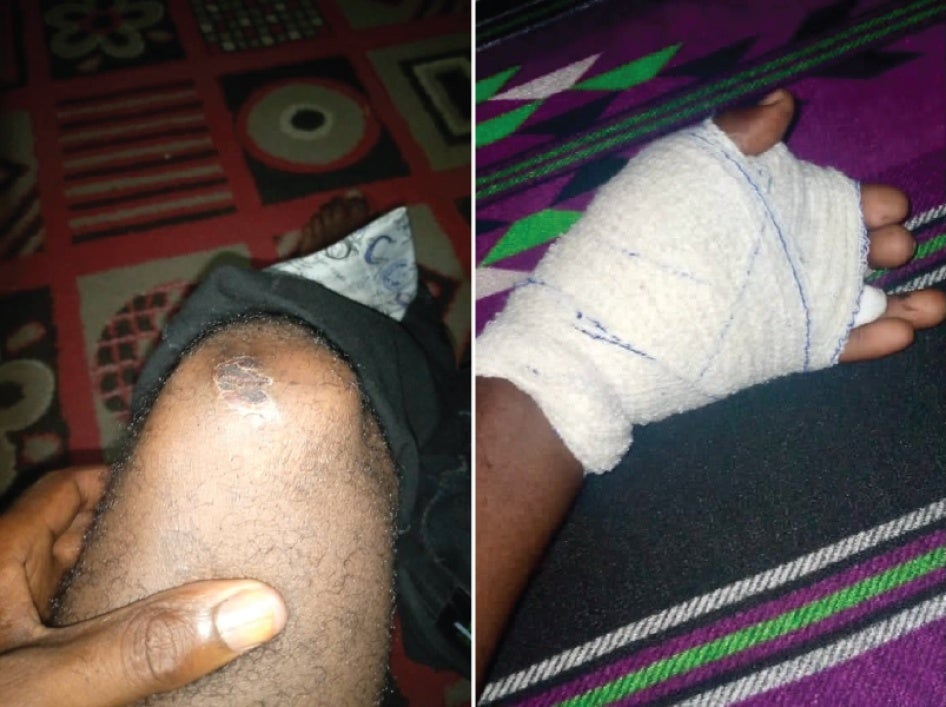
Human Rights Watch reviewed photos showing M.B.’s injured knee and hand before and after it was bandaged. After his treatment, police took him back to the station. “For four days I ate nothing… [The fifth day,] a friend brought me food,” M.B. said. A Mauritanian friend who visited M.B. in detention told Human Rights Watch: “I saw blood on his shirt… I asked, ‘Did they beat you?’ He told me ‘yeah.’”[121] M.B. said police transferred him to Arafat IV station and then finally took him to court, eight days after his arrest. “By then my injuries were more healed, the bandages were gone… At court, the prosecutor said… ‘The police said you are helping people to go to Spain. Are you guilty?’ I said, ‘No.’ He said they were investigating and would release me on bail.” After release, M.B. said he still felt pain in his hand and back from the torture.[122]
M.B.’s Sierrea Leonean friend, K.S., said after he brought the initial “bail money” for M.B. to Arafat II, police detained him (K.S.) for eight days, moving him between two police stations and the Ksar immigration detention center, where he encountered several of the Sierra Leonean migrants. The next day, “They transferred me to another police station, I think in Tevragh Zeyna [district]…. I stayed there for one day... They asked… where I got that money from…[and] if I knew [M.B.].”[123] There, he said:
[Two officers] beat me with a cane… more than 10 times on my back, and on my head once… it could have been 30 minutes or an hour, I don’t know. Blood came in my mouth when they hit my head. …[One] kept saying, “Tell the truth”… I said,…”I am...” They gave me water but no food for a day and a half.[124]
The next day, the police took K.S. back to immigration detention, releasing him after four or five days.[125] A woman who visited K.S. in detention said: “He told me he had been beaten, tortured, deprived of food.”[126] The other Sierra Leoneans were already gone, as police expelled them to Mali shortly after their arrest.[127]
Human Rights Watch traced one of the expelled Sierra Leoneans, D.M., to a shelter in Mali. He confirmed he had seen M.B. and that police had held him in Arafat II station for around two days, where “they beat me… I didn’t understand the language, to know why.” At the immigration detention center, “We were given no food… They hit us a lot.”[128] Staff at the shelter in Mali said they observed “marks of physical abuse on his body.”[129]
Rape and Sexual Harassment
Sources reported cases of rape committed by Mauritanian police against at least nine migrants, eight women and one man, between 2020 and 2022.
A 43-year-old undocumented Senegalese woman who worked at a restaurant in Zouérat told Human Rights Watch in 2022: “A policeman…threatens [migrants] – he says if we don’t give money, he will…send us to be expelled… He also forces women to sleep with him…or [face] deportation.” She named two women who had complied and said others who refused were expelled.[130]
A Senegalese man intercepted at sea by the navy or coast guard in 2020 said the seven women in the group were separated and raped during detention in a navy or coast guard post in Nouadhibou, according to two women he spoke with.[131]
The director of a shelter for migrants in Bamako, Mali, said he received two individuals expelled from Mauritania in 2022 who told him they had been raped. One, a Nigerian man in his early twenties, said he was caught by police near the Mauritania-Western Sahara border, detained at a border post, transferred to detention in Nouadhibou and Nouakchott, and expelled to Mali. “[The man] said two Mauritanian policemen raped him… they sodomized him.” Based on the man’s account, the director estimated the alleged rape occurred around August 2022. He said he had examined the man and observed rectal bleeding. “He cries all the time,” the director said.[132]
The other case involved a 20-year-old Cameroonian woman allegedly raped by police in Nouakchott. As the woman was pregnant from the alleged rape, “almost at term” when the shelter received her in September 2022, the director estimated the rape occurred around January or February: “She was held at the Ksar detention center…in preparation for expulsion. According to her account…, two policeman took her out of the center on a false pretext that she should do some housework… They kept her in [one officer’s] home for two to three days… Both policemen raped her,” he said.[133]
Two other migrants recounted experiences of sexual harassment by police. Khady Sonko, a 23-year-old Senegalese woman, experienced violence, threats of rape, arbitrary detention, and extortion by police in January 2020. She said she had entered Mauritania lawfully, transiting toward Morocco, where she hoped to work. As she neared the Western Sahara border in a group of migrants, Mauritanian police in khaki uniforms stopped them. She said:
Two police officers wanted to sleep with me, but I refused, so they hit me. I was injured on my hand. They gave me a choice – let them rape me, or pay them… I asked my older sister, who sent money by phone. I gave 100,000 CFA [US$180] to an officer. They held us for two hours in a desert area near the border, in some kind of building, maybe a police post. After I paid, they let me go.[134]
A 26-year-old Malian woman living in Nouakchott described sexual harassment by a police officer around May or June 2022. When she saw police about to arrest a Malian man, she tried to negotiate with them: “One of them said ‘OK, we’ll let him go. You get in [the vehicle] and we’ll go to your house, and we will… [have sex].’” She refused.[135]
Other Abuse and Ill-Treatment
Three others also experienced abuses near Mauritania’s northern border. Marco Gibson, a 46-year-old Liberian, said he had entered Mauritania irregularly in December 2024:
We were over 40 [migrants]…heading for the border. …The military captured us – they said they were the Mauritanian army… They said…we had no visa… [and] the manner we entered was improper… They told us to lie down... Some beat us with sticks… others used something like a rubber whip. My knee was beaten and since then it’s swelling up, paining me… I’ve never seen such a brutal attitude to human beings.[136]
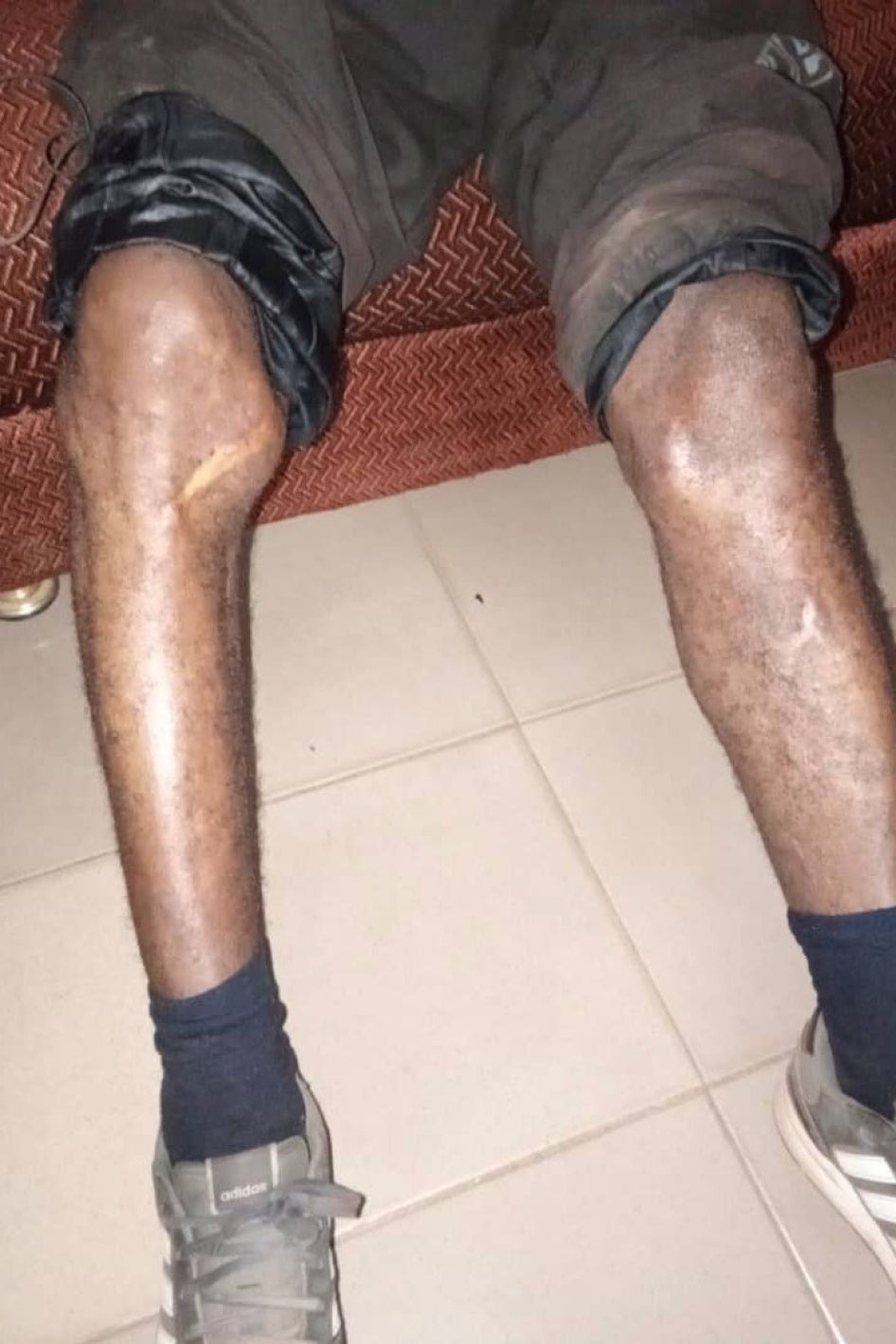
Gibson said the military handed the group over to gendarmes, who transferred them to the police, who expelled him to Mali after two weeks in detention. Human Rights Watch reviewed photos and video of the man’s injured knee.[137]
Baye Dirham Ndiaye, a 32-year-old Senegalese man, said he entered Mauritania lawfully in June 2020. He said around 10 Mauritanian police officers in khaki uniforms intercepted him close to the northern border with a group of some 20 West African migrants, including several teenage children. “They asked for our passports… everyone was legal. They asked for money. We refused, and they beat us… with batons or whips, some with their hands… I was injured on my head and wrist. They kept us 10 days in a police post or hangar in the desert. …They took 250,000 CFA [$450] from my bag… They freed everyone after we paid.” Ndiaye said they then transited the Moroccan-controlled border entry lawfully.[138]
Ousmane Diallo, a 22-year-old Guinean, said Mauritanian police caught him and another migrant near the northern border in September 2022: “They made us suffer a lot in the desert. They stripped us, took our clothes, left us to lie on the ground from 1 to 2 a.m. … Then they told us, ‘Go,’ and left us to walk in the cold…half naked… [until] a civilian gave me clothes.” He said other Mauritanian police caught him in Nouadhibou, detained him, and expelled him to Mali. A Human Rights Watch researcher met him in Bamako a few days later.[139]
Abdou Fall, a 28-year-old Senegalese man, said he entered Mauritania lawfully in 2021, traveling north toward Morocco. While in a car with a group of five West Africans, “Nouakchott police stopped us…[and] asked for money. They were hitting and mistreating me, pulling my hair… they…took 200 euros.” He said showing their documents made no difference.[140]
A 26-year-old Sierra Leonean man said he and his brother entered Mauritania irregularly in August 2022, intending to transit to Algeria to work. He was unsure of the town where they were arrested with several other migrants. He recounted:
We were walking in the street, begging for food, transport… police caught us… They said to give them money… We said, ‘We have nothing’… They said, ‘It’s not about the documents… If you have money you can pass.’ ...They locked us up for three days at a police station. …They beat us with a koboko [whip]. After they took our money, there was no [more] beating. …They released us at 8 p.m. …I [didn’t] see my brother… I still don’t know where my brother is.[141]
Immigration Detention: Poor Conditions and Mistreatment
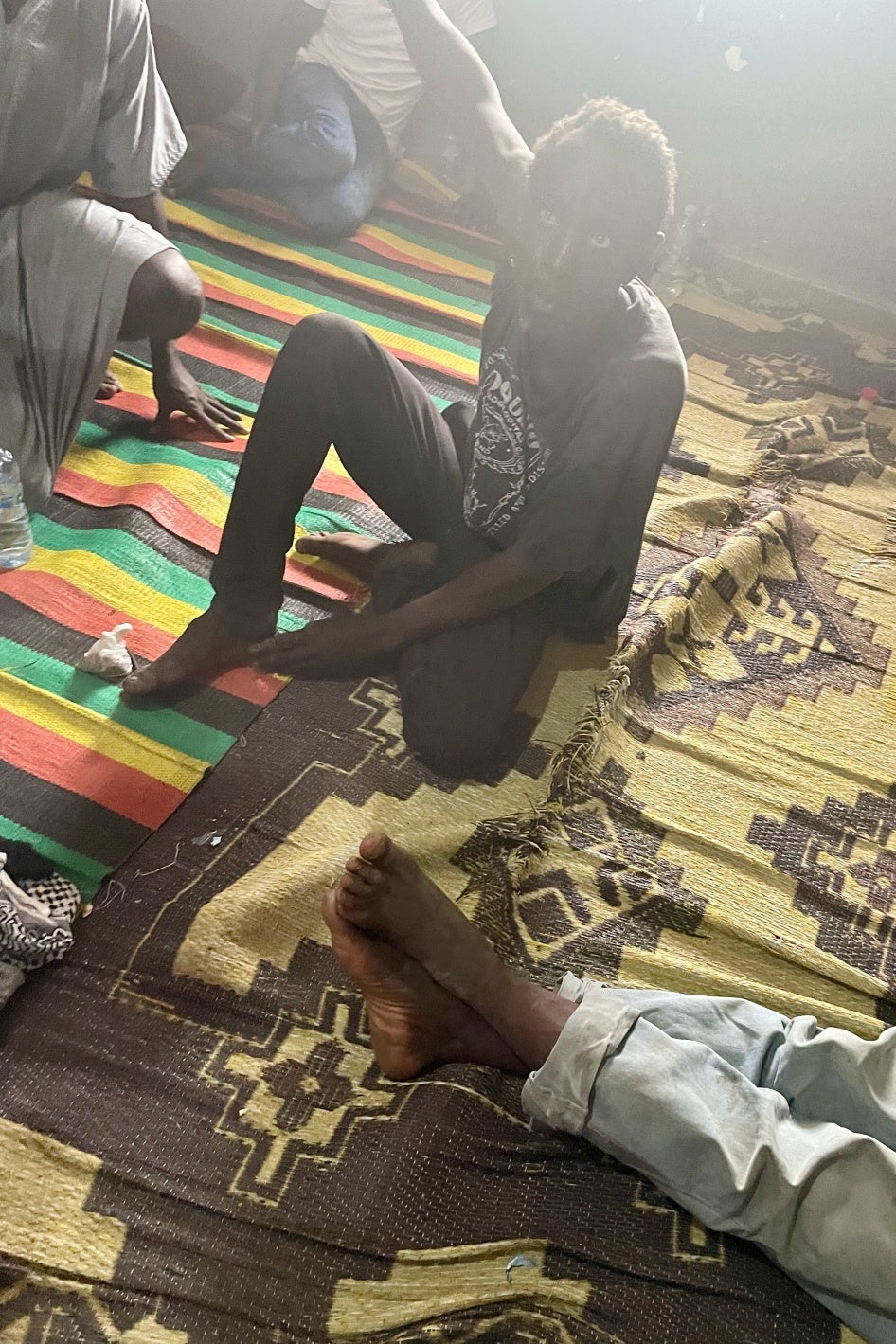
Authorities and EU officials refer to Mauritania’s police-run immigration detention centers by euphemisms such as “transit” or “holding” centers (centres de transit / rétention) or “reception” centers (centres d’accueil).[142] In reality, Human Rights Watch research between 2020 and early 2025 found that these have been closed centers where migrants are locked in rooms for days to weeks, typically leading up to their expulsion. In Nouakchott, a center in Bagdad district operated until around 2021; most people interviewed for this report were detained in the center in Le Ksar district, which remained operational until late 2024 or early 2025. In Nouadhibou, police have continued to use a facility at the regional police directorate for immigration detention.
In addition to several cases of physical abuse, dozens held in the Ksar, Bagdad, and Nouadhibou centers between 2020 and 2024 described inhumane treatment or poor conditions, including overcrowding, sleeping on the floor, poor sanitation, and restricted use of bathrooms. Most said the police provided little to no food, and they had to pay guards or call contacts to bring food, if they could.[143]
Ibrahim Kamara, a 23-year-old Sierra Leonean, said during three days in the Ksar center around August 2022, “[Police] beat me a lot and didn’t give me food. They treated me like an animal. When I wanted to go piss [or] talk to an officer, he would hit my hand or back with a koboko.” He said he ate only because other migrants shared food.[144] Four Guineans also said police hit them during immigration detention in 2022 in Nouadhibou or Nouakchott.[145]
Four men described witnessing violence at the Ksar center. A Senegalese man said in July 2023, “I saw police beat some others for no reason – Senegalese, Malians, Beninois. Punches and kicks.”[146] Two Guineans detained in November 2022 said the police only gave them bread, beating migrants who complained.[147] “My friend told them, ‘We want to eat,’ so the policeman… stomped on his back,” said one.[148] A Malian said he saw two migrants beaten in February 2021: “They handcuffed one Malian man, made him kneel, beat him with a belt… because he had two ID cards.” In the other case, “A guy said he was born in 2007 [age 14]. They said it wasn’t his real age and hit him.”[149]
A 30-year-old Cameroonian described his experience in the Ksar center in June 2022:
I spent one week there, until they had about 20 people [to expel to Mali]… Malians, Ivorians, and some Sierra Leoneans… None of us ate during that time, just drank water… They never allowed us to go to the bathroom. They had a bucket in the corner for us to urinate… For the other [defecation], you can’t do it anyway if you haven’t eaten. …
The true problem is racism. They think you don’t deserve help because you’re Black, like you don’t deserve the minimum human conditions.[150]
A 24-year-old Sierra Leonean said that in the Ksar center in August 2022, “We had to urinate inside, on the ground.”[151] A Malian, 19, said during immigration detention in Nouakchott (in Bagdad or Le Ksar) in February 2021, police handcuffed him punitively when he asked for food.[152] In January 2025, a 24-year-old Cameroonian said police still did not provide food in the Ksar center: “They said if you want to eat, you pay.”[153]
A Human Rights Watch researcher visited the Ksar center in 2022 and 2023, observing the bathroom and three rooms used to hold migrants. Men were in two rooms, with mats to sleep on. Based on interviewees’ accounts, women were held in a separate room. The researcher observed one woman in the third room, as well as several male guards, mattresses and bedframes, mats, a TV, a gas cooker, tea, water, and a bowl of food.

At the time of visits, less than a dozen people were detained; the numbers vary frequently as authorities carry out periodic expulsions to border areas. Other interviewees’ accounts indicated that sometimes dozens were held at a time. The center director told Human Rights Watch the facility’s capacity was 100 people, while high level police official said the capacity should be 70 people at most.[154] The center director said meals were provided twice a day – “rice, chicken, vegetables.”[155] However, accounts from detained migrants, migrant community leaders in Nouakchott, and others indicate this was rarely the case.[156] “People stay there during two weeks without food assistance… the youth, they cry and say ‘help us,’” said a Gambian community leader. “We have to take money from our own pockets to feed them… But if you detain people to expel them, you should feed them.”[157]
A police official told Human Rights Watch in 2023 that the General Directorate for National Security accorded quarterly amounts for food to the police stations and detention centers, but acknowledged it was “not enough.” He also said he had visited the Ksar center in February 2023 and had requested improvements.[158] In July 2025, the government said the Ksar center was temporarily closed for renovations to improve conditions.[159]
The Nouadhibou center, visited by Human Rights Watch in 2022, held no detainees at the time. The researcher observed two bathrooms and two big empty cells with grated windows, which police officials said could hold around 20 people each.
A Senegalese man detained in the Nouadhibou center in 2021 said: “When we arrived, I got just one bottle of water and some bread… From 6 p.m. to the morning, you can’t go out; you have to urinate in the room. We couldn’t wash.” He was transferred to the Bagdad center, where the “toilet area…overflowing into the room.”[160]
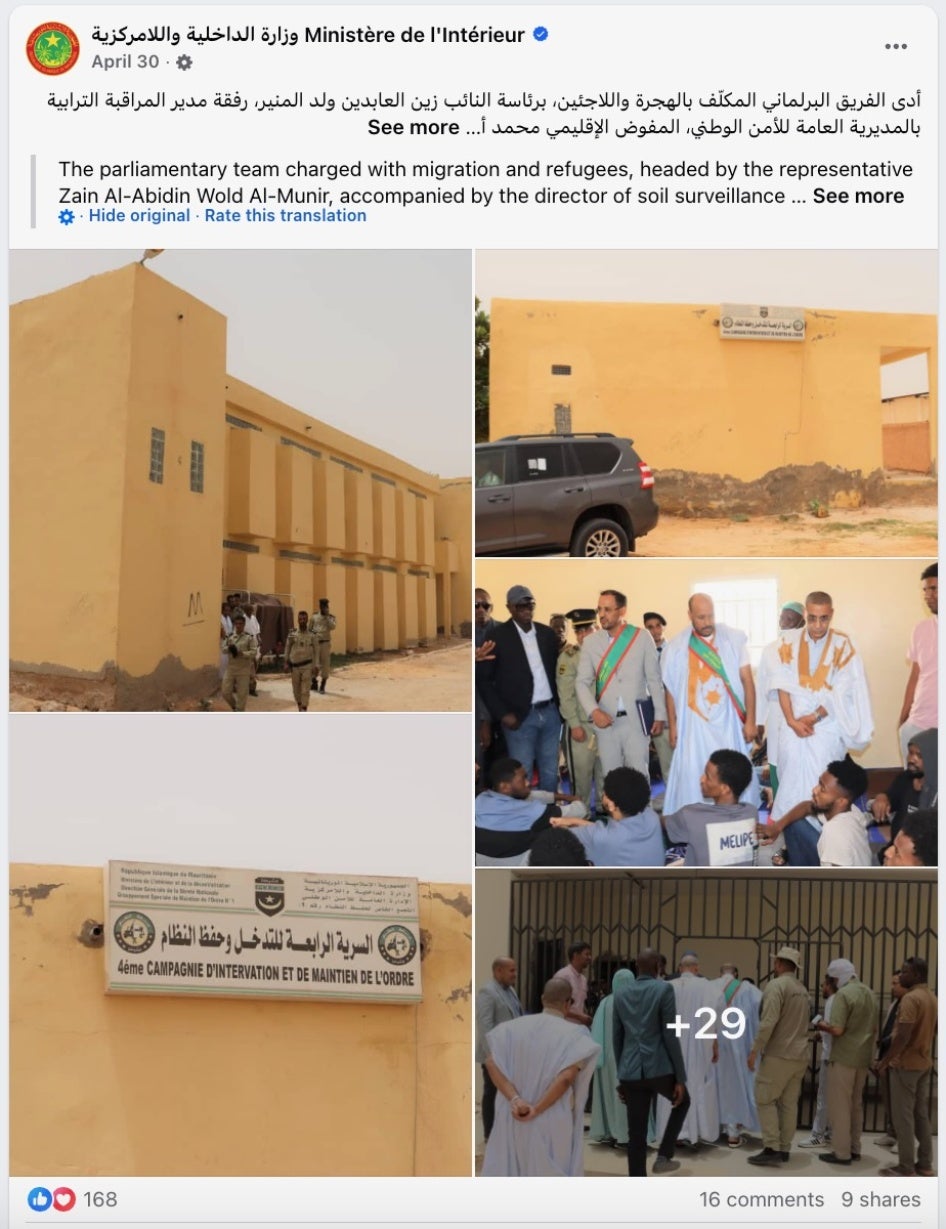
The Nouadhibou police chief told Human Rights Watch, “When migrants are brought here, we put them in the best conditions we can.”[161] The government said in July 2025 that this center was still in use, but was “being redeveloped… to improve reception conditions and guarantee the protection of the fundamental rights of impacted people.”[162]
During the surge in migrant arrests and expulsions in early 2025, to accommodate the increasing numbers of detainees, police began using three centers in Nouakchott’s Dar Naïm, Arafat and Sebkha districts. The National Human Rights Commission (CNDH), as well as a delegation from a parliamentary team on migration accompanied by the police (DST), separately visited these three centers in March and April to assess conditions of detention.[163] CNDH stated that it found “the detention conditions are respectable” and “the migrants interviewed did not report any mistreatment.”[164] Photos posted by the interior ministry on Facebook appear to depict the delegation walking through the centers and interacting with migrants, who are seated on mats or thin mattresses on the floor.[165]
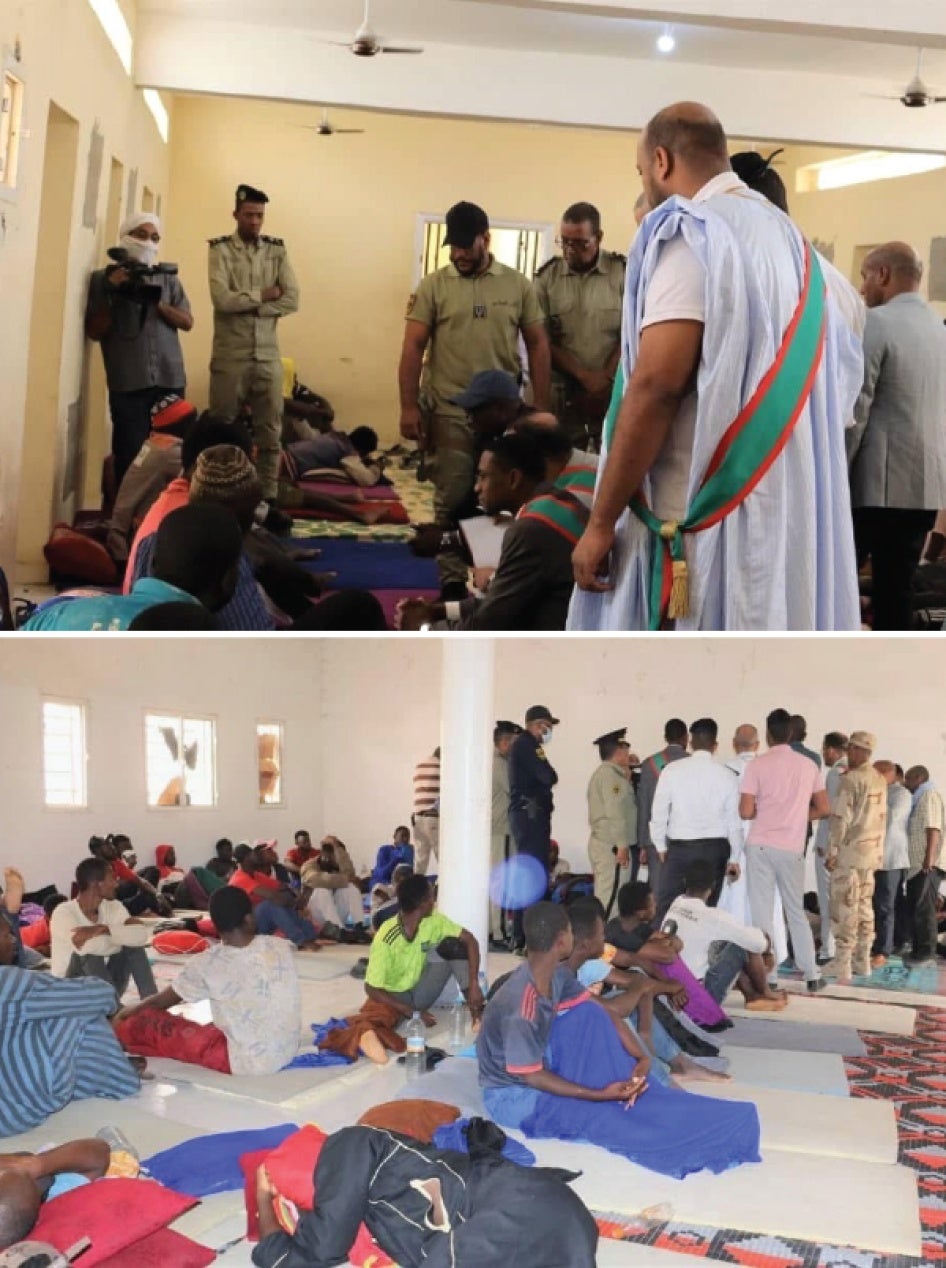
The government told Human Rights Watch in July 2025 that “three balanced meals are provided each day to all persons detained in migrant detention centers.” The authorities indicated that the Mauritanian Red Crescent would provide food at the two new centers in Nouakchott and Nouadhibou (the “Centers for the Temporary Reception of Foreigners,” or CATEs) set to open in September 2025, reserved for migrants disembarked from boats. They did not indicate whether the police’s budget for food in the other detention centers had been increased in response to the long-documented issue of insufficient food.[166]
Prisons: Poor Conditions, Prolonged Pretrial Detention
People charged with migrant smuggling in Mauritania have faced poor conditions in prisons; prolonged pretrial detention (over six months); and people in pretrial detention held alongside prisoners convicted of other serious crimes. The latter is contrary to international detention standards, which call for inmates to be classified based on their assessed risk level and for convicted prisoners to be separated from those in pretrial detention.[167]
In Mauritania, migrant smuggling may be prosecuted as a misdemeanor or felony. The government stated that pretrial detention is limited to four months for misdemeanors and six months for felonies, renewable once; however, the limit can be extended up to two and three years for misdemeanors and felonies, respectively, for “an offense committed by an organized gang, such as… migrant smuggling.”[168]
Overcrowded and squalid conditions persisted between 2020 and 2024 in Mauritania’s prisons, particularly one of the largest, Dar Naïm Prison in Nouakchott.[169] According to Ministry of Justice data, in August 2023, Mauritania’s national prison population was 2,417 inmates including 335 foreigners, with 977 in pretrial detention. Nearly half were held in Dar Naïm Prison at the time (1,010 including 117 foreigners), three times more than its intended capacity.[170] By June 2025, Dar Naïm Prison’s population had decreased to 854 including 140 foreigners, though Mauritania’s total prisoners nationally increased to 3,250 including 542 foreigners, with 1,705 in pretrial detention.[171] The June 2025 prison population included 300 people held on migrant smuggling charges, of whom 83 had been convicted and 217 were in pretrial detention; the majority were in Dar Naïm and Nouadhibou prisons.[172]
A justice ministry official said in 2023 that Dar Naïm Prison’s administration had “no capacity to classify people by type of crime,” but “tried to sort [prisoners] by…behavior, age, and adaptation.”[173] During a visit to Dar Naïm Prison in June 2022, a Human Rights Watch researcher observed overcrowded and dirty cells, where people slept on mats or mattresses on the floor. The facility held over 1,000 prisoners at the time, including 51 charged with migrant smuggling or complicity in smuggling – 11 convicted and 40 in pretrial detention (19 Mauritanians, 18 Senegalese, 11 Malians, 2 Gambians, and 1 Guinean). At least 17 had been in pretrial detention for over six months.[174]
A Malian community representative in Nouakchott said prolonged pretrial detention, including up to two to three years, was an issue among Malians held in Mauritania’s prisons.[175] Human Rights Watch individually and separately interviewed five men held in Dar Naïm Prison or Nouakchott Central Prison for between six months and several years, accused of migrant smuggling or complicity. All complained of false charges and poor detention conditions.[176]
Human Rights Watch also interviewed together two siblings of a Senegalese man, Cheikh Ngom, who they said died in September 2022 during his five-year prison sentence in Mauritania. “He fell ill in Dar Naïm Prison… my sister went there to see him,” said Ngom’s brother. “She asked the prison [administration] to take him to the hospital… he died in front of her at the Nouakchott regional hospital.” Ngom’s siblings said he had been having stomach pains and attributed his illness and death to “bad food” and “negligence of the prison guards at the time when he needed to go to the hospital.”[177]
In response to these allegations, the Mauritanian government requested more information and stated that “since 2021, no inmate named Cheikh NGOM has been known or recorded at Dar-Naïm Prison.”[178]
Children Abused, Detained, Extorted
Human Rights Watch interviewed six boys of West African nationalities between the ages of 13 and 17, whom Mauritanian security forces abused between 2021 and 2022. Their immigration status at the time was irregular or unknown. Three had attempted boat journeys to the Canaries. Five were detained; two paid police to avoid detention, including one case in which police explicitly demanded payment; and four experienced physical abuse.[179] The boys who were detained were held with unrelated adult men, receiving little to no food. One boy was held in a police station for 24 hours, and four boys were held in immigration detention between 5 and 15 days before their expulsion to Mali or Senegal.[180]
A 17-year-old Guinean boy who attempted a boat journey to the Canaries in February 2021, returning after problems at sea, said gendarmes arrested and beat him before transferring him to Ksar.[181] Police detained him with close to 100 migrants, he estimated, including around 10 teenage Malian boys:
We were all kept in same room... We slept on the tiled floor... If you needed to go piss… they said no, except for fixed times… After [biscuits and milk] the first day, they didn’t bring us food, except for their leftovers a few times. …Some Malians…called relatives to bring food…
[The police] asked my name, age, nationality… [and] for documents. …I told them my age and birth date. They didn’t say anything after… On the second or third day, a Spanish [officer] visited… [because of] a man accused of smuggling people to Spain.[182]
The boy said no one screened detainees for protection needs, and police gave him no chance to call anyone before expelling him to Mali.[183]
Another 17-year-old Guinean boy, who came to Mauritania to find work after his parents died, said police arrested him in the streets of Nouakchott in early 2021:
Police…asked for my ID. I said, “I don’t have one.” They… took me to [immigration detention], to a big room with lots of [West African] people there. I told them my age... They said, “Why did you leave your country as a minor?” …I spent two weeks there. It was not clean… I slept on the ground on a mat… The police didn’t give anything to eat... Another Guinean bought some food and gave it to me. Some days, I only ate once a day.[184]
A third 17-year-old Guinean boy said he came to Mauritania in hopes of traveling to Europe. Earning little money from odd jobs, he was homeless in Nouakchott.[185] One night in December 2021 or January 2022, he said:
I was sleeping outside, at the side of the road… Police got me... They asked for my ID. I didn’t have one. ...They took me to the [District 5] police station… around 11 p.m. They didn’t ask my age. I was in a small locked room with… some youth like me and some adults, all foreigners… They kept me there for a whole day and gave me nothing to eat. The next night, they just let me go.[186]
A community leader reported another case: in August 2023, he said, Mauritanian authorities arrested a Guinean boy, age 16 or 17, with a small group of migrants near the Western Sahara border. “He was trying to go to Morocco. He had his documents, he showed them to the border police, but they didn’t care,” the leader said. “He’d lost his [Mauritanian] residence permit – he was mugged and people took it, with his phone. But the card was still valid. He had a certificate of loss from the police station, a Guinean consular card, and a membership card for my association. I [knew him and] discussed his case with authorities, but they just said, ‘These people have to be expelled.’” Police took the boy to immigration detention in Nouadhibou and Nouakchott, then expelled him to Mali.[187]
Several adult migrants interviewed said they witnessed police beating both men and adolescent boys during arrests or detention.[188] Dozens described seeing and interacting with children in immigration detention or during expulsions.[189] Their accounts, along with those of the boys interviewed, indicate that authorities did not always check ages of people arrested or intercepted at sea, or in some cases took no action after learning children’s ages. While police in Nouakchott and Nouadhibou began more frequently between 2020 and 2024 to refer unaccompanied children – and sometimes children with their mothers – to protective services or alternate accommodations (via the International Organization for Migration, IOM; the government’s family ministry; or civil society groups), they at times placed children with their mothers in immigration detention, and still periodically detained teenagers with unrelated adults.[190]
A 20-year-old Malian arrested in Nouakchott in February 2021 said: “There were four boys arrested with us... The police put us all in [detention], didn’t ask their ages, didn’t separate them. We also encountered two girls in [detention], maybe ages 14 to 15, and 17.” The man said during three days with little food, “The children had a hard time…they were very hungry.”[191] A 29-year-old Malian detained around the same time said he saw around 10 children there in total: “I was obliged to share my bread... they didn’t have friends or relatives to bring them something to eat. …One Ivorian boy, maybe 17 years old, cried and cried, he couldn’t handle being detained.”[192]
Mauritanian officials told Human Rights Watch that any migrants who are children, if intercepted or arrested, should be referred to the Ministry of Family and Children or IOM.[193] In early 2025, an IOM official said police did not usually invite IOM to visit detention centers, but “when we know there are minors in detention, we advocate for their release.”[194] A former justice ministry official said that when a youth’s age is unclear or the individual has no ID, “the police have to prove he is an adult; if they can’t, they have to refer him to [the Ministry of Family and Children].”[195]
A police official in Nouakchott told Human Rights Watch: “When [police operating immigration detention centers] send me information, they say all the people [detained] are adults.”[196] In Nouadhibou, the police chief said: “If a child has no papers, often we call their community representatives… and their consulate is made aware.”[197] During Human Rights Watch’s visits to the Ksar center in 2022 and 2023, the center director said children were not kept in detention.[198] However, accounts told to Human Rights Watch and quoted above contradict the director’s assurance.
Under international human rights law, states are obligated to protect children from all forms of violence and abuse, including exploitation, and should provide appropriate care to unaccompanied or separated children. The African Union and the UN Committee on the Rights of the Child have determined that immigration-related detention is never in the best interest of the child and should be prohibited due to its harmful impacts.[199]
In its July 2025 response, the Mauritanian government cited its “commitment to strengthened protection of migrant children” and said that unaccompanied migrant children who have been intercepted or arrested are held separately from adults, are “never… detained beyond the term necessary for their shelter,” and are referred to appropriate protection structures.[200]
Arbitrary Arrests and Detention
Many of the people Human Rights Watch interviewed said Mauritanian authorities arrested them without checking their documents or allowing them to retrieve their papers. Some were asylum seekers; some said they had other valid authorization to be in Mauritania; and many said they were not accorded due process. Some migrants said that authorities asked to see their documents or inquired about their status during arrest or detention. However, this did not happen systematically, and those held in immigration detention generally were not brought to court and had no opportunity to contest their detention or expulsion. Police management of immigration detention was ad hoc, sometimes allowing phone calls or contacting migrant community leaders or UNHCR on detainees’ behalf, permitting some detainees’ release while denying others.
“The police wrote our names down, but did not ask questions,” said a Guinean man held in the Ksar center in 2022.[201] A Sierra Leonean man said police did not ask for his papers or pose any questions during his arrest in Nouakchott; in detention he told police his nationality, but he said they did not take any other information prior to his expulsion to Mali in 2022.[202] A Liberian expelled to Mali in December 2024 told Human Rights Watch, “[The police] said we entered illegally… They said they would take us to court, but they didn’t… we never went through any legal process.”[203]
In multiple cases, authorities arrested people, or threatened to arrest them, based on racial or ethnic profiling of those they assumed were irregular; to extort or steal money; or to prevent migrants from departing Mauritania irregularly, such as if they appeared to be preparing for boat journeys or for desert crossings into Western Sahara or Algeria. The Mauritanian government says that migrants are only penalized in connection with irregularly leaving the country as provided for in law, which would be if they are being accused of complicity in smuggling, or for failure to comply with exit protocols such as having documents stamped.[204] However, Human Rights Watch research indicates that migrants have been frequently detained when they were suspected of preparing to leave irregularly in circumstances other than provided for in law. In such cases, detention is arbitrary, in violation of human rights law.
While migrants were typically held in immigration centers for shorter periods, some said they were detained for weeks without a court order in other facilities, such as police stations or gendarmerie, coast guard, or navy posts. According to the Mauritanian government, “[A] judicial police officer may detain [a person] for a period of forty-eight (48) hours, which does not include weekends”; “This period may be extended once for a period equal to the initial period by written authorization of the public prosecutor.”[205]
“If a while passes without catching any ‘illegals’ [irregular migrants], they’ll start doing raids, grabbing anybody,” said a Mauritanian fish merchant in Nouadhibou, referring to police and coast guard arrests of migrant workers, including two Senegalese fishermen he employed.[206] “Often police round up a bunch of foreigners without looking at their papers, bring them to the [detention] center, and only then check their situation,” said a Guinean community leader who frequently assisted detained migrants. “Some police profit from this to scam people, asking for money.”[207]
“When migrants are intercepted, the police should inform humanitarians so they can do [protection screening], but often they don’t,” a UN official told Human Rights Watch. He said that he had visited detention centers and found migrants who were not asked their nationalities “or anything else,” but were “just dropped” into the centers without an individual assessment of their profile.”[208]
In contrast, the director of the Ksar center said that the police checked the immigration statuses of detainees individually. He stated that the people being held there were in administrative detention.[209]
Refugees and Asylum Seekers
UN officials in Mauritania said the police always granted UNHCR access to detention centers upon request, and occasionally invited UNHCR to conduct protection screenings. However, prior to the government’s adoption in 2025 of standard operating procedures for the management of migrants, UN officials said there were no formal procedures and referrals were not systematic.[210] A UNHCR official said in 2023 that he had observed “the safe protection environment… becoming diluted.” The official said that police sometimes pick up refugees or asylum seekers who don’t have their UNHCR paperwork with them and detain them without giving them the opportunity to get their documents from home. In some cases, the official said, asylum seekers with UNHCR papers have been extorted. “We did raise that issue,” he said, but the government’s “first response is always that it’s not official.” Their second response, he said, is that “they are doing trainings.”[211]
A 27-year-old Sierra Leonean man with valid UNHCR asylum seeker papers (reviewed by Human Rights Watch) said police arrested him as he was preparing to go to Spain’s Canary Islands in August 2021 in a “raid” on a house north of Nouakchott where he was staying with about 40 other migrants. Police expelled him to Mali.[212]
Unregistered asylum seekers are even more vulnerable. A 32-year-old Malian asylum seeker of Fulani ethnicity, who fled Mali’s Mopti region in 2021 due to security force abuses, said he had submitted asylum paperwork to UNHCR but was not yet registered. He said he experienced extortion on the streets of Nouakchott’s 6th district several times. “The police ask for papers and say, ‘Pay 1,000 to 2,000 ouguiyas [US$2.50 to $5], or you’ll have to go to the station,’” he said.[213]
A 32-year-old Senegalese woman said police arrested her and seven other women – three with UNHCR asylum seeker or refugee papers – during a raid in Nouadhibou in June 2022. “Two [Mauritanian] police and four Spanish officers came to our house… We were sleeping. They were looking for ‘illegals,’ but didn’t find them,” she said, referring to migrants planning to journey irregularly to Spain. The police first detained the women in Nouadhibou. After transfer to the Ksar center, police released the three women registered with UNHCR.[214]
Accusations of Irregular Status, Attempting to Leave Irregularly, or Smuggling
In some cases, authorities arrested African foreigners with regular immigration status, claiming they were irregular or planning/attempting irregular departures.[215] A Senegalese man working legally as fish merchant for a Mauritanian boss – whom Human Rights Watch also spoke with – said police arbitrarily arrested him in Nouadhibou in July 2021: “I went out to get dinner…and forgot my ID. Returning home, I ran into police, who said, ‘Get in the car. You are illegal.’ I took out my phone to call my wife, and they slapped me…and took my phone… All my papers were in my house…but they didn’t listen. …They took 11,500 ouguiyas [ US$28] from me.” Police detained him for four days before expelling him to Senegal.[216]
A 21-year-old Malian man said he was legally present in Mauritania[217] when police arrested him in March 2021 as he was transiting northward through Chami, a town 240 kilometers north of Nouakchott. After a week in detention in Nouakchott, he was expelled to Mali.[218] A Guinean community leader recounted a similar case in April 2023 when police arrested a Guinean man in Zouérat: “His wife gave me his residence permit and I brought it to [the police] to show them it was valid, but they took it from me. The police had arrested him because he was going to take an irregular route to Algeria, through the desert… but he hadn’t done it yet,” the community leader said. This man was expelled to Mali.[219]
Ten men interviewed separately said Mauritanian authorities arrested them during anti-smuggling operations, one in 2018 and the others between 2020 and 2023.[220] Six said authorities falsely accused them of migrant smuggling or complicity, while four said authorities interrogated them about smugglers and “accomplices,” including to find out who the “captains” were in intercepted boats. Seven experienced periods of arbitrary detention, without due process or formal charges.[221]
Thierno Diallo, a 34-year-old Guinean man, said he was living and working legally as a driver in Nouadhibou in February 2022 when the police arbitrarily arrested him:
There were three of us [migrants] in my room. [Police] knocked on my door. ...There were four Mauritanian policemen…and three Spanish policemen in plainclothes... A Mauritanian policeman grabbed my shirt collar… He asked me, “Are you Karim?” I answered, “No, I’m Thierno.” …He slapped me and handcuffed me. …They searched my whole room. They asked, “What do you do for a living?” I answered, “I’m a driver.” … I showed them my driver’s license. …They said, “No, you’re all immigrants… you’re going to Spain.” I replied, “No.” They took all my documents… They said, “After, if we find nothing, we will give them back.”
…When we arrived at the police station, they saw that my residence permit was valid… At first they accused me of allegedly [smuggling] illegal immigrants.…I said, “I can give you [my boss’s] number…” A Mauritanian police officer said, “No… We know all the foreigners that come here, it’s to go to Spain.”[222]
Diallo said that police confiscated his money (8,000 MRU, US$200) and documents, detained him nine days in Nouadhibou and Nouakchott, and expelled him to Mali.[223]
A Malian community representative in Nouakchott said that “police often arrest people they call ‘smugglers’ just to get money.”[224] In cases documented by Human Rights Watch in 2018, 2020, and 2022, authorities detained several Senegalese men for weeks after interception at sea, without due process, for smuggling-related interrogations and abuse.[225]
Extortion and Theft
At least 30 migrants and asylum seekers interviewed by Human Rights Watch reported that Mauritanian security forces extorted money from them during or under threat of arrest, detention, or expulsion. Eleven said authorities confiscated and never returned their money, phones, or both.
Moussa Ba, a 35-year-old Senegalese man, who was legally visiting Mauritania for work in 2021, said, “I was in Nouadhibou, in the market, and the police seized my iPhone because they didn’t find money when they searched me.”[226]
A 43-year-old undocumented Senegalese woman living in Zouérat said police regularly extorted her under threat of expulsion: “A policeman…calls my phone to ask for money, then comes to my restaurant... Each time I pay 2,000 MRU [US$50].”[227]
A 30-year-old Senegalese man showed Human Rights Watch a laissez-passer document authorizing his stay in Mauritania from May to August 2022, but said police had still harassed him in June 2022: “I got off work at 8 p.m. … I ran into three policemen… They brought me to the police [facility]… In front of the door, they said... ‘You have to pay, otherwise you’ll spend the night.’” After negotiation, he said, he paid 200 MRU [US$5].[228]
Ten Malian ironworkers and blacksmiths, most undocumented, interviewed individually, described dozens of experiences of extortion and arrests by police in khaki or black uniforms in 2021 and 2022, in various districts of Nouakchott.[229] They said police asked for 100 to 400 MRU (US$5 to $14); if arrested, they had to pay higher amounts to be released from police stations, up to 4,000 MRU (US$100). One man, age 29, said: “Almost every day, the police ask us for money. It’s like what I earn, I give to them.” He said that, in March 2022, “At the door of a restaurant, [police] stopped me. …They said, ‘You need to pay 5,000 ouguiyas [US$12].’ They brought me to the Basara station... In the morning I called my brother, who brought money to free me.”[230] Separately, a 25-year-old Malian said that in May 2021, “My brother and I were chatting in front of our house, when the police came and arrested us. They didn’t ask any questions, just took us to the [District 5] station. They said we had to pay 12,000 ouguiyas [US$30]... They locked us up for 24 hours… we called our brother who came and paid 8,000 [US$20].”[231]
Senegalese migrant fishermen described harassment by coast guard officers who they said periodically confiscated their boat engines and extorted them for money or fish when they lived in Mauritania between 2013 and 2020.[232] In 2022, the head of a fishermen’s union in Senegal, Moustapha Dieng, said, “The Mauritanian coast guard ask fishermen for money every day, even if they are legal.”[233]
III. Boat Interceptions, Rescues, and Disembarkations
Maritime search-and-rescue between Northwest Africa and the Canary Islands is vital, given the dangers posed to people in small boats in those waters and the ongoing deaths and disappearances of those attempting crossings. In 2022, the Mauritanian government expressed commitment to saving lives through search-and-rescue operations and “identifying deceased or missing migrants and facilitating exchanges with their families.”[234]
However, “pullbacks” (interceptions and forced returns) of outgoing boats headed for Spain’s Canary Islands by Mauritanian authorities, with funding and other support from the EU and Spain, are a murkier issue. Authorities have claimed pullbacks are necessary for security reasons and to prevent loss of life.[235] As shown in this chapter, the “saving lives” justification is contradicted by:
the inadequate search-and-rescue operations in the Atlantic;
the fact that increased interceptions push migrant boats to take longer and more dangerous routes to avoid patrols;
the often ad hoc disembarkation procedures in Mauritania that have failed to consistently address migrants’ medical and protection needs;
the documented abuses against migrants during and after boat interceptions; and
the fact that pullbacks can violate the right to seek asylum and the right to leave any country.[236]
This chapter also documents a 2023 case in which Spanish authorities intercepted or rescued a group of mostly Senegalese migrants in international waters and attempted to disembark them in Mauritania, which Mauritanian authorities refused to allow; the Spanish then disembarked the group in Senegal.
A country’s territorial waters, which extend up to 12 nautical miles from the coast, are part of its national territory and legal jurisdiction. Interceptions and forced returns of boats from territorial waters to land constitute a transfer from one part of the national territory to another. In the contiguous zone – adjacent to territorial waters, up to 24 nautical miles from the coast – a coastal state also has the legal right to enforce its immigration laws. Beyond 24 nautical miles, in international waters, a state’s immigration laws do not apply. However, international maritime law imposes a duty on all vessels at sea to rescue people in distress whether in territorial or international waters, and those rescued should be disembarked in a place of safety.[237]
Mauritania’s coast guard, navy, and the two maritime brigades of the gendarmerie all operate at sea and carry out rescues and interceptions. Most interceptions are made by the coast guard, which is responsible for control of fishing activities and irregular migration, as well as search-and-rescue in Mauritanian territorial waters.[238] The navy previously performed this role, and their uniforms are similar, leading to frequent conflation of the two by migrants.[239] The coast guard conducts daily patrols along the beaches and coasts, intercepting migrants during attempted embarkations as well as at sea.[240]
In practical terms, the coast guard’s control of fishing activities often intersects and blurs with migration control. Unauthorized fishing by migrants is a challenge for Mauritanian authorities, who have the right to enforce fishing regulations; and pirogues can be used both for fishing and migration. However, migrant fishermen – mostly Senegalese – have reported cases of coast guard harassment, extortion, and arrests even when their documents are in order.
The Mauritanian navy operates in Mauritanian and international waters. A navy colonel told Human Rights Watch that “any pirogue overloaded at sea always presents a danger to people on board,” and the navy will respond, but said that national security rather than migration is the navy’s primary focus:
It’s the gendarmerie and coast guard who are concerned with migration. But if we find a pirogue in danger at sea, we’re obligated to initiate rescue. This has always occurred in Mauritanian waters [as of 2023]. We go 400 kilometers [215 nautical miles] out, but never encountered pirogues that far. If they are in international waters, we wouldn’t stop [intercept] them. But in Mauritanian waters, we have to control.[241]
The gendarmerie’s maritime brigades are present at the ports of Nouakchott and Nouadhibou and operate only in Mauritanian waters, periodically conducting joint patrols with the Spanish Civil Guard, which has two boats stationed in Mauritania (as well as a helicopter, and occasionally a plane, assisting with maritime surveillance).[242] A gendarme official emphasized to Human Rights Watch that maritime operations were not only for law enforcement (countering irregular migration and smuggling), but also “to rescue people in danger.” He stated: “It’s not just to intercept them, but to prevent them from dying.”[243]
Following disembarkations of intercepted or rescued migrant boats in Mauritania, the gendarmerie and coast guard normally turn passengers over to police custody, while the navy would hand them over to gendarmes who should then transfer them to police, officials said.[244]
In total, Mauritanian maritime authorities intercepted or rescued at least 27,516 people attempting boat journeys to Spain’s Canary Islands between 2020 and the first half of 2025, according to data provided by the Mauritanian government in July 2025. This includes 5,762 intercepted or rescued by the gendarmerie; 5,739 people “apprehended” by the navy; and 16,015 people rescued or intercepted by the coast guard.[245] The data provided did not clearly distinguish people intercepted versus rescued in all cases.
Mauritania’s Interceptions or Rescues of Boats Carrying Migrants or Asylum Seekers | |||||
| Coast Guard | Navy | Gendarmerie | TOTAL | |
|
|
| Interceptions | Rescues |
|
2025 (first half) | 1,385 | 669 | 906 | 53 | 3,013 |
2024 | 8,038 | 954 | 1,681 | 796 | 11,469 |
2023 | 2,888 | 1,205 | 1,060 |
| 5,153 |
2022 | 378 | 1,023 | 758 |
| 2,159 |
2021 | 1,735 | 910 | 252 |
| 2,897 |
2020 | 1,591 | 978 | 256 |
| 2,825 |
TOTAL | 16,015 | 5,739 | 4,913 | 849 | 27,516 |
**Additional information provided by the Mauritanian government: Coast guard – 2025: 572 “attempts thwarted”; 52 pirogues intercepted; 27 pirogues rescued. 2024: 1,160 “attempts thwarted”; 116 pirogues intercepted; 82 pirogues rescued. 2023: 40 “attempts thwarted”; 37 pirogues rescued. 2022: 16 “attempts thwarted.” 2021: 101 “attempts thwarted.” 2020: 47 “attempts thwarted.” Navy – 2024: “11 attempts to leave for Europe blocked in 2024 by coastal patrols.” | |||||
Humanitarian and Protection Needs of Survivors
Pirogues attempting the Atlantic Route often carry people of multiple – mostly African – nationalities. Most are men, though boats also carry some women and children. Younger children are typically accompanied by relatives; unaccompanied children are often teenage boys. While people intercepted just after departure are less likely to need medical care, those rescued or intercepted after days or weeks at sea are often exhausted, dehydrated, hungry, and sick. Some boats get lost or run out of fuel, food, or water, or engines break down; passengers may experience deaths or violence. This can result in serious medical or psychological needs among survivors, in addition to preexisting protection concerns for victims of trafficking or people fleeing persecution, conflict, torture, or other abuses.
In 2020, at least two migrants died after their boat shipwrecked and Mauritanian police took charge of survivors, transporting them to Nouakchott detention without first ensuring they received medical care. According to UN officials, this “turning point” pushed authorities to be more vigilant in ensuring post-disembarkation medical checks.[246] With EU funding, IOM coordinated with Mauritanian authorities, the French Red Cross, and Mauritanian Red Crescent in 2020-2021 to develop standard operating procedures (SOPs) for disembarkations “to guarantee a more coordinated and human rights-based response.”[247] This included a “medical triage mechanism in Nouadhibou to assist and refer” disembarked people, who “receive medical and psychological first aid [and] humanitarian assistance, and are referred to hospitals if necessary.”[248] A 2022 version of the SOPs specified that Mauritanian authorities should notify the French Red Cross or Mauritanian Red Crescent of disembarkations, in order to ensure medical checks and care, while UNHCR, IOM, and the Ministry of Social Action, Children, and Family should screen for protection needs and take charge of unaccompanied children, refugees, asylum seekers, and other vulnerable people.[249]
However, the standard operating procedures were mostly implemented in Nouadhibou, even though many disembarkations have occurred in Nouakchott and elsewhere.[250] Furthermore, authorities did not inform IOM and the Red Cross or Red Crescent of every disembarkation. For instance, Mauritania’s maritime security forces intercepted or rescued a total of 2,897 people in 2021,[251] but IOM registered only 761 disembarked people who passed through medical and protection screenings.[252] In 2024, security forces disembarked 11,469 people,[253] while IOM registered only 2,776 who passed through screenings.[254] A UN official said that from 2024 into early 2025, the SOPs were not being systematically implemented even in Nouadhibou.[255]
According to UN and Mauritanian officials and migrants interviewed, between 2020 and early 2025, protection screenings have taken place either immediately upon disembarkation, later at police facilities, or not at all.[256] A coast guard official in 2023 said his agency typically communicated with the Red Cross, Red Crescent, and IOM about disembarkations, while UNHCR was “usually informed by IOM.” He stated, “We have ambulances and nurses that can help with urgent cases, and Red Cross or Red Crescent can also help. …We only refer urgent medical cases. For the rest [including protection needs], it’s the police that sort them out… We don’t have the resources.”[257] A UNHCR official in Nouakchott said that UNHCR was sometimes “notified late,” and that when there were multiple boats per week, UNHCR was less likely to be informed; but he said, “when we ask, [authorities] will always release people.”[258]
In a positive step in May 2025, the Mauritanian ministries of the interior, defense, and fishing and maritime infrastructure adopted two national regulations establishing updated SOPs for maritime search-and-rescue, interceptions, disembarkations, and the management of migrants. The SOPs designate responsibilities for alerts, coordination, and emergency responses to the Maritime Rescue Coordination Centre, local authorities, and security forces (the coast guard, navy, gendarmerie, police, and General Delegation for Civil Security and Crisis Management), along with other post-disembarkation roles (medical care, basic necessities, psychosocial support, protection, and other services) assigned to the family and health ministries, the National Authority for Countering Human Trafficking and Migrant Smuggling (INLCTPTM), IOM, UNHCR, the Mauritanian Red Cross, and others.[259]
The 2025 SOPs emphasize authorities’ obligations to respect rights and ensure dignified treatment, protection, and medical care, including through a medical triage mechanism, protection screenings (to be carried out by the INLCTPTM, IOM, and UNHCR), and identification, care, or referral of unaccompanied and separated children, people needing international protection, or other “vulnerable persons” (pregnant women, the elderly, trafficking victims, etc.). The SOPs note that weapons should not be used in boat interceptions, “except in cases of self-defense.”[260] They also include provisions for detention and expulsion of disembarked “irregular and non-vulnerable migrants” who are not in need of special protections or urgent medical care.[261]
The Mauritanian authorities’ increased attention to the needs of disembarked people, adoption of the SOPs, and collaboration with UN and humanitarian agencies are positive steps. However, authorities should set up trainings and monitoring systems with all relevant security forces to ensure that the new SOPs are implemented. The Mauritanian government stated in July 2025 that “a monitoring mechanism is already in place under the Ministry of the Interior, and will be gradually strengthened to ensure the rigorous application of the Standard Operating Procedures”; and “the process of setting up this mechanism is underway.”[262] The government did not specify whether the mechanism would monitor security forces under the jurisdiction of other ministries, such as the gendarmerie and navy (under the Ministry of Defense) or the coast guard (under the Ministry of Fishing and Maritime Infrastructure).
Ideally, any monitoring mechanism should be independent, human rights focused, and authorized to accompany and observe any of Mauritania’s security forces or other entities involved in rescues, interceptions, disembarkations, and management of migrants. Independent and comprehensive human rights monitoring is especially important given the inconsistent application of the earlier SOPs and accounts from migrants and humanitarian actors during the past few years, which reveal that Mauritanian authorities in many cases prioritized suppression of irregular migration to Spain’s Canary Islands above humanitarian and protection concerns.
Several people disembarked in Mauritania between 2020 and 2024 told Human Rights Watch their group never saw UN officials or went through any protection screenings.[263] One Senegalese man said he attempted a voyage in 2020 that failed, forcing the boat to land in Mauritania after seven people died at sea. He said upon disembarkation, after aid workers provided some medical help and food, survivors were quickly taken to police detention, where they received little food and no other medical or psychosocial support prior to their expulsion to Senegal.[264] Additionally, though Mauritanian authorities increasingly referred younger children disembarked from boats to IOM or government social services since 2020, they have not always done so for unaccompanied teenage boys, many of whom have been detained with adults, based on Human Rights Watch interviews with disembarked and detained migrants.[265]
Abuses At Sea and After Disembarkation in Mauritania
Human Rights Watch documented several accounts of abusive treatment of migrants by authorities during and after boat interceptions and disembarkations, including violence, arbitrary detention, and extortion. All but two cases occurred between 2020 and 2024. Eight interviewees were intercepted at sea by the Mauritanian navy or coast guard, while two came ashore due to problems at sea and were arrested on land. All ten were detained, nine without any legal procedures; the tenth, a fisherman, was accused of attempted smuggling and provisionally imprisoned pending a judicial investigation. Four, three men and one 17-year-old boy, experienced violence. Five, including a woman and boy, were expelled to Mali or Senegal.[266]

A Senegalese man who embarked from Mauritania in 2020 at age 25 said authorities beat and extorted him:
There were 65 people in our boat, Senegalese, Gambians, Guineans, Malians… including 7 women. After one week at sea, we were intercepted by the Mauritanian navy [or coast guard], 10 or more officers. …When we disembarked [in Nouadhibou], they threatened and insulted us in Arabic and French. They said, “Whoever has money, move to the side…” They hit us with their hands, batons, cables... I gave them 300,000 CFA [US$531].
We spent three days [detained] at a navy [or coast guard] post. …The women and men were separated... When we went out to eat, or in the hall, we could talk to the women. …Two Gambian women told me the [navy or coast guard officers] had raped…all of the women.[267]
After three days, he said, authorities transferred the men to another service he identified as the gendarmerie based on the badges on officers’ uniforms. The gendarmes detained them in an unidentified building, “neither a prison nor a center…it had no sign, but it was a bit far from town [Nouadhibou].”[268] He recounted:
The gendarmes took our documents and passports… then tore up everything! …They took our phones… They gave us food once a day. …They asked us how we organized [the voyage], who were the leaders. …The gendarmes accused me, “You organized the voyage, or you must know [who did].” …They beat me [with batons and whips]… I was injured on my hand… others were injured too. They said, “You’re going to prison” – but…it wasn’t me [who organized the voyage]. After 20 days, they freed us. They realized we were all just clients [migrants]… We never went to court.[269]
In another case, a Senegalese fisherman said he was an unpaid “captain” – a migrant who agreed to steer a boat for free passage – on a pirogue that departed Senegal in March 2020 when he was 26:
There were around 190 people in the boat… Senegalese, Gambians, Ivorians, Malians…some children, some women nursing babies… and two captains, including me. …The Mauritanian coast guard caught us…after almost three days at sea. …They asked for money… They threatened us, saying if we didn’t pay...they would take our fuel. …Several hit us... I suffered hard blows since I was a captain, and they believed I organized the convoy to go to Spain. I still have a scar from the beating near my left eye.[270]
The man, interviewed by phone, sent a photo of his scar to Human Rights Watch. He said collectively the migrants paid 2,000 euros (he paid 200) to the coast guard, who let them continue on their way.[271]
A 17-year-old Guinean boy described abuse by gendarmes upon disembarkation in Mauritania in February 2021, after the boat he was in with 38 people had been lost at sea for six days and had run out of food and water:
The moment we got down from the boat, there was the Mauritanian maritime control. There was violence at the water’s edge… We were mistreated, beaten. …They fired a bullet to scare people. They said, ‘Nobody move. Whoever moves, we’re going to shoot.’… It was the gendarmes in uniform, and some others not in uniform.[272]
The boy said the gendarmes transferred the group to the Ksar immigration detention center without ensuring medical care. “After we arrived, [police] gave us some powdered milk and biscuits… One guy had stomach pain... but no doctor came.” The police detained him with other teenage boys and men for a week, providing little food, before expelling them to Mali.[273]
In 2022, five coast guard officers intercepted a pirogue offshore from Nouadhibou and arrested a 23-year-old Senegalese fisherman in the boat. “They thought that I wanted to leave for Spain,” the fisherman said. In West Africa, smaller boats sometimes carry migrants out to larger pirogues waiting offshore, to evade detection. However, the fisherman told Human Rights Watch that he had been waiting for his brother to join him to fish and said his fishing authorizations were in order, which his employer confirmed.[274] Nonetheless, the coast guard turned him over to the police, who referred him to court for attempted smuggling. After six months of preventative or pretrial detention, he was released and the case was dropped.[275]
Another Senegalese man said he attempted to migrate to the Canaries several times between 2018 and 2023, but each journey failed. As a fisherman with navigation experience, he said he was one of several migrants who helped steer the boats. During his first attempt at age 23, in 2018—the only time he embarked from Mauritania – he set off “in a small Zodiac” with around 50 other West Africans.[276] After one day at sea, he said, around 20 officers in black uniforms, from an unknown Mauritanian security service, intercepted them near Nouadhibou:
They took all of us and put us in their big boat, where they did their interrogation. The officers threatened the [migrants] to find out who the captains were. I was one of eight captains. They left the other [migrants] in their big boat, put us captains back in the Zodiac, tied our hands, made us kneel, and beat us with batons. The scar on my head, I got from that.[277]
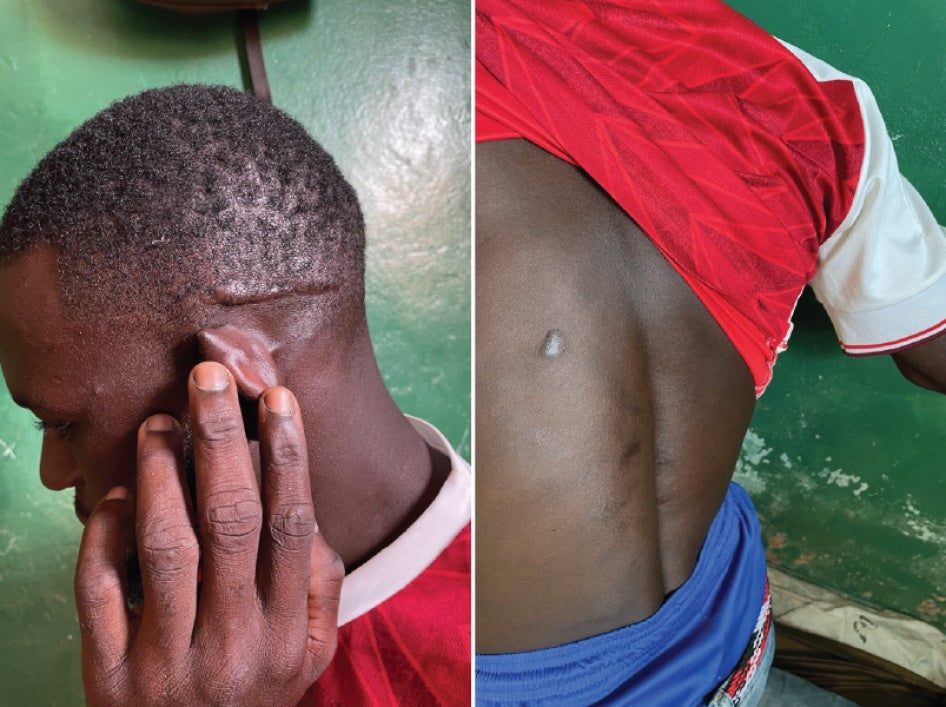
He said after the beating, the officers disembarked everyone in Nouadhibou, transferring them to police custody. “The others were detained only [a few] days and freed… They kept us captains…[for] 15 days,” he said. He said police drove them to a town between Nouadhibou and Nouakchott, detaining them in another facility: “During the first days of detention, we were abused. [We] had to accept to do work, cleaning, dish washing, preparing food, tea… like a slave. …They slapped us…and I have scars from a beating with a baton. …They never brought us before a judge.” He said finally the police drove them to Rosso, Mauritania, where police interrogated them again, took their photos and fingerprints, and expelled them to Rosso, Senegal.[278] Human Rights Watch photographed the man’s scars in 2022, which he said were from the beatings in 2018.
Inadequate Search-And-Rescue in the Atlantic
In a 2022 report, the Mauritanian government emphasized that “the search for missing persons…along the Atlantic route remains one of the major challenges,” highlighting “the lack of resources, international cooperation, and a clear reporting mechanism for families.”[279] This remained unchanged even as the number of people dead or missing increased in 2023 and 2024, according to Caminando Fronteras, a Spanish human rights group. It reported an estimated 6,000 lives lost along the Atlantic Route in 2023, nearly 9,800 in 2024, and over 1,400 during the first five months of 2025,[280] while IOM reported nearly 1,000, nearly 700, and around 200, respectively.[281] The figures differ as IOM reports only cases of which they are “100% certain,” using only the lowest figures in reported estimates of passengers in capsized boats, while Caminando Fronteras relies on hotline alerts and reports from migrants’ families and communities.[282]
Caminando Fronteras said that in 2024, 71 percent of the deaths and disappearances it had documented among people traveling in boats from West Africa occurred among those who had departed from Mauritania.[283] Mauritania’s foreign affairs minister said that more than 500 “bodies of young Africans” were recovered from Mauritanian shores in 2024 and more than 100 between January and April 2025.[284] Caminando Fronteras said that between January and May 2025, it recorded “a notable increase in tragedies [shipwrecks, deaths, and disappearances] involving boats departing from Mauritania.”[285]
The Atlantic Route is widely regarded as highly dangerous; in 2021, there was “an estimated ratio of…one death for every 20 arrivals [to the Canaries]... based on IOM figures, widely perceived to be…conservative.”[286] In 2024, if data from Caminando Fronteras is used, up to one in five people died or disappeared en route.[287]
Increased patrols incentivize boats to take longer routes to avoid interception. Since 2020, due to heightened securitization in Nouadhibou, departures from around Nouakchott began to increase despite the greater distance.[288] Following expanded migration control measures along the Senegalese and Mauritanian coasts in 2023, more boats began navigating west into the Atlantic before turning north to the Canaries.[289]
Mauritanian, Senegalese, Gambian, Moroccan, and Cape Verdian maritime forces all carry out interceptions or rescues in their own territorial waters, supported by Spanish Civil Guard personnel, vessels, and aircraft stationed in Senegal and Mauritania. Spain’s maritime rescue service, Salvamento Marítimo, reportedly has a fleet of 14 rescue vessels based in the Canaries; it operates mainly in Spanish and international waters, but is authorized to venture into African waters for small boat rescues. The Spanish Civil Guard, which coordinates rescue responses, must authorize Salvamento Marítimo to conduct rescue operations, according to a report by EuroMed Rights and AlgoRace.[290]
The search-and-rescue efforts of these entities have saved many lives. However, several organizations have pointed to inadequacies with the systems, which are under-resourced and insufficient to meet the scale of the need. On Spain’s side, “the centralised command structure has hindered [Salvamento Maritimo’s] ability to promptly rescue small boats, even in cases where they had already located the vessel,” according to the 2024 EuroMed Rights and AlgoRace report.[291] The report highlighted the limited number of rescue ships and insufficient human resources to fully use detection technologies, stating that Spain generally prioritized technology for border surveillance above rescue or protection uses.[292]
Caminando Fronteras and Alarm Phone, both of which frequently receive alerts from migrants at sea or families reporting boats in distress or missing, have criticized Spanish forces for delaying rescues in the Atlantic or not responding to alerts. These groups said Spanish forces at times pressured or relied on African countries to conduct rescues “even if they lack the necessary resources, capacity or will to do so;” they also said multi-country collaboration on rescues was hindered by “shortcomings in rescue protocols and poor coordination.”[293]

Spain’s Obligation to Disembark Rescued Migrants in a Place of Safety
On August 24, 2023, a Spanish Civil Guard boat intercepted or rescued a pirogue in international waters around 80-110 nautical miles (150-200 kilometers) from Mauritanian shores.[294] The pirogue had embarked from Senegal carrying 168 people, mostly Senegalese. The Spanish Civil Guard brought them to Mauritania’s Nouadhibou port, where Mauritanian authorities refused to allow them to disembark, resulting in a 4-6 day standoff.[295] During this time, the migrants “had no access to showers or toilets, and they slept on deck at the mercy of the weather,” InfoMigrants reported, adding that “some were also injured.”[296] Finally, the Spanish took them to Senegal, where they disembarked in Saint-Louis on August 30. The Spanish government did not indicate publicly whether it had conducted protection screenings or permitted access to asylum procedures.[297]
“The big Spanish boat was already en route to Nouadhibou,” a Mauritanian coast guard official told Human Rights Watch, “so they tried to bring the rescued people… We thought it was not really a rescue operation but an operation to combat migration, so that’s why [the disembarkation] was not authorized.” He said that the Mauritanian coast guard allowed assistance to go out to the migrants during the standoff, but would not allow the Spanish to bring them ashore. “We work a lot with the Spanish, but it doesn’t mean they have carte blanche,” he said.[298]
“They found the migrants very far from us, so it was not normal to disembark them here,” said a Mauritanian navy colonel. “The Guardia Civil has two boats here, and another in international waters… what prevented them from bringing out their other boats to help the boat at sea…? There is an agreement, an MOU, and this is not part of it.”[299] A Mauritanian police official added, “[The migrants] didn’t transit Mauritania. …Why didn’t Senegal send a boat to retrieve them?”[300]
In its July 2025 letter to Human Rights Watch, the Mauritanian government stated their position that this had been an interception and not a rescue by the Spanish, performed 110 nautical miles from Mauritania’s coast. The government said their legal basis for refusing the disembarkation was based on several elements, including that:
The “pirogue was not in distress and did not request assistance”;
The “Spanish ship was coming from Senegal, and the much closer port of Saint-Louis was the logical place for disembarkation in accordance with the principle of proximity and responsibility of the intercepting State”;
There had been no “prior coordination” as required by agreed-upon bilateral procedures, including an official request by Spain and formal agreement by Mauritania;
Disembarkation without Mauritania’s consent would have violated national sovereignty, as “Mauritania was neither the State of nationality of the migrants, nor the State responsible for the vessel, nor the location where the rescue operation was coordinated”; and,
There was a “lack of individual assessment and protection guarantees” for impacted people.
These explanations by Mauritanian authorities for blocking the disembarkation, as well as Spain’s decision to take boat passengers rescued in international waters back to African shores, illustrate not only the cross-country coordination difficulties along the Atlantic Route, but also the negative effects of Spain’s overarching border externalization agenda, including the de-prioritization of migrants’ rights and protection needs.
International maritime law requires people rescued at sea to be disembarked in a place of safety,[301] defined in UN guidelines as a location where “survivors’ safety of life is no longer threatened and where their basic human needs (such as food, shelter, and medical needs) can be met.”[302] Mauritania’s May 2025 adoption of the national regulations (SOPs) for boat rescues and disembarkations are a positive step, likely to increase respect for migrant rights. However, effective monitoring of how the SOPs are implemented will need to be in place so that a credible determination can be reached as to whether Mauritania’s maritime forces ensure consistent respect for rights and if Mauritania can be deemed a place of safety for disembarkations of rescued migrants or asylum seekers, or if there is a risk that they will be exposed to inhuman or degrading treatment incompatible with article 3 of the European Convention on Human Rights.
Given the impossibility of fairly and individually determining nationalities or assessing the protection needs of migrants and asylum seekers while at sea, Spain as a general practice should not disembark rescued people in their known or presumed country of origin.
The Right to Leave
The right to leave is laid out in the International Covenant on Civil and Political Rights (ICCPR), article 12(2): “[e]veryone shall be free to leave any country, including his own.” The right to leave applies to any individual, regardless of their nationality or legal status, but while exercise of the right often goes hand in hand with exercising the right to seek asylum, the right leave a country does not have a corresponding right to enter a destination country of choice.[303]
In the context of migration controls, the UN special rapporteur on torture has stated:
“Pullback” operations are designed to physically prevent migrants from leaving…or to forcibly return them…before they can reach…their destination State. …By their very nature, pullbacks prevent migrants from exercising their rights to leave any country or territory, not to be detained arbitrarily, to seek and enjoy asylum, and to have individual rights and duties determined in a due process proceeding.[304]
The ICCPR does not permit measures that restrict the right to leave unless they are (1) provided by laws using precise criteria,[305] (2) necessary and proportionate to protect a legitimate aim of “national security, public order, public health or morals, or the rights and freedoms of others,”[306] and (3) consistent with other ICCPR rights.[307] According to the UN Human Rights Committee, restrictions must be “the least intrusive” option and “must not impair the essence of the right,” such that the freedom to leave is rendered an exception rather than the norm.[308]
Any border control measures Mauritanian authorities impose with the effect of restricting the right of migrants and asylum seekers to leave must satisfy the three ICCPR requirements above. However, as this report shows, this has not consistently been the case, as for example non-Mauritanians intercepted by Mauritanian authorities have been detained and expelled without due process, and the documented abuses after disembarkation are inconsistent with ICCPR rights.
IV. Expulsions to Mali and Senegal
“If you’re going to deport someone you should return him to his country, but they [Mauritanian authorities] don’t do that. They just dump them at the border with no food, no money for transport.”
– Gambian community representative, Nouakchott, September 2023
The Mauritanian government regularly expels groups of between dozens and hundreds of people to its land borders with Mali and Senegal. These include third-country nationals from various African countries, in addition to Malians and Senegalese. The locations of expulsions over the years – to remote areas of Mali and Senegal with limited aid, in addition to insecurity in Mali – have put people at risk.
While most of the expelled have been men, children and women, including pregnant women, have also been expelled, amplifying vulnerabilities linked to health and protection concerns. Some were asylum seekers and others had valid legal status in Mauritania. Human Rights Watch documented multiple expulsions carried out without due process and involving abusive treatment, including violence, prolonged or painful restraints, lack of food, and non-return of confiscated money and belongings.
The expulsions continued even during the Covid-19 pandemic in 2020 and 2021, decreased in 2022, and gradually increased in 2023 and 2024, in parallel to the EU’s ramped-up migration cooperation with Mauritania. Between January and March 2025, a surge in Mauritanian authorities’ arrests of migrants was followed by a slew of expulsions to Senegal and Mali, including over 1,800 Malians, in addition to other West African nationals, resulting in tensions with Malian and Senegalese authorities.[309]
In the first six months of 2025, the government said it expelled over 28,000 people.[310]
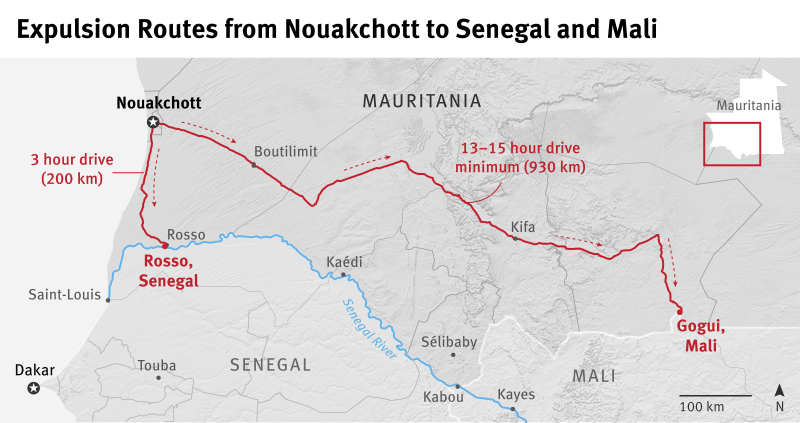
Mauritania’s police (DPAF/DST)[311] have carried out expulsions to the land borders using buses departing from the immigration detention centers in Nouakchott.[312] Migrants arrested or disembarked in other parts of the country were typically transferred to Nouakchott prior to expulsion. From Nouakchott, police transported migrants 200 kilometers south to the border town of Rosso, Mauritania, sending them across the river to the tiny town of Rosso, Senegal; or (up to March 2025) they drove them about 930 kilometers east to drop them at or near Gogui, Mali, a small border town in Mali’s Kayes region. In early to mid-2025, Mauritanian authorities also began expelling some migrants to new locations along its borders, including the remote village of Kabou (84 kilometers northwest of the Malian town of Kayes),[313] and reportedly the town of Kaédi near the Senegalese border.[314]
Between 2020 and 2025, Senegal has fluctuated in accepting and refusing nationalities other than Senegalese and Gambians, while Mali has received people of multiple nationalities expelled to Gogui (an aid worker in the area cited at least 16 African nationalities among arrivals).[315] Mauritanian authorities have often carried out expulsions without coordination with Malian authorities. “Many times the Malian authorities are not even aware,” a Malian aid worker said. “Mauritanian authorities just bring migrants [to the border], and they are left to walk into Mali. They don’t give lists to the Malian authorities... Sometimes the migrants don’t even pass by the border police.”[316] Even in November 2020, with the Mauritania-Mali border officially closed due to the Covid-19 pandemic, there were expulsions “every week, around 30 [people] each week,” a Malian border police officer said. He noted that Mali accepted all African nationalities even though there was “no official agreement” to do so.[317]
During the surge in expulsions in early 2025, civil society groups and Malian and Senegalese authorities protested the inhumane treatment of migrants, which included reports of beatings; non-return of money and valuables; expulsion of pregnant women, which involves health risks due the manner and location of expulsions; and failure to individually assess legal statuses.[318] This reflected a worsening of the same abuses Human Rights Watch has documented, detailed in this chapter. Mauritanian officials stated that all those expelled in 2025 were undocumented and that rights were respected.[319] However, according to news reports, the Mauritanian Association for Human Rights (AMDH) said that at least 700 people expelled in March had residence permits.[320] Aid workers in Mali confirmed to Human Rights Watch that pregnant women and people with valid residence permits in Mauritania were among those expelled in early 2025.[321]
In total, Mauritania expelled over 75,600 people to its land borders between 2019 and July 2025, based on data from the Mauritanian government.[322] The data provided does not distinguish between expulsions to Senegal or to Mali. However, the figures show sharp increases since 2023, with the number of expulsions during the first half of 2025 already nearly double those carried out during all of 2024.
Year | Expulsions by Mauritania |
2025 | 28,125 people (from January to July 15) |
2024 | 16,410 people |
2023 | 9,426 people |
2022 | 3,533 people |
2021 | 4,855 people |
2020 | 4,830 people |
2019 | 8,437 people |
These expulsions often involved groups of people expelled together without individual legal processes. Such cases constitute arbitrary or collective expulsions, prohibited under international law and African regional law.[323] Additionally, expelling people who may face risks of persecution, torture, or other serious harm can violate the international law principle of nonrefoulement.[324]
Though Mauritania’s 1965 immigration penalties law – amended by Law 2024-038 in September 2024, which added a reference to expulsion – criminalizes irregular entry or stay in the country,[325] migrants are generally not prosecuted for these two infractions, and the penalties of imprisonment or fines have rarely been enforced. Instead, police have often rapidly expelled migrants without court processes. Since September 2024, the police have referred some migrants but not others to court. Human Rights Watch interviewed three men expelled to Mali between December 2024 and March 2025 who, along with dozens of others expelled, never went to court.[326] However, in January 2025, a migrant community representative in Nouakchott said he had assisted seven migrants to pay fines of 10,000 MRU (US$250) at the Nouakchott West Court before their expulsion; he shared photos of the court receipts with Human Rights Watch.[327]
A former justice ministry official told Human Rights Watch, “In Mauritania, if people enter illegally, they’re expelled. It’s an administrative penalty… But these are not collective expulsions. …We can expel them in groups of people who came by same route, but we review case-by-case.”[328] A May 2025 government regulation states that expulsion is an “administrative act, not subject to appeal.”[329]
Since 2023 at least, the police have kept a database with information about the individuals detained prior to expulsion, including names, nationalities, expulsion dates, photos and fingerprints, according to the Ksar detention center director. “Asylum seekers and refugees are not expelled,” he said. “We are in touch with UNHCR to verify them.” He also said the police tried to limit migrant detention to 48 hours, noting that “we used to wait for [at least] 20-25 people to expel, but now we take even small groups.”[330] The May 2025 government regulation establishing standard operating procedures for the management of migrants cites a “72-hour period for the identification and processing procedure” after migrants are detained.[331]
While authorities have maintained for years that police carry out individual immigration status checks, Human Rights Watch documented numerous cases between 2020 and early 2025 in which this did not occur. Even when police do verify individuals’ statuses, due process rights are violated by the lack of opportunity to appeal deportations. In a 2022 report, the government itself recognized the need for “issuance of individual administrative decisions for migrants, communication of decisions through official channels, and establishment of an administrative appeal mechanism for decisions” related to expulsions.[332]
Human Rights Watch interviewed 37 people expelled from Mauritania, consisting of five teenage boys between the ages of 13 and 17, two women, and 30 men. Of these, 29 were expelled to Mali; 6 were expelled to Senegal; and 2 were expelled to both Mali and Senegal, on different occasions. Their expulsions mostly occurred between 2020 and 2025; two were in 2017 and 2018. Nine had been intercepted at sea, while the others were arrested on land.[333]
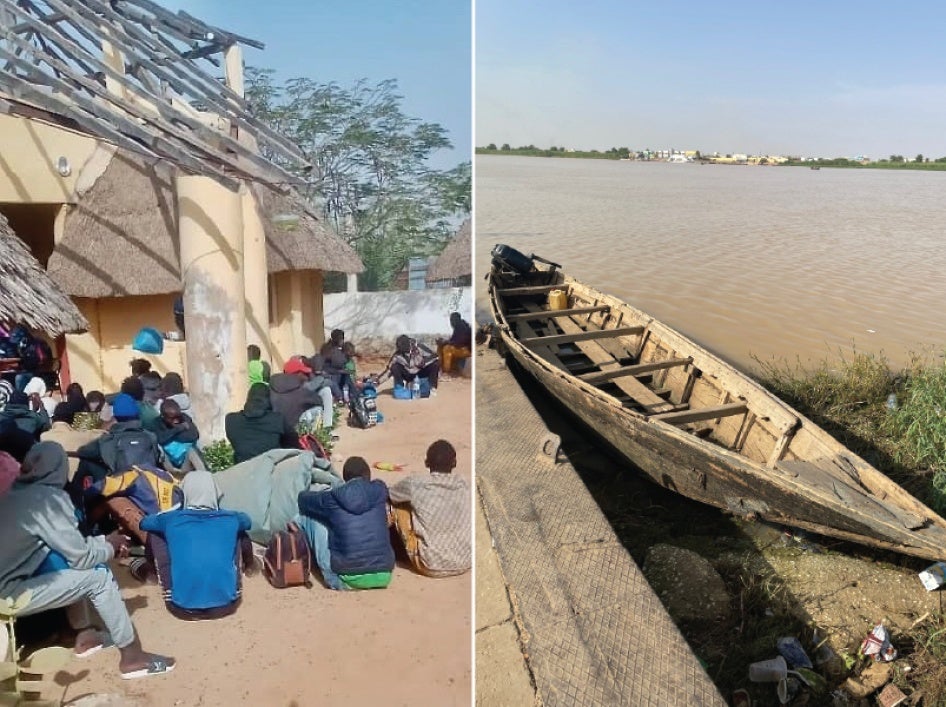
Interviewees expelled to Senegal included three non-Senegalese (two Guineans and one Cameroonian). Among the 30 interviewees expelled to Mali, 19 were not Malian, including Guineans, Sierra Leoneans, Liberians, Cameroonians, and one Senegalese woman, Ouleymata Mandiaye, who said authorities expelled her to Mali in November 2020 “because the Senegalese border was closed.”[334] The Malian Red Cross also assisted a group of eight Senegalese expelled to Mali in October 2023. “Does Mauritania even have the right to expel a Senegalese or Nigerian to [Mali]?” asked a Malian Red Cross worker. “Sometimes [Mauritanian authorities] say they transited Mali… but it’s not really verified.”[335]
Since late 2024, expulsions to Mali “intensified,” according to a Malian aid worker. “Previously it was two or three [groups] per month, but now we’re seeing 30-50 people every few days,” he said in October 2024.[336] The numbers increased further in early 2025.[337]
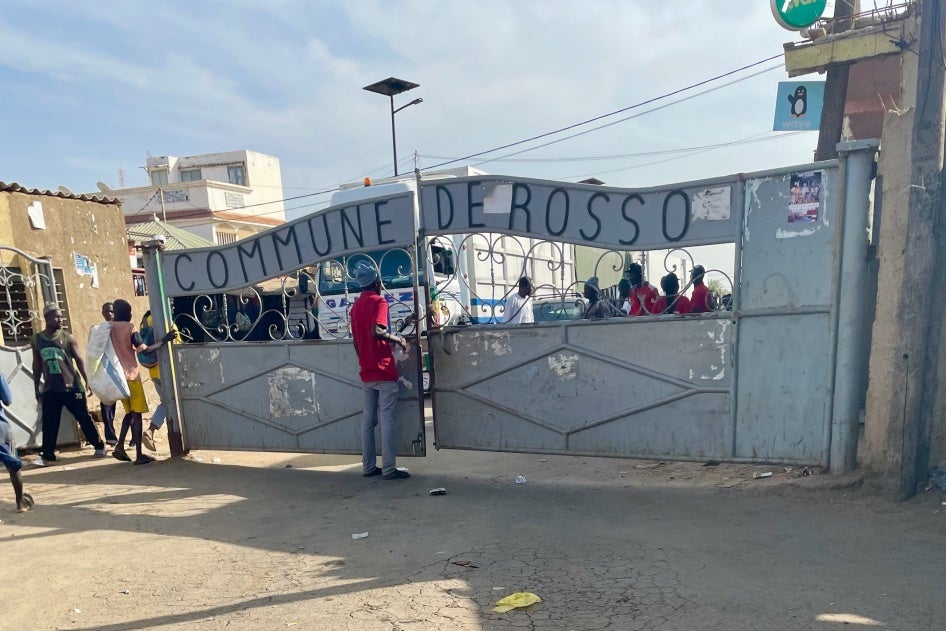
Expulsions to Mali: Security Risks and Limited Aid
Mauritania has put migrants at risk by expelling them to Mali, which is generally unsafe given the current context of ongoing armed conflict, with heightened risks in particular regions and border areas. For over a decade, Human Rights Watch has documented ongoing serious human rights abuses in Mali by Islamist armed groups linked to Al-Qaeda and the Islamic State, armed separatist groups, Malian security forces, government-allied ethnic militias, and, in recent years, fighters from the Russia-backed Wagner Group (rebranded Africa Corps) assisting the Malian government.[338] Following Mali’s military coups in 2020 and 2021, the UN peacekeeping mission pulled out of Mali at the request of the transitional military authorities in 2023, raising concerns about protecting civilians and monitoring abuses.[339] By late August 2024, over 600,000 Malians were displaced within and outside the country.[340]
Over the years, violence has spread from Mali’s north to much of the country. UNHCR’s “Position on Returns to Mali,” last updated in 2022, cited “the deterioration of the security and humanitarian situation” and called on states not to forcibly return to Mali anyone from seven of Mali’s ten regions, or from specific areas of the remaining three regions (Kayes, Koulikoro, and Sikasso), excluding the Bamako capital district.[341]
Since 2022, armed group activity has spread further. In September 2024, the Al-Qaeda-linked Islamist armed group known as the Group for the Support of Islam and Muslims (Jama’at Nusrat al-Islam wa al-Muslimeen, JNIM) launched a rare attack on Bamako.[342] Violence also increased in Kayes region, bordering Mauritania. The town of Gogui, where most migrants have been expelled, is located within the administrative area (“cercle”) of Nioro du Sahel, an increasingly insecure area in Kayes region. The town of Nioro du Sahel itself is around 67 kilometers from Gogui; migrants wishing to travel elsewhere in Mali must pass through Nioro. On January 6, 2025, JNIM attacked the town of Nioro, storming a police station and the governorate, which led to heavy gunfire.[343] On July 1, 2025, JNIM attacked Nioro again, as well as Gogui, the town of Kayes (the regional capital), and other towns in the area.[344]
Mauritania expelled migrants to Gogui both before and after the January 2025 attack on Nioro, according to aid workers and migrants interviewed in Mali. Human Rights Watch spoke with a 24-year-old Cameroonian man who said he was expelled there on January 15 with around 20 other people, including some children.[345] A 46-year-old Liberian man, Marco Gibson, said he was expelled around December 29, 2024, with around 25 people including women and children. Gibson said:
Some [in the group] were sick and some had been beaten… At the border, [Malian authorities] said, “It’s not only you; [Mauritanians] have deported so many Black people.” …The Malian military in Gogui helped us [with transport] to Kayes… people told us we were lucky we never came across an armed group.[346]
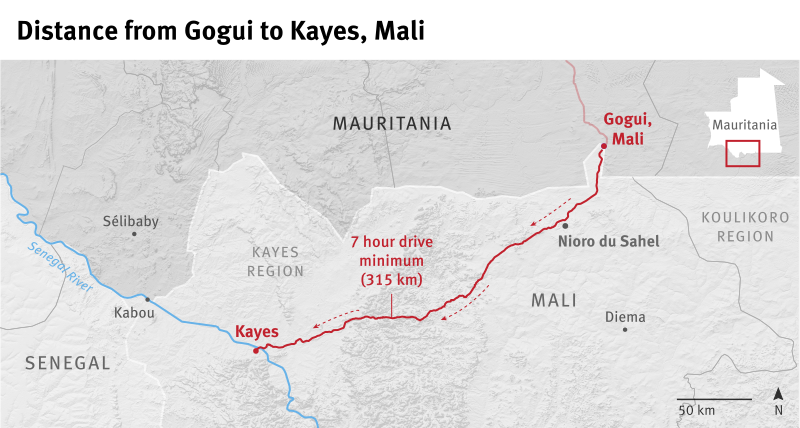
Due to Gogui’s remote location, limited humanitarian aid is available for people expelled there, many of whom arrive stripped of money and phones. Occasionally, Malian security forces or local authorities have provided support; the Malian Red Cross, IOM, and the Malian Association for Expelled People (Association Malienne des Expulsés, AME) are key groups assisting expelled migrants in Kayes region, but their capacity is limited. For years, Red Cross volunteers in Gogui have provided first aid, referred serious medical cases to the towns of Nioro or Kayes, and referred vulnerable migrants of specific profiles to other actors including IOM, UNHCR, and child protective services. Between 2023 and 2024, the Malian Red Cross assisted 332 people of 12 African nationalities expelled to Gogui with medical care, psychosocial support, or reconnecting with relatives, according to a representative in Kayes, who said this was only a small portion of those expelled. “Often the situation is overwhelming for us,” he said.[347]
In Nioro, a Malian AME aid worker has spent much of his time for many years – largely as a volunteer – assisting expelled and stranded migrants with transport, food, and shelter. “Each week I go to the border, to Gogui, and return,” he said. “There is no shelter here [in Gogui or Nioro]… When I built my house, I made a section to shelter migrants. When [expelled people] come, I notify the authorities and host them myself.”[348]
UN protection actors are not present near the border. “We… receive referrals from first line actors,” an IOM Mali representative wrote to Human Rights Watch. “Any identified vulnerable migrant at the bordering area with Mauritania… that is eligible for IOM’s assistance is transported to Kayes where there is an IOM presence/shelter.”[349] Some are then transferred to Bamako, which has another IOM shelter and NGO-run shelters. However, IOM’s protection assistance is mainly reserved for migrants asking for assisted voluntary return to their home countries, though people with “urgent needs” outside this framework can sometimes receive support, the representative said.[350] “The EU gives lots of money to IOM to shelter migrants, when it’s for voluntary returns,” said Ousmane Diarra, AME director, “but migrants expelled to Mali are not considered their [target] beneficiaries.”[351]
During 2024, IOM registered at least 4,143 people expelled by Mauritania arriving in Gogui, including 178 children.[352]
Expulsions to Senegal: Limited Aid
Rosso, Senegal, a remote border town in the region of Saint-Louis, is around 100 kilometers from the regional capital. As in Gogui, there is limited humanitarian or protection assistance available in Rosso.
Aid workers in Senegal said over the years that Mauritania has often expelled up to several hundred people there each month, periodically including children.[353] “The Mauritanian authorities don’t even inform us, they just do it [send migrants across the river] without warning,” said the mayor of Rosso in 2022.[354]
As of early 2025, only one shelter in Rosso, belonging to the Senegalese Red Cross, was available for migrants. Over the years, the Senegalese Red Cross and two associations, Diaspora Development Education Migration (DIADEM) and Association Relays Without Borders (Association Relais Sans Frontières), have provided basic assistance to some expelled migrants in Rosso, including first aid, clothes, food, and transport. However, they have struggled with limited funds and capacity.
“The migrants expelled to Rosso usually have spent several days without bathing or eating, and some arrive without [enough] clothes, or even barefoot,” said Mamadou Gueye, a member of DIADEM. “Sometimes Senegalese police in Rosso personally give food or money to expelled people… We have asked the government to set up a fund for this.”[355]
The relevant Senegalese government agency, BAOS (the Office for the Reception, Orientation and Monitoring of Senegalese Abroad and Migrants, under the foreign affairs ministry) “sent food, tea or coffee” for expelled migrants a few times in 2024, according to a Red Cross volunteer in Rosso. “They promised to do more,” he said, “but there’s not enough money.”[356] The BAOS manager for Saint-Louis region said, “Our efforts mostly focus on returned Senegalese migrants, but sometimes we’re obliged to help foreigners, especially in Rosso.”[357]
However, IOM in Senegal faces the same limitations as in Mali: “We can’t take charge of the expelled migrants because we only help voluntary returns, and we don’t want to support expulsions… [which] violate rights,” said an IOM Senegal official in 2023. “EU funds only allow us to support voluntary returns of Senegalese…if needed, we have to get funds from the Regional Office… There are extremely limited funds for other nationalities plus vulnerability.”[358]
Chain Expulsions and Pushbacks from Spain and Morocco
In some cases, Africans intercepted and forced back along the Atlantic Route experience chain expulsions. Cases documented by Human Rights Watch include people pushed back or expelled from Morocco to Mauritania, and people who arrived at Spain’s Canaries by boat and were expelled by Spanish authorities to Mauritania. The latter has occurred based on article IX of a 2003 bilateral readmission agreement permitting Spain to transfer third country nationals to Mauritania who have been “established” or “presumed” (two different standards) to have transited Mauritania.[359] After expulsion or pushbacks to Mauritania, the police took custody of these individuals and expelled them onwards to Mali or Senegal. In such cases, Spain and Morocco may share responsibility for subsequent rights violations against these individuals in Mauritania.
At least five flights expelled third country nationals from the Canaries to Mauritania between 2020 and 2023, according to Human Rights Watch interviews (cited below) and other reports. A European Council on Refugees and Exiles (ECRE) report stated:
In January 2020, 72 persons from Mali, out of which at least 14 were asylum seekers, were returned to Mauritania in the framework of a bilateral agreement… In November 2020, Spain further resumed the expulsion of migrants… Reports of returns from the Canary Island…without ensuring proper access to guarantees (i.e. legal assistance) and to the asylum procedure were made also in 2022.”[360]
In 2021, a UNHCR official told Human Rights Watch that three flights arrived in Mauritania from the Canaries in 2020. She said that UNHCR met only Malian nationals, and after screening 96 of them, found “only one person of concern who wanted to stay in Mauritania.”[361] A Mauritanian police official also cited a July 2023 flight carrying six Senegalese, stating, “We sent them to Rosso [Senegal].”[362]
Human Rights Watch interviewed two Malians, a 19-year-old man and 16-year-old boy, deported by plane from the Canaries to Mauritania around January 2021 and then expelled to Mali. Spanish authorities intercepted them at sea in mid-2020 and detained them on the Canary Islands for about six months until they revealed their nationality. The boy said he told Spanish authorities his age, but it made no difference. Arriving in Mauritania, the two said police detained them for five to six days in Nouakchott with only bread to eat before expelling them to Mali.[363]
Despite the above documented cases, the Mauritanian government wrote to Human Rights Watch that: “Since 2020, the Mauritanian authorities are not aware of any transfers carried out by the Spanish authorities to Mauritania under Article IX of the 2003 Agreement. No formal repatriation of third-country nationals, based on this mechanism, has been officially notified, coordinated or received by the competent services.”[364] However, the government said the 2003 agreement was still in effect, specifying that transfers of any third-country nationals would “require the transmission by Spain of formal proof attesting that the persons concerned actually transited through Mauritanian territory.”[365]
Human Rights Watch also interviewed three men expelled onwards from Morocco. A Senegalese man said Moroccan authorities intercepted him at sea in 2023 and detained him for 15 days before transferring him to Mauritanian custody. The Mauritanian authorities then expelled him to Senegal.[366] Two Guineans said that in 2022 when they tried to irregularly cross the border from Mauritania to Morocco-occupied Western Sahara, they encountered Moroccan security forces who beat them, took their IDs, phones, money, and water, and pushed them back to Mauritania in the desert, after which the Mauritanian authorities expelled them to Mali.[367]
Abuses During Expulsions
Between 2020 and early 2025, humanitarian actors in Senegal and Mali consistently described how expelled migrants arrived in poor physical condition, many with signs of abuse. “Often, they arrive chained at the Malian border. When you look at their wrists, you can see wounds,” said an AME aid worker in Nioro. “They often come without passports, IDs... Mauritanian authorities take their documents and don’t give them back.”[368] The coordinator of a migrant shelter in Bamako said those he hosted had often been “stripped of all their belongings” in Mauritania.[369] A 2023 IOM report said migrants arriving in Gogui “often present signs of immediate needs and extreme distress.”[370]
“Sometimes I see bruises or marks of injuries,” said Amedine Lo, the DIADEM representative in Rosso, Senegal. He said that according to the migrants he assisted, Mauritanian police had sometimes beaten those intercepted at sea who “resisted” being removed from boats or who “asked for their belongings” after police took their money and property.[371]
Human Rights Watch interviewed 18 migrants (3 boys, 15 men) who described abusive treatment by Mauritanian authorities during their expulsions. All were given little to no food and water; six said tight or prolonged restraints caused them pain; and three experienced or witnessed police violence.[372]
“We were handcuffed and chained for over 30 hours,” a 22-year-old Malian man said in describing his expulsion to Mali in 2021. “We spent the night at a building at the border…with no food.”[373]
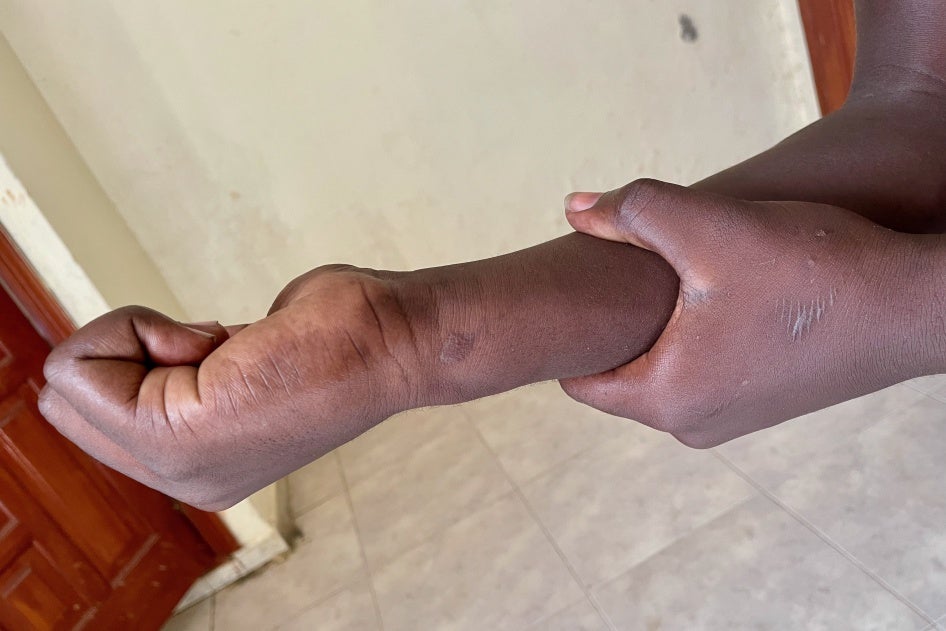
A 17-year-old Guinean boy expelled to Senegal in early 2021 said: “They handcuffed me [during the drive], for three hours. It was so tight that it hurt me, but when I told the police they didn’t listen. I have scars now.”[374] Human Rights Watch observed marks on his wrists.
A 19-year-old Malian expelled to Mali in March 2021 said: “The handcuffs were digging into my arms, so when the police pulled my arms, the cuffs cut my hands, and I fell. Two policemen came and kicked me when I was on the ground.”[375]
In November 2022, Human Rights Watch interviewed in person a group of Guineans (six men ages 18-27, and a 17-year-old boy) upon their arrival in Bamako, after their expulsion to Gogui two days prior. All were hungry, exhausted, and had been stripped of their money, phones, and other belongings.[376] They described several days in Mauritanian police detention, where they received little to no food and were unable to wash. They said police handcuffed them for the long bus journey to the Malian border, and “there was not enough water.”[377] They also witnessed police violence: “A Malian guy asked the driver to reduce the volume of the music, so [the driver] came and knocked his head, and… put his handcuffs really tight, for him to suffer.”[378] Upon arrival in Gogui, aid workers assisted the group with transport, food, and shelter.
Seven expelled migrants said that Mauritanian police confiscated and never returned their belongings, including phones, money, and identity documents. Marco Gibson, the Liberian expelled to Mali in December 2024, told Human Rights Watch that Mauritanian police took about 400,000 CFA [US $700] from him.[379]
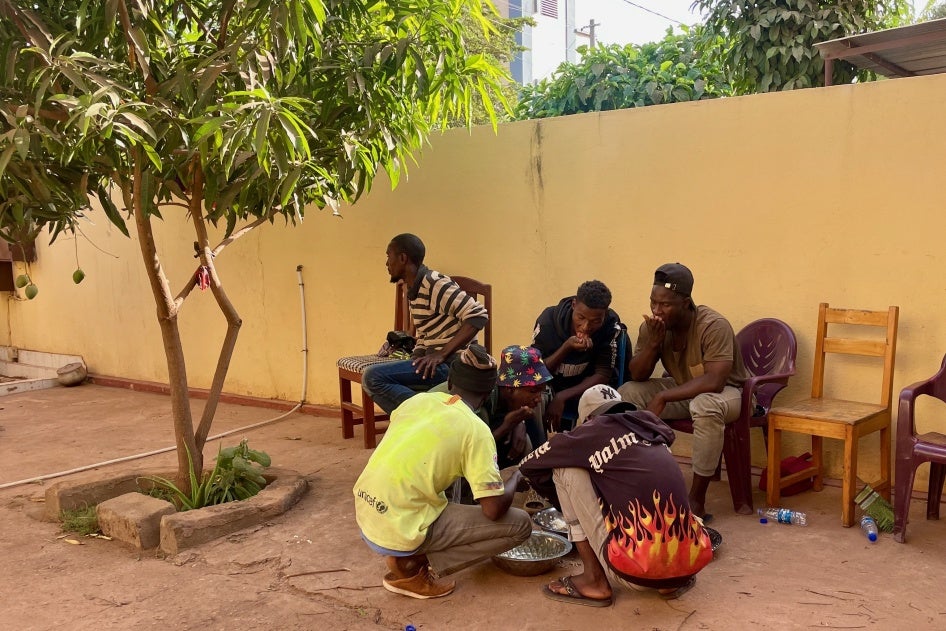
Mauritanian Expulsions of Children, Asylum Seekers, and Other Vulnerable People
Human Rights Watch documented Mauritanian expulsions of children, refugees, asylum seekers, pregnant women, and abuse victims to Mali, and expulsions of children to Senegal, between 2020 and early 2025.[380] While Mauritanian police authorities denied expelling refugees and asylum seekers, detaining children with adults prior to expulsion, or expelling unaccompanied children, the evidence proves otherwise, even if such cases are not systematic. Expulsion of vulnerable groups in this manner – with limited food and water, to remote or insecure areas, often to countries not their own – amplifies their vulnerability and protection needs.
“There are many children among those expelled,” said a Malian aid worker in Nioro in late 2024. “Young children are normally accompanied by family members… but I often see [unaccompanied] youth ages 15 to 17, girls and boys, but usually boys.”[381] A Mauritanian family ministry official acknowledged the problem: “If a child has no papers and seems older, authorities will expel him.” The official said IOM “intervenes often” with the police to prevent adolescent children from being expelled, coordinating with the family ministry to remove them from police custody.[382]
Human Rights Watch individually interviewed five teenage boys who were expelled in 2021 and 2022, three to Mali and two to Senegal. Over a dozen adults separately also described being expelled to Mali along with children between 2020 and 2025, including unaccompanied teenagers and young children with their mothers.[383] “The children had a hard time, because they were very hungry,” said a Malian man expelled in 2021.[384]
Esther Johnson, a 35-year-old Liberian woman who was living undocumented in Mauritania, told Human Rights Watch that she went to the police in Nouakchott in September 2022 to report domestic abuse by her fiancé, which had caused her to experience a miscarriage. She said the police ignored her report, arrested her, and expelled her and her 15-year-old son to Mali the next day. At the time of interview, she had not been able to obtain assistance from IOM in Mali to return to Liberia.[385]
Human Rights Watch interviewed two asylum seekers expelled to Mali: a Sierra Leonean man expelled in August 2021 while his UNHCR papers were still valid; and a Cameroonian man who said that his UNHCR asylum seeker document had expired but he was still awaiting his refugee status determination interview at the time of his expulsion in March 2025.[386]
Aid workers also reported other cases. “There are asylum seekers among those expelled [to Mali], but not ones who are registered... Many expelled before their [registration] don’t have documents to even show they applied for asylum,” said the aid worker in Nioro.[387] A UNHCR officer in Mauritania said that in 2023, “We had… two refugees and one asylum seeker… who contacted us and said there was a raid in Nouakchott… and they were expelled to Rosso, Senegal. They said they were not given a chance to get their documents. We did legal checks with authorities, and they said they didn’t have any record of those people being sent to Rosso.”[388]
2025 Update: Mauritanian Government Outlines Modified Expulsion Procedures
Since mid-2025, the Mauritanian government demonstrated an intent to modify its approach to expulsions, starting with the May 2025 regulation establishing standard operating procedures (SOPs) for the management of migrants.[389] In its July 2025 reply letter to Human Rights Watch, the government stated:
Since the promulgation of Joint Regulation No. 00591/2025, Mauritania has strengthened procedural safeguards relating to expulsion. Any person arrested for violating the migration regime is subject to a thorough individual assessment, identifying their protection needs, their actual administrative status, and the risks they may face upon return.
An appeals mechanism is currently being finalized. It will allow migrants… the opportunity to present evidence or documents… which may justify a temporary stay of removal.
These advances demonstrate the State's desire to strengthen guarantees of due process and respect for the right to asylum, while ensuring the proper functioning of the migration system.[390]
The government said expulsions would respect the principle of nonrefoulement and that unaccompanied migrant children will “never [be] expelled to land borders” but rather “oriented towards a durable solution, in conjunction with IOM, UNHCR or their embassies (family reunification, assisted voluntary return, local integration or resettlement).”[391]
The government cited “a strict ban on collective expulsions, particularly to unstable or dangerous areas,” but said Gogui, Mali and Rosso, Senegal would continue to be the main sites of expulsions, based on “their legal status, their logistical security, and the presence of minimal infrastructure.” The government did not address the issue of insecurity in Mali’s Nioro area and Kayes region, nor the limited humanitarian, protection, and transport services in Rosso and Gogui.[392]
The government said that “in order to avoid abandonment [of expelled people] in any dangerous or isolated areas,” and in line with the 2025 SOPs, “Mauritanian authorities will not carry out any expulsions without prior full coordination with the destination countries and the diplomatic or consular representations of the persons concerned,” and “security services on both sides of the border are informed in advance.”[393]
In response to a question on human rights monitoring of expulsions, the government said that “the CNDH [National Human Rights Commission] can exercise independent monitoring of… removal operations,” and that “UNHCR, IOM, ICRC, and partner NGOs are involved in monitoring.”[394]
Human Rights Watch welcomes all the information from the Mauritanian government, in particular on the measures that should increase protection of migrants’ rights and prevent abuse. However, we note that because these developments are very recent, Human Rights Watch has not yet evaluated on the ground the extent to which new measures are being implemented or standards fully observed.
V. Prosecutions and Due Process Concerns
“The presumption of guilt is the result of EU pressure. EU externalization has caused the need to find someone guilty, an organizer [smuggler]... But there is often a lack of knowledge of the crimes and constitutive elements that form the crimes.”
– UN human rights official, West Africa regional office, Senegal
All persons accused of crimes have the right to a fair trial and due process. Human Rights Watch documented violations of these rights in Mauritania with respect to people accused of immigration-related legal infractions, especially migrant smuggling.
Migrants and community leaders in Mauritania alleged that smuggling charges brought with little if any evidence and prolonged pretrial detention were recurring issues. Several people Human Rights Watch interviewed claimed to have been arbitrarily arrested and falsely accused of migrant smuggling. Some had been found innocent and released after months in prison, while others were imprisoned at the time of interview. During Human Rights Watch’s visit to Dar Naïm Prison in 2022, at least 17 people accused of migrant smuggling had been held in prolonged pretrial detention for longer than six months.[395]
Other common issues have included language barriers and limited access to legal aid and information. “Court proceedings are in Arabic, and migrants sign PVs [Procès Verbal documents listing the charges] that they don’t understand,” said a representative of the Mauritanian Human Rights Association.[396] In a positive step in May 2025, according to the former president of Mauritania’s National Human Rights Commission, the government “decided to create a team of…interpreters and translators within the courts.”[397]
Few organizations offer free legal aid to migrants in Mauritania. The National Authority for Countering Human Trafficking and Migrant Smuggling (INLCTPTM), which began operating in 2023 under the government’s human rights office, provides legal aid and other services to trafficking victims but not to people accused of smuggling, even though many such individuals are migrants themselves.[398]
While Mauritania’s 1960s immigration legislation criminalizes offenses linked to irregular entry and stay and (in some cases) irregular exit,[399] immigration-related prosecutions since 2020 have often been based on Law 2020-018, an amended version of a 2010 law that criminalizes migrant smuggling, the facilitation of irregular stay, and related acts, as well as attempts or complicity; penalties include prison and fines.[400] The law incorporates the migrant smuggling definition from the UN Convention on Transnational Organized Crime, Protocol against the Smuggling of Migrants by Land, Sea and Air:
the procurement, in order to obtain, directly or indirectly, a financial or other material benefit, of the illegal entry of a person into a State Party of which the person is not a national or a permanent resident.[401]
Between 2020 and 2023, the immigration offenses investigated and prosecuted most frequently were migrant smuggling, complicity in smuggling, or the use or fabrication of false identity or travel documents, according to a Nouakchott West Court official.[402] The official said in 2023 that the Nouakchott and Nouadhibou courts handled 90 percent of smuggling-related cases in Mauritania, with most at Nouakchott West Court. He said that migrant smuggling cases were often prosecuted as misdemeanors, and the right to a government-provided lawyer only applied in felony cases.[403]
Two new laws adopted in late 2024 also shifted the legal landscape in Mauritania. Law 2024-038 amended the 1965 immigration penalties law, mainly by adding language on expulsion for irregular entry or stay; while Law 2024-039 created a Special Court for Countering Slavery, Human Trafficking, and Migrant Smuggling.
The Mauritanian government did not share data with Human Rights Watch on annual prosecutions and convictions for migrant smuggling. However, as of June 2025, 300 people were imprisoned in Mauritania on migrant smuggling charges (83 convicted and 217 in pretrial detention), out of a national prison population of 3,250.[404]
According to the government, “Pretrial detention may be ordered by the investigating judge when it is justified either by the seriousness of the facts or… to prevent the disappearance of evidence…, the flight of the accused, or the commission of new offenses. The perpetrator of the offense of migrant smuggling often meets all, if not most, of these conditions.”[405] Mauritanian law limits pretrial detention to four months for misdemeanors and six months for felonies, renewable once. In cases of “an offense committed by an organized gang, such as… migrant smuggling,” the government says, pretrial detention can be extended to two years for misdemeanors and three years for felonies,[406] However, in certain alleged migrant smuggling cases – such as those with little evidence, cases without aggravating circumstances such as migrant deaths or human trafficking, and cases of lower-level alleged “complicity” (especially those involving migrants themselves) – pretrial detention for longer than six months is likely to be disproportionate. International law requires pretrial detention to be used only as a last resort, for the shortest time possible, and only for the most serious offences.[407]
Legal Gaps, Confusion, and Inconsistencies
Multiple migrants and a Mauritanian interviewed who had been arrested and/or prosecuted did not understand the concept of “migrant smuggling,” saying that authorities had accused them of “clandestin” (French for “illegal”). In Mauritania and Senegal, the term clandestin has for years been colloquially used by migrants, citizens, and even law enforcement to refer to both “illegal” (irregular) migration and migrant smuggling. This illustrates the persistent confusion outside the courts over the difference between the two legal infractions.[408]
The word is also colloquially used in both countries to refer to people themselves: while “clandestins” (“illegals,” or “illegal immigrants”) can refer to undocumented migrants, it has been increasingly used to refer to people attempting to leave by boat for Spain. Even senior Mauritanian officials demonstrated this perception. A senior police official said that “clandestins” were “people trying to organize journeys to Europe.”[409] The director of the Ksar detention center in Nouakchott, referring to the police expulsions of migrants, said: “The ones trying to go to Spain, clandestins, must be secured [handcuffed]. It’s not the same thing as… those who are undocumented.”[410] A former Mauritanian justice ministry official said: “Most migrants are not illegal when they’re here in Mauritania; most just become illegal when they try to leave irregularly for Europe.”[411]
However, provisions in Mauritanian law criminalizing irregular exit do not apply to all foreigners in all circumstances.[412]
During the first few months of operations of the Special Court for slavery, trafficking, and smuggling, in late 2024 and early 2025, confusion persisted among authorities, UN officials, civil society, and migrants in Mauritania about the court’s role and enforcement of the amended immigration penalties law (Law 2024-038). Sources described the court being used not only to investigate and prosecute smuggling and trafficking cases and refer victims to the National Authority on trafficking and smuggling (INLCTPTM) for assistance, but also to issue fines to migrants, for unclear reasons.[413] “The new court has started to fine immigrants before deporting them,” the judicial official said.[414] “So far there is no coherency between what different authorities say [about the Special Court],” a UN official said in January.[415] A migration expert in Nouakchott said in February:
The Special Court… is intended... principally for smugglers, and also those who entered the territory illegally… But people staying irregularly are not being targeted [for prosecution]… even though law says they could be prosecuted and subject to fines. …People attempting to travel [by boat to Spain], it’s these people they’re fining 10,000 MRU [$250].[416]
However, in their July 2025 letter to Human Rights Watch, the Mauritanian government stated: “Foreigners attempting to leave the country irregularly are prosecuted, where appropriate, for their irregular entry or stay and not for their attempt to leave the country, unless they are found to be complicit in migrant smuggling[…].” The government also said that the Special Court has “exclusive jurisdiction over migrant smuggling offenses,” but “may [also] hear offenses relating to the entry and residence regime, without having exclusive jurisdiction over them.”[417]
Alleged False Accusations and Limited Evidence
Six men interviewed by Human Rights Watch said Mauritanian authorities had arrested them between 2020 and 2023 and referred them to court for what they alleged were false charges of migrant smuggling or complicity.[418]
Ten other similar cases that appear to corroborate our findings were also reported to Human Rights Watch by migrant community leaders in Nouakchott, a fish merchant in Nouadhibou, and friends and family members of migrants in Mauritania and Senegal.[419] “In 2022, there were six cases of Malians all falsely accused of smuggling,” said a Malian community representative in 2023. “I got a lawyer to help and was able to free five.”[420]
A Senegalese man interviewed in Dar Naïm Prison in June 2022 during his seventh month of pretrial detention, accused of complicity in migrant smuggling,[421] told Human Rights Watch:
I have some friends who are fishermen like me… One day, we were having tea, and gendarmes descended on the house… They said, “You are accused of…clandestin…” But they had made a big mistake… We don’t even have a big pirogue, just little pirogues for fishing.[422]
A Mauritanian fish merchant described how two Senegalese fishermen he employed, both documented and with authorizations to fish, were intercepted in their fishing boats by the coast guard, accused of smuggling, and imprisoned pending judicial investigations in 2021 and 2022. They were released after eight and six months of detention.[423] One of the two fishermen told Human Rights Watch:
They accused me without proof… They only asked me one question at court… “What were you doing in the pirogue?” I explained I was waiting for my brother to go out to fish. …I showed my license, fishing authorization, ID, and residency permit…to the coast guard, police, the judge – but they refused to listen.[424]
His boss, the fish merchant, added, “He had only put 60 liters of fuel in the pirogue – that can’t even go 100 kilometers, and it’s 690 kilometers to Spain from here.”[425]
A Senegalese man convicted of smuggling in June 2022, interviewed in Dar Naïm Prison, claimed he was wrongly accused: “I wanted to leave [on a boat to Spain], so I paid an agent to go illegally… They didn’t do an investigation to find who was and wasn’t an organizer. There was no proof. I had only 800 [MRU] [US$20] in my pocket. We are clandestins, not criminals. We shouldn’t be here [in prison].”[426]
Another Senegalese man, convicted in November 2022 of “the misdemeanor of attempted migrant smuggling,”[427] told Human Rights Watch:
In Nouakchott [in April 2022], I often had tea with two Senegalese guys. One day…entering the house, I found police in plainclothes there. They accused me of trying to go to Europe… [At the police station,] one white [European] man…not in uniform…listened while the police chief asked questions. They said I’m trying to go to Europe, that I knew someone organizing travels to Europe. I kept repeating, “No, I never planned any of that.”[428]
Human Rights Watch reviewed the West Nouakchott Court ruling on the man’s case, which convicted him, two other Senegalese, and a Mauritanian in absentia. The ruling said “the means of committing the crime found in their possession” were “a 40-horsepower Yamaha engine and an amount of: 12,200 ouguiyas” (if referring to MRU, around US$300; if referring to “old” ouguiyas, around $30).[429] It is unclear how this amount of money could indicate culpability in smuggling, as smugglers typically collect the equivalent of thousands of dollars from passengers.[430] The man appealed his five year sentence, reducing it to three years.[431]
In addition to the act of organizing irregular entry into a state, a constitutive element to the offense of migrant smuggling is, according to Mauritanian law and the UN Protocol, that the act be committed “in order to obtain…a financial or other material benefit.” However, multiple documented cases appeared to involve little or no evidence of such a benefit. For example, in the case of M.B., the Black Mauritanian man who reported that the police tortured him in August 2022, the police arrested M.B. on his way to meet a group of irregular migrants and accused him of smuggling, but had little evidence against him because “nobody came forward to say ‘I paid money to go to Europe,’” M.B.’s friend told Human Rights Watch.[432]
Targeting Accomplices
In Mauritania, “Often we catch the accomplice, but not the main perpetrator [smuggler running a criminal network],” said a judicial official in Nouakchott. “Often they have fled, or are abroad.”[433] Many of those targeted for arrest and prosecution played smaller roles, such as people who house, store luggage for, or collect money from migrants; boat “captains”; or fishermen accused of preparing boats to carry migrants. A UN official in Nouakchott said:
[Since 2020,] the government is very hard on all intermediaries. Even guys sheltering migrants can get three years in prison… As they cannot target the big guys, they are targeting the small guys…[who] could be migrants themselves… The big networks are very difficult to cut. …Like everywhere, the police try to catch the small fish, not the ones that have all power.[434]
Authorities’ Collusion in Smuggling
Six interviewees also alleged that Mauritanian authorities, particularly coast guard officers, colluded in migrant smuggling, which could explain why there were few arrests of major smugglers.
A Mauritanian fish merchant in Nouadhibou, who knew people in Nouadhibou who had attempted to leave irregularly by boat, said: “The authorities here are accomplices. You pay… and they say, ‘You can go at this time.’ Then they can call their boss and say, ‘There are people about to leave,’ and they get caught. …There is not a pirogue that can leave here without the agreement of the authorities.”[435] Another Nouadhibou local said the same thing.[436]
A Senegalese fisherman in Nouakchott said: “People who want to organize illegal travels pay [coast guard officers], who escort them to depart. I have two friends who did that [in 2020].”[437] An aid worker in Nouakchott made the same allegation.[438]
Two migrants who attempted boat journeys to Spain also described directly witnessing authorities’ collusion with smugglers. A Sierra Leonean asylum seeker, intercepted in a house in August 2021 with other migrants preparing for a boat departure, said: “The police arrested everyone, except…the organizers [smugglers]. They had collected money from us and then went to the police. They were standing right in front of us, but [the police] let them go.”[439] Moussa Ba, a Senegalese man, said that he embarked in July 2023:
[The coast guard] who intercept migrants are in collaboration with the organizers of the voyages. We were 127 people… they helped us depart – they took us from the vehicle and put us in the pirogue. The organizers paid them. They were in uniforms, faces covered… In Mauritania, you can’t send a pirogue to Europe without the Mauritanian [coast guard] being involved.[440]
VI. Externalization of Migration Controls
“Externalization” is the increasingly prevalent global trend of wealthy countries seeking to prevent the entry of irregular migrants by outsourcing migration controls and extending border enforcement beyond their territories to migrants’ countries of origin and transit. This includes direct actions, such as interdictions and pushbacks, and more indirect actions, such as political agreements, support to countries’ border and migration management forces and systems, and development aid or other benefits linked to or conditioned on migration control.[441]
Externalization efforts by Spain and the EU in Mauritania trace back to the early 2000s, during the first major activation of the Atlantic Route.[442] The EU’s response between 2006 and 2018 included boat patrols and aerial deployments along West African coasts by Spanish forces and Frontex, the EU’s Border and Coast Guard Agency, which participated in interceptions and forced returns of migrant boats. Frontex no longer has an operational presence in West Africa, though it continued intelligence-focused activities there and sought from 2022 to 2023 to negotiate for legal authorization to deploy operations to Mauritania and Senegal.
In addition to their participation in EU and Frontex initiatives, Spain has bilaterally continued externalization in Mauritania since the early 2000s through transfers of third country nationals; deployments to Mauritania of Spanish Civil Guard and police personnel, vessels, and aircraft; and funded support to Mauritanian border control forces, including €10 million annually for the Mauritanian coast guard since 2017.[443]
According to the scholar Dr. Hassan Ould Moctar, the Mauritanian government’s National Migration Strategy, adopted in 2010, was originally “written up by a team of European technical experts” and demonstrates an “underlying logic of containment.” By around 2012, “the externalisation process…initiated in 2006 had been thoroughly absorbed within Mauritanian state institutions.”[444]
In March 2024, the European Commission and Mauritania signed a Joint Declaration launching a new EU-Mauritania migration partnership, accompanied by €210 million for Mauritania to “support migration management, including the fight against migrant smuggling, as well as promoting security and stability, humanitarian aid for refugees and support to host communities… [and] investments, infrastructures and job creations.”[445] The European Commission said this includes “EUR 100 million of budget support [to the Mauritanian government], EUR 60 million for different actions in the field of migration and forced displacement, EUR 22.5 million for enhancing cooperation on security under the African Peace Facility, EUR 20 million… [for] investments promoting job creation, and [EUR 7.5 million for] humanitarian assistance to vulnerable populations.”[446]
Both before and after the 2024 EU-Mauritania agreement, the EU has provided Mauritania with financial, technical/operational, and other support through an array of funding instruments and projects intended to improve border security and migration management in Mauritania, support humanitarian and protection responses, and, ultimately, reduce irregular migration to, through, and from the country.
Due to the lack of publicly accessible, clear, and centralized information about all of these initiatives, as well as the frequent blending of development, humanitarian, security, and migration management objectives within projects, it is nearly impossible for the public to trace the full scope of the EU’s migration-related interventions in Mauritania. However, this chapter and Annex I (at the end of the report) highlight some key EU projects related to migration control, mostly implemented through two EU external funding instruments: the 2015-2021 “EU Emergency Trust Fund for stability and addressing root causes of irregular migration and displaced persons in Africa” (EU Trust Fund for Africa, EUTF or EUTFA),[447] and the post-2021 “Neighbourhood, Development and International Cooperation Instrument” (NDICI).[448]
Ever since the launch of the EUTFA, the EU has pursued an approach of “addressing irregular migration through a multidimensional response”[449] in Mauritania and in Africa generally, by supporting capacity building among African border and migration control forces (securitization and deterrence) while seeking to address the “root causes” of migration through projects in a range of areas such as protection, peace and security, jobs, professional training, economic development, youth empowerment, food security, addressing climate hazards, and education. In Mauritania, the EU spent at least €89.5 million on EUTF projects between 2015 and 2021,[450] and at least €237.93 million through the NDICI between 2021 and 2024,[451] totaling over €327 million. EUTF and NDICI projects totaling at least €61 million took a securitization approach (focused on border/migration control) in Mauritania between 2016 and 2023,[452] in addition to an unspecified portion of the €95 million in “budget support” to the Mauritanian government in 2024.[453]
Separately, between 2022 and 2025, the EU designated €47 million through another instrument, the European Peace Facility, to equip Mauritania’s armed forces including the army and navy, for purposes blurring between security and border control.[454]
If Spain’s bilateral support is included, the EU and Spain have together spent well over €100 million on border and migration control in Mauritania since 2015, with much of this supporting Mauritanian security forces, particularly the coast guard, gendarmerie, and police. Given evidence of serious abuses against migrants and Black Mauritanians by these forces between 2020 and 2025, for example as documented by Human Rights Watch in this report, continued EU and Spanish support to these forces – as well as the participation of Spanish officers in migration control and anti-smuggling operations in Mauritania – could risk making the EU and Spain complicit in future human rights violations.
On the positive side, many EU programs in Mauritania have focused on areas such as human rights, development, peacebuilding, protection of children and refugees, assistance to migrants, and support to civil society.[455] In its July 17, 2025 letter to Human Rights Watch, the European Commission referenced, for example, that the EU had funded food, medical care, and shelter for 3,126 migrants disembarked from boats since June 2023, while “thousands in need of international protection are receiving support to enhance their livelihoods and self-reliance.”[456]
Outside of the EUTFA and NDICI, the EU has spent hundreds of millions on development aid to Mauritania through other instruments such as the European Development Fund,[457] while Spain has provided other development aid bilaterally.[458] In another positive, the EU and Spain have increased attention to legal migration pathways for Africans to work and study in the EU.[459] In 2024, Spain signed agreements with Mauritania, Senegal, and The Gambia with provisions on increasing circular migration (temporary work opportunities in Spain)[460] and announced plans to regularize many undocumented migrants in Spain.[461] EU Talent Partnerships with some African countries focus on opportunities for “students, graduates and skilled workers,”[462] while the EU’s 2023 “Action Plan for the Western Mediterranean and Atlantic Routes” includes “legal pathways to protection in the EU through resettlement, humanitarian admission and complementary pathways.”[463] The 2024 EU-Mauritania partnership lists “promoting legal migration” among its objectives, including by “explor[ing] possibilities to enhance circular mobility” and “improv[ing] the procedures for issuing visas.”[464]
A European Commission official told Human Rights Watch: “Border management… is a minor element of what we do compared to supporting international protection, [addressing] root causes [of migration], etc. The situation is complex, and our approach to migration is holistic. …Sometimes sectors are interlinked – governance, security, migration.”[465]
However, others have criticized this approach. A 2024 European Court of Auditors report found that the EUTFA was “spread too thinly” to address migration, financing “too broad a range of actions in the areas of development, humanitarian aid, and security”; that job creation in Africa was overstated; and human rights risks were not properly addressed.[466] Oxfam highlighted risks linked to “the EU’s formalization of the pursuit of domestic migration concerns under the guise of development assistance” through the EUTFA and NDICI, noting that “insufficient documentation hinders monitoring and scrutiny needed to ensure NDICI migration programming meets the EU’s legal obligations for development spending.”[467] A European Parliament human rights committee said it “regrets” that the “EUTFs… bypass parliamentary scrutiny” and “lack transparency and… accountability”; “that detailed data on funding allocations is not available or…hardly accessible”; and “that EU funds have been used to put pressure on partner governments to comply with the EU’s internal migration objectives,” with “increasing recourse to…conditionality between development cooperation and migration management.”[468]
Regardless of the proportion of EU funding dedicated to border/migration control versus other areas, the reality is that EU and Spanish funds have supported—without adequate human rights safeguards—Mauritanian security forces that have committed abuses. EU incentives to and pressure on Mauritania to control irregular migration have encouraged the harsh deterrence-and-repression approaches documented in this report, including boat interceptions, mass arrests of migrants, detention, collective expulsions, and criminalization of irregular migration. This replicates the EU approach documented across North Africa, including in Tunisia, Libya, and Morocco.[469] It also disregards African objectives for regional and continental free movement.[470] In 2023, the African Commission on Human and Peoples’ Rights stated:
The hardening of European migration policy,…focused on deterring irregular migration, has… led to the emergence of a repressive migration policy across the Maghreb. The region’s countries are subjected to European pressure to control the EU’s external borders and to impose repressive policies focused on securitization, particularly in…maritime border control.[471]
The African Union denounced European externalization as “responsibility and burden shifting,” stating that it “perceives such attempts as an extension of the borders of [European] countries and an extension of their control to the African shores,” which it called “xenophobic” and “unacceptable.”[472]
Leading up to the 2024 Africa regional review of the Global Compact on Migration, stakeholders “strongly urge[d]” West African states “to work together against external influence in securitizing or restricting free movement within the region, as well as…abuse of migrants’ rights.”[473] Responding to the 2024 EU-Mauritania migration deal, Hassane Koné, senior researcher at the African Institute for Security Studies, wrote:
African countries should avoid devoting resources and European “development aid” to strengthening border control. Instead, they should invest in collective solutions that address the root causes of irregular migration, including improving the governance of investments aimed at creating jobs and reducing poverty and inequality. …Instead of becoming Europe’s border guards or resettlement sites, transit countries should consult with countries of origin and destination… to find solutions that suit them.[474]
Spain
Spain has numerous bilateral cooperation agreements with Mauritania related to migration and border control, including the 2003 agreement allowing Spain to deport to Mauritania third country nationals “ascertained” or “presumed” to have transited Mauritania.[475] At least five such flights expelled third country nationals to Mauritania between 2020 and 2023, after which individuals – including children – were detained and expelled, in abusive conditions, to Senegal and Mali.[476]
In 2006, Spain’s Agency for International Development Cooperation funded the creation of Mauritania’s first immigration detention center, in Nouadhibou. The center, nicknamed “Little Guantánamo,” closed between 2010 and 2012 following criticism over poor conditions and abuses.[477]
In 2018, Spain spent €680,000 on equipment in Mauritania and Senegal, including computers and vehicles (4x4s, quads, and minibuses), for “the surveillance and transport of immigrants,” according to the Spanish newspaper El Pais.[478] As documented by Lighthouse Reports, vehicles supplied by Spain have been used by Mauritanian police to carry out migrant expulsions.[479] Since 2017, Spain has also spent €10 million per year on support to the Mauritanian coast guard, including training and equipment.[480] In a 2022 bilateral deal, Spain agreed to provide Mauritania even more “logistical and technical resources” for migration control.[481]
Additionally, “[a]pproximately 100 members of the National Police and Civil Guard are deployed at all times in Mauritania, Senegal and The Gambia,” according to Spain’s 2025-2028 Africa Strategy.[482] In Mauritania, Spain has deployed security officers since 2006 to support Mauritanian forces in anti-smuggling, maritime surveillance, and border control operations, including migrant boat interceptions.[483] Spain originally sent four patrol boats, a helicopter, and 20 Civil Guard officers to Mauritania in 2006.[484] Between 2018 and 2025, the Spanish Civil Guard operated two speedboats, a helicopter, and periodically a maritime surveillance plane, “for the benefit of the [Mauritanian] Coast Guard and the Mauritanian maritime gendarmerie,” conducting joint patrols.[485] A memorandum of understanding requires Mauritanian gendarmerie presence on any Spanish boats patrolling Mauritanian waters.[486]
A joint investigation team of Spanish and Mauritanian police has operated in Nouadhibou since 2008, with another activated in Nouakchott in 2022.[487] These teams “carried out a large number of investigations, operations and arrests of smugglers” which “resulted in legal proceedings.”[488] The Mauritanian government said that joint police efforts had “led in 2021 to the arrest of 173 [smugglers], 2,137 illegal immigrants, …[and] more than 3,000 people preparing to emigrate illegally…with a view to expelling them.”[489]
Migrant Encounters with Spanish Authorities in Mauritania
Seven people (six migrants and one asylum seeker) interviewed by Human Rights Watch described observing or interacting with Spanish police or Civil Guard officers during their arrests or detention by Mauritanian police between 2021 and 2022. Six cases involved human rights violations by Mauritanian authorities – arbitrary arrest or detention, abusive detention conditions, children detained with adults, and/or expulsions without due process. All six observed Spanish officers at the immigration detention centers in Nouadhibou and Nouakchott, highlighting that Spanish authorities are or should be aware of the conditions of detained migrants.[490] In the seventh case, a man alleged he was falsely convicted of migrant smuggling.[491]
Thierno Diallo, a 34-year-old Guinean man, said four Mauritanian police officers accompanied by three Spanish officers arbitrarily arrested him in February 2022 when he was working legally as a driver in Nouadhibou. He said the police accused him of involvement in smuggling, and “the Spanish…recorded my name.” Ultimately no smuggling charges were brought against him, but Mauritanian police nonetheless expelled him for allegedly planning to travel irregularly to Spain. Prior to his expulsion to Mali, Spanish officers visited the Nouadhibou detention center: “After three days without eating, I told the Spanish chief, ‘They’re not feeding us’… only then did they give me some bread.”[492]
A 27-year-old Guinean said in November 2022, Moroccan security forces at the Mauritania-Western Sahara border beat him, took his money and phone, and pushed him back into Mauritania, after which Mauritanian police arrested him. In police detention in Nouadhibou, where he received only bread to eat, he said, four Spanish officers interrogated him about his nationality, journey, and whether he had used smugglers. No one screened him for medical or protection needs.[493]
A 39-year-old Senegalese man, who was living and working legally in Mauritania as a fish merchant for a Mauritanian boss (whom Human Rights Watch also spoke with), said Mauritanian police arbitrarily arrested him in Nouadhibou in July 2021; detained him in Nouadhibou and Nouakchott, where he saw several teenage boys in detention; and expelled him to Senegal without due process.[494] “Spanish Civil Guard…showed up at the police [center in Nouadhibou] the day after we were arrested, and they took two people to interrogate… who were suspected of being smugglers,” the man said. “The Mauritanian police were also filming and took photos…to send to the Spanish.”[495]
A 17-year-old Guinean boy said he attempted a boat journey in February 2021, experienced abuse by Mauritanian gendarmes upon disembarkation, and was held in immigration detention in Nouakchott. In detention, he said he saw a Spanish officer who visited and “looked around.” He was expelled to Mali shortly after.[496]
A Senegalese woman said that four Spanish officers had accompanied Mauritanian police who arrested her and seven other West African women in a house in Nouadhibou in June 2022. She said the police transferred all the women to detention in Nouakchott, but later released three women with UNHCR asylum seeker or refugee documentation. It was unclear why those women were originally arrested.[497]
Frontex
Under Operation HERA (HERA I, II, and III) between 2006 and 2018, Frontex coordinated patrols off the coasts of northwest Africa to intercept boats carrying migrants and asylums seekers in international waters – and in Mauritanian and Senegalese waters, with their agreement – using its own equipment, vessels and planes, and occasionally through joint operations with Mauritanian and Senegalese forces.[498] Frontex reported that during HERA II, “3887 illegal immigrants on 57…(small fishing boats) were intercepted close to the African coast and diverted,”[499] while during HERA III, 2,020 irregular migrants were intercepted and 1,559 were “diverted back.”[500] The European Center for Constitutional and Human Rights (ECCHR), which attempted to obtain Frontex documentation on HERA, reported that it was unclear what “screening activities” were conducted before returns. ECCHR highlighted the “accountability and transparency deficits,” noting that “Frontex redacted significant parts of the documents provided, including information on potential human rights violations.”[501] In 2024, the European Parliament said HERA had still “not been evaluated on its impact on… the human rights of migrants,” including in Mauritania.[502]
Since 2020, Frontex has stationed a Liaison Officer in Senegal focused on intelligence-gathering and capacity-building with national security forces; in 2023, that officer’s mandate expanded to cover Mauritania and Gambia.[503] In 2022, Frontex opened a “Risk Analysis Cell” in Mauritania as part of the Africa-Frontex Intelligence Community (AFIC), which Frontex established in 2010 to increase information sharing on “migrant smuggling and other border security threats” with around 30 African states. Between 2017 and 2023, under an EU-funded project, Frontex supplied equipment for Risk Analysis Cells and trained local border police analysts in Mauritania and seven other AFIC countries on collecting and analyzing data on subjects such as irregular border crossings, document fraud, smuggling, and trafficking.[504]
In 2022, the European Commission began negotiations with Mauritania and Senegal over potential legal “status agreements” to allow Frontex to deploy border guards, vessels, and surveillance equipment to the two countries, in order to “perform tasks with executive powers” and conduct joint border management operations.[505] These would have been the first such agreements with non-European countries. As status agreements must be approved by the European Parliament, two special rapporteurs for the Committee on Civil Liberties, Justice and Home Affairs (LIBE) conducted a fact-finding mission to Mauritania and Senegal in February 2023 to assess the potential human rights implications. Dutch MEP Tineke Strik, the Mauritania rapporteur, expressed several concerns, including related to the “broader trend of externalization” and access to protection for people intercepted by Frontex.[506]
Between April and October 2023, Human Rights Watch presented initial findings on abuses against migrants in Mauritania at several European Parliament committee meetings, recommending against the Frontex status agreement. In November 2023, MEP Strik’s LIBE Committee report was published and a European Parliament non-legislative resolution was adopted by 390 votes to 135, both referencing Human Rights Watch’s findings and raising concerns about the potential Frontex-Mauritania status agreement, including:
That a fundamental rights impact assessment was not done before beginning negotiations with Mauritania;[507]
The “high risk of violations of fundamental rights and international protection obligations that are of a serious nature and likely to persist” in Mauritania, and potential “severe accountability gaps in the event of…rights violations”;[508]
Potential provisions related to immunity for deployed Frontex personnel which risked “fostering impunity,” and “uncertainty regarding [Frontex’s] legal accountability… under joint operations” in Mauritania;[509]
The “limited external possibilities to submit complaints” (for non-EU citizens, e.g. Africans, impacted by Frontex operations);[510]
The lack of a national asylum system in Mauritania;[511]
Risks related to data collection;[512]
The “potential impact…on the freedom of movement in West Africa.”[513]
In response to Parliament’s resolution, the European Commission and Frontex stated that a “[human rights] impact assessment…cannot be conducted before engaging in negotiations because it is these negotiations that identify the…scope of Frontex’s deployment”; that “the Commission is satisfied that the Frontex’s current complaints mechanism is accessible to Union and non-Union individuals”; that the “[Frontex] Fundamental Rights Officer [FRO] is actively consulted at every stage…prior to the launch of any joint operation”; and that human rights trainings would be conducted with Frontex participants and could potentially be organized with Mauritanian authorities. They also stated that “rules on the handling of sensitive non-classified information prevent Frontex from making [FRO reports] public unless they were…heavily redacted.”[514]
After several rounds in 2022 and 2023, negotiations with Mauritania and Senegal on Frontex status agreements stalled, after being “deemed too ‘politically sensitive’ by Mauritanian authorities.”[515] Instead, discussions shifted to possible Frontex “working arrangements” which would focus instead on information exchange, capacity-building, and readmissions, with no operational deployment. Working arrangements do not require parliamentary approval, which limits oversight.[516]
In October 2024, Spain’s interior minister urged the European Commission and Frontex to try again to secure permission for Frontex to patrol West African coasts through new discussions with Mauritania, Senegal, and the Gambia, with a view to reactivating Operation HERA.[517]
EU Projects
The EUTFA website and reports list nine national projects implemented in Mauritania since 2016, totaling around €81 million.[518] Among these, three totaling €36 million focused on border and migration control;[519] a €3 million project focused on protection of migrant children;[520] and five projects totaling €45.2 million focused on “root causes” of migration, including by supporting the economy, food security, and employment; addressing climate hazards; and contributing to security, including “prevention of violent radicalization.”[521]
The EUTFA website also includes 21 regional or multi-country programs mentioning Mauritania and other countries, with budgets totaling over €630 million.[522] However, almost none include budget or project details disaggregated by country. Of these, four programs (€280 million) focused on protection, assistance, and returns/reintegration for refugees, migrants, and displaced people; six (€54.8 million) supported economic opportunities, youth, and education; three (€45.3 million) focused on research, monitoring and evaluation; and eight (€252.9 million) focused largely on security, including border control, stabilization of border areas, responding to irregular migration and migrant smuggling, and police information system.[523]
An external evaluation of the EU’s cooperation with Mauritania during 2014-2020 flagged multiple shortcomings with the EU’s migration-related interventions:
[T]he human rights issues of migrant populations (e.g. access to justice, irregular situations) remain little taken into account in the EU cooperation strategy... Certain…state actors have seen their knowledge of migrants’ rights strengthened, but…deportations at the border have increased…and access to justice has not improved. …there is no real complaint or support mechanism in terms of access to justice…. Legal aid for migrant populations was…planned…but…not implemented.[524]
Under the NDICI, the European Commission originally budgeted €125 million for Mauritania’s 2021-2024 “Multi-Annual Indicative Program,” including €12.5 million for security and €12.5 million for migration governance. This encompassed rights and protection of migrants and refugees, countering migrant smuggling and irregular migration, and strengthening border and migration management, including through support for Mauritanian security forces, notably the police, gendarmerie, and coast guard.[525] The 2024 EU-Mauritania migration partnership with its new €210 million package covers similar ground, while adding mentions of legal migration pathways and maritime search-and-rescue.[526]
Based on publicly available documents, the EU allocated at least €237 million to Mauritania under the NDICI in 2021-2024, including two migration-control-focused projects in 2022-2023 totaling €16.8 million. The €95 million allocated in 2024 for “budget support” to the Mauritanian government is not disaggregated in the action document, despite the range of intervention areas cited.[527]
Repression and Deterrence
As highlighted by the EU’s externally-commissioned evaluation of its 2014-2020 cooperation with Mauritania, “the most visible support and results” of EU migration-related interventions “concerned the security dimension.”[528] The report noted that “the security aspect” of Mauritania’s National Migration Management Strategy received “a significant part of EU funding,” while “protection and human rights” were “targeted much less significantly.”[529] Later, in 2022, a Mauritania NDICI project document – itself largely security focused – cited this prior finding of an excessive security focus by the EU.[530]
Key EU-funded projects in Mauritania focused on border control and migration management are listed in Annex I, at the end of this report.[531]
One project, for instance – the 2021–2024 “Common Operational Partnership (COP) for Mauritania” (POC Mauritanie in French) – funded renovation of two migrant detention centers previously shut down due to inhumane conditions and abuse, a facility in Nouakchott’s Bagdad district and the so-called “Little Guantánamo” center in Nouadhibou.[532] While EU documents referred to them as “Centers for Temporary Assistance to Foreigners”[533] and the Mauritanian government calls them “Centers for the Temporary Reception of Foreigners” (Centres d’Accueil Temporaire des Étrangers, CATEs),[534] they will likely end up being detention centers, according to UN officials.[535] Regardless of the project’s intentions to adapt facilities to “adequate conditions” and to include human rights trainings for staff managing the centers,[536] a UN official warned that renovating the centers “will just give the logistics for more detention.”[537] In July 2025, Mauritanian authorities told Human Rights Watch that the two CATEs would open in September 2025; would host only migrants disembarked from rescued or intercepted boats; and would be jointly managed by the police, the Mauritanian Red Crescent, and the government’s National Authority for Countering Human Trafficking and Migrant Smuggling (INLCTPTM), with monitoring by the National Human Rights Commission (CNDH).[538]
Under the EUTF in 2023, the EU provided 14,439 “items of equipment,” “ranging from information technology (IT) and technical equipment to vehicles,” to Mauritanian institutional actors to “strengthen governance,” according to an EU-commissioned report.[539] Though it does not specify which actors received these items or their intended purpose, “governance” in EU terminology includes border/migration management.[540] Another report said the EU funded “nearly 10 border posts managed by the police and gendarmerie built [between]…2014-2020.”[541] A Mauritanian police official told Human Rights Watch in 2023 that the EU had spent “four million euros to reinforce capacities of the police in countering irregular migration,” including through provision of vehicles and equipment.[542] Other EU projects included additional support to the Mauritanian police, gendarmerie, coast guard, and navy.[543]
Insufficient Human Rights Safeguards
Many EU projects focused on migration management in Mauritania, and in Africa more broadly – particularly under the EUTF – did not appear to include sufficient safeguards to prevent or respond to human rights violations, though the lack of detailed information on project activities makes this difficult to assess. Safeguards should include prior human rights impact assessments; benchmarks or conditions for EU support; human rights monitoring during project implementation; and thresholds for suspension of EU funding in the event of rights violations. While EU attention to such safeguards increased between 2015 and 2024, it is concerning that EU support to Mauritanian security forces has continued for many years despite ongoing abuses.
In 2022, the European Ombudsman found that the European Commission had failed to adequately assess potential human rights impacts before providing support to African countries to develop surveillance capabilities under the EUTF, including through provision of equipment.[544] This is applicable to several Mauritania projects. The Ombudsman observed that the EU Financial Regulation and EU Trust Funds Guidelines apply to EUTF projects, but noted that “neither sets out a legal obligation to carry out a human rights impact assessment before the activities take place.” The Commission gave weaker assurances that human rights were “taken into account” in project design.[545] “While the Commission could decide to suspend funding if it finds human rights violations in the implementation of EUTFA projects,” the Ombudsman said, “this is a reactive measure and it appears it would be possible only with certain projects and not those related to technology or capacity transfers.”[546]
During a 2023 European Parliament subcommittee hearing on EU “external migration policy in West Africa” attended by Human Rights Watch, a European Commission official said that while “there is no legal requirement” to do prior human rights impact assessments, “we try to do in-house assessments.” He also highlighted human rights training components of EU programs.[547]
Most action documents for EU Mauritania border/migration management projects included at least a mention of human rights, though some had more developed human rights components than others. Some mentioned human rights monitoring, but without specifics. While several included human rights training for security forces, they placed more emphasis on technical training. For example, a report on the 2018-2023 EUTF project “Security-Resilience-Development Nexus in Mauritania [Nexus SRD],” focusing on the “maritime security” component supporting the coast guard and gendarmerie, cites only technical training provided in 2022.[548] In sections on risk mitigation, most action documents address only practical concerns, not human rights abuses. For example, the action document for “POC Mauritanie” (EUTF/2021-2024) says “a control and verification mechanism” will be implemented within the migrant reception/detention centers renovated by the project, but mentions neither the risk of authorities obstructing the mechanism, nor any mitigating measures in the event of rights violations.[549]
Similarly, the “Nexus SRD” action document states that “particular attention will be paid to…respect for the rights of migrants in the care of internal security forces,” but the risk mitigation section does not cover security force abuses.[550] This is also the case for the EUTF project “Rapid Action Groups – Surveillance and Intervention in the Sahel [GAR-SI Sahel],” which created and supported special gendarmerie border control units in Mauritania since 2017,[551] even after the addition of a “human rights approach” and plans to develop a “monitoring, control and evaluation mechanism” in an updated version of the action document.[552] A relevant project indicator in the first version of the document – the “number of complaints filed or incidents reported on the behavior of the [GAR-SI] unit”[553] – was removed from the updated version.
Compared to EUTF projects, action documents for NDICI-funded Mauritania projects include stronger human rights components and language, but still lack specific details. A 2023 border-management-focused project says that “rights-based and migrant-centered approaches will underpin all activities” and “control mechanisms” would aim to “ensure respect for human rights in the activities implemented…especially concerning…law enforcement.”[554] Going further, a 2024 action document cites the risk of “violations of the fundamental rights of refugees and migrants” by “the entities responsible for their management”; mitigation measures listed are “policy dialogue”; “performance indicators…linked to the protection of migrants and refugees; complementary actions to protect migrants and refugees”; and human rights training.[555] The document states: “In the event of a significant deterioration in fundamental values, budget support disbursements may be suspended, reduced or cancelled, in accordance with the relevant provisions of the financing agreement.”[556] Based on Human Rights Watch’s analysis of EUTF and NDICI documents available online, this appears to be the first time a public EU action document for a border/migration management project in Mauritania included a clause for suspension of funding.
Despite continued emphasis on countering migrant smuggling in Mauritania, no EU projects reviewed by Human Rights Watch mentioned any monitoring of smuggling prosecutions and trials to determine fairness and due process.
Acknowledgments
This report was researched and written by Lauren Seibert, researcher in the Refugee and Migrant Rights (RMR) division of Human Rights Watch. It was edited by Bill Frelick, RMR director; Hanan Saleh, associate director in the MENA division; Judith Sunderland and Iskra Kirova, associate director and advocacy director, respectively, in the Europe and Central Asia (ECA) division; Ilaria Allegrozzi and Allan Ngari, senior researcher and advocacy director, respectively, in the Africa division; Michael Bochenek, senior counsel in the Children’s Rights division; Skye Wheeler, senior researcher in the Women’s Rights division; and Claudio Francavilla and Friederike Mager, associate director and coordinator, respectively, in the Advocacy department. Aisling Reidy, senior legal advisors, and Tom Porteous, deputy program director, provided legal and program review respectively. Production assistance was provided by Freddie Salas, associate in the RMR division and US Program; Michelle Randhawa, officer in the RMR division; Travis Carr, publications manager; and Fitzroy Hepkins, senior administrative manager.
Human Rights Watch thanks all individuals who provided testimony and evidence for this report, as well as partners who provided vital research assistance, including the Association Mauritanienne des Droits Humains (AMDH); the Association Mauritanienne pour la Citoyenneté et la Développement (AMCD); the Association Malienne des Expulsés; DIADEM Senegal; and others.
