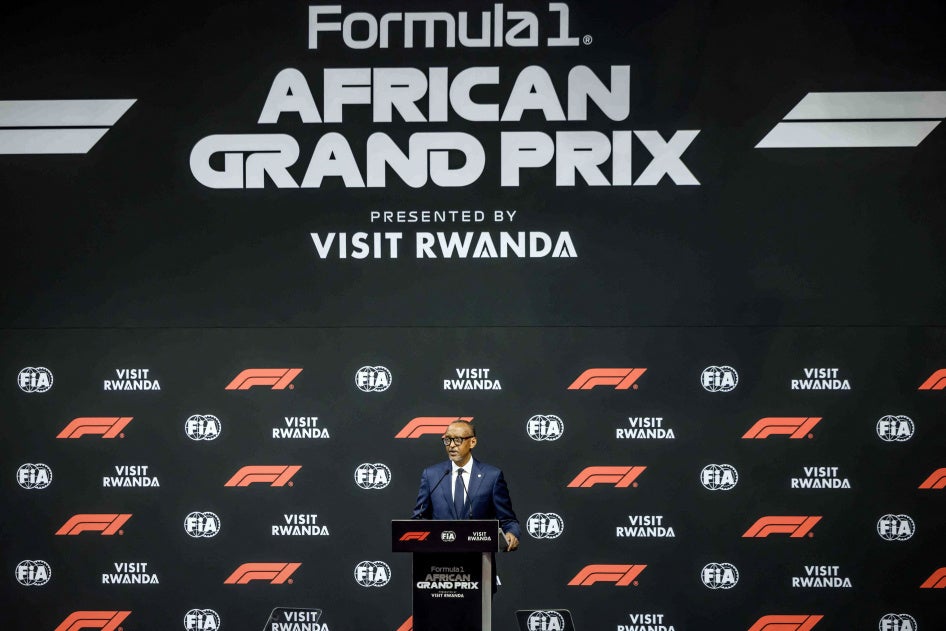
Formula One’s decision this week to bring a Grand Prix to Rwanda in the early 2030s could be an important moment for Africa. The continent deserves more prominence on the global sporting calendar.
But the 10-year agreement between Formula One and Rwanda also brings significant human rights risks.
The Rwandan government’s repression means journalists and others who challenge the government’s relentlessly positive image of the country may be at risk prior to, during, and after race weekends. The Rwandan government has long targeted independent media and political opponents both within Rwandan and abroad, including through torture, unlawful military detention, enforced disappearances and extrajudicial killings.
Human Rights Watch has also documented how Rwanda’s authorities routinely round up and detain homeless people and street venders before large events. People detained in the capital Kigali are held in a large warehouse—labeled a “transit center”—until foreign visitors have left. For example, some of the city’s poorest and most marginalized people were locked up prior to an international conference in 2021.
Rwanda, like other countries, has also used past high-profile sports deals and races to distract from its abysmal human rights record, a tactic known as “sportswashing.” Rwanda is currently the power behind the abusive M23 rebel group in eastern Democratic Republic of Congo and its military forces have been implicated in unlawful displacement, large-scale forced recruitment and arbitrary detention campaigns, and deaths of civilians in violation of international humanitarian law.
Human Rights Watch wrote to Formula One on February 24 to ask how it is addressing the risks of sportswashing and of human rights abuses connected to its events, including regarding Rwanda’s bid to host an F1 Grand Prix. We’ve yet to receive a response.
Prior to giving the green light to racing in Rwanda, Formula One should conduct an in-depth assessment of human rights risks, including by consulting with civil society groups inside and outside the country. Formula One’s agreement with the Rwandan government should include commitments, with measurable benchmarks, to protect national and international journalists covering the sport. Formula One should also address the risk of the Rwandan government using motorsport to sportswash its record.
Bringing Formula One back to Africa is good for the sport and for the continent. But the Rwandan government’s repression—at home and abroad—means Formula One can’t cut corners on human rights.