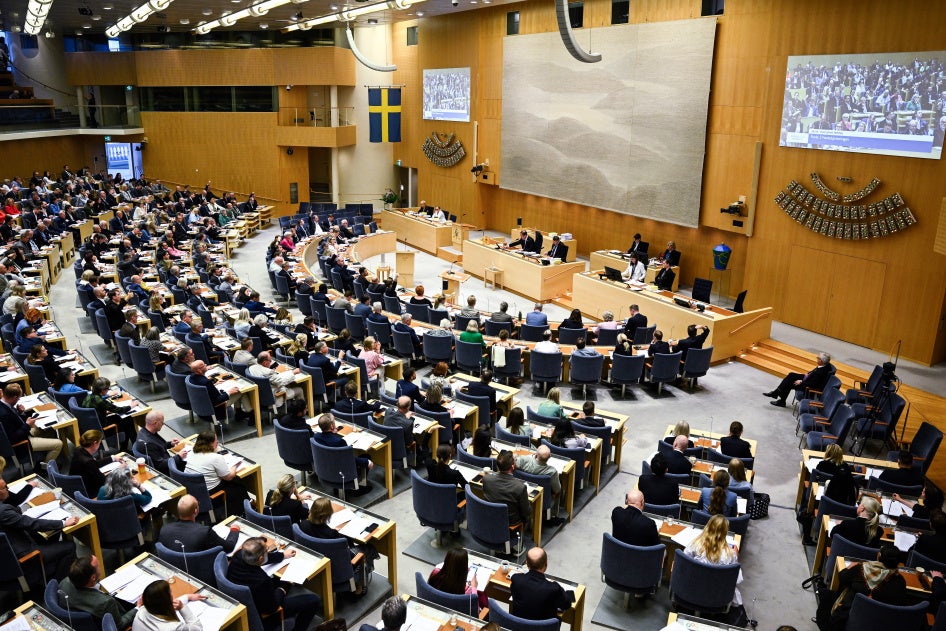
Sweden has a long history of supporting human rights, and successive governments across the political spectrum have described respect for human rights and international law as a "cornerstone" of Swedish foreign policy. That commitment is being tested.
Around the world, democratic institutions are weakening, authoritarian rule is expanding, and warring parties commit abuses against civilians with little or no accountability. Powerful governments increasingly flout international law, and human rights standards are applied selectively — invoked against adversaries, overlooked for allies.
This development is a call to action. Governments that still support a rules-based international order have a responsibility to defend it, and Sweden has an important role to play. The next government should adopt the following 10 measures to strengthen its human rights policy:
1. Set out a clear strategy for Sweden's international human rights work. Adopt a holistic approach and set out a vision for Sweden’s international work on human rights. Formulate a new foreign policy strategy for human rights, democracy and the rule of law, combined with an action plan.
2. Promote human rights centered approaches to technology. Develop regulatory frameworks to monitor and mitigate the human rights risks arising from the use of technology, including with regard to online platforms and artificial intelligence, and oversight mechanisms to hold harmful uses to account. The government should restore the Stockholm Internet Forum as a foreign policy priority, increase support for digital rights organisations and commit publicly to defending internet freedoms.
3. Commit to banning autonomous weapons. The government should set out a clear position on the issue of autonomous weapon systems – weapons capable of selecting targets and engaging, without meaningful human control. It should support an international instrument regulating these weapons systems - before the window closes.
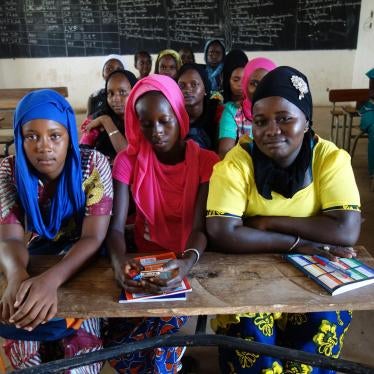
4. Strengthen children’s rights. The Convention on the Rights of the Child. guarantees the right to free primary education. But in today’s world, primary education is not enough. A global effort is therefore now underway to broaden the right to education to both free pre-school and free secondary education, but unfortunately Sweden is standing on the sidelines. It should support this effort.
5. Remain a party to the Ottawa Convention. The Ottawa Convention, which bans the use of anti-personnel landmines, has been a global success and now has 162 states parties. But nine in ten landmine casualties are still civilians, not combatants. There is currently a debate as to whether Sweden should withdraw from the Convention. That would be a historic mistake.
6. Restore and expand support for human rights monitoring and investigations globally. Sweden’s support for Ukraine has been exemplary, but Sweden should broaden its perspective and pursue a policy of global responsibility. In recent years, vital Swedish support for freedoms and rights has been scaled back in countries such as Myanmar, Cambodia, Afghanistan, and Liberia, where even small amounts of funding can make a big difference. Sweden should also consider leading an initiative on a specific crisis country situation at the UN Human Rights Council.
7. Strengthen protection of the rights of older persons. The UN Human Rights Council’s decision to pursue an international treaty on the rights of older persons recognized the gaps in protecting their rights within the multilateral human rights system and the need to address them. Sweden should reverse its opposition to a new treaty.
8. Use diplomatic and economic tools to uphold international law, including respecting Sweden's own obligations. Sweden should use all diplomatic tools to fulfill its international law obligations, and play a more active role within the EU and at the UN to persuade other countries to halt human rights and laws of war violations, wherever they occur. This should include Swedish and EU measures against the Israeli government’s violations of international law. Sweden should also evacuate medical patients from Gaza in need of urgent care and renew its support to UNRWA, the UN agency that supports Palestinians.
9. Reinvest in gender equality and women's rights leadership. Sweden pioneered feminist foreign policy more than two decades ago, but abandoned the label and eliminated the ambassador role that coordinated it in 2022. At this time, when women’s rights are facing a global backlash, it is even more important for the government to strengthen this work and rejoin the group of states pursuing an explicit feminist foreign policy.
10. Defend the rules-based international order, including the International Criminal Court. Sweden has been among the more vocal defenders of the International Criminal Court (ICC). It should press the European Union to strengthen its collective response to the US sanctions against court personnel, notably by activating its Blocking Statute without further delay, and developing additional measures to shield the ICC, Sweden should place international justice at the core of its foreign policy, including by rallying support for the court and encouraging other countries to join.
In the current global situation, simply standing by and watching is not an option. Sweden has the capacity to help protect people at risk and shape the human rights agenda for years to come. What is needed now is the political will to act.