(Bangkok) – Vietnamese authorities should reject proposed revisions to the penal code that violate basic rights, Human Rights Watch said today. The authorities should instead amend the law to comply with international human rights standards.
Vietnam’s Ministry of Public Security submitted the draft code to the National Assembly for review during the session from August 3 to 24, 2026, with the expectation that the revised code would be adopted after October 20. The draft revisions would increase already harsh penalties for vague and overbroad criminal offenses that infringe upon the right to freedom of expression and other rights.
“The Vietnamese National Assembly should reject the Ministry of Public Security’s draft revised criminal code and all rights-violating articles that the authorities frequently use to silence critics,” said Elaine Pearson, Asia director at Human Rights Watch. “Freedom of expression means that people are able to voice opinions critical of the government without fear of punishment.”
The Ministry of Public Security proposes to increase the punishment for violators of article 331(2), which criminalizes acts deemed to “infringe upon the interests of the state,” from a minimum of two to three years in prison. Article 117, which prohibits “making, storing, disseminating or propagandizing information, materials and products that aim to oppose the State of the Socialist Republic of Vietnam,” has been amended to broadly prohibit acts that “aim to oppose the Communist Party of Vietnam.” The ministry also proposes to criminalize offenses against the Communist Party flag, punishable by up to three years in prison.
In addition, the ministry seeks to eliminate initial warnings to accused violators, the lightest form of punishment. In the current penal code, warnings should be issued for those who have “committed a less serious crime [with] multiple mitigating circumstances, but whose case does not warrant exemption from punishment.” However, in the draft revised code, the lightest form of punishment is a monetary fine no matter how minor the infraction.
The draft revised penal code reduces the total number of crimes punishable with the death sentence from 10 to 4: treason, murder, drug manufacturing, and terrorism. Vietnam should use this opportunity to abolish capital punishment altogether, Human Rights Watch said.
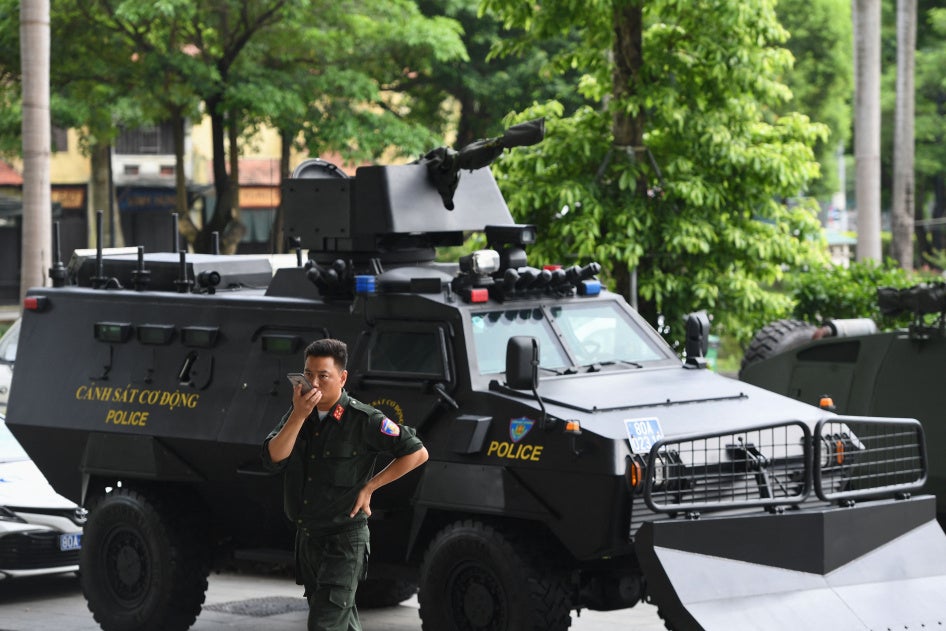
While increasing punishments for certain crimes, the ministry also proposed exempting the police, armed forces, and paramilitary self-defense forces from criminal liability for acts committed while carrying out official duties. During this session, the National Assembly is scheduled to review the Ministry of Public Security’s draft revised Law on Organization of Criminal Investigation Bodies, in which the police propose to abolish all “investigating bodies of the Supreme People’s Procuracy.” If passed, no entity outside the police force would be allowed to investigate alleged wrongdoing by the police and other security forces.
“Vietnam’s criminal laws need to be revised to become more protective of people’s rights, not to facilitate greater abuse by the police,” Pearson said. “International donors and trade partners should press the Vietnamese government to amend its penal code to ensure that human rights are protected in both law and in practice.”