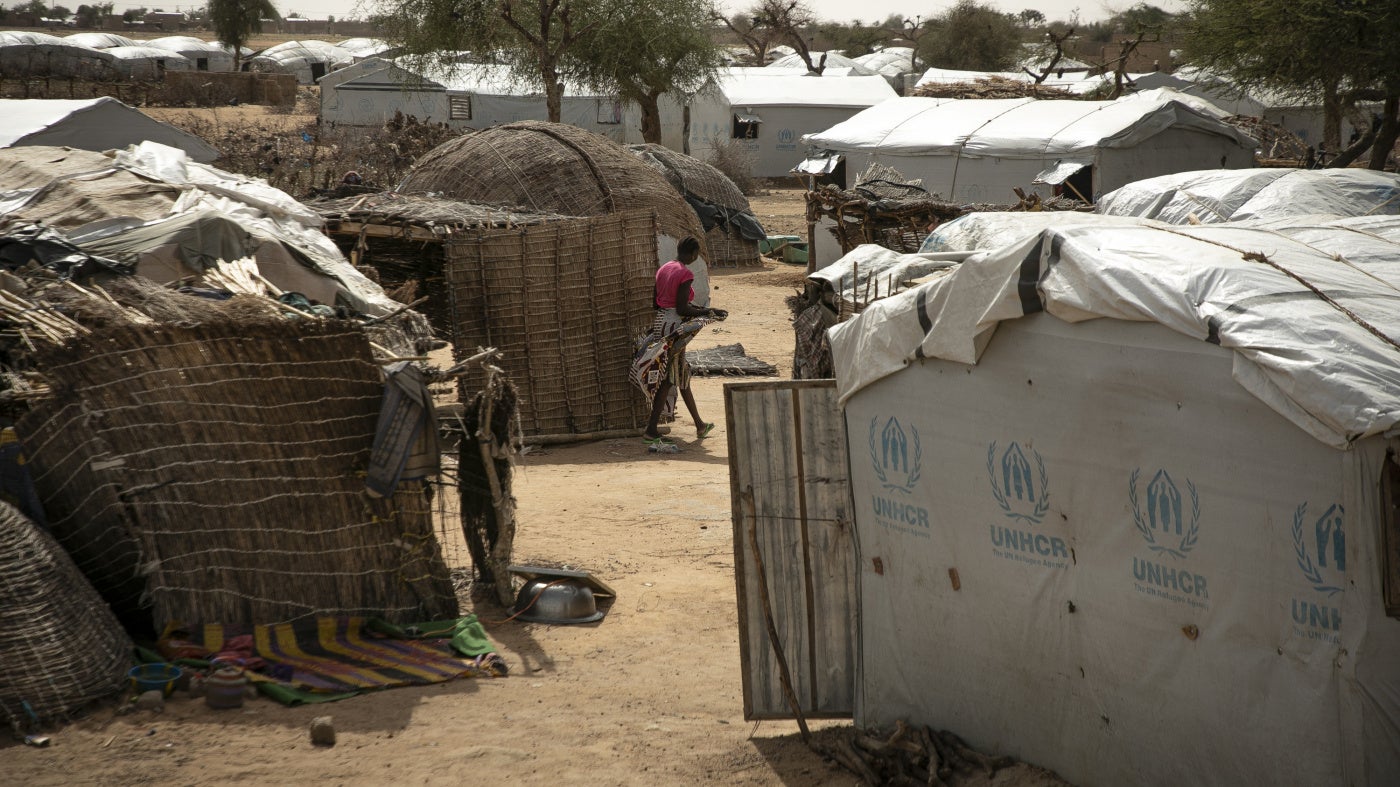
Human Rights Watch has released a report, “None Can Run Away,” about serious human rights abuses against civilians across Burkina Faso by the Burkinabè military, allied militias, and an Islamist armed group since 2022. This questions-and-answers document addresses key issues explored in the report.
- What were the key findings of the report?
- How did Human Rights Watch conduct its research?
- Why have the Burkinabè security forces targeted ethnic Fulani people?
- What is “ethnic cleansing” and has it occurred in Burkina Faso?
- What are crimes against humanity?
- How do these crimes fit into the broader conflict in the Sahel region?
- How have international organizations responded to the conflict in Burkina Faso?
- What are Human Rights Watch and survivors urging the Burkinabè authorities and the international community to do?
- If Burkina Faso has withdrawn from the ICC, how could the ICC still open a preliminary examination into alleged war crimes and crimes against humanity there?
- Why is documentation and evidence preservation so important?
What were the key findings of the report?
Human Rights Watch found that the Burkinabè military and allied militias, known as Volunteers for the Defense of the Homeland (Volontaires pour la défense de la patrie, VDP), as well as the Al-Qaeda-linked Jama’at Nusrat al-Islam wa al-Muslimin (JNIM), the dominant Islamist armed group in Burkina Faso, are responsible for numerous war crimes and crimes against humanity. Human Rights Watch provides a comprehensive account of 57 incidents that altogether resulted in the deaths of more than 1,800 civilians in 11 regions of Burkina Faso between January 2023 and August 2025.
Human Rights Watch found that killings and other grave abuses against civilians across Burkina Faso are central to the military authorities’ tactics as well as those of JNIM.
Burkinabè military and VDPs have committed grave crimes, including the killing and forced displacement of civilians, especially from the Fulani ethnic group, whom they accuse of supporting the insurgency. During large-scale counterinsurgency operations, the military has massacred civilians because they happened to live in JNIM-controlled areas or maintained relations with local Fulani people.
JNIM has targeted civilians in its effort to establish territorial control over rural areas. It has used coercion and violence to oppress populations and has punished and forcibly displaced communities whose members would not submit, or whom it accused of supporting government forces. JNIM has also laid siege to dozens of towns and villages across Burkina Faso, causing starvation and illness among residents and displaced people.
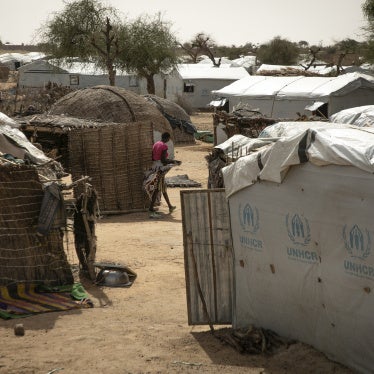
These crimes have resulted in the deaths of tens of thousands of people and the displacement of more than 2.3 million, an estimated 10 percent of the population.
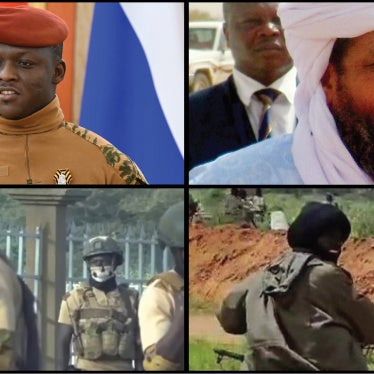
Human Rights Watch identified the president of Burkina Faso, Capt. Ibrahim Traoré, and six Burkinabè military leaders, as well as Iyad Ag Ghaly, JNIM supreme leader, and four other JNIM leaders, who may be responsible as a matter of command responsibility for the abuses Human Rights Watch documented. They should all be investigated and prosecuted as appropriate.
How did Human Rights Watch conduct its research?
Human Rights Watch carried out in-person and telephone research, including trips to Burkina Faso, Benin, Côte d’Ivoire, Ghana, and Mali between March 2023 and November 2025. Researchers interviewed over 450 people, most of them witnesses and survivors of abuses who were forced to flee into neighboring countries. Human Rights Watch also assessed and verified hundreds of photographs and videos and satellite imagery, and reviewed official documents and media and nongovernmental organization reports.
Human Rights Watch developed a software that extracted, transcribed, and analyzed 36,243 videos from the YouTube channel of Burkina Faso’s state broadcaster Radiodiffusion-Télévision du Burkina, as well as 2,476 posts from JNIM-linked social network ChirpWire.
The software filtered this content and generated a searchable database that captured references to armed activity within Burkina Faso, including mentions of combat operations, geographic deployments of military units, names of members of the military and JNIM, changes in military ranks, and military unit affiliations. This information enabled researchers to identify key elements of the military hierarchy and to corroborate witness accounts on both sides of the conflict.
Human Rights Watch partnered with Security Force Monitor, a nongovernmental organization focused on investigating chains of command, to establish chain-of-command information about members of Burkinabè military forces implicated in abuses.
Why have the Burkinabè security forces targeted ethnic Fulani people?
Islamist armed groups have actively recruited among Fulani communities in Burkina Faso and the Sahel region more broadly, by exploiting their longstanding marginalization, poverty, and the erosion of traditional pastoralist livelihoods. Some Fulani people have joined these armed groups out of frustration with economic hardship, government corruption, and abuses by Burkinabè security forces and allied militias.
This dynamic has triggered a dangerous cycle in which state forces and VDPs increasingly perceive the Fulani as collectively aligned with Islamist armed groups and subject them to harassment, violence, and discrimination, which in turn deepens resentment and mistrust toward the state.
While anti-Fulani prejudice existed before the 2022 military coup, Human Rights Watch found that hate speech, stigmatization, and violent attacks against Fulani communities have intensified since Traoré came to power and expanded the recruitment of VDPs. Counterinsurgency operations have frequently failed to distinguish Fulani civilians from Islamist fighters, resulting in mass killings and other abuses with near-total impunity.
In one such case, in November 2023, VDPs killed 13 civilians, including six women and four children, in a Fulani settlement about four kilometers from Bassé village, Hauts-Bassins region. They also burned at least 20 homes, and looted hundreds of animals. Some of the bodies were found blindfolded with their hands tied behind their backs.
What is “ethnic cleansing” and has it occurred in Burkina Faso?
Although the term “ethnic cleansing” has no formal definition under international law, a United Nations Commission of Experts defined it as a “purposeful policy designed by one ethnic or religious group to remove by violent and terror-inspiring means the civilian population of another ethnic or religious group from certain geographic areas” where “the purpose appears to be the occupation of territory to the exclusion of the purged group or groups.”
Human Rights Watch used that widely adopted working definition for the characterization of ethnic cleansing. Researchers found that the ethnic targeting of Fulani communities by military forces and the VDPs for killings, enforced disappearances, and looting, which led to the mass displacement of entire communities, amounts to ethnic cleansing.
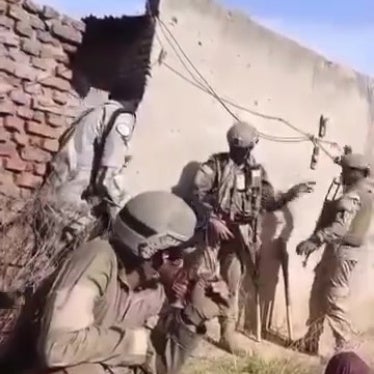
One example is the killing of more than 130 Fulani civilians during Operation Green Whirlwind 2. This coordinated government offensive was carried out between March 8 and 13, 2025, by Burkinabè military forces, including special forces and VDPs, in the western Boucle du Mouhoun region, near the town of Solenzo. Video evidence Human Rights Watch analyzed, along with witness accounts, shows that Fulani civilians were singled out based on their ethnicity. In some cases, VDPs backed by the military issued explicit calls for their extermination.
What are crimes against humanity?
The Rome Statute of the International Criminal Court (ICC) defines crimes against humanity as specific criminal acts—including murder, rape, torture, apartheid, deportations, and persecution, etc.—committed as part of a widespread or systematic attack directed against any civilian population according to a state or organizational policy. These are among the gravest offenses under international law.
Many of the crimes that Human Rights Watch documented formed part of a widespread and systematic attack directed against the civilian population in Burkina Faso, and as such may amount to crimes against humanity. In one such case, on February 25, 2024, in the villages of Nondin and Soro in northern Yatenga province, the Burkinabè military summarily executed 223 civilians, including at least 56 children, accusing them of collaborating with JNIM.
In another incident, on August 24, 2024, JNIM killed at least 133 civilians, including dozens of children, in Barsalogho in Sanmatenga province, in retaliation against a local community it accused of supporting the VDPs. Government forces have also carried out the crimes against humanity of forced displacement, arbitrary imprisonment, torture, enforced disappearance, and other inhumane acts.
How do these crimes fit into the broader conflict in the Sahel region?
The crimes by all sides in Burkina Faso fit into a broader pattern of violence in the central Sahel, a region that has experienced a dramatic deterioration of its human rights environment in recent years, marked by increased threats to civilians caught in armed conflict, emboldened authoritarianism of their military juntas, and growing marginalization of independent institutions. In Burkina Faso, Mali, and Niger, the rule of law has seriously eroded, widening impunity for serious human rights abuses, and leaving civilians increasingly vulnerable.
Islamist armed groups and government security forces have committed serious violations of international humanitarian law in all three countries. As of March 2026, the armed conflict in the central Sahel region has killed tens of thousands of civilians, resulting in one of the world's most acute humanitarian crises, forcing over three million people from their homes.
Since 2020, Burkina Faso, Mali and Niger have experienced military coups. The ruling military juntas have shown intolerance for political opposition and dissent. Civic and political space has shrunk as a crackdown on journalists, civil society activists, and opposition party members has increased, through arbitrary detention, enforced disappearances, and unlawful conscription. The military leaders of the three countries have solidified their power without elections, delaying the return to democratic civilian rule.
The authorities in Mali, Burkina Faso, and Niger have ignored calls for accountability and failed to uphold their international legal obligations to investigate serious rights violations by their security forces, and hold those responsible accountable, allowing impunity to fester and emboldening the abusers. In January 2025, the three countries officially left the Economic Community of West African States (ECOWAS), depriving their citizens of the opportunity to seek justice for human rights violations through the ECOWAS Court of Justice. In September 2025, the three countries also expressed their intention to leave the ICC, a move that would jeopardize access to justice for victims of atrocity crimes.
How have international organizations responded to the conflict in Burkina Faso?
Despite the rapidly deteriorating security situation in Burkina Faso, international engagement has not matched the scale or urgency of the crisis. Diplomatic pressure, protection efforts, and humanitarian response remain insufficient compared to rapidly growing needs.
The African Union, especially the AU Commission and the Peace and Security Council, and the United Nations, including the UN Security Council and the Office of the High Commissioner for Human Rights, have taken insufficient measures to assist the governments to better protect civilians or to press the authorities to ensure accountability for serious crimes committed by all sides.
The European Union has also not kept pace with the scale and evolution of the conflict in Burkina Faso, having limited and cautious diplomatic engagement with the military junta.
What are Human Rights Watch and survivors urging the Burkinabè authorities and the international community to do?
The conflict in Burkina Faso has been marked by near-total impunity for war crimes and crimes against humanity by all parties, leaving people across the country without justice for the atrocities they have experienced.
Victims of serious human rights abuses in Burkina Faso and their families have consistently sought acknowledgment by the Burkinabè authorities of the harm civilians have suffered at the hands of both government forces and JNIM, as well as for justice and accountability for those responsible for abuses, and redress for what they have lost.
However, the authorities have shown neither the capacity nor the will to investigate and prosecute serious conflict-related abuses, including by the armed forces.
Burkina Faso’s 2025 withdrawal from ECOWAS further limits accountability by removing access to the ECOWAS Community Court of Justice. While individuals can still apply to the African Court on Human and Peoples’ Rights, weak enforcement and frequent state noncompliance with its decisions constrain its impact.
Human Rights Watch has urged the Office of the Prosecutor of the ICC to open a preliminary examination into war crimes and crimes against humanity by all parties to the conflict since September 2022.
If Burkina Faso has withdrawn from the ICC, how could the ICC still open a preliminary examination into alleged war crimes and crimes against humanity there?
Even if Burkina Faso were to withdraw from the ICC, that would not automatically block the court’s jurisdiction.
Under the Rome Statute, withdrawal takes effect one year after a state formally notifies the UN secretary-general. Crucially, withdrawal does not affect the ICC’s jurisdiction over crimes committed while the country was still a member. Under certain circumstances and based on the ICC's jurisprudence, the court can continue examining and prosecuting crimes that occurred during the period of membership.
Why is documentation and evidence preservation so important?
The conflict in Burkina Faso has become one of the world’s most severe human rights crises. Its scale and gravity remain largely obscured due to the climate of fear and repression fostered by the authorities.
As violence persists, meeting victims’ longstanding demands for accountability requires a timely and credible assessment of ongoing abuses. It is critical to collect and preserve available evidence now to support future accountability efforts. Without such action, evidence risks being lost through neglect or deliberately destroyed, further diminishing the chances for victims to obtain justice.