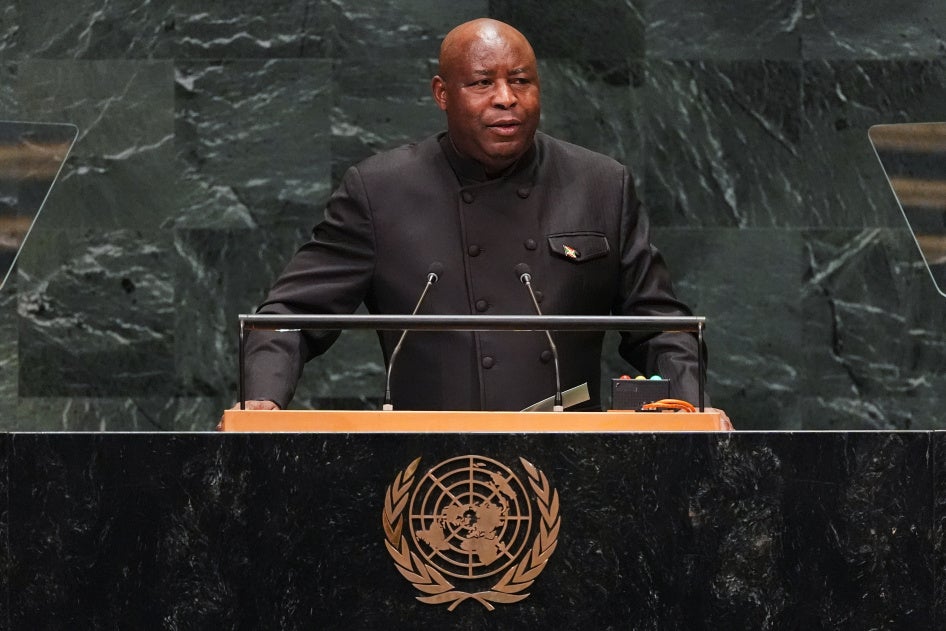
(New York) – Burundi is set to win re-election to the United Nations Human Rights Council in a vote on October 12, 2026, with no competition, Human Rights Watch said today. Burundi is seeking to retain its seat even though the government of this Central African country has not improved its abusive human rights conditions.
Burundi is one of the four African countries running for the same number of seats on the 47-nation council. The regional slates for the Western group, Latin America and the Caribbean, Central and Eastern Europe, and Asia also lack competition. This effectively guarantees all 15 candidates, fit or unfit, spots on the UN’s premier rights body for three years beginning on January 1, 2027.
“This uncompetitive vote makes a mockery of the word ‘election,’” said Louis Charbonneau, UN director at Human Rights Watch. “UN member states should insist on competitive slates so they can reject candidates with poor human rights records. No one should have a seat on this crucial body handed to them on a silver platter.”
Ghana, Nigeria, and Zambia are candidates for Africa’s other three available seats. In Asia, Japan, Jordan, Kuwait, and Nepal are running for the region’s four seats. In Latin America and the Caribbean, Brazil, the Dominican Republic, and Uruguay are set to take the region’s three spots. For the Western group, Germany and Ireland are on track to get the group’s two available seats, while Moldova and Ukraine will take Central and Eastern Europe’s two spots.
Despite some positive government statements, Burundi has not carried out meaningful reform to address longstanding concerns related to governance, justice, or accountability. Grave abuses persist with impunity, including extrajudicial executions, enforced disappearances, arbitrary arrests, and detention. Freedom of expression, assembly, and association remain severely restricted.
Burundi is in the third year of its current term and is allowed to run for another consecutive term. On October 6, the country’s delegation tried to use their membership to prevent UN scrutiny of Burundi’s poor human rights record, first by calling a vote to renew the mandate of the UN special rapporteur on Burundi and then by voting against it. The resolution was adopted, though, 22 to 7, with 17 abstentions.
That resolution not only expressed concerns about ongoing rights violations but highlighted Burundi’s refusal to cooperate with the council and most of its mechanisms, including the special rapporteur.
General Assembly Resolution 60/251, which created the Human Rights Council in 2006, says that countries voting for members should “take into account the contribution of candidates to the promotion and protection of human rights.” Council members are required to “uphold the highest standards in the promotion and protection of human rights” at home and abroad and to “fully cooperate with the Council.”
Candidates only need a simple majority in the secret-ballot vote in the 193-nation General Assembly to secure a seat on the Human Rights Council. That makes it highly unlikely that any candidate will lose, no matter how unqualified. Nevertheless, UN member states should not cast votes for abusive governments that are demonstrably unqualified for council membership.
Among the other candidates, Nigeria should ensure accountability for serious international crimes committed by all parties—including security forces—during the conflict with the armed group Boko Haram. Brazil should investigate and curb police abuse after law enforcement officers set a grim record in 2025 by killing more than 6,500 people, the vast majority of them Black.
Ukraine has suffered countless atrocities committed by Russian forces on its territory since Russia’s full-scale invasion in 2022. At the same time, Ukrainian authorities have unjustly prosecuted Ukrainian civilians living under Russian occupation, including teachers, medics, municipal workers, and volunteers for doing essential work that international humanitarian law permits civilians to perform under occupation.
The Human Rights Council scrutinizes all UN member states’ rights records in the Universal Periodic Review process. In November 2025, the United States refused to participate in its review. If the US government does not participate in its rescheduled review in November, it will become the first member country not to complete its review.
The Human Rights Council has played a crucial role in ensuring independent investigations of abuses in Syria, Myanmar, North Korea, Russia, Ukraine, Israel/Palestine, Afghanistan, Sudan, and elsewhere. Council members should press for investigations of abuses by other countries in need of scrutiny, including major powers. These should include China’s crimes against humanity against Uyghurs and others in Xinjiang, as well as the US military’s unlawful strikes targeting vessels the Caribbean and Pacific, amounting to extrajudicial killings.
The council should also explore possible action to support global justice in the face of a US assault on international accountability mechanisms. The US on October 9 imposed unjustified sanctions on the International Criminal Court (ICC). The Trump administration has made clear its aim to destroy the ICC to shield US and Israeli officials from facing charges before the court. The US had previously sanctioned ICC officials, Francesca Albanese, the UN special rapporteur on human rights in the Palestinian Territory occupied since 1967, and several prominent Palestinian human rights groups.
“The human rights movement is under increasing attack by powerful governments, including established democracies,” Charbonneau said. “The Human Rights Council has done victims of human rights abuses a huge service with investigations that often deter governments and armed groups from committing violations. We need the council now more than ever.”