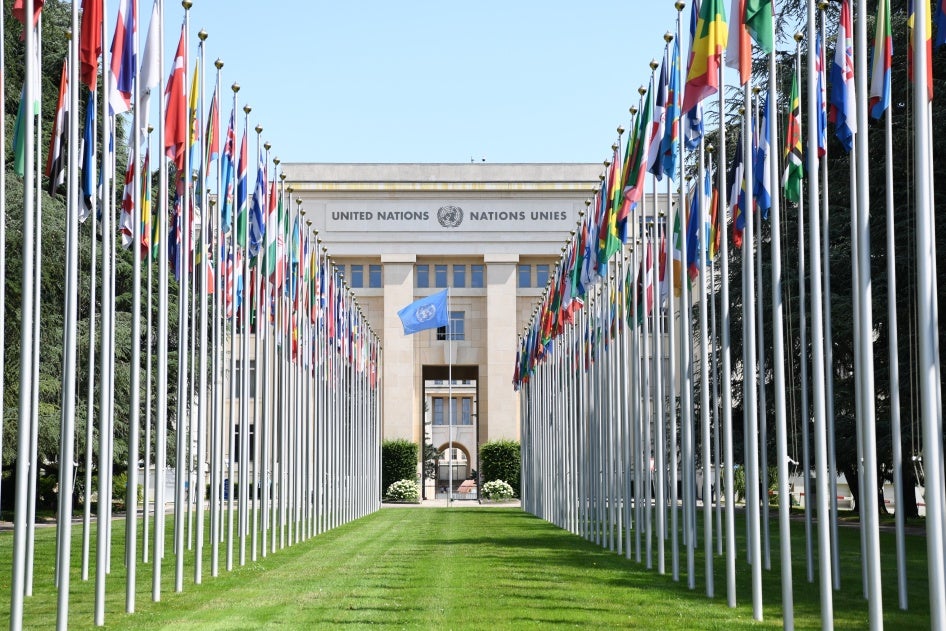
This statement was delivered by Human Rights Watch at the 63rd regular session of the UN Human Rights Council during a general debate on human rights situations that require the Council's attention held on September 22-23, 2026.
Mr. President,
States at this Council should move beyond double standards and take overdue action to address grave ongoing human rights violations across China.
Ten years since abuses escalated against Uyghurs in Xinjiang, the Chinese government crackdown remains severe, with continued mass arbitrary detention, unjust imprisonment, mass surveillance, cultural and religious persecution, restrictions on travel and communication, and pressure on Uyghurs abroad. State-imposed forced labor in Xinjiang affects global supply chains, in sectors including automotive, solar panels, apparel, seafood, agricultural products, and critical minerals.
This Council should convene a dedicated discussion to follow up on the recommendations of the landmark 2022 OHCHR assessment report – which concluded, based on extensive research and analysis, that grave abuses against Uyghurs and other Turkic Muslims in Xinjiang “may constitute … crimes against humanity” – and should also address government repression across China, including in Tibet and Hong Kong, and the persecution of religious minorities.
Human Rights Watch shares the concern of the Independent International Fact-Finding Mission (FFM) on Venezuela that the repressive State machinery that has sustained political persecution and facilitated systematic grave human rights violations, remains operational.
Impunity continues, while some of those the FFM found reasonable grounds to believe responsible for crimes against humanity and other serious human rights violations remain in key positions of power.
Notwithstanding the release of some political prisoners and the decrease in certain forms of repression, hundreds of people are still arbitrarily detained while key abusive laws that have enabled repression over the past decade remain in place.
Following a visit to Caracas last week, our position remains unequivocal: sustained international engagement, based on objective independent human rights investigations and benchmarks, is essential in this fragile moment.
We therefore call on all members of this Council [states] to support the two-year renewal of the FFM on Venezuela, whose work can guide and support such engagement.
Mr. President,
We regret the closure of the confidential complaint against Tajikistan under the Council’s opaque complaint procedure.
A large number of journalists and public figures remain in prison for expressing their opinions on government policies. Most did not benefit from a recent prison amnesty or only received a negligible reduction to their sentences.
Hundreds of nongovernmental organizations have closed, systematic repression of ethnic minorities in the Gorno-Badakhshan Autonomous Oblast province continues, and the government is actively engaged in transnational repression of critics and dissidents abroad. Political movements and parties seen as a threat are banned, with members sentenced to lengthy prison terms.
We appeal to the Council to convene an open meeting with the participation of victims of abuses, civil society and UN human rights experts to follow up on measures to which the government has apparently committed.
Thank you.