- Israeli attacks on four oil depots around Tehran on March 7, 2026, may cause long-term health and environmental harm for civilians.
- Strikes on primarily civilian infrastructure causing foreseeable civilian harm are violations of international humanitarian law and are likely war crimes.
- Israeli forces don’t appear to have factored in the foreseeable long-term harm in the Tehran vicinity, for which they should be held accountable.
(Beirut) – Israeli attacks on four oil depots around Tehran on March 7, 2026, may cause long-term health and environmental harm for civilians, Human Rights Watch said today. Strikes on primarily civilian infrastructure causing foreseeable civilian harm are violations of international humanitarian law and are likely war crimes.
On March 8, Iran’s state-owned oil distribution company reported that “four sites used for storing and distribution of petroleum products and a petroleum products transport center in the provinces of Tehran and the Alborz were attacked by hostile enemy aircraft.” That day, the Israeli military posted on X that it had targeted “several fuel storage complexes belonging to the IRGC [Islamic Revolutionary Guard Corps] in Tehran.”
“Israel’s March 7 attacks on oil depots surrounding Tehran may have devastating consequences on the environment and people’s health for many years and likely amount to war crimes,” said Bahar Saba, senior Iran researcher at Human Rights Watch. “Israeli forces don’t appear to have factored in the foreseeable long-term harm in the Tehran vicinity, for which they should be held accountable.”
Human Rights Watch spoke directly or through third parties with eight people in Tehran and Karaj about the effects of the strikes, and to nine environmental and health experts. Researchers analyzed satellite imagery and verified videos related to the attacks. Human Rights Watch wrote to Israeli and Iranian authorities on March 26 for further clarification regarding the attacks. Iranian authorities have not responded.
The Israeli authorities responded on March 30, stating that the attacks “were conducted in accordance with the principles of distinction, proportionality, and precautions.” They stated that the oil depots attacked “were designated to provide fuel directly to units in the regime’s armed forces, in support of the operation of military aviation, UAVs [unmanned aerial vehicles] naval vessels, and other military infrastructure.”
Human Rights Watch confirmed that the oil depots were used for civilian purposes but was not able to determine whether they were also used to support the military. One informed source said that the oil depots only contained gasoline and diesel, which would not be used for aviation, UAVs, or naval vessels.
Human Rights Watch confirmed the attacks on the four oil depots using satellite imagery and verified videos, some geolocated by the volunteer group GeoConfirmed.
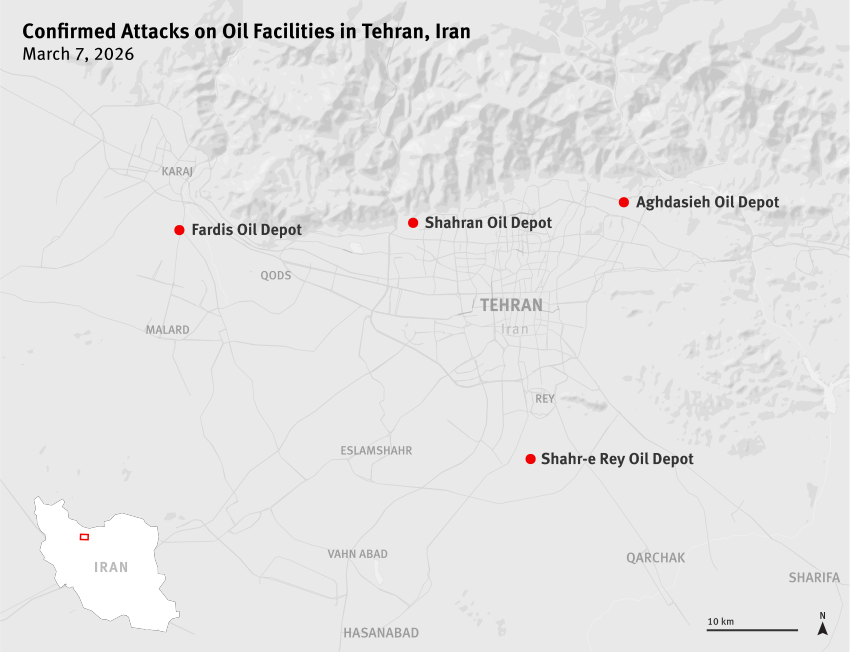
Satellite imagery from March 9—more than 24 hours after the strikes—shows large smoke plumes arising from the Shahran, Aghdasieh, and Shahr-e Rey oil depots.
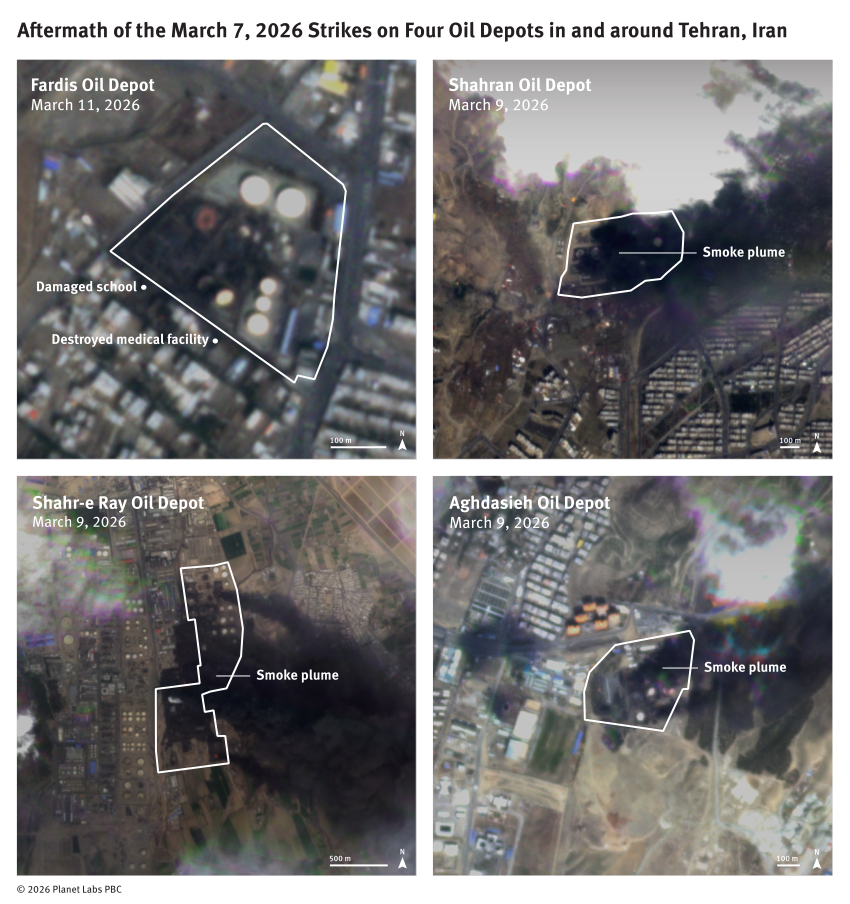
March 11 imagery shows destroyed fuel storage tanks in the Fardis oil depot. Alborz University of Medical Sciences reported that a dialysis center near the Fardis depot “was set on fire and its equipment and building were destroyed” during the attack. High-resolution satellite imagery from March 18 shows apparent damage to a medical facility and a primary school near a destroyed oil tank in the Fardis oil depot.
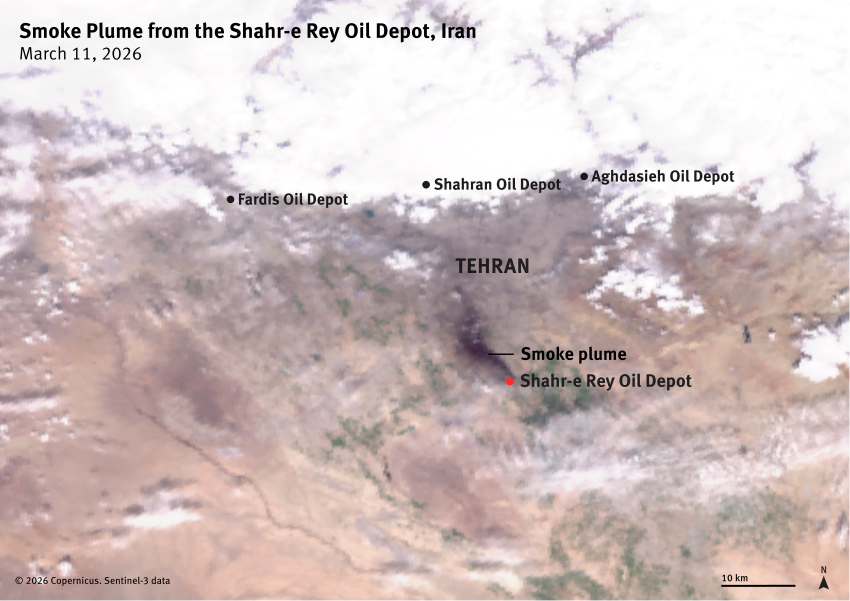
Satellite imagery from March 11 also shows a black smoke plume rising from the Shahr-e Rey depot toward central Tehran. Dozens of fuel storage tanks are visibly damaged or destroyed across the four sites on imagery from March 17, including fire and smoke billowing from the Aghdasieh oil depot.
The governor of Alborz province said that the strike on the Fardis oil depot had killed at least six people and injured 21 others, which could not be verified. There were no reported casualty figures for the other three attacks.
A woman in northern Tehran told Human Rights Watch, “The day after they hit [the oil depots], you couldn’t see the sky – it was black.”
“The city looked apocalyptic,” said a woman from Shahrak-e Gharb in northwest Tehran. “The facades of the white buildings, cars, mosaics in the courtyards, flower bushes and plants, and the city’s cats were covered with a layer of black soot.”
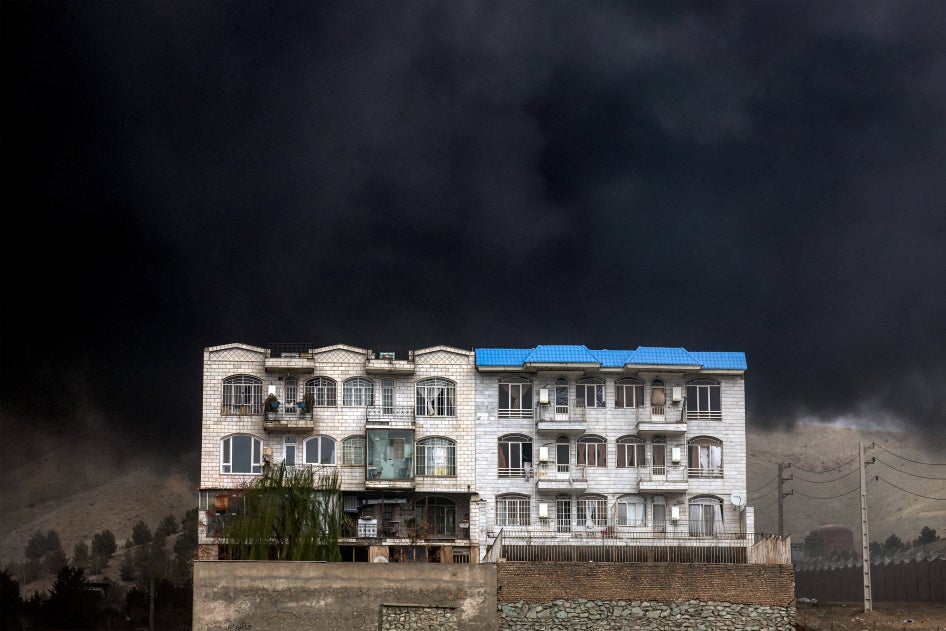
Residents described respiratory symptoms immediately after the attacks such as shortness of breath, continuous coughing, chest pain, and skin and eye irritation.
Environmental and health experts said that the attacks on oil depots caused the emission of dangerous air pollutants, both gaseous and visible, that could cause acute and chronic health effects on nearby residents, possibly for decades.
The United Nations Environment Program stated on March 13 that, “Heavy smoke from burning oil, which includes hazardous compounds, is now being directly inhaled by people in Iran−including young children−raising serious concerns about long-term impacts on both human and environmental health.… Pollution from uncontrolled fires may also enter soil and water, leach into groundwater, and be absorbed by crops, contaminating food supplies.”
The World Health Organization (WHO) said that the attacks “raised concerns of wider regional pollution exposure and the toxic pollutions and pollutants that affect respiratory health and contaminate water can have long-term effects.”
Under the laws of war applicable to the international armed conflict in Iran, attacks may only be directed at military objectives. Warring parties must take all feasible precautions to minimize harm to civilians and civilian objects, including by avoiding placing military targets near densely populated areas.
Oil depots and other energy infrastructure are presumptively civilian objects, but they can become military objectives if used to support the military. However, attacking them would be unlawfully disproportionate if the expected harm to civilians and civilian structures exceeded the anticipated military gain.
The International Committee of the Red Cross guidance provides that proportionality assessments need to consider “reasonably foreseeable” indirect environmental impacts. These include long-term or “reverberating” effects on the water, food systems, and the health of civilians. Attacks against military objectives are also unlawful if they are expected to cause “widespread, long-term and severe” damage to the natural environment, measured in months or years.
Serious violations of the laws of war ordered or committed with criminal intent—that is, deliberately or recklessly—are war crimes.
In addition to ensuring that the oil depots were military objectives, Israeli forces should have taken into account the foreseeable long-term consequences of the attacks on the environment and on people’s health, Human Rights Watch said.
Iranian forces have targeted oil and gas infrastructure in other countries, including in Bahrain, Kuwait, Oman, Qatar, Saudi Arabia, and the United Arab Emirates.
“Israel, as well at the United States and Iran, should be on notice that the laws of war provide specific protections for the environment,” Saba said. “Attacks targeting oil and gas infrastructure are likely to affect millions of people far longer than the conflict itself.”
Israeli forces on March 7 attacked four major oil and gas depots in and near Tehran: Shahr-e Rey oil depot, located just east of the Tehran Oil Refinery in south Tehran; the Shahran oil depot in northwest Tehran; Aghdasieh oil depot in northeast Tehran; and Fardis oil depot in Karaj, in Alborz province about 48 kilometers west of Tehran. Israeli forces had targeted the Shahr-e Rey and Shahran oil depots in June 2025.
Articles published in Iran’s domestic media between 2020 and 2025 and a September 2025 statement by the National Iranian Oil Products Distribution Company indicate that Shahran oil depot was a major storage and distribution point for fuel, including gasoline for vehicles. Hundreds of trucks distributed fuel from the facility to fuel stations across Tehran on a daily basis, particularly in north, northwest, and central Tehran.
The facility was built in 1974-1975 on the outskirts of the city, but by 2020, as a result of the immense increase in Tehran’s population, the location had become a densely populated residential and commercial area. Residents and local city council members had repeatedly raised concerns about the severe risks to the population in the event of an accident.
A former engineer for the Tehran Oil Refining Company said that the depots all stored gasoline and diesel used for daily life, “cars, trucks, agriculture.” He said that they did not store fuels and petrochemicals derived from crude oil or natural gas distillation, such as kerosene and petroleum naptha, which have specific industrial and aerospace propulsion applications more likely to be used for military purposes. However, the petroleum products at these oil depots could still be used by the military.
The following sections address the short-term and potential long-term effects of the March 7 oil depot strikes on the environment and people’s health.
Black and Acid Rain
A Tehran resident described the immediate aftereffects:
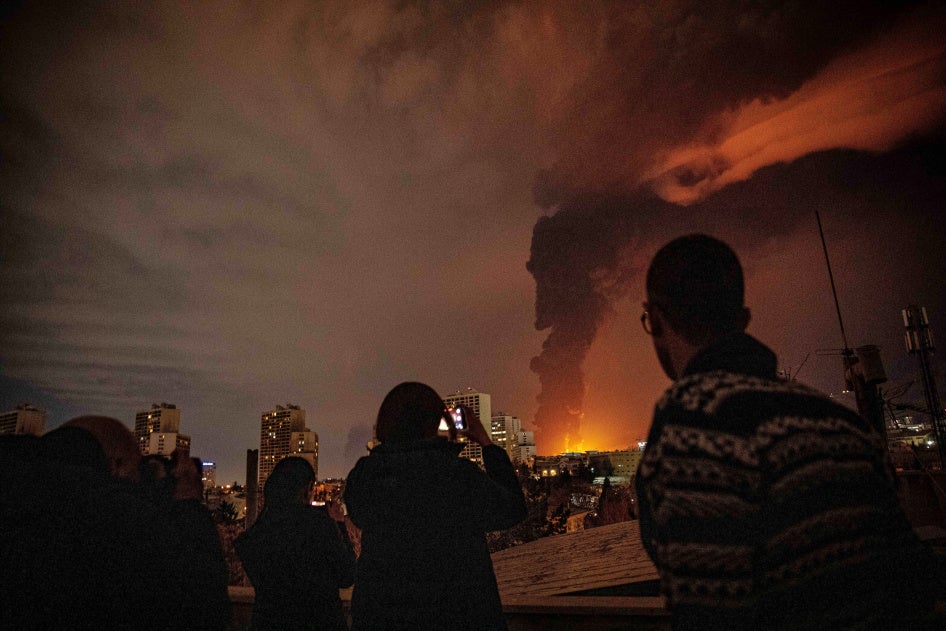
“After the explosion at night, it became day in some parts of Tehran. The sky turned red and black clouds gradually covered the city. Many people were on the rooftops watching the flames and smoke. But the main confrontation with the depth of the disaster was the next morning. When we waited, the sky did not light up. At 8:00 a.m., the sky looked like midnight.”
Residents of Tehran and Karaj widely reported black dust coating cars, animals, plants, and other outside surfaces. Environmental experts said that it was very likely black carbon, or soot, which is very dangerous for human health and the environment.
Human Rights Watch geolocated a video from a March 8 CNN report showing a blackened sky and a wet terrace covered in a soot-like material, which the reporter says is seemingly rainwater saturated with oil, on a building in northern Tehran, about 10 kilometers from the Shahran and Aghdasieh oil depots. A woman said that her friend in Tehran had said “all the cats were black” after the attack. Another person said cats in the city looked like they were “soaked in heavy soot.” One image from Tehran shows jasmine flowers covered in black dust.
The day after the attack, many people on social media, as well as the WHO, reported black and acidic rain in Tehran and Karaj. A Tehran resident told his daughter after the attack that, “The air was dark and I couldn’t see the sun in the morning.” The rain that came the next day left black drops on his glasses, he said.
Armin Sorooshian, a professor of chemical and environmental engineering at the University of Arizona, said that based on the photographs and accounts from Tehran after the attack, it was clear that “soot, also known as black carbon, was what was in the air. Most other particles don’t absorb light so that’s why they don’t appear black.” He also said that the acid rain that people reported seeing the day after the attack was most likely combined with soot prevalent in the air at the time.
Acid rain is the precipitation of harmful, acidic chemicals from the atmosphere. Discussing the conditions in Tehran on March 10, Christian Lindmeier, a spokesman for the WHO, said, “The black rain and the acidic rain coming with it is indeed a danger for the population.”
The woman from Shahrak-e Gharb said that in northern Tehran, “People were wearing masks and showing each other the traces of black soot on their clothes and faces.” She said people were expressing concern about breathing the air and afraid that the black layer was covering their lungs. “A little later, it started raining heavily,” she said. “Black tears flowed down the car roofs on the street. The city looked like a woman crying with her makeup smeared on her face.”
A student in Karaj said that his lungs were “generally sensitive” because of asthma, but he went outside after the attack. When he returned inside, he “had a severe, continuous cough that lasted until noon the next day.”
A professor of sustainable energy engineering said that it was foreseeable that such an attack “would be expected to create an acute, city-scale air pollution emergency,” covering the entire city of Tehran for at least several hours, affecting its 10 million inhabitants.
While the student in Karaj and others said that the air appeared cleaner after a few days of rain, the Iranian Health Ministry recommended that people “stay at home and not be outdoors unnecessarily,” and avoid sports and walking in parks.
The Iranian Red Crescent Society issued a warning about toxic chemical air pollution leading to acidic rain, which it said was extremely dangerous and could result in chemical skin burns and lung damage. This was followed by two educational announcements advising residents to take measures such as repeatedly washing any skin exposed to the rain with cold water, nasal and throat rinsing after the rain, even for those who had not left their homes, and refraining from going outside immediately after rainfall.
Threats to the Environment
“It is disastrous, disastrous,” a Tehran resident said in a voice message after the strikes. “It is so polluted, Tehran is under black chemical clouds. Many are poisoned, I myself cannot breathe properly and had to get an inhaler. [I also have] burning in the eyes and the throat.”
Human Rights Watch spoke to six environmental experts and engineers with knowledge of Iran’s energy infrastructure regarding possible pollutants that could have been released into the air by the oil depot attacks.
Hans Peter Heinrich Arp, an environmental chemist at the Norwegian University of Science and Technology, said: “There will be two waves of pollution from the black rain,” referring first to the immediate surge of toxic exposure through air, water, and skin, and second to a longer-term spread of hazardous chemicals—including pollutants from oil plumes and firefighting foams—that will affect nearby populations. “If there was no war, the best that could be done is to actively try and remove much of the plume as possible and contain it before it spreads, which is difficult on its own when there is no risk of further bomb threats.”
The sustainable energy engineer said that burning gasoline and diesel in a “tank-fire setting” would most likely release pollutants such as “fine and ultrafine particulate matter, black carbon or soot, VOCs [volatile organic compounds], carbon monoxide, sulfur oxides, nitrogen oxides, aldehydes, benzene-type aromatics, and combustion-derived PAHs [polycyclic aromatic hydrocarbons].” He and other experts similarly said that black rain was caused by the “incomplete combustion of petroleum products,” which contained pollutants, including those he listed.
The environmental experts said that these pollutants are known to be extremely dangerous for the environment. They warned of the potential and severe long-term impacts on the ecosystem and food chain that could result from the attacks.
Sorooshian described the longer-term effects of the acid rain: “[T]he main issue with it is about ecosystems. The majority of [the acid rain] is going to hit the ground, the ground has soil. Or the waterways. It could reduce the pH of whatever water bodies you have, and if it reaches the soil, it could get into the groundwater and acidify whatever it’s touching.”
Kaveh Madani, the director of the UN University Institute for Water, Environment and Health, described the possible downstream effects of the pollutants: “If they’re toxic, they’re going to impact the water and thus the agriculture and food systems.” He said that the pollution “affects the skin, the plants, dogs, birds, cats, everything. And rain can make things worse; it stays in the environment.… it may have entered the groundwater and soil.”
Arp, the environmental chemist, said, “The plume [the toxic materials released] will continue to expand as pollutants spread, representing a long-term risk to the soil and groundwater [of Tehran] for decades.” He said that long-term groundwater protection measures should be implemented after surface cleanup to limit the spread of contamination. These may include pump-and-treat methods, in which groundwater is extracted to remove contaminants, or the installation of subsurface barriers to prevent further migration.
Possible Health Consequences
In addition to the immediate health impacts of the attacks, several people in Tehran described their or others’ ongoing health issues days and weeks later.
One woman said that her sister, a Tehran resident in her 40s without health problems, had needed to go to the bank soon after the attack. She said she parked her car as close as she could to the bank so she wouldn’t need to walk far in the polluted air, but that after a few steps her lungs began to hurt. “Until this day [more than a week later] her lungs still hurt,” her sister said.
Human Rights Watch spoke to six health and environmental experts regarding the possible short-term and long-term health consequences of the oil depot attacks. Each said that these consequences were projections based on their understanding of the pollutants that were likely to have been expelled by the attacks, but that further data was needed to make more accurate predictions.
“Pollution is a chronic type of weapon—the kind that keeps on killing when the guns have stopped,” Arpsaid in a post on social media, underscoring the likely long-term health consequences.
Acid rain may indicate the high prevalence of air pollutants harmful to human health. Air pollutants that are common drivers of acid rain, which are produced primarily through fossil fuel combustion, can have profound negative effects on health when inhaled, increasing the risk of acute health conditions like heart and asthma attacks and contributing to chronic respiratory and cardiovascular disease, and neurocognitive impairment in children.
Eoghan Darbyshire, an environmental scientist at the UK-based Conflict and Environment Observatory, said: “It’s really the black carbon and metals that pose onward risks from deposition and then resuspension with wind and into people’s lungs.”
The sustainable energy engineer, commenting on the WHO’s analysis of possible health hazards stemming from exposure to the pollutants likely resulting from the attack, said: “This is important for Tehran because widespread reports of soot deposition would suggest that residents were not only exposed to nuisance smoke, but to a high concentration of combustion-generated fine particles with substantial health significance.”
The WHO’s Lindmeier said that he had not had access to reports from national authorities on measurements of concentrations of pollutants. However, exposure to the pollutants that were most likely emitted from the attacks on the oil depots are “irritating to the lungs and eyes in the short term,” and could also lead to chronic diseases in the longer-term, including “chronic respiratory disease, cardiovascular disease, cancer – particularly lung cancer – and adverse pregnancy outcomes.”
The US Environmental Protection Agency (EPA) has previously stated that “fine particles [including black carbon] can penetrate deep into the lungs.” The EPA has also said that exposure to these fine particles “can cause premature death and harmful effects on the cardiovascular system (the heart, blood, and blood vessels).”
The UN Environment Program in its March 13 statement referred to the experience from other conflicts showing the significant health risks of exposure to smoke, particulates, and toxic emissions.
Samira Barzin, a senior researcher at the Environmental Change Institute at the University of Oxford, said that while there is no data on health impacts from the Israeli forces’ attack on the Shahran oil depot in June 2025, normally there is a “very high prevalence of leukemia in children from areas around oil facilities.” She added that airstrikes on the Iranian oil depots would lead to further exposure to these harmful particles as the attacks would “release so many more of these particles in the air.”
The WHO recommends health surveillance in affected communities, ground-level exposure assessment, telling people in affected areas about risks and protective measures, protecting drinking water sources, and strengthening clinical capacity for anticipated respiratory and cardiovascular caseloads.