The 30th annual United Nations climate change conference, COP30, will bring together states that are party to the UN Framework Convention on Climate Change as well as thousands of experts, journalists, climate activists, and representatives from businesses and nongovernmental organizations. The conference will take place from November 10 to 21, 2025, in Belém, Brazil.
The meeting will mark the 10th anniversary of the Paris Agreement, the landmark international treaty aiming to limit the rise of global temperatures to 1.5 degrees Celsius. COP30 takes place amid an alarming acceleration of the climate crisis. The year 2024 was the warmest on record and yet COP29, hosted in Azerbaijan, failed to make progress on limiting global warming to below 1.5 degrees Celsius above preindustrial levels.
This makes COP30 a vital opportunity for ambitious climate action. As host of COP30, Brazil has the opportunity to re-center multilateralism and ensure that the global response to climate change is anchored in human rights. By prioritizing the need to phase out fossil fuels, protect land rights and forested areas and communities adapting to the impacts of climate change. Brazil can help steer the negotiations toward outcomes that match the scale of the climate crisis.
This year, countries are expected to submit updated national climate plans outlining how they will reduce emissions through 2035. Yet most countries have not submitted their plans, and many of those submitted so far fall short of aligning with limiting global temperatures to 1.5 degrees Celsius. Governments should commit to ambitious climate plans that set out concrete milestones, such as ending new fossil fuel exploration and licensing, phasing out government subsidies, and ensuring adequate monitoring and accountability.
Following the International Court of Justice’s unanimous advisory opinion on July 23, 2025, confirming states’ legal duties to protect the climate and cooperate, COP30 should press governments to translate those legal obligations into time bound fossil fuel phase-out plans in their 2035 national climate plans, including fossil fuel subsidy-removal schedules.
The following are questions and answers addressing the main priorities for COP30 from a human rights perspective.
- What can we expect on the transition away from fossil fuels at COP30?
- What would a “Just Transition” aligned with human rights look like at COP30?
- How can COP30 support forest protection and safeguard the rights of Indigenous peoples and local communities?
- How can COP30 address the needs of communities relocating on the front lines of sea level rise and other climate-related hazards?
Despite COP28’s historic commitment to transition away from fossil fuels, no significant progress was made at COP29. Meanwhile, several governments are planning to increase fossil fuel production supported by ongoing subsidies. Fossil fuels remain the primary driver of the climate crisis, responsible for over 80 percent of global carbon dioxide emissions. Human Rights Watch has documented that communities living near coal, oil, and gas infrastructure bear the brunt of the health, environmental, and other human rights harm caused by fossil fuel production.
COP30 should move forward with implementing the commitment to transition away from fossil fuels. For instance, Brazil’s Minister of the Environment and Climate Change Marina Silva suggested that the summit could result in a roadmap to guide a “planned and just transition” away from fossil fuels. This roadmap could require all countries to report concrete targets and timelines for phasing out of fossil fuels along with accompanying measures and policies.
COP30 negotiation tracks such as the UAE dialogue on the Global Stocktake (GST) implementation, through which countries monitor progress made towards the goals of the Paris Agreement, the Just Transition Work Programme (JTWP), aimed at enabling a just, orderly, and equitable transition, and a possible COP30 cover decision could also be used to advance the goals.
Human Rights Watch urges adoption of principles for a just transition that align with international human rights law, including the right to a clean, healthy, and sustainable environment; economic, social, and cultural rights; and the right to development.
The expected outcomes of the Just Transition Work Programme (JTWP) should incorporate human rights standards on issues such as the rights to social security, education, and health care.
Just transition principles should also address the impact of the extraction and processing of minerals needed for the energy transition on Indigenous peoples, as well as on other communities, and workers. These principles should build on the report of the UN secretary-general’s Panel on Critical Energy Transition Minerals, which underscored that “human rights must be at the core of all mineral value chains.”
Negotiators should consider recent human rights analysis and standards, such as the latest UN Committee on Economic, Social and Cultural Rights’ general comment 27, adopted on September 16, 2025, which states that “the full realization of Covenant rights demands a just transition towards a sustainable economy that centers human rights and the well-being of the planet.”
It says in particular that “fiscal policies should be sustainable, support a just transition to low-carbon economies” and notes that “addressing economic and structural inequalities is essential for the full realization of Covenant rights and for advancing sustainable development.”
The JTWP decision should reinforce the efforts to develop a UN Framework Convention on International Tax Cooperation, whose negotiations will be taking place in Nairobi at the same time as COP30. The convention will be finalized in 2027, which could be a critical tool to mobilize the resources to support and accelerate a just transition to low-carbon economies. Additionally, countries should back the proposed Belém Action Mechanism under the JTWP to ensure meaningful participation by workers and rights-holders, so that these principles translate into appropriate action.
- How can COP30 support forest protection and safeguard the rights of Indigenous peoples and local communities?
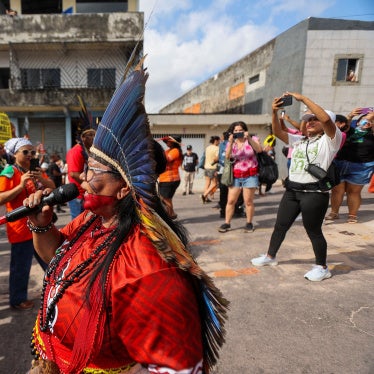
President Luiz Inácio Lula da Silva chose Belém as the city to host COP30 “to put the Amazon rainforest at the center of the UN climate talks.” Brazil is expected to initiate the Tropical Forest Forever Facility, an investment fund that would reward countries that keep their tropical rainforests standing.
Human Rights Watch has called for the protection of land rights and the full participation of Indigenous peoples and local communities in the design and implementation of the investment fund.
The fund could support the recognition and advancement of land rights by reserving funding for surveying and titling traditional territories, which in turn can contribute to decreased deforestation.
The fund should also explicitly align with international human rights standards, recognizing Indigenous peoples as rights-holders over the territories they use and occupy, currently or historically. It should acknowledge that many of these communities existed before the state and that self-identification is a fundamental criterion, not contingent on government recognition or formal land title. The text should reference the UN Declaration on the Rights of Indigenous Peoples and International Labor Organization (ILO) Convention 169, and embed free, prior, and informed consent, land and territory rights, and participation through representative institutions across all of the fund’s policies, funding windows, and monitoring frameworks.
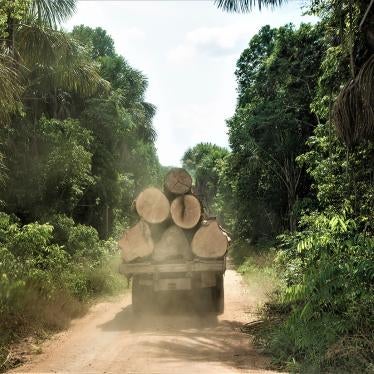
In addition, the fund should develop exclusion criteria that would prevent the funds from being used to boost the industries most responsible for climate change and large-scale tropical deforestation. In particular, these funds should not be used to finance the expansion of fossil fuel infrastructure, monocultures, logging or rearing livestock. Finally, these funds should not be invested in the expansion of gold mining operations, whether these are privately or publicly owned.
- How can COP30 address the needs of communities relocating on the front lines of sea level rise and other climate-related hazards?
At COP30, countries should develop and adopt indicators to measure progress toward a global adaptation goal, aimed at supporting countries in better adapting to the impacts of climate change. These indicators should take into account human mobility dimensions, such as planned relocation, without oversimplifying them. For example, it is essential to recognize that while planned relocation can be a preventative measure to reduce forced displacement or a durable solution to respond to displacement, if inadequately planned and supported, it can also be a serious threat to human rights.
Parties should also include human mobility dimensions in their national climate and adaptation plans by 2035, integrating strategies to prevent displacement alongside needs to support displaced communities to find durable solutions including through planned relocation. Without measurable indicators and inclusion in national planning, complex human mobility risks and responses may be ignored or underfunded.