Reports

How the U Visa Builds Trust, Counters Fear, and Promotes Community Safety

The 50-page report, “‘We Need U’: How the U Visa Builds Trust, Counters Fear, and Promotes Community Safety,” finds that the administration’s deportation policies undermine federal visa programs that provide a pathway for crime victims to obtain legal residency when they cooperate with law enforcement. Changed enforcement guidance, such as allowing Immigration Customs Enforcement (ICE) officials to apprehend people in previously safe places like courthouses and health centers, is a strong deterrent for immigrants who might otherwise report crime to police or seek a protective order.


Federal agents detain a woman exiting an immigration court hearing
A woman looks out of the window of a damaged building

Search

  • May 19, 2020

    Failure of Protection under the US-Guatemala Asylum Cooperative Agreement

    The joint report by Refugees International and Human Rights Watch, “Deportation with a Layover: Failure of Protection under the US-Guatemala Asylum Cooperative Agreement,” shows that the US-Guatemala Asylum Cooperative Agreement, or ACA, does not meet the criteria in US law for a Safe Third Country Agreement that would enable Salvadorans and Hondurans to seek asylum in a safe country other than the US.
    202005Americas_Guatemala_cover
  • February 5, 2020

    United States Deportation Policies Expose Salvadorans to Death and Abuse

    The US government has deported people to face abuse and even death in El Salvador. The US is not solely responsible—Salvadoran gangs who prey on deportees and Salvadoran authorities who harm deportees or who do little or nothing to protect them bear direct responsibility—but in many cases the US is putting Salvadorans in harm’s way in circumstances where it knows or should know that harm is likely.

    202002US_Elsalvador_cover
  • December 3, 2019

    Denial of Education for Rohingya Refugee Children in Bangladesh

    This report documents how Bangladesh prohibits aid groups in the refugee camps in the Cox’s Bazar district from providing Rohingya children with accredited or formal education. There is no secondary-level education, and groups are barred from teaching the Bengali language and using the Bangladesh curriculum. Rohingya children have no opportunity to enroll in or continue their education at private or public schools outside the refugee camps.

    video content
    201912CRD_Bangladesh_cover
  • September 5, 2019

    The Treatment of Unaccompanied Migrant Children in the French Hautes-Alpes

    The 80-page report found that examiners whose job is to certify a child’s status as a minor – that is, under age 18 – do not comply with international standards. Human Rights Watch found that examiners use various justifications to deny children protection. These include children’s minor mistakes with dates, their reluctance to discuss particularly traumatic experiences in detail or work they did in home countries or while in transit, and what examiners deem as unrealistic life goals.

    video content
    201909CRD_France_reportcover
  • July 2, 2019

    US Returns of Asylum Seekers to Mexico

    This report finds that thousands of asylum seekers from Central America and elsewhere, including more than 4,780 children, are facing potentially dangerous and unlivable conditions after US authorities return them to Mexico. The US and Mexico agreed on June 7, 2019 to dramatically expand the returns program.

    201907us_mexico_cover
  • May 13, 2019

    Corporal Punishment in Lebanon’s Schools

    This report finds that children suffer from corporal punishment at school because of a lack of accountability for the abusers. Human Rights Watch said that Lebanon should enforce a longstanding ban on corporal punishment and propose ways in which the Education Ministry, with support from international donors, can end the abuse. 

    201905crd_lebanon_cover
  • January 21, 2019

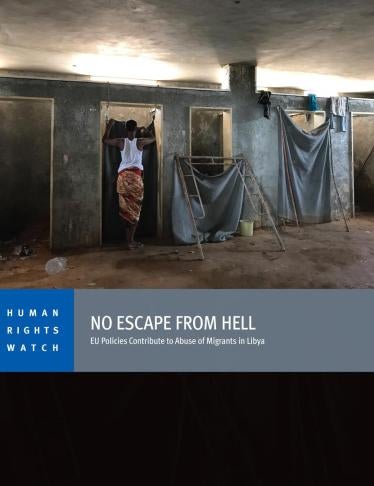
    EU Policies Contribute to Abuse of Migrants in Libya

    This report documents severe overcrowding, unsanitary conditions, malnutrition, and lack of adequate health care. Human Rights Watch found violent abuse by guards in four official detention centers in western Libya, including beatings and whippings. Human Rights Watch witnessed large numbers of children, including newborns, detained in grossly unsuitable conditions in three out of the four detention centers. Almost 20 percent of those who reached Europe by sea from Libya in 2018 were children. 

    map content
    video content
    Cover
  • September 3, 2018

    The Need for a Regional Response to an Unprecedented Migration Crisis

    This report documents efforts by South American governments to address the massive numbers of Venezuelans crossing their borders, as well as recent setbacks that threaten Venezuelans’ ability to seek protection. In some Caribbean islands, Venezuelans are subject to arbitrary arrests and deportations. Xenophobic incidents are a growing concern. 

    photo gallery
    map content
    video content
    Cover
  • August 5, 2018

    The Plight of Rohingya Refugees from Myanmar

    This report is based on a May 2018 visit to Cox’s Bazar. Human Rights Watch found that the mega camp is severely overcrowded. The average usable space is 10.7 square meters per person, compared with the recommended international standard of 45 square meters per person. Densely packed refugees are at heightened risk of communicable diseases, fires, community tensions, and domestic and sexual violence. Bangladeshi authorities should relocate Rohingya refugees to smaller, less densely packed camps on flatter, accessible, nearby land within the same Ukhiya subdistrict where the mega camp is located, Human Rights Watch said.

    map content
    video content
    Cover
  • July 18, 2018

    Denial of Education to Child Asylum Seekers on the Greek Islands

    This report found that fewer than 15 percent of more than 3,000 school-age asylum-seeking children on the islands were enrolled in public school at the end of the 2017-2018 school year, and that in government-run camps on the islands, only about 100 children, all preschoolers, had access to formal education. The asylum-seeking children on the islands are denied the educational opportunities they would have on the mainland. Most of those who were able to go to school had been allowed to leave the government-run camps for housing run by local authorities and volunteers.

    map content
    video content
    Cover
  • April 20, 2018

    Mass Evictions of Syrian Refugees by Lebanese Municipalities

    This report documents inconsistencies in the reasons municipalities have given for expelling Syrians and the failure of the central government to protect refugees’ rights. United Nations officials identified 3,664 such evictions from 2016 through the first quarter of 2018. While Lebanese municipal authorities make tepid claims that the evictions were based on housing regulation infractions, Human Rights Watch found the measures taken by these municipalities have been directed exclusively at Syrian nationals, and not Lebanese citizens or other foreign nationals.

    Cover of the Lebanon refugees report
  • October 2, 2017

    Jordanian Deportations and Expulsions of Syrian Refugees

    This report documents that during the first five months of 2017, Jordanian authorities deported about 400 registered Syrian refugees each month. In addition, approximately 300 registered refugees each month returned to Syria during that time under circumstances that appeared to be voluntary. Another estimated 500 refugees each month returned to Syria under circumstances that are unclear. Jordan has hosted more than 654,500 Syrian refugees since 2001. Human Rights Watch has repeatedly called for other countries to increase their assistance to Jordan and to resettle greater numbers of Syrian refugees living in Jordan.

    Cover for Jordan Report
  • September 27, 2017

    Cameroon’s Mass Forced Return and Abuse of Nigerian Refugees

    This report documents that since early 2015, Cameroonian soldiers have tortured, assaulted, and sexually exploited Nigerian asylum seekers in remote border areas, denied them access to the UN refugee agency, and summarily deported, often violently, tens of thousands to Nigeria. It also documents violence, poor conditions, and unlawful movement restrictions in Cameroon’s only official camp for Nigerian refugees, as well as conditions recent returnees face in Nigeria.

    map content
    Cover for Cameroon Report
  • September 14, 2017

    Lack of Transparency in Donor Funding for Syrian Refugee Education

    This report tracks pledges made at a conference in London in February 2016. Human Rights Watch followed the money trail from the largest donors to education in Lebanon, Turkey, and Jordan, the three countries with the largest number of Syrian refugees, but found large discrepancies between the funds that the various parties said were given and the reported amounts that reached their intended targets in 2016. The lack of timely, transparent funding contributed to the fact that more than 530,000 Syrian schoolchildren in those three countries were still out of school at the end of the 2016-2017 school year.

    Cover of the Children's Rights report on Syrian Refugees in Turkey, Lebanon, and Jordan
  • August 1, 2017

    Escalating Violence and Abuses in South Sudan’s Equatorias

    This report documents the spreading violence and serious abuses against civilians in the Greater Equatoria region in the last year. The report focuses on two areas: Kajo Keji county, in the former Central Equatoria state, and Pajok, a town in the former Eastern Equatoria state.

    photo gallery
    map content
    Cover of the South Sudan Report