US Expulsions of Third-Country Nationals to Countries in Africa
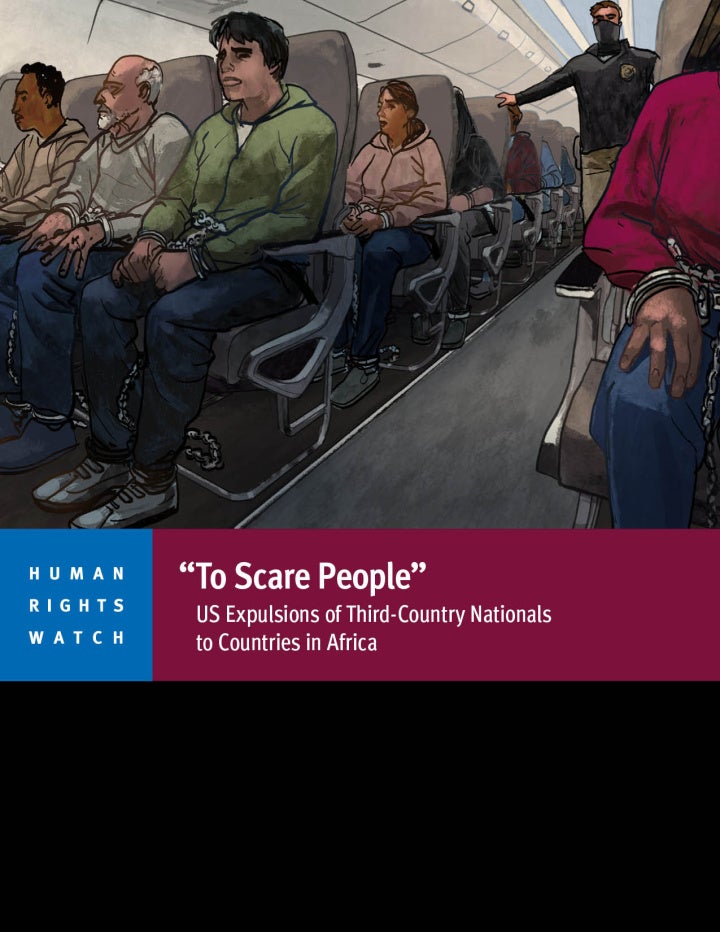
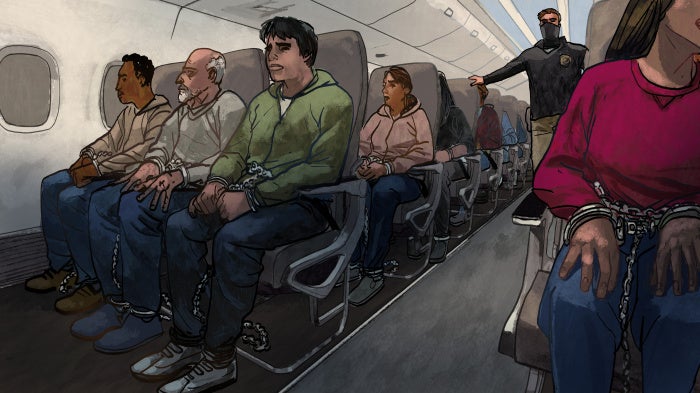
The 125-page report, “‘To Scare People’: US Expulsions of Third-Country Nationals to Countries in Africa,” documents that US authorities denied the more than 500 people transferred to third countries a meaningful chance to contest their removals or to articulate their fears of being removed to these countries. Some countries arbitrarily detained people they had accepted, and some have sent people onward to the risk of persecution or torture in their home countries, violating the international law principle of nonrefoulement.
Discrimination against Women Living with HIV in the Dominican Republic
Women in the Dominican Republic are routinely subjected to involuntary HIV testing, and those who test positive are fired and denied adequate healthcare. This 50-page report documents the human rights violations women living with HIV suffer in the public health system as well as in the workplace.
Human Rights Watch has issued numerous reports showing that human rights abuses against persons living with and at high risk of HIV/AIDS contribute significantly to new HIV infections worldwide. This is true in Thailand, the host of this year’s AIDS conference, as well as in numerous other countries worldwide.
The War on Drugs, HIV/AIDS, and Violations of Human Rights
This 60-page report provides fresh evidence of extrajudicial killings, arbitrary arrests and other human rights violations by Thai authorities. The report contains first-hand testimony from relatives of people killed during the drug war, as well as drug users who endured beatings, forced confessions and arbitrary arrests at the hands of Royal Thai Police.
This 33-page report documents how the Tunisian authorities continue to hold as many as 40 of the country’s more than 500 political prisoners in long-term isolation in prisons around the country. This policy violates Tunisian law as well as international penal standards, undermining government claims of prison reform.
The States Parties to the Convention on Conventional Weapons (CCW) have long recognized the dangers of cluster munitions. They first questioned the civilian harm these weapons cause at the Lucerne Conference in 1974 that eventually led to the CCW.
The United States Department of Defense Fiscal Year 2005 budget, which covers October 2004 to September 2005, includes several requests for procuring cluster munitions or their subparts. The Army, Marines, Air Force, and Navy all seek funding for variations of these weapons.
Turkey’s public universities are still emerging from more than twenty years of military influence and centralized ideological and operational controls.
With most of Burundi at peace, the United Nations has assumed responsibility for the African Mission in Burundi (AMIB), a peacekeeping force already in place under the auspices of the African Union.
Indefinite Detention Without Trial in the United Kingdom Under Part 4 of the Anti-Terrorism, Crime and Security Act 2001
The U.K. government introduced emergency legislation in the wake of the September 11 attacks in the U.S. The resulting Anti-Terrorism Crime and Security Act became law on December 14, 2001. This briefing paper details how indefinite detention, contained in part 4 of ATCSA, has seriously damaged the mental and physical health of the detainees.
The Kyrgyz government’s human rights record has steadily deteriorated during the past several years. Human Rights Watch has documented serious rights violations, particularly in the areas of political participation, freedom of assembly, and freedom of expression. Local rights groups in particular have exposed serious violations of fundamental rights.
The Venezuelan government is undermining the independence of the country’s judiciary ahead of a presidential recall referendum that may ultimately be decided in the courts. President Chávez’s governing coalition has begun implementing a new court-packing law that will strip the Supreme Court of its autonomy.
Human Rights Watch submitted a number of requests to the U.S. government for documents relating to trafficking in persons in Bosnia pursuant to the Freedom of Information Act. Two years after our initial request, we obtained a limited number of documents.
Since the establishment of the Government of National Unity in Kinshasa in June 2003, peace has eluded eastern parts of the Democratic Republic of Congo (DRC), particularly in Bukavu and the wider Kivu region, Ituri and Northern Katanga.
Child domestic workers are nearly invisible among child laborers. They work alone in individual households, hidden from public scrutiny, their lives controlled by their employers. Child domestics, nearly all girls, work long hours for little or no pay. Many have no opportunity to go to school, or are forced to drop out because of the demands of their job.