I used to think being gay was just part of my life and now I know it means dark cells and beatings. It is very, very difficult to be gay in Egypt.
I'll tell you something. Some things that happen in your life you can forget. And there are some things that you can never forget, even for one minute. You forget the good times; you may have been happy in a moment, and you forget. But the black days you can't forget. If it's inside you, you remember every minute. And [the day I was tortured] was a very black day in my life. … It hurts me to remember.
I don't sleep at all. If I sleep I would dream about the trial. If I have to go back to prison, I will kill myself. What do they want from us? I have no one to talk to, no one to ask. No one who can understand. What do they want from us? Why do they want our lives?
-Ziyad (not his real name), a defendant in the "Queen Boat" trial, interviewed by Human Rights Watch in 2003.
I. Justice at Stake: An Introduction
A. Summary
"Every place we were held, somebody beat us," the twenty-five-year-old told Human Rights Watch. "We asked, why is it us who are getting beaten? It was like they weren't dealing with human beings at all. … Like we weren't even animals, just mud or something they could kick around."
Another man said, "They punished me only because of my sexual orientation and they condemned me as a criminal for my entire life. … In brief, they killed every beautiful hope and future I ever had." A young man in his twenties told Human Rights Watch, "I don't understand why they do these things to men who hurt no one. I don't understand why they must hunt us down. …I am a human being. Aren't I? Tell me that I am. No, I know I am. I just can't believe this happened to me."
The questions multiplied, but one echoed again and again. A man wrote Human Rights Watch, "Why do they destroy our future, who allowed them to do that? Did they only discover that Egypt is full of homosexuals two years ago? Why do I have to live my life away from my family and my friends, and my city and my country for I don't know how long? … Why did I see the look of victory in their eyes while interrogating me?" In a provincial city, another man pleaded, "Why is it bothering them so much? Why do they have to torture us? Why do they care? We don't do anything to anyone else. Who do we harm? Why do they hate us? Why?"
Egypt is carrying out a crackdown. The professed motive is cultural authenticity coupled with moral hygiene. The means include entrapment, police harassment, and torture. The agents range from government ministers to phalanxes of police informers fanning out across Cairo. The victims are men suspected of having sex with men. The violence is aimed not only at their loves but at their lives.
Since early 2001, a growing number of men have been arrested, prosecuted, and convicted for having sexual relations with other men. Human Rights Watch knows the names of 179 men whose cases under the law against "debauchery" were brought before prosecutors since the beginning of 2001; in all probability that is only a minuscule percentage of the true total. Hundreds of others have been harassed, arrested, often tortured, but not charged.
More than men who have sex with men are among the crackdown's victims, however. Its effects reach beyond the broken bodies, wrecked families, and ruined lives lying in its immediate trail. The offense against the marginalized potentially endangers everyone; the offensive against privacy corrupts the principles of public life. Every Egyptian's dignity and integrity are under threat in a time of torture, when the law accepts violence as investigation and stigma as certainty.
The severity of the brutality inflicted indicates the crackdown's intensity. Police routinely torture men suspected of homosexual conduct, sometimes to extract confessions and sometimes simply as a sadistic reminder of the burden of shame their alleged behavior incurs. Men have told Human Rights Watch how they were whipped, beaten, bound and suspended in painful positions, splashed with ice-cold water, and burned with lit cigarettes. Men taken during mass roundups may be tortured with electroshock on the limbs, genitals, or tongue. Guards encourage other prisoners to rape suspected homosexuals. Psychological torment complements the physical trauma. One man, showing the scars of excruciating torture on his limbs, said: "I want to scream. I want to cry. I can't let it out."
Egypt enlists medicine to join the maltreatment. Men arrested for homosexual conduct are forcibly subjected to anal examinations at the hands of the Forensic Medical Authority, an agency of the Ministry of Justice. Doctors compel the men to strip and kneel; they massage, dilate, and in some cases penetrate the prisoners' anal cavities in search of signs that they have been "habitually used" in "sodomy." Invasive, abusive, and a form of torture in itself, the practice is predicated on outdated pseudoscience, on myths-of the "marks" left by anal intercourse-which date back nearly a century and a half. Yet doctors continue to invent means of investigating prisoners' anuses, boasting to Human Rights Watch of "new methods" employing electricity.
May 2001 saw the best-known case in the crackdown begin: fifty-two men ultimately went to trial, many arrested during a police raid on a Cairo discotheque, the "Queen Boat," frequented by gay men. The proceedings, less judicial exercise than extravaganza, accused the men-most of whom did not even know each other until their jailing-not just of dissident desires but of participating in a blasphemous conspiracy. Sensational headlines savaging them as "Satan-worshippers" and "sexual perverts" filled the papers for months. They spread a new image of homosexual conduct: no longer a private matter but a menace to public safety, the code of a cult eroding moral values, a subversive network threatening state security.
The hysteria made the "Queen Boat" case the most public episode in the campaign, and it indeed comprised a watershed in some ways. Before the headlines, Cairo had the tentative beginnings of a community of men who desired other men-people who perceived a commonality among one another, and sometimes (though not always) described themselves as "gay." A few pubs and meeting-places, circles of friends who shared stories and talked about the meanings of their desires-these were the substance of that incipient solidarity, which remained largely invisible to others, and neither challenged any authority nor impinged perceptibly on the public sphere. The scandal and scare tactics around the trial, the paranoia the press evoked, shut that inchoate community down. Friendships died and solitude set in.
Yet the Queen Boat trial, for all its consequences, marked neither commencement nor climax of the crackdown. Even before the bar raid, agents of the Vice Squad (a morals police within the Ministry of Interior's national police force, with divisions in each jurisdiction) had started surveillance of the Internet, answering personals advertisements placed by men seeking men, arranging meetings with them, and arresting them. Internet entrapment has expanded till by early 2003 it appeared to reach a rate of at least one arrest a week. It both builds on and reinforces the growing fragmentation of friendships and atomization of trust. Warnings of danger, words of caution, no longer move through shattered circles of increasingly suspicious men. Having closed down places where community could be affirmed and communication could happen, police are now in position to pick off men one by one.
In other cases, police in Cairo and elsewhere have raided private apartments, or wiretapped phones to collect and arrest contacts, or used "trusted secret sources" to finger men suspected of homosexual conduct. Vice Squads maintain lists of homosexuals; massive roundups may follow if a gay man is murdered, with dozens or even hundreds arbitrarily detained. The victims are interrogated and tortured, sometimes for weeks. An extensive network of informers supports the crackdown, feeding names and information to avid authorities. One Vice Squad officer in the Giza section of greater Cairo has informers invite guests to parties, then hand them over to the police: Human Rights Watch has documented twenty-three arrests accomplished by that officer alone.
Egypt's government has publicly claimed that the surveillance and suppression of homosexual conduct defend its cultural values, its "unique norms and evolving practices." Yet torture and entrapment, the key tools of the campaign, are not defensible norms or values. They insult the dignity and integrity of the human being. They break the bonds of trust that culture and religion protect.
Not cultural inheritance but an ineptly written law underlies the crackdown. Egyptian officials have deceptively claimed that the country codifies "no distinction or discrimination based on a person's sexual orientation." In fact, as Human Rights Watch shows in this report, legislation originally meant to penalize prostitution swelled, during its drafting, into a sweeping instrument punishing "promiscuity" in general. The law is now clearly understood to criminalize consensual, non-commercial homosexual conduct, under the name of "debauchery" (fujur)-in provisions which work comparably to so-called "sodomy laws" in other jurisdictions. A growing roster of states rejects such laws as intolerable assaults on privacy and equality, and as breaches of international human rights protections.
A law without distinct limitations lent opportunity to a criminal justice system under diminished restraint. Both activists and commentators in Egypt have called alarmed attention to the failure of oversight of police and prosecutors in the last decade, as well as the deterioration of judicial expertise and independence. Criminal justice now serves less to uphold the rule of law than to enforce brutal social control. The spread and routinization of torture-the degree to which police abuse has become not the exception but the rule-reveals a crisis in Egyptian justice.
The physical and psychological cruelty meted out to men who have sex with men is only one aspect of this crisis. Yet it foregrounds the factors which both allow abuse to spread and create particular vulnerabilities to it. Vicious campaigns of vilification in the state-owned media foster ideas of homosexuality as a national danger: no paper protections against official abuse deter authorities from using any available means against the menace. Police brutalize victims and fake reports. Prosecutors press charges based on a defendant's looks or walk, the style of his hair or the color of his underwear. Judges rule by rote, regardless of whether evidence is fraudulent-or even whether it adds up to the elements of a crime according to the letter of the law.
The arbitrary is the usual: torture becomes normal. The attacks on individuals are also an assault on the abstract principles that cement society. The victims' shattered dignity reflects the degradation of justice.
The assault on basic rights must end.
B. Methodology, Terminology
This report is based on research conducted by Human Rights Watch during a mission to Egypt over three months in the early 2003, as well as on documentation and legal research and analysis carried out by human rights activists in Egypt. Human Rights Watch interviewed sixty-three men who had been arrested on suspicion of homosexual conduct, in Cairo and in other cities in lower Egypt. One fact registers the reach of stigma and fear: all those arrested asked us not to reveal their identities.
We also interviewed families, friends, and partners of arrested men; attorneys and judges who have worked on "debauchery" cases; government officials; and human rights activists. Human Rights Watch also examined official files in the cases of 126 men arrested on "debauchery" charges since 1997.[1] Human Rights Watch studied press articles and legal texts, and consulted Cassation Court and Constitutional Court decisions in cases relating to sexual offences heard over five decades.
Many voices thus make themselves heard in this report, those of the powerful as well as the profoundly powerless. In such a polyphony, terminology itself becomes a matter of debate, and a question of power.
Two words are particularly crucial, and contested, here. Hossein-a young man from a desperately poor background, illiterate though gifted and creative-told Human Rights Watch how he came to be on the Queen Boat: a friend "told me that there is this disco which is a 'gay disco.' I didn't know what 'gay' meant, because of my education. He told me what it meant, and because I thought I was 'gay,' I went."[2]
The word "gay," describing men who have sex with men, emerged out of a North American subculture in the twentieth century. Its more scientific-sounding synonym, "homosexual," is not much older-coined by a central European doctor in 1869.
The relative youth of the words should raise caution in ascribing antiquity, or ubiquity, to what they purport to describe. The identity of the "homosexual" is a recent, regional development. The concept of "sexual orientation"-constructing a personal and public identity around the sex of the person one desires-is only one way of understanding the fact of homosexual conduct, and attaching meaning to it.[3]
The political ethics as well as the propriety of employing terms such as "gay " has recently become contentious. One writer sympathetic to protecting homosexual conduct per se accuses international human rights groups, and Western lesbian, gay, bisexual, and transgender organizations, of imposing identity categories on Arab experience, in an endeavor to "transform" intellectually and sexually colonized men "from practitioners of same-sex contact into subjects who identify as homosexual and gay."[4]
Yet even such an argument acknowledges that the conduct called "homosexual"-the desire for, and erotic acts or emotional relationships between, people of the same sex-is wholly indigenous in Egypt, not imported. Egyptian society, like all others, has perpetually attached interpretations to those acts and desires.[5] Another writer controversially contends that sexuality in Arab societies is essentially "inegalitarian," with sexual relations "understood as relations of power linked to rigid gender roles."[6] Clearly the distinction between penetrator and penetrated in particular sexual acts runs through many stories in this report, and remains an important axis for understanding sexuality. Yet these roles are not absolute or rigid. To assume that they always reproduce "inequality" denies individual inflection or equivocation. People negotiate: taking one role in one act or situation may give way to another elsewhere.[7] Whatever power sexual roles confer is redefined by other social forces. The symbolic system of sex never works in isolation from the rest of experience.
Not all men who have sex with men-in Egypt or elsewhere--regard themselves as "gay," or "homosexual." This is not just idiom or idiosyncrasy. Men may see the sexual role they play-as penetrator or penetrated partner, "top" or "bottom"-as the constituent element in their identity, not the sex of the person they desire. Men may, however, also see themselves in multiple roles, which may offer multiple self-definitions not reducible to the straightjacket of a single adjective.
Another word reverberates through this report. Khawal (plural khawalat) was a term for male transvestite dancers in the nineteenth century. They performed at many public celebrations, as a respectable substitute for dancing women.[8] The term now vilifies rather than describes. As its meaning has become derogatory, though, its scope has also shifted. In some cases it is used abusively for men seen as the "passive" partner in intercourse-clearly its older usage.[9] Yet in instance after instance here, it encompasses both partners. Much as many of those men employ a version of "gay" to describe a common identity regardless of role, khawal increasinglyinscribes a suddenly common stigma.
Social understandings of sexuality are not fixed. Constantly mutable, they move in the context of larger forces of cultural change and interchange. Those borrowings and revisions negate the notion that any interpretation can be pinned to permanence, accused of alienness, or applauded as "authentic." Hossein, visiting the Queen Boat, found a term which seemed to describe a part of himself. The term was foreign; but in adopting it he adapted it, and gave it his own meaning.
The language of rights-protecting basic freedoms of expression and thought-includes rather than precludes the right to define oneself. Human Rights Watch has tried to use the terms people themselves used in self-description. Where we call men "gay," it is generally because they called themselves that. Where we call men "bottoms" or "tops" ("passive" or "active" partners in sex: in local slang, kodyana or barghal) it is because they embraced the attribution. Our aspiration is to respect the voices and vocabularies of those who speak in and through this text.
C. Creating a Moral Panic
The question "why" remains. Arrests did not begin in 2001. As this report shows, the law used against homosexual conduct dates from five decades earlier. Harassment of men who had sex with men had been happening for a long time before the Queen Boat case-on a smaller scale, and often not ending in prosecution.
In Cairo, police had routinely carried out campaigns against various populations whose public presence detracted from the capital's preferred image. Street hawkers, street children, and sex workers recurred as victims.[10] The next chapter demonstrates that men having sex with men had joined such groups at least by the late 1990s: the Vice Squad targeted them on Cairo's streets. This mounting harassment apparently drew energy from the violent animus of the Squad's head in Cairo, Taha Embaby.
At the same time, and on a broader level, Egypt's government has increasingly manipulated moral panics-sensationalized scandals in which groups are singled out for stigma, and made focal points of popular fears and resentments.[11] In the late 1990s, a series of such panics filled the press; Shi'ites and teenage rock fans became, at various points, unlikely victims of vilification as "Satanists" and conspirators.[12]
These panics served multiple purposes. On the one hand, they diverted the media from the mounting crises of a political system mired in inaction and mass immiseration, unable to address growing poverty or popular discontent. On the other hand, they served up sinister enemies-often literally demonized, smeared as offenders against religion-to be blamed when that discontent demanded scapegoats. And a government that routinely repressed religious fundamentalism could improbably recast itself as defending orthodoxy from the blandishments of organized deviance.
The Queen Boat arrests sparked another panic, on a scale to stun and fascinate citizens for months. The state exploited sexuality as sideshow: but the prurient spectacle strengthened its Puritan credentials. As an Egyptian writer contends, the government skillfully used the sensation not just "to divert public attention from economic recession and the government's liquidity crisis," but "to present an image as the guardian of public virtue, to deflate an Islamist opposition movement that appear[ed] to be gaining support every day."[13]
Politics thus bolstered police practice. The moral panic and the quieter clean-up campaigns met. The Queen Boat scandal let the state assert its power over a figurative form of customs control: the authority, unchecked by irritant claims of privacy or freedoms, to patrol cultural borders and to excise what it found unacceptable even in the recesses and reticences of intimate life. It also reinforced local policemen's perception that homosexual conduct was a lurid and immediate enemy-and gave officers across the country every incentive to step up raids and intensify harassment.
The results have multiplied the arbitrary arrest and torture of men who have sex with men. Despite the publicity the Queen Boat case garnered, many of the most serious abuses have gone unreported until now. Even the cases Human Rights Watch has uncovered undoubtedly represent only a fraction of the whole. It is time for the detentions and prosecutions, the torture and betrayals, to stop.
D. Key Recommendations
Human Rights Watch calls on the government of Egypt to:
- End arrests and prosecutions for adult, consensual homosexual conduct.
- Amend its laws to eliminate all references to "debauchery" (fujur) as well as other vague language that can be used to target people on the basis of adult, consensual homosexual conduct.
- End police surveillance and entrapment of persons based on their suspected homosexual conduct.
- Protect the right to free expression over the Internet.
- Train all officials of the criminal justice system in international human rights standards, including issues of sexuality and sexual orientation; and punish officials who engage in, encourage, or condone maltreatment of, or discrimination against, people based on their homosexual conduct.
- End the practice of forensic anal examinations of men accused of "debauchery" or any other crime.
- Prevent and punish the crime of torture, by bringing legislation into line with international standards, and ensuring full and fair investigations of allegations of torture and ill-treatment.
- End illegal arrests and incommunicado detention.
- Repeal legislation that permits arbitrary detention and establishes courts that allow no ordinary judicial appeal.
- Invite United Nations human rights mechanisms to scrutinize its protections against torture and other forms of abuse.
Human Rights Watch calls on donors offering aid to Egypt to:
- Condemn the criminalization of consensual homosexual conduct in Egypt, along with the entrapment and torture that accompany it.
- Demand progress reports from the Egyptian government on concrete steps taken to end abusive practices and improve its human rights record.
- Ensure that all aid or training programs for Egyptian criminal-justice officials contain a human rights component, and include issues of sexuality and sexual orientation in a way designed to eliminate prejudice and stigma.
- Ensure that technological support or aid does not contribute to surveillance or persecution of vulnerable groups, such as men who have sex with men.
Detailed recommendations can be found in the conclusion to this report.
II. Homosexual Conduct and the Law: The Conditions for a Crackdown
A. Khaled's Story
Harassment of men suspected of homosexual conduct did not begin with the Queen Boat case. Khaled, twenty-five, told Human Rights Watch a story of how the apparatus of police repression worked. Khaled says,
I was in the fourth year at university: it was exam time, in May 2000. I went to Tahrir Square on a Thursday evening, I was standing waiting for a taxi. Suddenly a police wagon stopped in front of me, a truck full of police.
A man jumped down in front of me and asked for my ID. He was the head of the Cairo Vice Squad, Taha Embaby himself, I later found out-but I didn't know this at the time. He was wearing plainclothes. Then a guy came out of the van. His nickname is Mustafa "Laila Elwi."[14] … He's gay but is an informer. The officer asked him about me. Mustafa "Laila Elwi" said, "Yes, I know this person." [15]
According to Khaled, Taha Embaby asked him, "Are you gay?"
He used the term "gay" in English. I said I didn't know what the word meant. He used the word because he wants you to repeat it back to him as an answer. And if you know what it means, if you pronounce it in the English way, then you are definitely gay. Unfortunately, I fell into the trap more or less-I said I didn't know what "gay" meant, but I pronounced the word as if I did. And the uniformed guards came out and dragged me off as if I were a murderer or drug dealer. …
There were six men inside the van. The police started collecting more. The officer confirmed they were gay through this informer. Finally, there were twenty or twenty-five people prisoners. There were two vans. … Each van would fill, then be sent to the station, then sent out again.
Police, according to Khaled, were picking up men as they entered the bar in the Nile Hilton Hotel, a popular gay gathering place, as well as what were believed to be gay cruising areas in Tahrir Square.
They took us to the second floor of al-Azbekiya police station. I had my mobile: I rang my family to say I'd been arrested and I didn't know why. My mother and father came. It was one of the worst moments of my life. … The head of the Vice Squad had me called from the room. He confronted me with my father. He said "This son of yours is a khawal, he gets fucked." And he said I was caught in the act. He said, "I'll prove it." He made me undo my trousers. By lucky chance I was wearing ordinary underwear-white underwear, the same ordinary design and color as most Egyptians wear. He believed colored underwear meant a person was not only gay but passive. And in Egypt it is a catastrophe to be known as a gay bottom. … Embaby got very mad. "No problem," he said. "OK, so he doesn't get fucked, but maybe he still fucks children and khawalat." The effect on my father was electric. He left me there and he went home.
Every time a family member asked after one of the men that night, the family would leave and go home because they were so horrified by what they found, and Taha Embaby and his men tried to horrify them.
Khaled was returned to the room where police were recording the arrestees' names. "There were over a hundred and fifty, I think. I was surprised."
Taha Embaby was surprised too. He said he couldn't believe there were this many khawalat in Egypt. He said: "I have to do something: I must either kill you or make you regret that you were born." He picked out people who were wearing what in Egypt is considered "debauched" dress-foreign or too-stylish clothes or jewelry.
One boy had an earring and they beat him half to death.
He abused people verbally: "You're the kids who have suddenly appeared and are corrupting this country; you look like you're being fucked by the guys standing behind you." He'd ask each guy his name, then turn it into a woman's. Then he started hitting them, slapping and punching them in the face and kicking them with his boots.
Sent to cells for the night, in the morning the prisoners were forced to sign arrest reports:
They started calling each person by name. Those who refused to sign would get beaten very badly. They hit [us] with a big stick and also a whip. One of the guys swore at an officer. They tied his ankles and hung him from the ceiling by them. Then they started beating him on the soles of his feet. After the first few were beaten most just signed.
I was one of the last. I refused. They started beating me with the stick, and with the whip on my back. A new policeman came, with an iron bar in his hand. I was weeping, but I refused to cry out. The officer took the bar and beat me. I tried to use my hand to ward off the blows: I got hit on the hand: I still have the scar.[16] Finally I was exhausted. I fell on the floor. I said, I'll sign. All my body was broken up by this beating. I don't know how long it went on, ten, fifteen minutes.[17]
It was Friday morning: the prisoners were taken to the al-Azbekiya niyaba.[18]
There was a huge number of family members gathered in front of the niyaba. … And you can only imagine how we felt going out, with family members looking at people. Yet the family members saw how we were wearing the bruises of our beatings: and they started to believe that we were victims of trumped-up charges.
Without interrogating the prisoners, prosecutors charged them with "habitual practice of debauchery," and ordered their release pending trial. Then they were returned to the al-Azbekiya lockup. There, according to Khaled, "We were all beaten without exception. I still have a scar over my left eye":
I will never forget that night. This was at al-Azbekiya on the floor above the ground floor. They stood us in line and an officer went by, one by one, abusing us, slapping us, spitting in our faces. "Are you a whore?" he'd ask. We all said no. He said, "You sicken my eyes. It shows on you that you are whores." He slapped my face several times and spit in my face. The five boys who they thought were dressed effeminately were brought forward again and all the guards joined in beating them with slaps and punches in the face and stomach.
Then they were taken to Embaby's office, in the Abdin police station.
My father had found a wasta [influential protector]to try to get me free-because Taha Embaby didn't seem to want to let go of us, though the prosecutor had ordered us freed. There were about seven who had friends agitating for their release. Taha Embaby was furious. …He started making fun of the seven of us and slapping our faces. He said we were the scum of the earth, an abomination to Egypt before God, we had no right to live. He started hitting us again with the whip on our backs. … Taha Embaby, I believe, is insane. This man is dangerous, he is really not a human like other humans. He beat me with the whip and it took a month for the wounds and the pain to heal.
He joined us with the rest who were left. And the guards took all of us down and let us go. … When we left the station we were in a state of complete nervous and physical collapse. Some of us could barely stand. I was embarrassed for my friends, for my family, to see me like this. I looked like a beaten dog. I prayed for any of my friends who faced such a situation in the future, or who had the evil luck to stand one day face to face with the brutality of Taha Embaby. [19]
B. The Development of "Debauchery"
Khaled's story-that of a student who suddenly found himself caught up in a police roundup-points to many of the themes this report will explore. It reveals that the Queen Boat case drew on existing police practice-on a mounting impetus toward punishing stigmatized sexual behavior.
Indeed, the legal framework for persecution had been put in place almost fifty years before. The first issue to be examined here is: what law brought Khaled before the Vice Squad? How does Egypt criminalize sex between men?
Since 2001, Egypt has steadily claimed it has no such laws. Responding to a U.N. expert's criticism of the Queen Boat trial, for example, the government alleged its books held "no provision that designates sexual perversion as a criminal offence"[20]; and in 2003, the speaker of Egypt's People's Assembly told the European Parliament that "Egypt's penal code does not include punitive measures against the homosexuals as the country's law by no means interferes in the private affairs of individuals."[21]
These statements are false. Egyptian legislation has effectively criminalized male homosexual conduct for over fifty years. The prohibition appears in article 9(c) of Egypt's "Law on the Combating of Prostitution" (Law 10 of 1961, first passed ten years before). This provision punishes the "habitual" practice of fujur and di`ara with up to three years' imprisonment, plus fines.[22] The Arabic term di`ara isgenerally understood to mean prostitution in the sense of commercial sex, while fujur is a much broader term (translated here as "debauchery") encompassing a concept of sexual excess.
As Appendix B documents, the language of the law sprang from a sense of moral urgency as colonial domination drew to a close. In a rush to prohibit prostitution-seen as representing not just sin but political subjugation-Egypt's parliament enacted a much more sweeping prohibition. Veering between punishing sex work and prohibiting sexual misconduct in general, legislators stated they meant di`ara to describe "immorality" by women, fujur "immorality" by men. Fujur, an instrument of moral condemnation rather than legal exactitude, took on a life of its own as courts and the criminal justice system determined what was immoral for males, and concentrated on homosexual conduct.
In the following decades, Egypt's Cassation Court was called on repeatedly to rule on what di`ara and fujur meant, and their connection to sex work in the narrow sense.[23] The most significant decision came in 1975. The Vice Squad had broken into a private home, and found one man in the act of sexually penetrating another. The passive partner was charged with fujur. He testified that he had had sex with men repeatedly, but for no financial return.[24]
The Cassation Court found he was still culpable, meaning that fujur was legally uncoupled from sex work, but connected to male homosexual conduct.
The legislator explicitly stated that this crime [the habitual practice of debauchery] happens when one practices vice [fasha']with people with no distinction, and when this happens habitually. He did not necessitate for this charge that the practice of debauchery [fujur] … happens in return for a payment.[25]
This ruling is cited again and again in contemporary Egyptian court verdicts, to justify convicting men for having non-commercial sexual relations with other men.
Fujur or debauchery thus was divorced from prostitution per se, and came to mean non-commercial male homosexual conduct. In the process, the application of Law 10/1961 to men and to women diverged, moving in radically different directions. Repeatedly, courts held that non-commercial sex between a woman and a man was not punishable even if practiced "habitually." [26] Non-commercial sex between two men was.
The legal fate of the other partner in the sexual act also differed drastically. The ban on di`ara falls upon the (female) prostitute alone. Only women are liable before the law; the men who buy sex are innocent. Men caught in flagrante with women found to be prostitutes normally go home after filing testimony against their sexual partners.[27]
Fujur cases seem originally to have followed a similar pattern-in which the "passive" participant was seen as exclusively "debauched," the "active" as a comparatively innocent "pleasure-seeker." In the 1975 case mentioned above, two men were caught in the act of penetration; the penetrated man was hauled into court and sentenced to six months in prison for "debauchery," while the penetrator testified against him and went home.
Such a practice reflects, of course, not just the influence of prostitution cases but a construction of sexuality in which role trumps object. What matters is less the sex of one's object-choice than whether one penetrates (and retains the attendant prestige of masculinity) or is penetrated (and loses symbolic and social authority).
Yet now, in case after case, men are now convicted of "debauchery" for relations with other men regardless of their sexual roles. Both partners in male homosexual sex are now criminals.
The roots of this shift are debatable. Tectonic plates are clearly moving in the social understanding of sexuality: a common if still tentative identity between "active" and "passive" partners has emerged in Egypt, sharing a common stigma. Western models of "homosexuality," in which emphasis on role gives way to the overriding significance of object-choice, have played a part. Yet the change cannot simply be reduced to their influence. The legal development also stems logically from eliminating the financial requirement for "debauchery" prosecutions. Exchanging money marks out different social roles-purchaser and seller-as well as sexual ones. With that element gone, the tendency increases for the two partners to collapse indistinguishably into one imputation of guilt.
Simply put: fujur in Egyptian law now means homosexual relations between men, whether commercial or not. The law requires that the act be "habitual"-legally taken to mean that it must have been committed more than once in three years, with more than one person.
It is tempting to say the history of this provision illustrates a law not on Egypt's books: that of unintended consequences. Anxieties over sex work created penalties that would find their full, harsh utility during a second moral panic, in a new millennium. Today article 9(c) of Law 10/1961 is Egypt's primary tool in punishing male homosexual conduct.
C. "Dance, Khawalat, Dance": Growing Harassment and the Dangers of Community
Khaled's story also shows the growing police attention to a phenomenon of late-1990s Cairo: the fact that a substantial subculture of men having sex with men gathered, called themselves "gay," and grew.
Manyself-identified gay men in Egypt recall the years before 2001 as an interval of connectedness and comparative liberation. In fact, most who joined in what some now describe as Cairo's fin-de-siecle "scene" did so secretively. Few if any disclosed their sexuality to their heterosexual friends, much less their families. Opportunities for being "out"-for affirming one's desires to others who shared them-were confined to private parties, friendly cafes, or a few clubs (the Queen Boat discotheque and the Nile Hilton bar among them) on selected nights of the week.
Cairo had long had its cruising areas: places where men interested in sex with men could covertly encounter one another. The pubs and parties emerging in the 1990s, although quiet, allowed still more space and apparent safety for friendship and conversation. In the process, some people began to coalesce around a shared identity, often using the term "gay." Participants were not exclusively drawn from the privileged. They came from diverse Cairene classes: the list of those seized at the Queen Boat raid in May 2001 includes doctors and teachers, but also truck-drivers and electrical repairmen. Indeed, Human Rights Watch's own research indicates that the idea of a "gay" identity is widely disseminated, even among working-class men in towns outside Cairo. Men were drawn to these gatherings not only by the need for love or sex, but by the hope of making friends, an individual aspiration which contributed to the collective construction of an incipient community.
The aspiration could look very different to the police.
We received information that some young perverts frequent the Taverne bar in the Nile Hilton to hunt pleasure-seekers to practice perversion with them. Today, as we were inside the bar to observe the status of public morality … we saw a person walking around the tables and acting in a way to draw attention, and walking in a female way, touching men inside the bar. We saw him walking outside the bar and walking in the corridors of the hotel, trying to touch men. Then we saw him whispering to a man and they both walked out together. Secret investigations showed that the first person who was being watched is a sexual pervert who practices debauchery with men with no discrimination, and so does the second. The first is a passive whereas the second is active. So we approached them and revealed our identity. They were both escorted to the headquarters.[28]
Ismail, in his early twenties when arrested in 1998, was the subject of this police report. He told us how he was arrested near the Hilton bar one Thursday night:
I was waiting for a friend who had gone to the bathroom. While I was standing there the police stopped me in the lobby and took my ID card.
They took me to the Tourist Police office in the basement of the Hilton. Thirteen or fourteen people were there, all accused of having sex with each other. … The officers had one Egyptian with them, and he gave them information about people who were entering the Hilton.
They paired us off, they said, "You had sex with you." I was paired with another one of the arrested. They took us all to the Mugamma`.[29] I didn't know this guy I was paired with. He signed the statement they wrote for him-they slapped him and he agreed. I refused to sign. … And so three officers started beating me. I was kicked, punched, and slapped. They brought a whip and started flogging me to sign. I finally did; I would have lost my skin otherwise.[30]
Another police narrative of "perverts" reads:
We received information that some young sexual perverts frequent Ramsis Square to hunt clients who are seeking forbidden desires with men, to practice debauchery with them. … Today while at the Square we saw someone sitting at the bus stop. He sat next to someone, they had a conversation, and then he put his hand on the thigh of the man and tried to grab his penis. But the man stood up and walked away. We approached [the man who walked away], revealed our identities and what we saw, and he stated that the person sat next to him and asked for his telephone number and that he grabbed his penis and that the man walked away. So we approached the person, revealed our identities and what we saw and heard from the other person … and he told us that he is used to practicing passive debauchery since his childhood. …The other person refused to come with us or tell us his name to protect his reputation.[31]
The passage is from an arrest report in a 1997 case. Nabil, the man described, twenty-eight years old when he spoke to us in 2002, tells his own story:
I was walking near Ramsis train station. I met some of my gay friends at a café called Shobokshy. I stopped inside to say hello and suddenly we were surrounded by policemen in plainclothes who asked for our IDs. They ordered all twelve of us to go with them to the police station.[32]
The late 1990s saw intensifying attention by the Cairo Vice Squad, in particular, to the sites and circumstances in which gay men met other men. Police apparently felt growing pressure to "clean up" the places where "perversion" transpired. Khaled even remembers that, while jailed, "I heard guards saying that the head of the Vice Squad [Taha Embaby] had promised to the minister of the interior that within a year he would have gotten rid of all the gays in downtown Cairo."[33]
The provisions the Vice Squad used derived from a law against sex work; likewise, the Vice Squad's developing approach to "debauchery" drew upon prostitution cases. The standard templates for fujur arrest reports describe a man "walking in a way that draws attention [and] seduces instincts," or moving "his tongue in a seductive way." One arrest report from 1997 makes the analogy explicit, noting the "increase in the number of sexual perverts who conduct themselves as do female prostitutes … in a seductive way that contradicts Islamic values."[34] The suspect is regularly said to accost another person, who offers testimony of being solicited but is released without identifying himself.
Vice Squad officers spun mythologies about how to identify khawalat. Colored underwear, long hair, or tattoos were all telltale signs. Police "assumed because his hairstyle was strange that he was gay," one victim told us about a fellow arrestee.[35]
Yet men who had sex with men rarely rendered themselves as conspicuous as the police claimed. To unearth them, the Vice Squad instead relied on networks of informers. Kamal, an illiterate shoeshiner arrested in the Queen Boat case, described how police sent informers into cruising areas: "They just round up some 'girls', the kind who would be in Ramsis. And then these bottoms are thrown down from the van … and they go out and they say: that one's a khawal. They would go and talk to someone, and the officer would go over and pick up the person."[36]
Police also began raiding bars and clubs, using informers to pick out gay men inside. The Queen Boat was raided several times before the mass arrests in May 2001. One man told Human Rights Watch of an incursion in early 2000:
Suddenly we heard that the police were waiting at the door. … We'd heard that the police came in there several times. They'd take people who were obviously gay. Many in the discotheque had been arrested before. … But my friends and I thought we were not effeminate.
But as I was leaving, officers stopped me and asked for my ID card. … This man said "OK, OK, I know you. Come with me." And he took me along. I said: "How did you know me?" I got no answer. He took me to this microbus. There were a lot of people in it, a dozen or more. One of them was a man who I think was their informer. They arrested him also, I think to cover the fact he was informing.[37]
Also common in fujur cases was the torture Khaled described. Sometimes it was used to extract confessions. Nabil told us that after his arrest, he was beaten to sign the arrest report: "I asked what was there, and then punches and slaps came from everywhere. I had to sign eventually. They grabbed my hair and shook my head till I was dizzy. … The police all acted as if I were too disgusting even to spit in my face."[38]
Sometimes, however, brutality seemed purely punitive. Magdi, twenty-two when Human Rights Watch spoke to him in 2003, told a harrowing story of his arrest in 1997, when he was seventeen. He remembers, "I had long hair and they suspected I was gay."
I was picked up and put in a car when I was walking normally along the street. …They took me to al-Azbekiya Police Station. I spent eight days there. There were about twenty or twenty-five of us picked up the first day, mostly about the same age, in their twenties. They said it was fujur we were arrested for…. But when you said "Why," they'd say it was none of your business and hit you. …
After that, on each day, they picked up more people, five or ten or eleven every day. All for fujur. At the end of the eight days there were maybe eighty or a hundred of us. They were doing a general sweep in Azbekiya for khawalat. Not everybody was tortured. They concentrated on those who were picked up the first day and we were tortured all the time.
They tortured us with whips. And they burned several of us. They made us strip naked. They'd handcuff you to bolts in the wall with your arms extended, and your feet chained too, so that you were sort of hanging in the middle of the room. And then they burned us with their lighters. This was upstairs, in a special room. They'd move you up there to do this, one by one, or sometimes two by two. I went there and I collapsed because it was so painful. All they burned was my arm, because I fainted after that.
Magdi displayed a one-inch scar on his left arm, left by the cigarette lighter.
When they came to do the other stuff, they couldn't do it, because I'd already fainted after the arm. But with other people they burned the anus, or the penis, the shaft and the head. How long they would use the lighter depended on how long the lighter would last. …
When they found out the lighter fuel ran out too quickly, they'd get candles and drop wax on the anus and the penis. Everybody fainted at some point. The police would bring people back to the cell after torture, unconscious. Sitting downstairs you could hear the people screaming in the room upstairs. Our nerves were shot, each one would be waiting for his turn. The ones who'd refuse to go upstairs would be dragged up.
They had these big butane gas containers. They would lift them up to the ceiling with chains, then they'd hang you under them, with your hands and feet chained behind you. You'd hang like a chandelier, and if you struggled and the container fell on your back it could break your back and kill you. You would hang there for two, three hours, I don't know the time. They did this to me, to a lot of us. [39]
The Cairo Vice Squad has been the driving force in the campaign against homosexual conduct.[40] By the late 1990s, though, police in some other cities joined in the harassment. Kamal, the shoeshiner, told us what had happened in his hometown of Mansoura:
There also they used to take us from the streets. A group of friends, we would go out at night and go out for a walk. But when we'd see the government, we'd run away, because some people would point to the officers and say, "These are khawalat." Ordinary people who were offended to have us around.
So the police would take us to the station and keep us a couple of hours and then let us go. They would make us dance for them, and ululate [zaghrata], one girl after another. They'd watch us dance and laugh at us. They'd tell us, "If you want to get out, you must dance. Dance, khawalat, dance!" So we'd dance for them for a few hours.[41]
When we asked whether the men did this voluntarily, Kamal seemed puzzled by the question. He said, "We danced because we wanted them to let us go."
Yet in those years, homosexual conduct was still treated as a sporadic, individual offense-not a collective social threat. While mass arrests furnished police with evidence of a growing community, they still charged the arrested men, as in Khaled's case, individually. Sentences remained light, tending toward the minimum penalty; often cases were not sent to prosecutors-and a few days' imprisonment served as punishment in itself.
The crackdown that has burgeoned since 2001 was enabled by the sudden, media-spread perception that men having sex with men were a menacing, manifold group, endangering the nation, demanding drastic measures. That belief was fostered by the furor around the Queen Boat case.
III. Scandal and Stigma: The Queen Boat Trials
In the early hours of Friday, May 11, 2001, the Cairo Vice Squad and officers from State Security Investigations (Mabahbith Amn al-Dawla) raided the Queen Boat, a discotheque on a cruise vessel moored in the Nile.[42] They detained some three dozen men.
Newspapers told the public a major case was in the offing. They trumpeted the arrest of over fifty adherents of a "devil-worshippers' organization," who practiced "perverted activities" and took "pornographic photographs."[43] The Satanists were seized "during their practice of debauchery and while naked in the hall"[44]; their party was "a marriage ceremony for two male youth, God protect."[45]
Over six months, the men's names made headlines while their faces stared from newsstands. Homosexual conduct drew unprecedented, censorious, and salacious attention. Fifty-two men were tried before an Emergency State Security Court, one boy before a juvenile court. All were charged with the "habitual practice of debauchery," and nearly half convicted. Most of the men had been tortured in detention. The lives of all were ripped apart.
Human Rights Watch has examined State Security and prosecution files in the case, and interviewed twenty-one defendants, as well as many friends, family members, attorneys, and one judge in the case. Despite charges that the "cult" was caught at the Queen Boat, only thirty of the fifty-three who ultimately went to trial were arrested there. Most of the rest were picked up on the street, through informers, in the days before May 11.[46]
The lead defendant, Sherif Farhat, was a businessman related by blood and marriage to eminent Egyptians. State Security officers arrested him weeks before the others. A few of his co-workers and acquaintances were also taken in; the rest of the men were strangers to him, trawled in and framed to create the illusion of a homosexual "organization."
Many of Farhat's family believe he was the victim of a political vendetta aimed at his relatives. One defendant jailed with him says Farhat, in prison, called the trial "a revenge match between two big families in the country."[47] What is certain is that prosecutors built up a story of a conspiratorial homosexual group around Farhat, using it to discredit him-and fifty-two other men.
The trial's effects, though, spread beyond Farhat's wrecked reputation, or his inadvertent co-defendants' devastated lives. Homosexuality abruptly became visible in Egyptian society and politics, as a vociferously condemned corruption.
The case was far from marking the first or last official move against homosexual behavior. Arrests had long preceded it, and have proceeded since. Yet it loudly admonished public and police that homosexual conduct undermined religion and national security alike. And it advertised to individual officers that crackdowns could further their careers.
A. The First Defendant
Sherif Farhat, thirty-two, was a wealthy engineer and executive from a politically connected family. Relatives told Human Rights Watch he was an amateur photographer with work shown in several exhibitions, and a devout Muslim who had performed the pilgrimageto Mecca.
On April 24, 2001, State Security Investigations officers arrested Farhat. Family members told Human Rights Watch that officers had raided his apartment before his arrest, "and took all the files, all the pictures and books, everything." After that, they summoned him to State Security headquarters in Lazoghli to retrieve his belongings. "And they never let him go."[48]
Farhat is in prison; human rights organizations have not been able to speak to him.[49] The only record of what happened to him lies in statements taken down by prosecutors during his interrogations-possibly deliberately distorted in transcription.
These suggest that State Security had observed Farhat for weeks. One prosecutor reports Farhat as saying security officers questioned him first on April 12. He was let go: but first, in an unexplained non-sequitur, he recounted a dream he had had fifteen years before, in which he saw the Prophet Mohammed visited by a blond boy. The Prophet explained the boy was a Kurd, who, after a future Turkish attack, "will escape in the mountains. … Then this boy will emerge and take revenge on the whole world, specifically on Jews, Christians, and Moslems, because they did not try to prevent the Turkish attack on Kurds." [50]
The bizarre prophesy of the "Kurdish boy" became key to the case.
Whatever the motive for their initial concern, the files indicate State Security officers quickly decided Farhat was homosexual. Homosexual conduct became the infraction State Security would use to construct a case. However, fujur, a morals offence, would not justify a State Security prosecution. To preserve their own jurisdiction, investigators identified his desire as the dogma of a blasphemous cult, making him liable for "contempt of heavenly religions" under article 98(f) of the Criminal Code: a security offence.
Next officers set about assembling-victims say, inventing-evidence of the cult. None of the material that State Security officers claimed to find in searching Sherif Farhat's home was ever produced in court. The only records of its existence are the lists compiled by State Security agents and prosecutors. Allegedly, officers discovered copies of a twenty-nine-page booklet called "Agency of God on Earth: Our religion is the religion of Lot's people, our prophet and guide is Abu Nawas," which tied homosexuality to religious ideas.[51] Topics in the text included "Our world-why the people of Lot-our Sharia in brief-Homosexual [mithli]chants-Dos and Don'ts."[52]
State Security interrogation records show Sherif Farhat confessing that he "set up the Agency of Allah, God of Soldiers," and that one of his work colleagues, Mahmoud Ahmed Dokla, had built a prayer room at his own home for the Agency.[53] Later, through the courtroom cage at one of his trial sessions, Sherif Farhat told a reporter that he had been interrogated for "more than three weeks, blindfolded. I could not see the people who were asking me questions and hitting me. … Electricity, this is the first thing I can tell you, not only to me but to other people."[54]
Later in April, State Security arrested Mahmoud Ahmed Dokla, twenty-three.[55] At Farhat's flat, officers also found photographs,[56] later numbered at 893.[57] Among these were an unspecified number of scenes of "naked men and adolescents [fetyan]". In some, Farhat allegedly "appears while having sexual perversion; in others he appears alone." [58]
State Security now called on the Cairo Vice Squad for help. In early May, Vice Squad officers located and picked up one man who appeared in the photographs.[59] The Vice Squad then began rounding up other suspected homosexuals, to add to the case.
B. "Some Salt in the Dish": Police Prepare the Case
Bashar, a car mechanic in his mid-twenties, told Human Rights Watch,
I knew Sherif-he used to come to my garage. … One day he came and said, "It's my birthday and you're invited." So I went. There was beer and liquor there. And a bunch of people, mostly men. … There were pictures that were taken when I was drunk. [60]
Years passed. On May 2, 2001, Bashar was arrested.
The government took me from my work, from my garage, with the knowledge of someone called Mustafa "Laila Elwi." He's an informer. … He drives a cab, a Suzuki Swift, and I fixed it before. Any fujur arrest, they use this type of person to round up people. Anyway, what happened is they showed Mustafa the photos, and he said, "This is Bashar." They had to beat me to get me in the police van.
Taken to Abdin police station, Bashar was met by the head of the Cairo Vice Squad.
Taha Embaby asked me to go and get people for him as an informer. I didn't know anyone, I told him. He started beating me. … Taha Embaby keeps this whip in a niche near his desk in Abdin. It was the little finger of my left hand, I still can't use it. The whip was coming down on my head, I put up my hand to ward it off. The vein broke in the finger and it was pouring blood. …. I have marks of a whip on my skull, two of them.[61]
He showed me the pictures, and he said, "These are of you." … He said, "Don't be scared, you can go home, just go find us khawalat." … All day for three days I was beaten up in Abdin police station. They beat me for some time every day.
Bashar agreed to inform. He spent almost a week in jail before he was called on to do so. On Wednesday, May 9, the Vice Squad began picking suspected gay men off the street and bringing them to Abdin. Bashar says, "An officer said, 'We just need some salt so the dish will turn out nice.'"
Bashar told Human Rights Watch about an informer's itineraries. He was sent out in a microbus, together with Mustafa "Laila Elwi," a Vice Squad officer, and three State Security officers. "I befriended one of them. … He even said, 'This case has no evidence. And you were caught in it.'"
We started at 7 p.m. or so. We went round and round for an hour. There was nothing. Then we parked in front of the Café l'Americain on the corner of 26th July and Talaat Harb streets. It's a big cruising area. So I went on the street and a guy I know, Alaa, said, "Hi Bashar." Suddenly they were on top of him. … And another guy was with Alaa and they pounced on them both. And the other guy was beaten on the street. The officer said, "Do you know him?" I said I didn't, but they put him in the microbus.
The police got tired. We went back toward Abdin. Mustafa "Laila Elwi" said to the Vice Squad officer, "There's two more people I know." They got out and arrested them. They ran after one of them, Hassan [not his real name], and beat him and dragged him to the van... They beat him and tore up his clothes. Then we went back to Abdin.
Hassan, an electronics repairman, was also in his mid-twenties. He told us, "A guy I knew, who was gay, he fingered me. And he is in the case also. His name is Bashar. They beat me. They treated us like dirt."[62]
Bashar remembers, "Taha Embaby was interested in kids. He said, 'I want people from seventeen to twenty.'" Embaby also wanted figures from the photographs. In one picture, Bashar says, "There was somebody I knew called Tamer. And Taha Embaby told me, 'Bashar, if you bring me this Tamer I'll let you go, and charge him.'"
We went to a café in Sayyeda Zeinab. We didn't find Tamer, but we found another guy I knew. I asked him where Tamer was and he said he had his phone number and could call him. He called Tamer and he didn't answer. So the officer took this guy. [63]
Meanwhile, during the days immediately before May 10, some of the same informers were used to arrest people who were taken to a different downtown police station, at Qasr al-Nil. Kamal is illiterate and unsure of his age, but appears to be in his late twenties; he worked as a shoeshiner near Ramsis Station. He told us,
They picked me up while I was sitting on my shoeshine box by Ramsis. It was about 5 p.m. … A lot of people are rounded up that way pretty often. The officer said, "Come, give me your ID."
I get into this van with some people, I can't tell you the number, with lots of young guys. There was this bottom with them. She would say to the officer, "This is a khawal." And that was how they caught me. Her name was Mustafa, Mustafa "Laila Elwi."
And they drove around and around for a few hours. To Ramsis, Tahrir, and to 26th July, picking up people. Then they took us to Qasr al-Nil station. I didn't know anything all this time. They made us spend the night in this room in the stairwell. … And at the police station they said, "Are you a khawal?" I said: "No." The officer said: "This bottom says you are." And then they beat me.[64]
Six or seven suspected homosexuals were detained at Qasr al-Nil on that Tuesday and Wednesday. One of them was brought to the Abdin station to check his prior record. There, he met Bashar, who knew him. Bashar saw his interrogation:
Taha Embaby said to this man, "Bring me some bodies and I'll let you go." This man said, "I know someone called Wahid [not his real name]; his nickname is 'Anemia.' He phoned him that day, Wednesday, from Taha Embaby's office and arranged a meeting. He said, "I'll wait for you at the Shobra train station." He told Wahid there was a possibility of a job. Wahid ran and they caught him. I was along on this one.[65]
Human Rights Watch spoke to Wahid. Also illiterate, twenty-two years old, he lived in a village near Cairo and worked as a driver. He cried while telling his story.
I had been to the Queen Boat four times before I was arrested. I had made acquaintances with people there, nothing more. On the day of my arrest I got a phone call from someone I had met in the boat. He told me there was a common friend who wanted to meet both of us.
As soon as I got down from the microbus, I was surrounded by five people who started beating me. A police bailiff from Shobra police station stepped in to know why they were doing that. But they told him to go away. So they took me away to a police microbus. When I got inside, there were three other people inside.
These three people were informers. And so was the one who phoned me to meet me. He was on the street to meet me, yes, but they took him also-and he joined me and the three other informers in the van. And the people who beat me were the plainclothes policemen.
Then we went to the Boulaq neighborhood. The informers went and got someone who was sitting in a café. And in Boulaq also they got someone from his home.[66]
"I knew two guys in Boulaq, I got them," Bashar said.[67]
Murad was arrested on the same round. He told Human Rights Watch,
I was picked up at 10 p.m. or so, in 26 July Street. There were a lot of police, in plainclothes, with a police microbus. They just got me, not my friend who was walking with me, and I don't know why. They were going around, picking up people one by one. The van had an informer in it. He was just helping them pick up gay people in general. There were a lot of people in the van already. I don't remember how many. In the end we had to sit on each other's laps. The van drove around until about 2 a.m.
I'm thirty years old. I have a ninth grade education. I live with my mother; my father is dead. I just want to know why they thought I was so dangerous they should do this to me.[68]
On the day before the Queen Boat raid, State Security officers were also arresting others linked to Farhat. One, Bassam, who worked in a gymnasium in Giza, had given Farhat a massage less than two weeks before. "It was the first time I'd seen him," Bassam told Human Rights Watch. "He asked me my name, and how long it takes to build muscles like mine. And he left."
About ten days later an officer came to the gym in the evening. … He said there was an officer of a very high rank in the Dokki station who needed a massage, and he asked if I could come. The receptionist at the gym said, "Go, if we ever need anything from the station this could be useful." I went with him very innocently. There was a police microbus outside. There was an officer sitting there with sunglasses, they told me this was the officer. … He told me to get in the microbus and we drove off.
They took me to a photo studio in Mohandiseen. They took four people from there. I didn't understand what was going on. After getting the four, they took us to Agouza. .... They took somebody from there. He was just sitting there fixing his motorcycle on the street.[69]
The four worked at the studio where Farhat had his photographs developed; State Security had decided they were involved in the case. The man with the motorcycle apparently figured in at least one photograph. Twenty-four when arrested, Yusuf was a car mechanic from a working-class family. He told Human Rights Watch,
The thing with Sherif was just an adventure. That must have been in 1996. At that age you're adventurous. … I used to compete in bodybuilding matches, back then. I won prizes. And what happened was that I met Sherif because I had this motorcycle. What happened was, he nearly hit me with his car. And when I got off my bike, I was going to hit him but he soothed me, calmed me down, "Oh, you have such a nice body," and so on. We talked about bodybuilding. He said he was interested in it, that I could get into championships outside Egypt.
Five years later, Yusuf says,
I was arrested from next to my house. "Just one half hour," they told me as they were taking me, "and you'll be back." … They found me because I had this motorcycle. Sherif told me after he hit my bike, "Let me show you my place." I said, "Come with me to my house first, I need to leave my bike there." And then years later, he could give the police directions to my house.[70]
Bassam says, "They took this group of people and we went to the Abdin police station. I had my massage oil and cream and I stood there in the station waiting. …They took out photographs and started looking and comparing us to the photographs. There were people nude and that kind of thing."
By Thursday night, May 10, the police had almost twenty people detained at Abdin and Qasr al-Nil police stations. Two of the prisoners who knew Sherif Farhat remember that he was brought in to face them. Bashar told Human Rights Watch, "He was completely beaten up, his cheeks swollen. He was blindfolded, his hands cuffed behind him. … They had brought him to Abdin just so that I could identify him, and to be shown to Taha Embaby."[71] And Yusuf says,
I didn't recognize him. He looked like he had really been worked over. The government does not have mercy on you. If you say good morning, you get hit. There were dark circles under his eyes, his clothes were ragged and torn, his face was bruised and swollen. He told us later he'd been electroshocked.[72]
Most of the prisoners, however, still did not even know who Sherif Farhat was.
Meanwhile, police planned to multiply those charged with cult membership, through a raid on the Queen Boat itself.
C. "While I was Beaten, Time Stopped": The Queen Boat Raid
People who were on the boat that night remember minutely the circumstances that led them to the wrong place at the wrong time. Ziyad was twenty-two. He came from a provincial city, had finished college, and was in Cairo looking for work, staying with a friend from the Gulf. He says,
I'll tell you something strange. That day, I wasn't planning to go out. I have this sixth sense. I felt if I did, something would happen. I was at my friend's house. He and I were going to go out. He had a relative there and she asked us not to, really urgently. But no, we wanted to go.
I don't know what put it in our heads to go to the Queen Boat. We got there around 1 a.m. As we walked toward it I even saw some police cars outside it. But I couldn't tell that was what they were. They looked like TV vans. And then, what happened, happened.[73]
Hossein was twenty-three and worked as a deliveryman. Shy and exceptionally polite, he told Human Rights Watch that
It was only my second time at the Queen Boat. … Before this, I was living my life, I was content. I only have a fourth-grade education. I can read and write a little but very badly. … I went to the Queen Boat to dance. I only knew the boat through a friend of mine, Saad. He was arrested there with me. My friend made a date with me on a Thursday, and I went to the Queen, and he introduced me to his friends, and I was really pleased to meet them. They asked me to dance, and I danced. So I enjoyed that night and I went again.
While I was dancing on the dance floor some people started looking at me with strange glances. I went back to the table where I had been sitting, and I insisted on going home. As I was going out this guy met me, and asked for my ID. I took it out for him and gave it to him. He looked at it and pushed me and they forced me to stand to one side.[74]
Hossein's friend Saad, a university student, told Human Rights Watch, "Two guys from Abdin police station, maybe more, were sitting in plainclothes in the disco, like regular patrons. So they took me outside. They said, 'Just half an hour and you'll be on your way home.' That half hour lasted a year."[75]
Foreigners were usually freed. Amr, a language teacher, was at the discotheque with his English employer. He remembers,
I saw two men checking people's IDs at the doors of the discotheque. … Men in plainclothes then walked in and started arresting everybody but us because they thought we were foreigners. Then my friend Kevin called me loudly by name to tell me he was going home. It was then that the police heard an Egyptian name and asked me for my ID. I gave it to one man who walked out with it and sent someone to arrest me. When I went out I found three big vans packed with people.[76]
Faisal, a married man on board the disco, says, "The buses were so full that some of us were put into private cars of people who were on the Queen Boat, who drove them to Abdin police station. There were at least two private cars. The police officers knew the owners, and thanked them, and sent them home. They must have been informers. … Some people who were detained with us knew the car owners. They said they worked with the police and it was not the first time they had helped frame cases."[77]
Around forty prisoners arrived at Abdin police station after 2 a.m. They were forced to kneel. One man remembers, "The officer called Taha who was in charge really enjoyed seeing us beaten and afraid."[78] Ziyad says,
This officer who I think was a psycho came over to us. He started shouting abuse at all of us. He said to us, "I want the khawalat to one side and the ordinary people to the other side. " He was silent for minute. "Of course, you don't have any normal people, you're all khawalat."
Other officers came over and this officer called us out one by one. They looked us over. I was one of the first to be called out. I was well-dressed but he thought my clothes looked "girlish" though I was just wearing a tight T-shirt top, and a jacket, and pants with a little flower stitched on them, around the cuff. They all thought I was effeminate, all through this ordeal, so I was singled out for special attention. After that, he made me take my pants off to see what I was wearing underneath. He seemed to admire my underwear a lot. He told me, "Of course you are a khawal." I said, of course not. And then he started beating me terribly. …
He used fists and a hose. He beat me on my back with it. Over and over. I'll never forget that.
Almost in tears, Ziyad added, "You know, it is very difficult to be gay in Egypt."[79]
Saad says,
At the beginning they had us all on our knees. And the officer was in front of us; he said, "You are an insult to me." … Then they started to look at our underpants. They forced people to show their underwear, ripping their pants open. … If you wore colored underwear, it meant you were gay.
Embarrassed and shaking, Saad remembers,
They started saying, "Go on, you khawal! Are you active or passive?" And they'd take each of us and show our underwear to the other officers. Then they'd hit you with the flat of the hand on the back of your neck, or on your back, and say, "Get dressed, khawal." The officer who did this was Taha Embaby.[80]
"They hit me really hard on the back of the neck," Wahba says.[81] And Hossein remembers, "We were so humiliated there, I had never had things like that said to me in my life. What they said to us were things that can't be repeated."[82] One prisoner told Human Rights Watch,
Mohamed al-Mergawi of State Security was sitting on a chair and kept calling names from our ID cards in his hands. After hearing my name I went and got on my knees in front of him. "Are you a khawal?"he asked me. When I said no, I didn't know where the hits on my back, neck and head came from. The officer unbuttoned my shirt and looked at my chest. "Do you shave the hair of your chest?" I told him I was naturally smooth. The beating didn't stop during the interrogation.[83]
Another victim told Human Rights Watch,
They beat us with a hose from a shisha [water pipe] and a baton with a big head. Everyone was beaten. They had our IDs: they'd call your name, and you would go up, and they beat you. I got beaten by the baton and from a hundred hands. I can't tell for how long. You could feel the time when it flowed, but while I was beaten, time stopped. [84]
Bassam, the bodybuilder, says he was spared the abuse:
I watched them getting beaten, but me they didn't beat. They hit them hard. I saw a lot of people with bloody marks on their backs from the belts. … You know, I have muscles, I look like a man. The guards respected me. All along I was treated quite differently from the others.[85]
Several prisoners were released from the Abdin police station, including at least nine Gulf Arabs, and Egyptians with influential protectors. Meanwhile, prisoners already picked up in street arrests were still jailed elsewhere in the Abdin station. Some of the informers, including Mustafa "Laila Elwi," had been freed. Others, including Bashar, remained in the case. Earlier in the day or night, five or six prisoners from the Qasr al-Nil police station had joined them. Kamal, from the Qasr al-Nil group, says, "They took us up to the fifth floor in Abdin. They said, each of you take off your clothes. They made us strip, they checked what was under our clothes. They were beating us to tell if we were khawalat. If we denied it, we were beaten. They hit us hard."[86]
Near dawn on May 11, all the men were herded into police wagons again. For the first time, the Queen Boat victims and those arrested on the street met each other. Wahid, picked up in Shobra, says, "We found about thirty people in the wagon. No one understood where the others came from, or where we were going."[87] They were taken to the al-Azbekiya police station, to spend the next day and night. [88]
On Friday at al-Azbekiya, they endured a further humiliation. Ziyad says, "In the morning they started calling us by name. Taha Embaby called us out of the cell, saying 'We need your voices, khawalat, we need your voices, each khawal will come out and say, I am a khawal. And then in half an hour you will go home.' Now I have nightmares about 'half an hour': if anybody says it to me, I say, 'Make it thirty-five or forty minutes.'"[89] Wahid says,
Taha Embaby started calling all of our names. He was a high-ranking officer. Very big and fat and cruel. … He had a tape recorder with him. Everyone was forced to say whether he was passive or active. He said, "I just want to know the number of khawalat, of disgusting perverts, in Egypt. I'm doing a research on this and I need to know in one hour." This hour lasted for thirteen months. So one by one we went to the tape recorder and said whether we were active or passive. Those who refused were beaten. I said I was both and I was beaten.[90]
Hossein says,
We went out of the cell to the officer's desk. We were very happy, hoping we would leave. We found out it was the opposite. The officer shouted at us and humiliated us, and they beat us, and no one went home. It turned out to have been a game. … He told me to say that I was gay. He actually said the word "gay." He had the tape recorder on. I said, "What does "gay" mean?" He hit me. "Just pronounce the word I told you to say." So I said that word. And after that I went out into a room, and there was the rest of the group.[91]
Ziyad recollects,
My turn came. Taha Embaby said, "Come on, pretty girl." … I may be hesitating but it hurts me to tell this. It hurts me to remember.
Taha Embaby said: "Look, don't play games." He had a cassette recorder. "Come on, say you're a bottom, so we can let you go." … They beat me again to make me talk. I was crying so hard I couldn't talk into the mike. It wasn't Taha Embaby who was doing the beating, it was the two animals with him. Not with a hose, with their fists. I made the recording; I went out the door; I found all the people who had gone out, outside that door.[92]
Wahba says, "They slapped me in the face. And they also hit me across the back with a shisha hose. There were five or six officers doing this."[93] Saad remembers, "I didn't want to say whether I was active or passive. The recording, if it exists anywhere, would show that I was being hit.[94] Most of the hitting was on the back, with the hand or a cane. They hit me with their hands and fists. … Finally I said I was active."
The prisoners stayed at al-Azbekiya till the next day. Wahid told Human Rights Watch, "A State Security officer entered the cell. He said, 'I am not going to fool you, your case is really big, I want you to be strong and be prepared for what is going to happen to you.'"[95] The next day they were loaded into a transport vehicle again. Ziyad says,
We didn't know where we were going, till one of us-a tall, thin guy, Wahid, who we called "Anemia"-stood up in the wagon and said, in a deep voice like death, "This is the way to Amn al-Dawla." All the girls were terrified and shrieking! What a name! What have we done to deserve State Security? We were completely incredulous-We've done nothing, surely! He said again, "This is the road to Amn al-Dawla." We asked the guards. They said, "You'll know when you need to." So we arrived at Amn al-Dawla.[96]
Wahid says, "We were taken on a long road. That road lasted years for me. It led to the State Security prosecution office in Heliopolis."[97]
In a dark cell in the prosecution office, or niyaba, different groups of prisoners began to exchange experiences. "We realized we were a sort of cocktail," one told us[98]; another said, "We saw that people from Qasr al-Nil, the Queen Boat and others were added together to make this case."[99] Ziyad says, "In the cell, we heard about a man named Sherif, we heard there were pictures-some of the guys taken from their homes were the guys in the pictures."
They had brought the photographers [from the studio where Sherif's pictures were developed]. … One of them broke down and started crying and saying all sorts of things in the cell, that this Sherif was behind it, that he didn't know what was going on, they were Sherif's photos; he said, 'I wish I'd never got a job as a photographer.' We all began to feel we'd fallen into a disaster: State Security isn't simple.[100]
Wahid says, "There was a huge crowd of journalists inside the building and they took our photos. We didn't understand. We didn't know they were there to ruin and wreck what was left of our lives."[101]
The prisoners were dazed, hungry, sleepless. Believing Vice Squad raids for fujur had swept them up,expecting questions about their sexual conduct, they were astonished when a different topic drove the interrogation. The transcript of Wahid's questioning is typical. It begins:
Q: Who is the Kurdish boy? A: I don't know what this means.
Q: Have you read books on Kurds and their history?
A: No, I can't read because I am illiterate.[102]
Prosecutors' first questions focused on the mysterious cult of Sherif Farhat-whom almost none of the defendants knew. Yet this misled some prisoners into confessing to homosexual conduct. Wahid says,
When I went inside the prosecutor's office they asked me about my membership in an organization that a person called Sherif had formed. … I talked later to the other prisoners and none of us really knew what the questions were about. They asked me if I had manufactured weapons or airplanes. I told him that I couldn't read or write. I didn't know anything about such things. Then they asked me about sexual perversion. I was terrified, I thought this was a lesser charge than the airplanes and the security charges. I confessed to habitually practicing sexual perversion.[103]
Murad says, "I was so scared that in the end I said, 'I don't know anything about contempt of religion, I am just gay.' I thought contempt of religion was a very serious charge. I didn't know being gay could be so serious also."[104]
Many prisoners were sentenced solely on the basis of these confessions. Some prosecutors, however, did berate the prisoners for being gay. Faisal remembers angrily that "Taha Embaby and the prosecutor were the same. They both insulted and humiliated us in any way you could imagine. I particularly remember, and it makes me angry, the prosecutor asking me if I waxed my chest and arms. I refused to take this way of talking to me, and the result was more insults and humiliation."[105]
Some prisoners tried to tell prosecutors about their mistreatment by police. Hossein says, "I told him about the beatings. I don't know if he wrote it down. I can't read, so I couldn't read it anyway. He made me sign a statement. I told him I was illiterate and I didn't know how to read it. He told me to sign it. I can write my name. My lack of education has caused me a lot of problems."[106]
Bashar says, "I told the prosecutor I'd been beaten. I showed him whip marks on my back and on my finger. The prosecutor said to his clerk, 'Write that the accused came before us wearing a vest'-he rattled off all my clothes-'and that we found no injuries.'"[107]
Sherif Farhat was led before all the prisoners, and asked to identify them. Murad says, "He said he didn't know any of us, except the 'iron guy'-the bodybuilder-and two others. These included the guy who informed on us, Bashar."[108] Bashar himself says, "At the niyaba, I saw Sherif, cuffed to this man called Mahmoud Dokla. Dokla said to Sherif, 'Sherif, you've ruined me.' Sherif said, 'Mahmoud, I'm just like you.'"[109]
Prosecutors told each prisoner he was charged with contempt of religion. Only when led to the transport vehicle did they find they had been given fifteen days of detention while under investigation. "When we went out," Wahid says, "we saw a huge security presence all around us. I had never seen anything like it, so many police and soldiers."[110] In the transport vehicle, Ziyad says,
I didn't know where we were going. To our doom, as it turned out. Wahid, "Anemia," stood up again and said in that dark voice of his, "This is the road to Tora Prison." He was really strange, slow-speaking-he walked like a mountain moving. And all of us cried.[111]
D. Detention and Defamation
"We were received in the filthiest way possible" at Tora Penitentiary, Wahba told Human Rights Watch.[112] Ziyad said, "They put us to sleep in this miserable room, more than fifty of us, no blankets, nothing, and mice and insects running over the floor."[113]
In the morning, the prisoners were taken out and ordered to strip to their underwear.[114] "One guy was stripped completely naked because he was 'not normal'-he looked like a queen."[115] Their heads were shaved; another prisoner recalls, "The barber was abusive and said we must have all had AIDS and that he was burning his tools after he finished with us lest he infect other prisoners."[116]
Muharram says, "Then we were beaten. The policy is not to have the guards beat prisoners, so they can't be sued, but to have other inmates beat prisoners. Many other prisoners participated in the beating."[117]
The prisoners were divided into two cells, for married and single men.[118] Bassam's physique created a category confusion:
The State Security officer took one look at me and saw my muscles, and put me in a room by myself. I stayed there for three days. … I was locked in this room twenty-four hours a day. I had nothing but the blanket I slept on and a bottle of water. There was no bathroom; I was let out in the morning to use it, at 8 a.m., when the others were let out. There was no toilet; I would drink my water and prepare all night to be ready for the bathroom in the morning. That was the first three days, maybe four, I think. … So finally I said, "You have got to put me with other people." So he returned me to the cell with the married men, and I passed my imprisonment with them.[119]
In Tora, Faisal remembers, "The door was closed for an entire month. We were isolated in the room. They just opened it to give us food and collect garbage. There was no running water almost all the time: only between about 5 and 6:30 p.m. We used to have fights for the right to use the bathroom and wash clothes. We only had one blanket to sleep on, on the floor. We put our shoes underneath our heads as pillows, and wrapped ourselves in the blanket for warmth."[120] For the first month the prisoners had no visits, letters, packages, or communication with their families. After weeks, the cell doors were allowed open for two hours daily-one hour at the beginning, one hour at the end of the day. Yet the prisoners were never allowed into the open air, only to stand in the corridor.[121]
Abuse by guards and inmates continued. "If we were being led out to go to the niyaba, for example, the guards would shout, 'Hello, devil worshipper, khawalat, perverts' … and sometimes hit us with hands or sticks."[122] Hassan says that as they gradually were permitted contact with the rest of the prison, "Other prisoners would join in playing games with us toward the end. But there were a few who were treated especially badly by everybody-the officers, other prisoners. These were the ones who were obviously gay. … A lot of the other prisoners would beat them."[123]
Gradually, families learned the men's whereabouts-some through the newspapers. Hossein told us,
A friend told my uncle, who was worried about my disappearance, that there was a group of kids arrested for Satanism, in the newspapers. He said, "Look in there, his name might be there." That was how my family found me: they found my name in the newspaper. So my uncle told my family, and their journey started.[124]
And while the men waited, the media was seizing on their case. Hassan complained, "The newspaper men since the first day had written the dirtiest and lowest things you could imagine about us, every day. And then at Tora Prison they read these things to us, so we could know what scum we were."[125] Hysteria saturated the press for the next six months. On May 15, the government-owned Al-Masa', claiming that all the men had confessed at the niyaba to being "Satanists," listed the full names of fifty-five arrestees.[126]
On the same day, under the headline "Satanist Pervert Surprises: They Called Themselves God's Soldiers and Practice Group Sex in Private and Public … Meetings Every Thursday at Queen Boat," the state-owned Al-Gomhoureya gave the full names, ages, professions, and workplaces of thirty of the suspects.[127]
On May 25, the weekly Rose al-Youssef published excerpts from the "Perverted Organization's Manifesto." It warned that the perverts "do not admit the existence of borders and boundaries between the peoples of the earth or the animosities that exist between them, and they look forward to a near future in which everybody is a pervert … so peace and sympathy will rule the earth."[128]
Foreign influences were accused and abjured. The state-owned Al-Akhbar spoke of "the globalization of perversion."[129] The independent weekly Al-Ahrar blamed the "Ministry of Interior which made youths too frightened to pray in mosques. … until most parents adopted the slogan 'Don't go near the mosque, otherwise you will get arrested.'"[130] The independent Sawt al-Umma spoke for a nation "desperate to voice your anger at the sons of the rich who constantly come up with new crimes."[131]
Several articles featured photographs of the arrested men, sometimes though not always with eyes blacked out. [132] The state-controlled magazine Al-Musawwar on May 18 featured a three-page story on "Lot's people"; a photograph, clearly doctored, showed Sherif Farhat wearing an Israeli army helmet, sitting at a desk with an Israeli flag.
Maher Sabry, the flatmate of one of the arrested men, began sending news about the arrests by e-mail, from an anonymous account, to human rights organizations around the world. As those organizations responded, however, press attacks in Egypt crested. In July, Rose al-Youssef launched a broadside:
Amnesty International surprised everybody by its statement defending a group of perverts who were recently accused in Egypt of forming a "Lot Organization." … What's this nonsense? Why don't they understand the obvious cultural and value differences between them and us? …It seems that Amnesty International, on the occasion of its fortieth anniversary, wanted to present an extremely ridiculous comic show, without making sure that this fantasy is funny to everybody.[133]
When a group of U. S. legislators condemned the trial, the semi-official Al-Ahram al-Arabi headlined a spread of articles, "Be a Pervert and Uncle Sam Will Approve."[134]
The media furor augmented families' anguish. Ziyad did not try to contact his parents from prison: "I didn't want them to know because I was so ashamed." His mother, living in a provincial city, told Human Rights Watch, "We found out when a neighbor told us he had seen the story in the papers. It was several weeks after he was arrested. We were desperate. We went to Cairo two times. We asked people at the courts where the jail was: they only told us, the case is at the High Court."[135] Ziyad says,
My family didn't know where I was for five months or more. I didn't even have a lawyer until a "staircase lawyer" [Egyptian slang for lawyers who frequent courthouses in search of clients] volunteered to represent me. I talked to the judge myself during the hearings. … I think it was only at the second hearing before the verdict: I was crying in front of my lawyer, saying "I'm afraid my family will find out."… My lawyer found my mother. He told me how she had been looking for me for months. She hadn't even known that I was in Tora.[136]
Ziyad's mother told Human Rights Watch that when she finally went to Tora Prison, "the guards were brutal. They searched us rudely: they stuck their hands in my dress, put them on my breasts. They called us names: they said, 'How can you have such a child?'"[137]
In the al-Azbekiya station, Ziyad had met two older gay men, lovers arrested in the case: "They took care of me inside, all the time."
They never let me want for anything, because their families sent them things. Whenever I needed anything they never refused. And they respected the reasons why I didn't want to talk to my family. …We'd comfort each other. Not a day would pass without my crying myself to sleep. They all felt I was the youngest there, even though there were others who were younger. But I was so alone. It was hard to bear.[138]
E. Trial and Retrial
All fifty-two defendants continued to be taken before State Security prosecutors, where their detention was regularly renewed. In late June, they were referred to the Forensic Medical Authority for anal examinations. Sixteen were found "used."
A lawyer who worked on the case says, "The charge [of debauchery] did not come up until the third renewal of their detention. Till then, the charges were all contempt of religion and the creation of a new Satan-worshipping cult." He adds, "As the investigation went forward, it became clear there was no case for [contempt of religion]." Yet having exposed a specious network, the state could not release the prisoners. "There had to be a case against all of them."[139]
All the men were charged with the "habitual practice of debauchery." Sherif Farhat and Mahmoud Dokla received the additional charge of contempt of religion under article 98(f) of the Criminal Code.
Their trial opened on July 18, before an Emergency State Security Court for Misdemeanors-a procedure allowing appeal only to the Office of the President of the Republic.[140] Hordes of media mobbed the small courthouse at Abdin. The prisoners tried to hide their faces behind newspaper pages or plastic bags. According to a reporter, "Several of their relatives screamed, slapped their own cheeks and then beat photographers, while one prisoner had what guards called an epileptic seizure and had to be carted from the room."[141] The session dissolved in chaos.
The case was moved to a larger courthouse to accommodate crowds. One defense lawyer reflects, "The authorities wanted to send a message, that in this trial state interests were at stake and it was a matter of great public concern. … They set the stage and the media came."[142] The pandemonium of press and gawkers disrupted every hearing: officers barred families from the tumultuous sessions, and ushered cameramen in. Ziyad's mother recalls guards jeering at weeping women, "You are the ones who spawned the khawalat," while reporters inquired "how it felt to have a khawal for a child."[143]
Hossein says, "Each session we went to in the court, we got a really hard time. Beatings and abuse, and being photographed by the newspapers. And knowing our families were having a very hard time."[144]
Faisal says, "The families asked us to hide our faces so that distant relatives and neighbors wouldn't recognize us, as soon as they realized there would be so much press around the trial."[145] The accused began wearing masks torn from white prison clothing. Featured in the global press, their hidden faces became a worldwide symbol of the atmosphere of shame. According to one defendant, "In prison, after the first hearing, they took everything but our clothes from us to keep us from covering our faces at the trial: they wanted our faces seen. They'd come into the cell and take handkerchiefs, even tissue paper. We would hide it to keep the guards from discovering it."[146]
The verdict was handed down on November 14. Reporters joined mobs of onlookers behind a dense police cordon. Relatives and defense attorneys, both barred from the session, pounded on the courtroom door, while inside, cameramen filmed the masked defendants crowded in the cage. Rashid told us, "The judge was whispering and the officers shouting. It was so humiliating. I didn't even know what the sentence was until I got back to Tora Prison. We were weeping, all of us, like children, as the truck bumped along the road. The warden was the one who read our sentences to us. I had been found innocent."[147]
Ziyad said, "I didn't hear about it from the judge. … I heard my name, I screamed to speak louder, but I couldn't hear the sentence. I was devastated, dizzy. When I got back to the prison and they told me for certain, I fainted. My sentence was two years."[148]
Twenty-nine defendants were acquitted, twenty-three convicted. Sherif Farhat was convicted of both "debauchery" and "contempt of heavenly religions," and received five years; Mahmoud Dokla, convicted only of the second charge, received three. The other convicts took two years for the "habitual practice of debauchery" (except for the bodybuilder Bassam, who received one). Each term would be followed by the same period of police supervision. Wahid, one of the convicted, says, "In November they sentenced me to a living death. But I had already been dead for months."[149]
Interviewed over a year after the trial, the presiding judge in the case, Mohammed Abdel Karim, stated,
Within the criminal justice system, the guilty verdicts have to be based on certainty, with no room for doubts or suspicion. So for those found guilty, I was absolutely confident of their guilt. The evidence I relied on comprised, first, confessions; second, photographs in which several of the defendants appeared; and third, an important piece of evidence: the forensic medical examination. This found that several people were habitually used. These combined pieces of evidence were the ones that made the court absolutely sure of the convictions. Those not pointed to by one of these three pieces of evidence were acquitted, with the result that more were acquitted than convicted.[150]
Human Rights Watch's own analysis of court files in the case suggests, by contrast, that the evidence for conviction rarely amounted to such "certainty," and the combinations of evidence Abdel Karim cited were almost nonexistent. Thirteen of those convicted had not confessed at the niyaba, and were found guilty based on forensic evidence alone. (One, Bassam, was convicted despite his denials, and despite a forensic finding that he had not been "used"-due to Sherif Farhat's claim they had had sexual relations once, which should have been insufficient to establish the element of "habituality" or repetition required by the language of the law.)
Forensic evidence, however, was formally weak to the point of irrelevance without more substantial forms of implication to support it. The usual language of the forensic reports stated that the defendant was "habitually used from behind for a long time that is difficult to technically specify exactly," or that he was "used in sodomy with penetration from a long time which is difficult to specify, which could facilitate his being taken recently without leaving signs to indicate it." This means that most of the forensic tests, even taken at face value (and chapter VI will demonstrate their medical worthlessness), did not positively conclude the acts had taken place within the three-year limit. Some of the confessions used to convict also fell outside the three-year period. Two defendants (Bashar and Yusuf) who confessed cited only acts five years in the past; another said he practiced homosexual acts seven years before, for one year only; all three denied any homosexual conduct since, and all three were found unused by the forensic exam. Yet all were still convicted on the basis of those confessions alone.
As we pressed him about the three-year interval and how he established habituality, Judge Abdel Karim told Human Rights Watch:
As I said, the evidence has to be based on certainty. But in the criminal system, the pieces of evidence complement one another. So the forensic examination may not be enough in itself to prove guilt. But if it is added to the investigations conducted by the police, and the confession of defendants who implicated one another, it adds up to build the certainty of the court about whether defendants are guilty or no.
Finally, he stated: "To determine the habituality of the act and whether it has happened within three years is completely up to the court, within its sphere of discretion. In this respect it is not subject to supervision even by the Cassation Court."[151]
The acquitted were freed to face their devastated families.[152] The condemned men continued in Tora Prison. Some family ties broke beneath the shame. Wahba's wife severed contact when he was found guilty:
Through the six months before the trial, my wife would come visit. She would bring my little daughter-she was six months old when I was jailed. After the trial, her family took her back to her village so she couldn't visit me…. I waited in prison for my wife for a week, two weeks, three weeks-she didn't come. I didn't lose hope in her, because she had promised me she would never abandon me. But she never came.[153]
International pressure on Egypt's government grew, however, as new arrests reinforced memories of the men consigned to prison. One year after the raid, the state partially relented. In May 2002 the State Security Office for the Ratification of Verdicts, a Presidential office responsible for reviewing Emergency State Security trials, overturned fifty of the fifty-two verdicts, holding that charges of "habitual practice of debauchery" should not have been heard in a State Security court. The two lead defendants, convicted of "contempt of heavenly religions," remained jailed; the twenty-one other convicted men were freed. However, prosecutors could seek new trials for all fifty.[154]
Even for those ordered freed, abuses continued. Trucked to different police stations and-for those from outside Cairo-different cities to check for prior warrants, some were not released for weeks.Hossein says that
I was transferred to Lazoghli [the headquarters of State Security Investigations] in the transport vehicle. And there we were beaten again and humiliated, slapped and kicked, and called khawalat. "Here are the whores, the ones who take it up the ass." "Come here, pretty girl"-and all these girls' names. All the officers mocked us. They told us, "You'll get out of here but if we ever see one of you again, you'll die." They let us out and we went back to our families.[155]
Prosecutors decided to retry the twenty-one convicted men. A new ordeal, before an ordinary Court of Misdemeanors, began on July 2, 2002. [156]
Judge Hassan al-Sayes summoned the arresting police for cross-examination, and subpoenaed arrest records from downtown police stations for the five days preceding the raid. Defense attorneys hoped to show that warrants had not been issued, and that charges of collusion in a cult were refuted by the random way people were picked up.[157]
At hearing after hearing, neither officers nor the records appeared.[158] Without ever having heard defense arguments, the judge handed down a verdict on March 15, 2003. Claiming the case echoed "the happenings in the time of the Sodomites and the wrath that fell upon them," he confirmed the convictions of the twenty-one men previously found guilty--and increased their sentences from one or two years to three, the maximum allowed.[159] The judge did not set bail for the defendants pending an appeal, meaning they could be rearrested the moment the prosecution ordered it. No such command came, but many of the terrified men went into hiding.
An appeal hearing was held on June 4. Only four men dared to appear in court and enter the cage to hear the judgment. The judge upheld their convictions but reduced the sentences to one year, effectively to time served. Appeals for the remaining defendants may still take place.
Sherif Farhat and Mahmoud Dokla remain in Tora Prison. Some of the other Queen Boat defendants have left the country, as has Maher Sabry, whose first brave e-mails spread the word of the case to human rights organizations.[160] The lives of those still in Egypt are in disarray. Saad, acquitted in the first trial, told us his six months' imprisonment "was a hole in my life, an empty space. We have no justice in this country."[161] Those convicted faced much harder situations. Wahid, who used to work as a truck driver, wept as he said simply: "After I went out, I realized my life was ruined. Since I got out of prison I've found that driving depends on your reputation. Even my uncles who have trucks won't let me drive."
I'm twenty-five years old. … I live with my parents still. They are humiliated in our neighborhood and among all those who know them, because everyone read in the papers what they said I was. I can't read but I know my name has become filth.
Having been sentenced means that my country will never accept me, even when I get out. It means my life is over. Many inside attempted suicide, in our cells. They couldn't face the life that lay ahead of them, they couldn't walk that road. Other inmates stopped them. I did not attempt suicide. But I know I could. The sentence still hangs over me. My life is over. I think about suicide all the time.[162]
After he was released, Wahba tried to find his wife, who had abandoned him when he was convicted. He discovered she had taken his infant daughter and was suing for divorce. "I had no money to give. At every place I tried to get work they wanted the certificate that I had a clean arrest record. And when I went to get my paper, the paper said I had been convicted for fujur. I have eight brothers and sisters and they have turned against me. Even the owner of our building wants to evict me." He says,
My life has stopped. The life I am living is more like hell. I cannot live it. I am also thinking about my daughter. When she grows up, what will they tell her about her father? How will she remember me? As the man who loved her, or the man who stood in a cage?[163]
Yusuf's brother told us, "There was too much gossip in the neighborhood. People stared at him, threatened him, tried to beat us up. For the rest of the family it was terrible, also." The family had to move to a new neighborhood.[164]
Some remember their persecutors. Saad says, "Taha Embaby makes me angry. I wish I could make him feel how hurt I was, how hurt my family was, how hurt dozens of families and hundreds of people were by what he did."[165]
Twenty-four-year-old Ziyad looked back on his two-year ordeal. Shaking visibly, but still unbroken, he summed up:
I used to think being gay was just part of my life and now I know it means dark cells and beatings. It is very, very difficult to be gay in Egypt. …
I don't sleep at all. If I sleep I would dream about the trial. If I have to go back to prison, I will kill myself. …. What do they want from us? Why do they want our lives?[166]
IV. In the Wake of the Queen Boat: Assaults on Privacy and Community
The Queen Boat trial intensified harassment. A new wave of cases in which groups of men were arrested spurred renewed speculation over gay "organizations" and "cults." Amid tabloid headlines and allegations of orgies, these stories recapitulated the better-known scandal on a smaller scale.
The pattern of both prosecutions and publicity suggests that law enforcement officials read a signal in the Queen Boat case-taking it as an incentive to increasing rigor, or even a route to career advancement. Indeed, one police officer in Giza presided over three group arrests in private apartments (at least two through the same informer's services), and took in twenty-three victims, within one year.
Police and press exploited fears of homosexual "networks" to assault individual privacy-and to discredit the reality, and demolish the remnants, of gay community.
A. Introduction to an Informer: A Birthday Party in Al-Haram
Magdi, who was arrested and tortured in the al-Azbekiya police station in 1997, went to an abortive celebration in 2001. He told Human Rights Watch, "The birthday party was the worst thing. A friend of mine invited me, a gay friend. Hafez."[167]
Hafez was no ordinary friend. Information Human Rights Watch has accumulated suggests that this shadowy figure-"nobody knows his full name, but his nickname was 'Mishmisha [apricot]'"-recurrently sets men up for arrest. Hafez has worked as an informer in at least two group arrests of gay men in private homes in the Giza governorate (the section of Cairo west of the Nile); he appears to be a favored informer of officer Abdullah Ahmed, of the Giza Vice Squad.
"I knew Hafez," Magdi relates, "through the Amon disco and the Queen Boat disco. He was a face in the crowd. He was around twenty-eight. I didn't have any reason to be suspicious of him before this happened":
He invited seven people in addition to himself. He said it was his birthday. This was September 2001. ... The apartment was in al-Haram [a district in Giza governorate, across the Nile from Cairo proper]. I got to the party around 10:30 p.m. I went with some other people who knew Hafez. Hafez let us in, then said he had to go buy drinks.
He locked the door behind him. About fifteen minutes later, we found someone knocking at the door. We looked through the peephole but we didn't see anyone. So we went on with our evening. Then we found the door opening and somebody coming in. They had the key. They were police, in uniforms, about twelve of them. They said, "Everybody freeze." I was terrified.
Human Rights Watch inspected the court file in this case.[168] The investigation report, from officer Abdullah Ahmed of the Giza Vice Squad, states that "Today, while observing the status of public morality, we met one of our secret sources" who informed police that the flat's owner, "an active pervert," lived there with three other active perverts, opening his rooms to "passive perverts" for the practice of debauchery. It asks for a warrant to detain seven people: Hafez's three "pervert" roommates and the four "passive perverts."[169] All are named; all eventually became defendants.[170] The arrest of the apartment's alleged owner, the "active pervert," is not on the menu of requests.
Magdi says the police "never showed a warrant, just their weapons."
I was so scared. They made us open our pants and checked our underwear, to see if it was colored. They called us names, insulting our families. They hit this one kid with long hair, they slammed him against the wall.
Then, although we were all fully dressed, sitting and standing around normally when they came in, they made some of us strip and made them go downstairs draped in bedsheets. I refused. They tried to force me but I told them I would throw myself out of the building. Three others stayed dressed but three took their clothes off.[171]
At the Giza Security Directorate,
Three officers questioned us. They filled out reports and made us sign them. That took from about midnight till 5 a.m. We were allowed to read them: it said we were prostitutes and we were having sex in the apartment. We said, "How can we have done this?" They said, "Sign," and they beat us to make us sign, slapping and kicking us around.
Then we stayed in the cells till the morning, and then we went to the al-Haram niyaba. At the niyaba, they interrogated us one by one. The interrogation was very simple: "Khawal?" "No." "Khawal?" "No." They said we were used khawalat. They gave us four days' detention. We never saw Hafez again during all this.
At the niyaba, all were charged with "habitual practice of debauchery."[172] The seven then were taken to the al-Haram Police Station. Magdi says,
All seven of us were kept together in one cell. There were lots of other prisoners in the cell, including some who had already been sentenced. The guards showed us to the other prisoners and said, "If you want to fuck these guys, go ahead. They're khawalat and take it up the ass." Many people tried to fuck us and we shouted and made a fuss. They got afraid we'd make a disturbance and so after a while they stopped.
Every day there was humiliation. The seven of us were singled out. We got "special treatment." The guards would use their shoes, and also beatings with a stick. Guards would pull us out [of the cell] one by one, all the seven, and beat each one. They would get us on the floor, and stand on our back with their boots, and kick us. They made a hobby out of calling out one of us each day to beat that way.
We had no food there-the other prisoners would sometimes give us food. Most of us seven had given the police false names and destroyed our IDs while we were in the police transport vehicle, so they couldn't trace us back and tell our families-and we were ashamed to contact our families.
After more than three weeks in the al-Haram police station, the seven prisoners were moved to the general prison at Mazra'at Tora. Magdi remembers:
At Tora we could get information out for the first time. People would come to visit other prisoners, and we could give them our families' numbers. We stayed in Tora for another twenty-two days. We were kept in a separate cell from the other prisoners. They were afraid the others might catch the khawal disease. We still had no blankets, we slept on the floor. My mother came to visit me at Tora. It was terribly depressing for her, because of the shame.
The prisoners were freed after over six weeks in detention. "I have no idea why they released us: they didn't say," Magdi told us. A trial was held in late 2001. The defendants received six months' imprisonment.[173] Magdi remembers,
Most of us had torn up our IDs and given wrong addresses, so we never got the summons. I never found out when the hearings were. No one from the case went. They were all sentenced without being there. … And I don't know anything about the other six anymore.
Magdi remains in hiding: if he is caught and recognized, the sentence could still be imposed.[174]
B. "Of Course the Police Would Trump Something Up": A Party in Boulaq Al-Dakrour
The morning after the first Queen Boat verdict, the story in the state daily Al-Akhbar contained an inset box:
The Giza Vice Squad today apprehended a den of perverts run by an unemployed man. … The Giza Vice Squad had received numerous complaints from the inhabitants of an apartment house, concerning suspicious people repeatedly visiting a certain apartment, and of a cassette player playing loudly, creating noise and disturbances out of which came sounds of strange and effeminate music. [175]
The story signaled that the state's vigilance was still unstinting.
Egyptian activists immediately went to the western districts of Cairo, where they learned the four men were being questioned at the Boulaq al-Dakrour Public Prosecutor's office.[176] They were able to speak to one of the men through the bars of a police transport vehicle. In tears, the defendant told of having been stripped and splashed with cold water; beaten with batons; and left hanging by the bars of their jail cell.
Officer Abdullah Ahmed of the Giza Vice Squad was again responsible for the raid. Eighteen months later, Human Rights Watch spoke to one of the now-freed men. Samir, twenty-two at the time of his arrest, explained:
I had a friend, Reda.[177] "Fairouz" was his nickname. It was an ill-fated greeting when I ran into Reda on the street. He told me there was an apartment, and two other guys who wanted to meet people would be waiting there.
So we went, the two of us. And these two others were there. I knew Reda. I didn't know the other two. We had some drinks. Then we found somebody breaking the door in. It was the government. We were dressed. We were just drinking a little and listening to music. It was around 11 or 12 p.m. There was one officer and five others, all in plainclothes. Did they have a warrant? No, they didn't speak, they acted. We understood there was nothing we could do. … They addressed us in the feminine. They punched and kicked us till most of us fell down. Then they dragged us on the floor out of the apartment.
They beat us and insulted us and took our things and used them as evidence-and the underwear and towels from the apartment. … But of course police would trump something up: they would never say the light was on, that there was a normal evening going on, with men sitting there simply, in their own clothes.
They took us off to Giza Police, the Security Directorate.[178]
The court file shows officer Ahmed developing a familiar if confused story: told by a "trusted secret source" that homosexual acts were being performed on the premises, officers moved quickly and caught offenders in the act.[179]
At the Security Directorate, Samir says, they were taken to a room where "there was 'Morality' written over the door. Four or five officers came in and beat us. They punched us, slapped us in the face."
It happened again and again over the next week, they would decide to beat us. Maybe three or four times it happened over seven days. Real beatings, not play. The officers would come in the cell and beat us.
Sometimes they hung us up and splashed us with cold water. They didn't question us, the officers. They didn't ask us any questions beyond our names. There was a point after our arrest when they made us sign something. Maybe that was even a day or so after. I signed a false name. I didn't read before I signed. How could I? Was I signing a land deed or something? The pressure and the fear made us sign. Reda refused to sign. He was beaten very severely in front of us, in the chest and back. Finally he signed.
Their trial began in January; at one hearing, Judge Medhat Fahwakih opened the proceedings by demanding, "Where are the khawalat? Bring in the khawalat!"[180] On February 3 all were convicted and sentenced to three years of imprisonment followed by three years of police supervision.
An appeal followed. Only at this point did the court refer the two presumed "passive" defendants to the forensic medical authority. In April, almost six months after the arrest, the examination saw "no signs or traces indicating they were taken in sodomy with penetration from a recent or long time."
In September, the four were found innocent on appeal. Judge Ahmed Omar al-Ahwal threw out the confessions before the police, noting their "style of answering the questions was [too] similar. … It was obvious that it was one person who answered all the questions in a story where incidents did not represent truth in any form."[181]
After ten months, the four were free. Samir says,
If a dog does something wrong, you punish the dog but you can't make it stop being a dog. I am a human being and I did something they said was wrong and they made me stop being a human being. [182]
C. Torture in Damanhour: The "Beheira Perverts' Organization"
In late January 2002, as memories of the Queen Boat case subsided, a flurry of articles announced a new scandal in the Delta province of Beheira. Under the headline, "Major network of perverts arrested," Al-Wafd proclaimed that a
civil servant had turned his house into a lair for debauchery, perversion, orgies and drugs. A group of investigators stormed the apartment, and the eight defendants were caught in debauched positions during a party for group perversions. They were wearing nightgowns and makeup.[183]
Days later, Al-Osboa headlined the "Beheira Perverts Organization Ringleader's Confession." It said the case "caused much popular anger in Beheira; some people tried to kill the suspects while they were being arrested."[184] One co-worker of the "ringleader" in the "strangest case Beheira has ever seen" declared,
"It is a crime for this civil servant to be a civil servant. He is mentally ill. Society should be purged of him and his like."[185]
A defense attorney in the case told Human Rights Watch, "It was a festival of humiliation. The newspaper reports created a huge mass of public opinion against the defendants in Damanhour." [186]
Police reports in the case differed from the press accounts, naming five, not eight, defendants, and not alleging an orgy. And in two interviews, the alleged "ringleader" in the case told Human Rights Watch another story: an account of arbitrary arrest and torture.
Gamal (not his real name) is in his forties. He says roundups of homosexuals in Damanhour began in December 2001, after a police bailiff was found murdered. The crime scene yielded evidence of the victim's homosexuality.[187] Gamal told Human Rights Watch, "the police were shocked that someone who worked with them was gay. They found names and numbers of so many gays in Damanhour on his premises, and they wanted to make a case to scare the other gays."[188]
Gamal says,
The arrests started in December. Someone came to my place and said an officer wanted to talk to me. They said, "Five minutes and you'll be back." I went to the police station and they showed me other [arrested] men and asked me if I knew them. All of those whom I could recognize were taken aside, along with me, and given sheets of paper and pens and asked to write down all the names and phone numbers and addresses of gay men we knew in Damanhour. … I wrote first names only-I claimed that I didn't know full names or home numbers or addresses, since it was others who came to my place. [189]
"I kept getting summoned to the police station every day and sometimes twice a day to get more information out of me," Gamal says.[190] As the arrests continued, he saw "dozens, maybe hundreds" of men in the station-until "I myself could never have imagined there were so many gay people in Damanhour."[191]
Some of the men were beaten severely-"I can't tell you how terrible it was," says Gamal.[192] On January 1, he attempted suicide, swallowing an overdose of pills, but was revived at the hospital. "I was so worn out by the torture I was seeing that I couldn't take it anymore."[193]
To avoid the daily summons, Gamal began leaving for Alexandria each day after work, returning in the middle of the night. An informer told police, and one night "I found them at the door to my apartment: they said, 'The officer wants you.'"[194]
Gamal was taken to the Beheira Security Directorate.[195] There, he met the other four defendants in what became his case: they had been arrested separately.
They had caught the killers. Then they said, let's kill two birds with one stone: we'll keep these five and charge them. The head officer told me this. … He said, "You cunt, I'll make a case for you. All those nights I stayed up late, me and my detectives, should we spend all those nights for nothing? No, you'll go to jail and I will get a medal."[196]
Two officers singled out the five for renewed and intensified torture.
They wanted me to confess to being gay and to name other gay people. Cigarettes on my arms. I still have the marks. Electricity: telephone wire around my arms and my penis. At the police station we were tortured every third day, with two days in between. There was fifteen minutes with the electricity. They took telephone wire and wrapped it around my fingers, my toes, my ear, my penis. It was connected to a kind of telephone they cranked up by hand to produce the shocks and it was like death.
There were beatings, sometimes before, sometimes after that. They kept your hands cuffed behind your back and your legs tied, or in shackles. They would pull down your pants and strip your upper body and beat you with plastic sticks.
It happened individually, so that they would torture the others on days when they were not torturing me. At first they would slap me a lot, when I didn't give names. Then after the slappings they moved on to electrocuting me with the telephone wire. Then to the cell, for half an hour or so. Then they would come get me again. They would say, "So, you still haven't decided to give names or addresses?" Then would come the cigarettes. That was the routine.[197]
On the day of his arrest, an officer took Gamal back to his own apartment:
They robbed me blind. I can't describe the pillage enough. They took my video, mobile, satellite receiver, VCR, walkman. My entire library of music cassettes. … They took soap bars. My former wife's clothes! Everything they could steal. And when I asked, "Why are you taking them?" The officer said, "So we can have a bit of fun. You're going to jail: who will these things be for? So that what's left will be safer, I'll seal it with red wax." And when I was acquitted I couldn't get in the apartment for three months because of the seal.[198]
Gamal says he saw the niyaba only "fifteen days or so" after his arrest.[199]
While we were in the niyaba another prosecutor took us to a room and gathered all the prosecutors in one room. He put his feet on the desk and asked the five of us to say in one voice, "We're khawalat, we're whores, we like to get fucked." The other prosecutors were watching and laughing. I refused to say it; so the prosecutor stood up and slapped us all. [200]
On January 17 all five defendants were ordered to receive a forensic anal examination. Gamal says, "At the Forensic Medical Authority, they showed no interest when I told them about torture. I showed the doctor my wounds, the cigarette burns; you could still see burns from the electricity. He said he was only empowered to look for a specific thing."[201]
At successive niyaba hearings, the defendants' detention was renewed. Ultimately they were transferred to the Damanhour Prison. "We were harshly beaten on arrival by about eight guards. They stripped us fully naked and beat us with their bare hands until we almost fainted. They ran after us with batons."
"One guard in prison was the most evil among them," Gamal says:[202]
He hit us with plastic sticks. He filled tubs with frozen water and dumped us in it or splashed us with it. He made us sweep the prison stairs, and mop them. And there were insults all the time. Did he treat us worse than the other prisoners? Oh, yes. There were others who were the scum of the prison, who were beaten and insulted, but he treated us like the servants of the scum of the prison. We were the lowest of the low. Such misery you cannot imagine. He would open our cell at night as we were sleeping, and come in and slap us. I had religious booklets to console me. He told me I was too filthy to deserve them, and took them and tore them up. The beatings happened every day. The baths in ice water happened almost every day for weeks. The burns on my arm happened in the police station, but in the prison, he made these cigarette burns on my leg.[203]
Gamal allowed Human Rights Watch to photograph his leg: a year later, it was still covered with scars from cigarette burns.
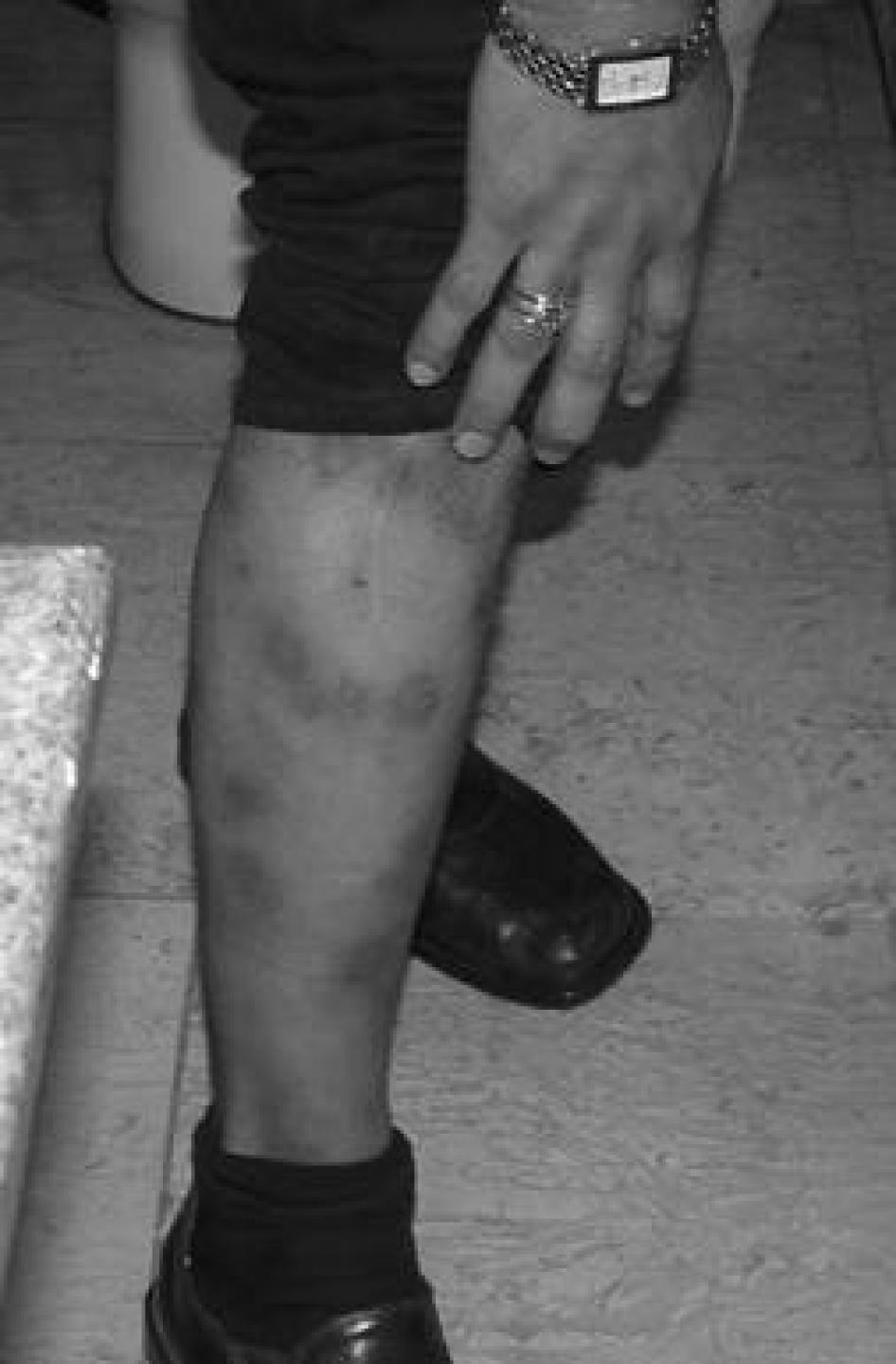
Gamal's leg, showing scars of torture inflicted by a Damanhour Prison guard.
© 2004, Human Rights Watch.
Gamal also says that the guard "took me several times to Cell Seven. There the worst criminals were kept with the longest sentences. He told them: 'Here's a khawal. Take him for entertainment.' Something like twenty-five prisoners raped me. They would fuck me three or four times each, sometimes, while they beat and slapped me."[204]
I stopped eating and drinking. It was not a hunger strike. I simply wanted to kill myself. There was no glass in the cell, nothing to cut my wrists or throat with. I had no other way. … In a few days I fainted and they couldn't revive me. So they took me to the hospital. When I returned to the prison the administration had intervened, and they began to treat us a bit better. The beatings were less, the [freezing cold] baths stopped.[205]
The men's trial was held on March 11, with the defendants still in detention. Judge Mohammed Mokhtar sentenced all five to three years of imprisonment to be followed by three years of police supervision, as well as a fine. Gamal says, "I fainted in court when I heard the verdict."[206]
The men were finally released a month later after enduring three months or more of imprisonment. Appeals judge Hany Kamal Gabriel overturned the guilty verdicts in a ruling highly critical of police and prosecutorial practice: "There is no crime or offence that could be pressed against the defendants," he stated, and admonished that "The protection of freedoms should be placed above the quest for celebrity." [207]
Gamal told Human Rights Watch,
I lost my apartment-the landlords kicked me out. My family refused to speak to me. My relationship with my parents is better now, though they don't like to be seen with me. But my two sisters don't talk to me. They have said that they consider me dead. I left the town and went elsewhere. I wish I could have left the country. [208]
D. "I am Broken By This": An Apartment in Tanta
On May 5, 2002, a West Delta newspaper reported a new group of homosexuals had been found and foiled in the city of Tanta:
A male teacher puts aside all principles and follows his perverted instincts, putting on women's clothes and makeup on his face to seduce men who seek forbidden pleasures, who are perverts like him, and who practice sex in his flat. Information was received by Lieutenant Ahmed Abdel Wahab, head of the Vice Squad of al-Gharbeya …[209]
The article gave the initials, ages, and workplaces of three arrested men-enough to make identifying them easy.
The arrests had in fact taken place six weeks before. The police report in the case accuses the ringleader of "forming a group of Satan-worshippers."[210] Lieutenant Abdel Wahab had obtained a warrant for the arrest of five persons supposedly from the "group"; yet only one of those it named, the apartment owner, was actually arrested or charged. In fact, police used an informer to draw a random collection of men to the apartment-and then tortured them to confess to sexual relations.[211]
Human Rights Watch spoke to two defendants in the case. Sabir (not his real name), a worker in his thirties, hesitantly told his story.
I had known Karim [not his real name], who owned the apartment, for about thirteen years. … I met this guy at Karim's house. He was small and nobody quite liked or trusted him. Then I didn't go to Karim's for three months. Then my mother said, "A man called Tawfiq called, he wants to see you." Tawfiq, the guy, he'd said, "I'm waiting for you," and I knew he meant at Karim's apartment. So I went over there. … Tawfiq was an informer that was what I didn't know. He thought I could be made to have sex with Karim.[212]
Sabir found Karim and another friend, Ashraf (not his real name), in the apartment. "They had some bango on the table so I assumed we were all there to smoke."[213]
Tawfiq kept coming and going in and out on different excuses. … We should have suspected. We were on the floor on Karim's big cushions, watching TV. Tawfiq kept pouring more drinks. …I found out later, when I was in prison with Karim and Ashraf, that they remembered a phone on Tawfiq ringing while we sat there. He didn't have a mobile usually, so they thought that was strange. And he'd jump up and walk in the kitchen and then come back. … There was some arrangement where an officer was giving him a missed call. And Tawfiq would go send them a "no" to say things weren't ready yet.
Abruptly, Tawfiq left again, for the last time.
We sat around for a few minutes watching TV … Then we heard something scratching at the door. Karim got up to put his eye to the peephole. Suddenly the door burst open in his face, flew off its hinges. And Karim went flying with it across the room.
There were a lot of detectives and policemen, maybe fifteen in all. …They were saying, khawalat. I was terrified. … Karim was divorced. Some of his wife's old clothes were still in the bedroom. The officer went in the bedroom and started going through the drawers and things and pulled out nightgowns, some of her underwear, some makeup. …
I wish it had been drugs, that would have better for us in the world's eyes. … They didn't charge us with any drug offence. The officer, Ahmed Abdel Wahab, said, "Nightgowns in the closet." He zeroed in straight on them, that was the kind of thing he wanted.
The apartment owner, Karim, a teacher in his forties, told us,
The neighbors brought it on-they had told the police I had people coming and going in and out of the apartment… [The police] tied our hands with rope. They tied me up like a thief. What had I done, I didn't know. … They searched the whole apartment. They kept beating me, slapping me on the nape of the neck, inside the apartment and while going downstairs. Oh, I was treated like a dog, worse than a dog. I was put on display. They knocked on the neighbors' doors and made the whole building look at us, going downstairs. They told the neighbors, "We've relieved you of the khawal."[214]
Sabir says,
We went to the Security Directorate. The head of the Vice Squad himself, Ahmed Abdel Wahab, took me to the upper floor. He and officer Mohammed Goma beat me till I signed what they wrote for me. … They were taking turns on us while writing down reports. My hands were shaking so badly when I signed that my signature was shaky.
I didn't see what I signed. Not all of it. Some of it said that I was with Karim inside the room, and Ashraf was sitting outside waiting his turn.[215] But even if it was a marriage contract and I was marrying my own mother, I would have signed, I was beaten so bad. I was beaten with a strap, a belt from a bicycle. They beat me on my shoulders through my shirt so it wouldn't leave such traces in the niyaba. They didn't hit me in the face. When I came out the other two said, "Why did you sign?" I said, "It's nothing, a signature."
Later they beat Karim till they nearly killed him. When he staggered out we asked him, "All right, why did you sign?"[216]
Karim, seen as the "bottom" among the three, may have received the worst treatment. He told us, "At the Directorate they started beating me and torturing me. They used sticks; they slapped the nape of my neck, and kicked me":
They made me take my clothes off. This was Ahmed Abdel Wahab who ordered his men to do this, and watched. Officer Mohammed Goma of the Tanta Police was there and he hit me with sticks. I can't tell you what they did to me. I can't tell it.
They stripped me, even of my underwear. They told me they'd show I was a khawal, and they made me bend over on the carpet, hitting me, and they spread my ass cheeks. And they - they opened my ass with their hands. I can't think about this. They said they were checking to see whether I was a khawal or not. And they brought people in to see me bending there. They told people to come and look at the khawal.[217]
Weeping uncontrollably, Karim said, "I can't talk about this. Why do I have to remember this? Why can't I forget it? It was such a terrible, terrible time. I am so unhappy. They were terrible. Terrible."
At about 8:30 a.m. the prisoners were taken to Tanta's second police station. [218] Karim remembers, "I got a hemorrhage there, from the beatings I had received. I was vomiting blood. They said, 'We don't care, we hope you die here.'"
On the following evening, they were taken to the niyaba and interrogated separately. Sabir says, "the niyaba started pulling out this underwear-he had it in a box-and showing it to me, asking me, 'Does Karim wear these things for you?'"
Before we left, the head of the niyaba walked in. He asked the deputy prosecutor, "What's going on-who's this guy? The nayyeek [top] or the bottom?" The prosecutor said, "This is the nayyeek." The head prosecutor said, "I'm so tired of these cases. If you examine Tanta you'll find that three-quarters of the men are khawalat."
The niyaba never asked me any questions about drugs. I asked why did the officer ignore the drugs and whiskey and only talk to me about the sex we never had? He just nodded. … I said, I had eight detectives beating me till I signed. I took off my shirt and showed my back. … The prosecutor didn't write it down. Ashraf showed his bruises also and the prosecutor didn't write it down.[219]
The prosecution report, dated March 25, shows that all three prisoners were charged under article 9(c) of Law 10/1961. Karim did not have a lawyer; he says, "My friends tried to bring one and he refused to go upstairs to join me, because the detectives downstairs shouted, 'Look at the lawyer who's come to defend the khawal.'"[220]
The prisoners were taken from the niyaba to Tanta Prison. Of their days there, Sabir says, "All the prisoners knew about us. The guards when they let us in and out of the cell said, 'Come here, khawal, go in, khawal, you person who takes it up the ass.'"[221] Karim, in tears, told Human Rights Watch, "They shoved food in to us like dogs. It's very hard for me to tell what goes on there. I can't. I can't. People wanting to rape me inside. Khawal. Khawal."[222]
At a court hearing on April 11, the prisoners were freed on bail. The trial dragged on for over a year. On May 26, 2003, all were convicted in their absence. Karim was sentenced to three years' imprisonment; the other two defendants received one year each.[223] All are now in hiding.
After his initial release, Karim says, "I was in a state of nervous collapse. I never imagined such a thing could happen." Once again he began to weep:
I lost my job. My mother died of grief because of this, literally of grief. … Every day in the light of day I try to forget this, all the things that happened, just to live my life. That lasts while there is light in the sky. Then every night I remember. I cannot stand to remember. The darkness kills me. Oh, it is unbearable, unbearable. I had a life and now I have nothing. I wish I were dead.[224]
Sabir says simply, "I am broken by this. Broken."[225]
E. Hafez Celebrates Again: Twelve Men in Agouza
On August 23, 2002, Al-Wafd announced the "Arrest of twelve youths, six university students among them." The newspaper alleged that the "number one offender," owner of the apartment where they met, induced them to "practice debauchery by showing them gay sex movies, and through the Internet."[226]
The men had in fact been arrested in an apartment in the Agouza area of Giza, on the night of August 19. Their court file reveals police reports which restage the scenario, and repeat the language, of the al-Haram and Boulaq al-Dakrour cases. The same arresting officer of the Giza Vice Squad constructs a familiar narrative, in which a "trusted secret source" revealed that a "passive sexual pervert by the name of Hafez … manages [an apartment] for immoral acts. He recruits passive sexual perverts to that apartment and they hunt sexual pleasure-seekers who are active homosexuals, and practice sex in this apartment."[227] The "number one offender" fingered by the newspaper is also a familiar figure: the informer Hafez.
According to the court file, police descended on the apartment and caught twelve suspects, two in the act of having sex with each other and the others in suspicious circumstances, some half-dressed.[228] According to the file, Hafez was not among them. The records show that one of the twelve arrested was seventeen; the rest were between nineteen and twenty-five-years old.[229]
Human Rights Watch was able to talk briefly to two of the men in the prison where they are serving their sentences. Speaking quickly and finishing each others' sentences, they told a different story from the police:
We were walking on the Corniche when one of us got a phone call from Hafez-"Mishmisha"-whom he knew slightly from before. We went to Hafez's place that night to have drinks. At the end of the evening Hafez told us he was going to have a party the next night and asked us to sleep over there to help him prepare for it and so we did.
The next night we were fourteen in the apartment, including Hafez. In the middle of the party the police came in. Nobody was having sex. We were taken to the Giza Security Directorate. Hafez and a friend of his named George were freed there. Only the twelve of us stayed. A guard named Mohammed beat us all with a baton. We learned later that Hafez was the same "Mishmisha" who got people in al-Haram last year. This wasn't his first time helping police arrest gays.[230]
Taken to the Agouza niyaba the morning after the arrest, they were split in two groups and interrogated by two prosecutors.[231] One of the two, Yasser Khalifa, followed the police model by forcing the prisoners to identify as active or passive. When several said they were both, he grew enraged.[232] The prisoners Human Rights Watch interviewed said, "Yasser Khalifa slapped three of us on the face." [233]
They were referred to the Forensic Medical Authority and examined by a single doctor; all were found "taken in sodomy over a long time." Their detention was repeatedly renewed. Meanwhile, officials leaked their "confessions" to the tabloid Rose al-Youssef, which in September headlined "a new organization of sexual perverts."[234]
On October 2 all were referred to trial, charged under article 9(c) of Law 10/1961. Hafez was also referred, as a "fugitive" defendant-charged additionally with managing a house for debauchery, under article 9(b).
On November 12, 2002, all thirteen defendants were sentenced to three years' imprisonment to be followed by three years of police supervision.[235] On appeal in early 2003, the sentences against twelve defendants (including Hafez, who however remained at large) were upheld.[236]
"Mishmisha" is still free. The eleven adults are serving their time together. Two told Human Rights Watch,
We're kept together in a separate cell. … The problem is they don't let us mix with any of the other inmates. We only get out of the cell for one hour per day to walk in the prison yard. And they evacuate the yard of other inmates before letting us out. … Inmates see us from their door-windows and call us "the women." Our guards always refer to us as "the women" and our cell is dubbed "the women's cell."[237]
One of the men wrote to an Egyptian activist:
I want you to deliver my voice to the United Nations. Tell them I want to be out of this jail. Tell them I don't belong here … They are denying me the right to live and be free here in Egypt.[238]
F. "They Thought That This Was Personal Freedom": A Wiretap in Giza
In March 2003 the press again blared the "arrest of a homosexual network."[239] Banner headlines called them "perverts who embraced the devil, lost the path of spirituality, and strayed from the straight good path to the ways of hell." Articles told how wiretaps had stored their words and sealed their fates, and revealed the names, ages, and places of work or study of most of the men. [240]
This time the Tourist Police rather than the Vice Squad brought the charges. The case appears to have reached them by accident; once involved, however, officers pursued it in competitive emulation of their Vice Squad colleagues' practices.
The lead defendant, Wael (not his real name), in his mid-thirties, owned a flat in Giza; there, according to one visitor, he'd "have a nice time, a party, some drinking, some dancing … Mainly we were together because we were gay and it seemed safe."[241] Another guest, who became a defendant, says, "I had been to the flat two times … Wael was very normal. I had a drink and left. This talk about sex parties there was not what I heard about the place."[242]
Someone complained.[243] An occasional guest told us that "a lot of people in the neighborhood and everyone in the building knew that [Wael] was a gay, and they didn't like us. The building man would insult as we came in: 'Go to hell, khawalat!'"[244] Tourist Police headquarters are in Manial, directly over the Nile from Giza and the apartment; apparently the informant simply crossed the bridge to the nearest police station.
The Tourist Police handed the case to their own Morality Intelligence Unit, which functions as an internal Vice Squad. On January 19, 2003, a Giza district judge authorized them to tap the telephone of Wael's flat for thirty days; this was renewed on February 16. By then, however, police had enough information. The head of the Morality Intelligence Unit later told prosecutors that the defendants "practiced debauchery … to the extent that they thought that this is personal freedom."[245] On February 17, the Tourist Police received a warrant to arrest Wael, along with any "men practicing debauchery and sexual perversion who happen to be in the apartment and those for whom there are criminal telephone conversations."[246]
Wael was arrested in the apartment. Nine others were taken from their homes. They included university students, a hotel worker, an actor, and shop employees. In the police account, all admitted to having had sexual relations with men.[247] Relatives of Wael told Human Rights Watch at a March 27 trial hearing that he tried to kill himself on his arrest, an account the arrest report confirms.[248]
In ensuing days, police sought more men, from a full list of sixteen apparently compiled through the wiretaps. One prisoner was induced to call two friends and arrange to meet them at a café in the Mohandiseen district, where they were arrested. Bailiffs were sent to seize another implicated man in the Suez city of Ismailia. In the end, three from the sixteen remained at large, and were tried in absentia.[249]
Human Rights Watch was able to speak to Yehya, nineteen years old, a defendant ultimately acquitted in the trial.
I was taken to the Tourist Police office in Manial. Then I was left there for a day. I didn't know what was going on. Every time I asked, they would say, "We will ask you some questions and let you go." I stayed standing for twenty-four hours. Every time I nodded off, they would slap me or push me to wake up again. The guard would beat me, telling me I would never see my mother again. I would cry.
I hadn't been put with the others yet so I didn't know what was happening. They never asked me any questions at the station. I had to sign a blank paper. There was nothing on it. They beat me to get me to sign it. Two officers beat me, and one held a jackknife in front of my face and threatened me with it. I was crying all the time.
And at night, they took me to the niyaba in a transport vehicle. They tied my hands and they put a bucket of water over me, so every time the car braked the water splashed me-to humiliate me and to keep me awake. At the niyaba, just before I went in, the police officers started making fun of me… They asked how long I had been a Satanist and a pervert. I was wearing an ordinary silver necklace with a pendant on it with my name inscribed, and they said this was a Satanic thing.
The deputy prosecutor told me: "If you don't say what we want to you to say and sign what we want you to sign, we'll give you a good lesson." He threatened me. Again, he made me cry. He kept asking how many times I had seen Wael wearing a wig with makeup. I said, "I never saw that." He said, "Yes, you did and you will say you did."
The deputy prosecutor was screaming at me and shouting. He said, "I'll give you fifteen days and you'll never go back home if you don't confess. You'll never see your family. You'll go behind the sun. If you deny that you are a khawal, we'll send you to the forensic exam and they'll find the proof."[250]
They took me downstairs to a holding cell in the basement. The guards were hitting me all the way. It was underground and I found the other twelve in this case down there. They were handcuffed together. They had been hit. All of them were bloody and bruised. Wael's shirt was open and he had big bruises on his chest. They were blindfolded with the dirty socks of the guards. They had all been kicked and slapped and beaten. I wasn't blindfolded for some reason so I could see. [251]
Meanwhile, at the niyaba, six of the thirteen defendants denied all charges. Others, however, were induced to confess and to implicate others in the case.
The prisoners were taken to the Giza police station and held there through their trial. Despite the publicity, authorities closely controlled access. Families as well as lawyers had no contact with them until the trial began.[252] In the station, Yehya told Human Rights Watch,
There were three changes of shift every day. Every one, the guards came in and beat us. They beat one of us on the face till his nose was bloody-I think it was broken. They made us lie on our stomachs on the floor and walked on our backs. It was an officer and two guards. They always slapped us on the back of the neck, and kicked us. The thirteen of us were singled out. At first we were kept in isolation, for about fifteen days. They cleared out a cell in the women's section and put us there, because they said were women, not men. …
They beat us also with a branch from a palm tree, and with canes. With every change of shift! When they beat us in the cell they turned our faces to the wall. They would say before coming in, "Faces to the wall, khawalat," or "Face down on the floor," so that when they came in we couldn't see who was doing the beating.
Once, it's hard to believe this, but they brought a class of maybe thirty boys from a school, six or seven years old. They made us lie face down on our stomachs, and the small boys watched the policemen walking on our backs. Then the boys walked on us. The police did this to make it clear to the boys that men who fuck each other end up like that. They told the boys, "This is how khawalat end." It was like a school trip.
Not long after they brought the children in, they took us out of isolation and put us in a cell with other prisoners … There were threats of sexual abuse. The prisoners called me "bottom" and "bitch." … The other prisoners would come in and curse us or try to touch us sexually while we were trying to use the toilet.[253]
When a verdict was handed down on April 17, only two defendants were acquitted. The rest had sentences ranging from three and one half years (for Wael) to one year, with most receiving two years.[254]
Yehya told us,
When I was found innocent I went to the Security Directorate in Giza to finish my papers. I was beaten there with a belt and a whip. I was told, "You are a khawal, you fuck each other, you got out because of
connections but we know you are a khawal and you will pay." One of the officers took a gun and put it to my head. He said if this was an Islamic country he would have killed me, but since it wasn't, he couldn't.
On July 19, 2003, an appeals court overturned the verdicts against the eleven men who remained in prison. Judge Mo'azer al-Marsafy said: "We are so disgusted with you, we can't even look at you. What you did is a major sin, but unfortunately the case has procedural errors and the court has to acquit all of you."[255]
V. Exploiting Solitude: Entrapment Over the Internet
A. Raoul's Story
Raoul-the name he used on the Internet-was hardworking but had charm. Through his computer, he reached out to new friends who might not otherwise know he existed. Yet he possessed a virtue endearing him to many of the lonely men he contacted through their personals ads, or chatted with on instant messaging services: people interested him. Even without physically meeting him, some found themselves falling in love with an interlocutor who wanted so acutely to learn about their lives.
In late 2002, Raoul read a personals ad posted by Amgad, a young professional in his twenties, living with his parents in Upper Egypt, secretive about his sexuality and achingly lonely. Raoul reached out to Amgad, who wrote back by e-mail:
I'll start my first message to you by saying that it's my pleasure to write to you, and to be your friend. You seem to be a very good romantic nice guy … Feel free to call me at any time, BUT remember that my family doesn't know anything about me being gay, so-we'll talk just as friends. I know you'll appreciate my situation.
They began "conversing" computer-to-computer over an instant message program.[256] Like many gay men in Egypt, Raoul seemed careful. He wanted to see the faces of men he chatted with, so Amgad sent photos, looking sober and serious in suit and tie. Raoul told about his own past, and asked detailed questions about Amgad's sexual history. Soon, Amgad was sending rhapsodic e-mails to raoul75@hotmail.com:
I've never told someone the things I told you yesterday, I always keep my feelings concealed in my heart, but I couldn't hide them from you. …
Raoul's responses left Amgad still more persuaded he had found true love. A few days later Amgad wrote:
I was rewarded
for being good
for having good intentions
and a faithful soul
I was rewarded
and YOU are my reward …
I waited
waited for someone
someone exactly like you
Oh God is so merciful to send you to me[257]
Not long after writing that, Amgad left for Cairo, full of hope, to meet Raoul.
In the end, though, Raoul did not appear for his encounter with Amgad. This was not because he suffered panic or second thoughts. It was because Raoul did not exist.
Instead, Amgad found himself surrounded by police as he waited in Tahrir Square, dragged to police headquarters, and placed under arrest. His very loneliness made him a victim of the Cairo Vice Squad's latest device to snare men suspected of having sex with men: the use of informers or undercover policemen on the Internet. Underlying Raoul's concerned but disingenuous curiosity, in the end, was a detective's unromantic attention to detail.
B. Sex, Lies, and Cyberspace: Identities of an Entrapper
Human Rights Watch knows the names of forty-six men arrested and brought to trial for homosexual conduct since early 2001 after they were entrapped by police over the Internet. In all likelihood this figure is only a fraction of the whole. The evidence presented in these cases is typically still more confused and inconclusive than in other "debauchery" cases-yet men are sent to prison as police and prosecutors rarely question even gross misapplications of Egyptian law.
The Internet came to Egypt in 1993, with a user community of no more than 2000 persons.[258] Frayed phone lines and steep connection fees slowed its spread, yet by the decade's end an estimated half million Egyptians accessed the Net.[259] On January 1, 2002, a loudly-trumpeted era of "free" Internet access began; users could log on at ordinary phone rates, which the state telephone company would divide with private Internet service providers (ISPs).[260] Usage soared.
Josh, a US citizen long living in Cairo, whose partner Wissam Toufiq Abyad was entrapped over the Internet, says that by the turn of the millennium, many urban gay Egyptians "lived in a wired world; their friends were wired; they carried on social life through it."[261] The new medium offered multiple chances for interaction. There were websites where one could post a personals ad. Some were for gay and straight people, some just for men seeking men; most were password-protected and membership-only. There were Internet "chatrooms" where one could "meet" people and "converse" over the screen. Many gay websites had country-specific chatrooms; in the "Egypt" room at such a site, a man from Cairo could get to know the men next door, with anonymity ensured and actual geography obscured. There were instant messaging services which let one "chat" computer-to-computer with anyone who had the same program. For those rich enough to afford it (the increasing cheapness of access was only relative) the mechanics of the Net, with its masking of faces and places and its promise of spigoted control over self-revelation, seemed seamlessly suited to the closeted.
The Queen Boat trial and the accompanying press scandal changed the character of gay Cairo and cyberspace alike. "The city just shut down," one man says. [262] Another told Human Rights Watch that "Gays have become really terrified": "They don't go out, don't go anywhere. They are alone."[263]
Josh believes the atmosphere of fear "enhanced the numbers of people who were chatting just to seek friends: they felt they had no place to go anymore. All of that died. They were lonely, and the Net was a consolation. People got online chatting instead, trying to figure out other ways to meet."[264]
With parties defunct and pubs deserted, however, chances for face-to-face conversation also receded, giving way to a ghost-world of impersonation rather than intimacy, of pseudonyms and evasions. Men rarely revealed the actual exigencies of their lives, much less discussed political conditions around them, over the Web. The situations where men at risk might warn other men of dangers, and be believed, grew fewer. Many of the men chatting faced a gathering loneliness in the grey, real world, while on the Web, circumlocutions and secrecy became the rule. As both community and communication ebbed, isolated, desperate men became easy police prey.
Entrapment of men over the Internet began even before the Queen Boat case. The first arrest known to Human Rights Watch occurred in January, 2001; two men were entrapped by a man claiming to be a Swiss gay visiting Cairo. Arrested at the meeting place, they were sentenced to three months' imprisonment.[265] On March 5, 2001, the tabloid Al-Naba' announced the arrest of two men in Tahrir Square, seized while waiting to meet potential partners whom they had encountered through Internet ads. "We believe," it declared, "we must use more and more restrictive surveillance of the Internet, and strengthen laws concerning this matter to prevent people from such actions."[266]
Anxiety about the Internet was plainly growing in official circles. Unconfirmed reports spread of new Internet monitoring units in the Ministry of the Interior.[267] In May 2002, General Abdel Wahab al-Adly, head of the Vice Squad within the Ministry, stated that nineteen homosexuals had been arrested through the Internet: "It was great arresting them."[268] Another Interior Ministry official said, "We are dealing with a different type of criminal and the spread of new crimes … This requires security and technical expertise to be able to patrol the Internet the same way we patrol Egyptian streets."[269]
The pace of arrests has accelerated. One lawyer working on such cases told Human Rights Watch in March 2003 that "the number has increased till the arrests this firm knows of have reached a rate of roughly one per week."[270]
"Raoul" is not the only pseudonym used by police informers over the Internet. At least two men have been lured to arrests by one purporting to be "Wael Samy." A number of men were entrapped in 2003 by an agent calling himself "Dennis." Raoul himself takes on different personae with different cybercontacts. Sometimes he says he is a native Cairene; sometimes, aware that many Egyptian gays feel safer in the company of foreigners, he claims to be Spanish, Italian, Swedish, or Russian. Mahmoud, arrested through Raoul in mid-2002, told us, "He described himself as an Italian working in Cairo, newly arrived, has no friends and wanted to meet and get introduced to other gay friends. … We spoke [a] few times over the phone, I could swear that person was an Italian, he had a very strong Italian accent and he spoke very well English."[271]
Sometimes, indeed, the Raouls show a sinister sense of irony. When one victim, Ehab, who worked in the arts, asked Raoul what his favorite opera was, he replied, "Die Fledermaus": a Viennese work about entrapment which ends in a prison cell.[272] And Raoul makes a double-edged commitment in arranging one meeting:
Raoul says: and I promise u 2 things
Incubus says: which r?
Raoul says: first I will make u so happy
Raoul says: second u will never forget me[273]
Several police agents probably impersonate Raoul, and possibly at least one gay foreigner living in Cairo has been entrapped or blackmailed into working for the police. Whatever his true identity or identities, certain consistencies underlie Raoul's approaches. He asks his interlocutors to chat with him on an instant messaging service-where a record of the chat can easily be downloaded as a text file (and introduced, eventually, into a court file). He asks about the victim's sex life, cognizant that a conviction for "habitual practice of debauchery" requires sexual relations with more than one man within three years. In January 2002, "Wael Samy" answered a personals listing which a lonely twenty-three year-old from the Delta city of Ismailia had placed on the website gayegypt.com. The young man, Zaki Saad Zaki, began corresponding with Wael, who lured him into offering a detailed description of his first sexual experience:
Dearest Wael,
It is always so fulfilling to hear from you 'cause your e-mails are full of sincere emotions and feelings although they are always too short. I am also so happy to know that my emails give you such pleasure. …
Well, this time, as you've requested, I'll try to give you an account of what happened during my first and only sex experience which happened about six years ago, hoping you can e-mail me with yours next time.[274]
"Finally, thank you once again for your precious time and hope to hear from you very soon," Zaki wrote, closing, "Lots of love." He went to Cairo to meet Wael Samy three days later, and was arrested.[275]
Amgad, whom Raoul entrapped in late 2002, told us his story:
I had been chatting with people on the Internet for two years or so. I knew nothing about gay society in Cairo. The town where I live is a very simple place, and I come from a conservative and Christian background. … I wasn't looking for a relationship or sex, but friendship. If anything more happened, if I fell in love with someone who fell in love with me, that would be wonderful, but I wanted friends.
When I met Raoul I was already growing bored with chatting-that's the irony. I was starting to feel I wanted more than the people I met there. And this man-I don't know what happened. I became attracted to him from the way he wrote to me, the person he seemed to be. I was so lonely. He said he was Swedish, his name was Sevensen, he worked in the Ericsson company. "Raoul," he said, was his favorite football player. …
We chatted for more than a month. I called him on the mobile number he gave me. We only spoke a few words: his English was not very good, with what I now think was an Arabic accent. …
In September, I thought of going to visit him in Cairo. I thought he was a true friend. Perhaps I thought he was the true friend, the one who really understood me. I was really very excited to meet him. I thought this would be the great experience of my life.
Then I went to Cairo. He had given me an address in Tahrir Square.[276]
C. Arrest and Interrogation
I was standing just inside the building. A man came up to me and asked, "Where are you going?" I said, to Sevensen's flat. Suddenly, seven or eight men were surrounding me. They said, "Come with us." They said not to make a scene, or I'd be humiliated publicly. This had never happened to me before in my life. I went into the car quietly. …They took me to the very big building in Tahrir called the Mugamma`. They pushed my head down on the thirteenth floor, so I couldn't see where I was going or what was this place. It was about 6:30 p.m. They kept me standing for some time, just to make me more-scared. … Then they took me to a small room and started asking me questions.[277]
That is Amgad's story. Amir, twenty-three years old, arrested a few weeks later, says,
We were to meet at Hardee's [restaurant] in Tahrir Square at 12:00. He called me as I stood there. I saw a guy across the street: he was looking at me. He didn't have a phone. The man on the phone said, "I'm there." I said, "I'm here, too." He said, "I can't see you: what are you wearing?" I told him. The same second, the guy was crossing the street and then he grabbed my arm. And then there were four guys. Two grabbed my arms and another grabbed my belt, while one of them asked me for my ID. … They took me across the square to the Mugamma`, to the thirteenth floor.[278]
Generally Raoul prefers to meet his victims in Tahrir Square, within walking distance of the Vice Squad offices in the Mugamma`. Sometimes, however, he sets appointments elsewhere. Wissam Toufiq Abyad, a Lebanese citizen, was arrested on January 16, 2003:
It started when I was waiting for that guy I chatted with on the Internet a couple of days before that day, right in front of McDonald's of Merghany, Heliopolis near where I live. It was almost 1 p.m., when I found four big guys surrounding me. …I was fighting and yelling in the street "Who are you? What do you want from [me]? Let me go, please." A security guy from McDonald's came to them asking who they were and what I did. The general ordered him to back off and said, "It's not your business." I was dragged, almost carried to the police car. While they were pushing me inside, one of these guards were [sic] trying to steal my watch. He was pulling it out of my wrist. I started yelling "You robbers." … He didn't take it, but he broke it. … I was taken to "Mugamma." The 13th floor. The "Adab" Section, which takes care of prostitution, raping, and recently homosexuality.[279]
At the Mugamma`, confused prisoners are often led to believe they are involved in a security case. Amgad told us,
They asked me how long I had known this man … They told me this guy was an Israeli spy. They said he would have sex with me, then take photographs of me and then threaten me and make me work for Israel. …They started to ask about other guys I know. The older one said: If you tell the truth, you'll get out of this. So I said, I know a few gay people. He asked for names and addresses. I said I only knew the names they used on the Internet, not where they lived. … You must understand. Being scared is not the word, even. I'd never seen the inside of these stations. But because they didn't hurt me physically, it doesn't mean they didn't hurt me: don't imagine they treated me with respect. My whole world was falling down around me.
I told them all about my gay life, such as it was-the friendships I had made over the Internet and why they were important to me. Then they looked at each other and said something like, "We will make this only a personal relationship case." Now I realize how funny they thought it was to lead me on this way.
The thing is, they didn't blink. They didn't feel that doing this would destroy a whole life. They caught me because I am gay, but they didn't even think that my future could be destroyed. I am not rich, I cannot leave the country or start my life over. … And they didn't feel anything. Anything. Can you understand what they were thinking? I cannot.[280]
Omar, arrested with a friend when both went to meet Raoul in late 2001, says, "The officer who interrogated me claimed [he was] a State Security officer. He said that all he wanted was for me to confess that I was gay. He said this is 'personal freedom' and that if I confessed they would inform State Security and let me go immediately."[281]
Other prisoners have been beaten to make them sign an arrest report. Amir recalls officers "asked me who I knew who was gay":
I didn't give any names. … The man said, "We're looking for members of this political organization. We believe you when you say you don't belong: if you sign this, you can prove it and we will let you go." I didn't agree. So I was pushed and slapped. The guard hit me on the face and shoulders-I don't know for how long, but long enough. In the end, they made me sign the chat and the picture.[282]
Abdullah, nineteen years old when arrested in May 2002, says the arresting officer, Adel Abdel Aziz, "is crazy, some kind of a psycho. He seemed very violent."[283] Ehab, interrogated later in 2002 by Adel Abdel Aziz, says, "He insulted me a lot: 'Son of a bitch, a sick person, khawal, you must get treatment, asshole, you are the garbage of this society.' He said he would hurt me. He slapped my face. I broke down, I could not say a word in response. I signed. He put his hand over the paper so I couldn't read it."[284]
Alaa was arrested in 2002, with a friend, while waiting in Tahrir Square for Raoul. At the Mugamma`, the interrogating officer summoned other police
and he asked me in front of them to sign, and I said I won't sign until I read it first, and then it has to match what happened, so he laughed hysterically, and he told them while laughing, "See, he doesn't want to sign. Can you make him sign, boys?" I thought that was only happening in movies, but I saw it for real. They started beating me up, and I could hear my friend [being beaten] as well, three guys beating me up, for almost one hour, and of course at the end I had to sign.[285]
Zaki Saad Zaki, held for two weeks in the Agouza police station after his arrest in January 2002, told local human rights activists that officers beat him daily; at one meeting with his lawyer, he still had blood crusting his face.[286]
Most prisoners leave the interrogation convinced they will be set free. Amgad told us that, in the Mugamma`, "They said then I must go to Qasr al-Nil police station to get my IDs-they had taken them from me."
"Then you can go home." So I signed, I didn't even look. … The funny thing is the guards looked at each other and they were laughing at me. I was a fool, such a fool, to believe anything they told me. And so I went to Qasr al-Nil, holding my bag and feeling confident that I was just taking my ID to go home. I was surprised when one of the guards started shouting, as we entered the police station, "Fujur! Fujur!" One of the officers there asked me: "What are you coming for?" I told my name and said the men at the Mugamma` said I would take my ID from here.
Then the officers in the station handed my report among themselves and they knew what was inside it-that I would stay. They didn't tell me, they just started to humiliate me with words. "Khawal" and such things. And they took me to the head of the station. He looked me up and down and said, "Do you pray?" I really didn't know what to say.
Amgad begins to cry.
The thing is … I know I have more values and more honesty than him. And I know my relationship with God is more than he knows. But to him I am just an accused person-worse than an accused person, an animal-because I am gay. He asked me as if I were full of evil. … It was so much worse for me than you can ever imagine.[287]
D. "The Country of Hate"
Amir says, "As soon as I got into the station the guard gave the officer this big envelope. The officer said, 'Another khawal!' I knew I wasn't leaving."[288]
"They took me downstairs to the most horrible place I have ever seen in my life," Amgad says. "The lowest guard could say anything to me and I could not respond. Again and again it was 'khawal,' 'khawal.' There is no one to speak or think gently or kindly in a place like that. It is the country of hate."[289]
Nader, arrested in 2001, remembers that while he was held at the Giza Security Directorate, "The officers liked to make us stand in the middle of the room and show us to other guys and tell them about our cases, that we were khawalat. They did this almost every day. One the guards tried to show me his cock to suck."[290]
Many detainees tell how, in dark cells, they found other prisoners seized in the same way: a sign of the frequency of Internet arrests-and of how many cases remain unknown to human rights activists. Tarek, arrested in the spring of 2002, says,
I met another guy about three days after I arrived. He was from Mansoura. … It was the same scheme: he came to Cairo to meet Raoul, and they arrested him. He told me he only had sex with foreign persons, not Egyptians, because he thought it was safer. Raoul had said he was foreign. He had succeeded on appeal, and he was in Abdin station waiting to be released. His story gave me some hope.
Then after forty-five days in Abdin, I met two other guys I knew. Later they were found innocent, the first instance also. I think they have both left the country. They had set up a meeting together with Raoul, and they were arrested at the same place I was, in Tahrir Square.[291]
Nader says, "I was the fourth case like mine in the station-there were three others with cases like mine, arrested at least two weeks before."[292] And Amgad recalls, "I met another man in the Qasr al-Nil lockup. He told me he was in jail for forty-five days waiting for the forensic medical report. He'd been told he'd have to pay 10,000LE in bribes [about US$ 2,250] to get out of jail before the report came."[293]
Lawyers flocked downtown police stations, looking for Internet arrestees. In Abdin, according to Tarek, "In the morning, they took me to the niyaba. One of the guards took me out of the cell and told me, 'Come, we will get you a good lawyer to defend you.' I found out later that the guards work with a lawyer."[294] Amgad says,
There were police officers out there [in the police station] who get paid by the lawyers. They tell the lawyers, or the lawyers' people who are hanging around the jail, that someone was arrested. They look especially for cases of debauchery because they know the families will be desperate. So the lawyers go and call the parents. Lawyers are like fleas in these places.[295]
Amgad reports that, during his weeks in Abdin station,
I overheard some officers saying, "The way they are catching khawalat through the Internet, they are doing it so that human rights can't say this is not right. We don't want human rights to bother us. So they make these cases in a way that they won't get bothered by the rights people."[296]
Despite this, the state media still publicizes Internet arrests and trials: Zaki Saad Zaki Abd al-Malak's 2002 conviction, and his full name, were proclaimed in Al-Ahram and Al-Akhbar.[297] Other articles commend Vice Squad officers for their vigilance: a front-page spread in Al-Goumhoreya cited "a high security official" as proud that "we have been successful at arresting a few of the sexual perverts … but we will continue to pursue them vehemently, avidly, and unrelentingly."[298]
Most men entrapped over the Internet are charged with both the "habitual practice of debauchery" and with some form of "inducing" or "advertising" for debauchery, the latter offering prosecutors a choice from a range of legal provisions.[299] The evidence presented is rarely airtight. Often the only evidence of debauchery is whatever description of sexual acts "Raoul" elicited in Internet chat[300]; since the chat is presented as a printed-out text, interlocutors or interrogators could easily have altered it.[301] Likewise, the only evidence that the Internet personals ad belongs to the man arrested is the photograph (if Raoul persuaded him to send one) and the defendant's signature at the police station; the photograph could have been gotten through other means, and the signatures were often obtained under torture. [302]
All the same, most defendants in cases Human Rights Watch has examined were convicted in a court of first instance. Amir says of his trial,
At the trial the judge knew nothing about the Internet. I could tell he didn't understand it at all. He wasn't sure what a website was, or what "chat" was, and he was puzzled by the difference between chatting with someone over the phone and over the Internet. … Then the sentence came: one year in prison, and one year sleeping every night in the police station after that. That day, I had a nervous breakdown.[303]
And Amgad adds,
All of them-the judges, the lawyers, even the niyaba-knew nothing about the Internet. The deputy prosecutor even said, "I know nothing about the Internet and I don't have time to learn about it. What is it? What do you do on it? Do people just talk around with men?" They knew nothing about how the things I was charged with actually worked, how these sites work, how you enter them or use them, or even how you log onto the internet or send an e-mail. They knew nothing except that the police officer had said I was gay and stood in Tahrir making feminine motions, and that the Internet was somehow part of this.[304]
Nader told Human Rights Watch that the other three men who shared his cell
had one judge handling all their cases, a different one from the one who presided over my trial. One of the three reached the judge and bribed him for a lenient sentence, and so since they had all been entrapped in the same way, he gave the same sentence to all of them for consistency-three months, which they had already served.
I couldn't bribe anybody. My verdict was two years. That was the worst day of my life. I made an appeal and it was reduced to six months, with six months police supervision. Except in the end I could spend nights at home -after my release they toured me around four different police stations to have my probation at one of them, and they all refused to take me because of the nature of my case. … But from 6 p.m. till 6 a.m. they could send somebody for me and if I wasn't at home, I would go to prison.[305]
Given the weakness of evidence in these cases, comparatively sophisticated appeals judges often reverse guilty verdicts or at least reduce them to time served.[306] This is not predictable, however. Wissam Toufiq Abyad's sentence of one year and three months was upheld on appeal.[307] Zaki Saad Zaki's three-year sentence was also upheld; he is now serving it.[308]
For all the victims, traumas persist. Amgad says that, though freed on appeal,
I went home to find a wrecked home. What happened is more than I can bear. … My parents see me and they see this shadow behind me. And I wake up and walk with this shadow and I feel that I am the shadow. …
I consider myself strong to have gone through all this and still have my dignity-not to have gone crazy. But I fear for myself. I lost my confidence in people. I want to trust people so much. And now I don't trust anyone, even myself. … I don't understand why they do these things to men who harm no one. I don't understand why they hunt us down.[309]
Mahmoud, who left the country after his conviction, writes that "Honestly there will be no words to describe what I have been through. They punished me only because of my sexual orientation and they condemned me as a criminal for my entire life, to be away from my beloved family and friends, to close down my business that I worked very hard to establish. In brief, they killed every beautiful hope and future I ever had!"[310]
Meanwhile, arrests continue. On March 19, 2003, Human Rights Watch attended the appeals hearing of a foreign national who had been entrapped on a business trip to Cairo; his sentence of one year was overturned. Eight days later, Al-Akhbar announced "the arrest of two youths" who "had presented themselves on the Internet for the practice of sexual perversion. They were sent to the prosecution in the context of [Interior] Minister Habib al 'Adly's instructions to confront the criminal use of the Internet in the advertisement of debauchery."[311]
Alaa, who also left Egypt after he was convicted, answered when Human Rights Watch asked if he had any final thoughts on his ordeal:
Why are they destroying our futures, not only us as gays, but our families too? You cannot imagine how this affected my mother and sister, you cannot imagine that I lost my job because of this, that I lost my dream because of this, you cannot imagine how hard it is to live away from your family and friends (and you didn't choose this)-you are just looking for your freedom, you cannot imagine how hard is it when your family looks at you, even if they knew about you from before, but something like this brought the shame to each and every one of them. …
Why do I have to live my life away from my family and my friends, and my city and my country for I don't know how long?
Why did my mom have to be humiliated as she is the mother of the homosexual? Why did I have to see my mother climbing the court stairs on her hands and knees?
Why do they enjoy destroying our lives? Why did I see the look of victory in their eyes while interrogating me?
I think I'm still human even if I'm gay, and I think I have rights, but I lost all my rights, and I need help, I need to find my rights back and get them. … All what I want now is for all the guys in prison to get their rights back.
I need my rights back
Thank you.[312]
VI. A Flawed Mirror: Prejudice and the Workings of Justice
A. A Moulid in Tanta
The stigma attached to homosexual conduct in Egypt imputes a generalized guilt to those who practice it. Police and prosecutors assume men who have sex with men to be capable of, and culpable for, any other criminality.
Police may thus see an act of violence against a gay man not as an occasion for investigation but as a pretext for further injustice. Instead of a concentrated search for a criminal, they stage a roundup to persecute an entire community. In several cases Human Rights Watch has documented, authorities reacted to the murder of an allegedly gay man with indiscriminate mass arrests, picking up dozens or hundreds of people with no probable cause-on the basis not of a concrete suspicion but of their mere implication in homosexual conduct-holding them illegally, and torturing them. Finding the killer gives way to the goal of expanding police repression. Such cases show unrestrained police power coupled with the power of prejudice.
Several victims told Human Rights Watch the story of one such roundup. Khalil-in his forties and from a poor background in Gharbeya governorate-recounted how the events in Tanta in late 2002 "happened because this man, Adel, was murdered in his home." When three of Adel's gay friends broke the door down and found the body, the police arrested them. Khalil says:
The police tortured them, not because they thought they had done the crime but because they knew they were gay and could lead them to other gay people. They tortured them until they confessed to being gay. Then the officers demanded they inform on others.[313]
Khalil was quickly picked up: "They came to my work with a big hullabaloo, talking about khawalat." At the police station, officers beat him to name names.
Like Khalil, Rafiq, in his mid-thirties, is a central figure in the community of self-identified gay men in Tanta. He says, "I still can't believe Adel is dead. He was so strong, the strongest of all of us in body and mind and thinking. God rest his soul."
Adel was killed on Sunday, September 29. Four days later they came to my house. They searched the house, the mattresses, they pushed my mother. I wasn't home, it was around 11:30 p.m. I was in front of the police station, actually. I had heard that Adel's murderer had been caught. I had friends who had already been arrested. I went to the police station believing the case was over and they would be released.
Instead Rafiq was seized by an officer and "dragged to the detectives' unit," where an officer beat him on the back of the neck. Blindfolded and handcuffed, Rafiq was questioned "from 1 a.m. to 6 p.m." Officers, he says,
asked filthy questions: "Do you have an itch in your ass that you want to get fucked, does a worm cause it?" I said this is psychological, not physical. They said, "Filthy khawal, how can you talk such language with a secondary-school education?" I said, "I read, I learn. And gay people learn from and educate each other. We're normal people, we talk about the world. We don't have to be ignorant because we are gay."
At 6 a.m. police took Rafiq to the city of Mahallah al-Kobra to pick up "two of my friends: we seized them from their homes."[314] One of them, Beshoy, told us,
They didn't find me at home when they came for me- I was spending the night at my sister's home. … So they said, "We'll take you until we get him." They took her to the police station. She must have told them where I was because they came to my sister's house and took me from there, and released my wife. They told her that I was being arrested because I was a khawal. It was a terrible shock.[315]
Rafiq says police arrested eighty-six men in those days. According to Khalil, "For the first six days, we were tortured. They would get you from the cells when you were just awake. And they would beat you again, and use the shocks."[316] Rafiq says one of the men who found Adel's body was brutally tortured:
They tied his hands and feet, and put him on a metal thing with two legs-a kind of metal sawhorse-and tied him so that he was hanging under it. He was blindfolded and naked. They attached wires to him and electroshocked him all night. They electroshocked his tongue. The next day they brought us in to him. He was lying on the floor in the office of the chief of detectives, where the torture happened. His tongue was swollen and hanging out of his mouth. I recognized his fingers and toes as they brought me in to him-there wasn't much else I could recognize. I could barely understand him when he tried to talk. … An officer came in. He said, "Write down the names of all the khawalat you saw in Adel's apartment in the last ten years." He had shown him to us as a warning.[317]
Another man was "hung up for four days without food or drink, by cuffs in the window."[318] "They beat one man, hung him up, and shocked him on his ears and feet and tongue," Khalil remembers. "They'd say, 'So you won't talk, fine,' and they'd buzz his tongue. One time they made all of us they'd arrested stand in the room where he was hanging with his hands above his head, while they used the electricity on him."[319]
And many others were tortured, according to Beshoy: "They would take them from the cells at night, around 2 a.m. Then they would bring them back at 6 or 7 in the morning, and throw them on the floor, blindfolded. They could barely move or speak. When they revived a little they would tell us about the electroshock."[320]
Khalil says,
There was this top, Fahd [not his real name], whom I love very much. When they asked me about him I said I didn't know him. They beat me on the face and kicked me, and used the whip. … They said, "Go get him." And I told them, believe me, if I knew how to get him, I'd have got him.[321]
Human Rights Watch spoke to Fahd. He said, "They rounded up so very many, but they didn't find me. They got one guy from our street-I didn't even know he was gay. The police came by night; they told the neighbors they were getting khawalat."[322]
After a week Rafiq "saw they no longer wanted to catch the murderer, but to bring in as many gay people as possible. … That day I fainted, when I saw blood on the floor."
We were all illegally held. They forced us to sign an investigation report so if anyone inspected the police station they could say you were being investigated. … It had no date. They could put in a date when they wanted, because they had no right to hold us more than forty-eight hours.[323]
Tanta holds the mosque and tomb of Sayyed al-Badawi, one of Egypt's great religious shrines: his moulid or festival each October draws enormous crowds. As it neared, officers decided to use the detained men to cast a wider net. Freed during the day, they were forced to return to the station at night, to trawl the streets with police. Rafiq says, "We were looking for gay men, people we knew."[324] According to Khalil,
We would go to the streets with detectives, and if we knew someone was a top or a bottom we'd just go up to the person, or wait for them to approach us. And they'd grab him, whether top or bottom. And most of the time they'd take him to the station.[325]
Medhat, a gay man from Cairo, told us about his eventful trip to Tanta.
I went for the moulid in October. That night it was very, very crowded. A young guy stood in front of me. Suddenly I found him grabbing my zipper and trying to open it. I don't like that kind of thing at all. …
Then suddenly four other guys were coming fast, through the crowd. One grabbed my belt. These, who were plainclothes cops I guess, took over. They pulled me to the side, in the open, next to the mosque. They asked for my ID. One demanded, "What are you doing at the moulid?"
I said I was hearing Yasin al-Tohamy [a Quranic singer]. He said: "Are you top or bottom?" I played dumb. He showed my ID to another officer, who shook his head. The first one said, "Goodbye. Go home."
That was all. But when I was taken I heard screaming and crying in the crowd. And when they released me-I was in a dark place at the edge of the mosque-some people came up to me in the darkness. They said, "What happened? Why did they let you go?" These were gay people. I understood from them there were informers the police had gotten because of this murder in Tanta. … The men were very, very scared.[326]
Fahd, Khalil's friend, told Human Rights Watch that
I met Khalil in the moulid, in the crowds. He whispered, "You don't know me." When he got out of jail finally, he wanted me to come to his house: he said, "You must. I have to show you something."
He took his shirt off. There were whip marks all over his back. He said, "All this was for you. They wanted me to say you were a khawal. And I didn't give you up to them." I was shaking with terror when I saw.[327]
Over two weeks after the first arrests, the scouring of the moulid stopped: police arrested a suspect. But, Khalil says, many of the tortured men fled the city.
B. Fear, Loathing, and the Law: The Effect of Stigma
The roundup during the moulid in Tanta shows how, in police practice, prejudice overcomes the lack of evidence, and annuls any pretence of due process. The contempt associated with "debauchery" in Egypt can render the rule of law irrelevant. According to attorney Maher Naim, who defended the accused in the Damanhour trial (which began with a similar roundup), in debauchery cases
police and prosecutors … don't search for any evidence to acquit defendants: they don't care about them, because from their point of view they are outside the bounds of humanity and human behavior. In sum, this crime is loathed in Egypt; the person who commits it is described as the filthiest and lowest thing possible, and until he is proved to be innocent, by some miracle, he is always despised like a leper, avoided by everyone.[328]
This chapter examines how stigma impedes the law's promises of equality and universality in Egypt. It engenders an atmosphere in which-where "deviant" acts or identity are alleged-fairness succumbs and legal protections vanish. The mass injustices in Tanta are only one, extreme result.
i. Surveillance, Arrests, and Harassment
Well-publicized mass arrests of "khawalat" have become staple items in Egypt's press. Less high-profile arrests and harassment, however, remain regular.
The priority police place on close surveillance of men who have sex with men is shown in the network of informers they nourish. Informers are used to make arrests, and to maintain Vice Squad files. Walid told Human Rights Watch he was one of hundreds of men detained in the al-Zawiya al-Hamra district of Cairo in 1998, in a mass roundup after a gay man was murdered there. He says police "showed us pictures of khawalat, classified active and passive and 'versatile.' So many pictures! A huge book, from all over Cairo." Throughout the roundup, informers "brought in people who were known to be gay, so they could register them and their photos and let them go-to fill the Vice Squad files."[329]
One man who has informed on others described to Human Rights Watch the pressure to do so. In January 2003, Al-Arabi claimed that a US diplomat had been robbed at the Marriott Hotel in Cairo by a man he had picked up.[330] Late in that month, Ibrahim, a gay man in his twenties, was named to police by an informer as frequenting the Marriott, and summoned to the Tourist Police office in the Manial district.[331] He says,
There were ten people or so there waiting outside. Some others were inside. I could hear their screams. They were being beaten on the soles of their feet. The ones who had been tortured came out. I saw some of them leaving who couldn't walk, who just fell on the floor. Our group went in, the ones who had just been summoned. The officer said, "You will not be tortured." But he insisted we bring in other people.
Ibrahim arranged an ambush: "I called a friend who was gay, and arranged to meet at a café. The police were waiting, and they arrested him."[332]
Informers and police presence in suspected cruising areas steadily lead to arrests. On June 14, 2002, for instance, ten men were arrested while coming out of the Odeon Hotel in Cairo. "I was with two friends," one told us. "A policeman at the door stopped us, took our IDs, and put us in a transport vehicle. When they had enough prisoners, they took us to the Qasr al-Nil police station. They said we were khawalat."
The men were beaten and kicked to force them to sign confessions; after two days, taken before prosecutors, they were released on bail. "I fled the country," the victim said. "The police had contacted my workplace and I was fired. The rest of them must have been convicted. I know my two friends are now in prison."[333]
Ramzi, nineteen years old, recounted how in November 2002, he was arrested in Ramsis Square. "I found a guy telling me, 'Just get in, girl. It's obvious what you are.' And he led me over to a police vehicle."
They picked up about five more of us. Mustafa "Laila Elwi"-he's the one who informed on us. I learned who he was and what his nickname is later. I found out later she's known all over Cairo as a big informer. I know she's an informer because she got in the police car with us. But at the police station, she got out and went home.
Ramzi was taken to the al-Azbekiya police station, where
All the officers started beating us. They slapped us on our faces and hit us on the nape of the neck. …They kept saying, "We're going to involve you in really serious cases, you are the people who are spoiling the country, we have to catch you and the organizations behind you."
With a hidden cellphone, he called a lawyer, who bribed Ramzi's way free. Ramzi says, "I don't know what happened to the others. … They were all pretty young, but older than me-in their twenties, thirties. And they were terrified too. … The policemen were looking for younger men-I don't know why. But one of the policemen told me, 'We'll teach you young people a lesson, we'll show all the young people in this country the right path.'"[334]
ii. Without Protection of the Law
Not only are men suspected of homosexual conduct in Egypt subject to arrest and abuse by police: they routinely find themselves defenseless against abuse by others.
Medhat stressed to Human Rights Watch how perilous gay life in Cairo has become. Heterosexuals regularly rob and blackmail men who have sex with men: "They know that you can't do anything about it: police would arrest you instead."[335]
Anwar, in his thirties, was a victim of one such incident. In 2002, he met a man who pretended to be gay, in the cruising areas around Ramsis Station in Cairo. Instead, however, the man and a group of his friends robbed Anwar at knifepoint. Later, the man continued to harass Anwar for money. "He said he knew I was homosexual and he would tell my workplace. … What could I say in a society that is against gays?"
Finally, meeting the man in Ramsis Square one night, Anwar physically took him to the al-Azbekiyya police station to report him as a thief. "The man denied everything. He said that I was a khawal, and that I had asked him to fuck me, and he refused." An officer decided to determine whether Anwar was gay.
He made me walk back and forth, and sit down: and open my shirt, and he looked at my chest hair. I was very embarrassed when he asked me to pull down my pants. He looked at my underwear. … Then he grabbed me and took me down to a holding cell and had the guard open it, and he threw me in. He told the prisoners in the cell, "Here's a khawal, maybe. Find out if he's a khawal." And he locked the door.
Several prisoners advanced, one with a switchblade: "Let's have a look, khawal, let's see what you can do." Resisting rape would be the proof of Anwar's story.
I wrestled the knife from him and put it against my stomach and said, "Anyone comes near me for that, I'll kill myself." … The guy then hit me for having taken his knife. But then he patted me on my shoulder and gave me a cigarette. I sat down, and it wasn't until ten minutes later that I started to calm down. … The officer came back. He asked the prisoners, "Did anything happen?" They said, "No, he's OK, he would have killed himself if we had had him." So I understood the "test."
However, a traumatized Anwar dropped the charges.[336]
Tamer was twenty-two and living in Alexandria in 2001, when two heterosexual male acquaintances broke into his apartment: "They stole about 7000LE [about US$ 1500 at the time], some watches, my toiletries and perfumes, all my CDs. I called the parents of one of them to ask that they return all my stuff. The father said he knew I was a khawal and he was proud his son did all that to such an immoral, disgusting person."
Tamer went to the police. Once arrested, the men declared Tamer was homosexual. "The policemen began to treat me like shit," Tamer remembers, "to say things like: 'Aren't there any girls, do you have to go out and act the bitch yourself? Is your asshole is taking over your brain?' The officer hit me and slapped me in the face. He left a big bruise on my face. They went on abusing me for forty minutes or so."
The investigating officer ordered Tamer to drop the charges. "Again he began cursing. He said, 'It's legal to steal things from people like you.' I said: 'If I am gay, I don't have the right to ask for help when things are stolen?' He said: 'Absolutely not.'"
Tamer went home, but "It wasn't over." The officer demanded the next day that he return with his belongings. "He said they had arrested three gay guys for debauchery, and if I didn't come, they would put my name and address in the case." The officer forced Tamer to give him expensive articles, "as a 'present' from me, to keep silent."
Tamer says, "Almost a month later I accepted a low-paying job in a distant area, to get away from Cairo and Alex. I am paid so little. …But it is better to be there than exposed to these dangers. I'm very alone."[337]
Ahmed, a businessman in his fifties, told Human Rights Watch a story of attempted murder in which the victim became a defendant. In 2000, a man with whom he had had a relationship raped him, then robbed him with an accomplice, stabbed him, and left him for dead.
Although seriously injured, Ahmed hesitated to report the crime because of "the scandal for my family. My father and mother didn't know I am gay; they couldn't have stood the shock." However, a police officer visited him late one night:
He told me, I know that you are gay and you have to tell us everything. He said they had the names of many gay men; he showed me he was going to make an investigation, asking thirty or forty persons. He would check with all my friends. He told me I wouldn't be accused. But he said, "Tell us, because we have to get these people"-the two guys.[338]
Ahmed ultimately told the police about the assault and robbery-though not the rape. However, when referred to the Forensic Medical Authority to check his wounds, he found prosecutors had also ordered that an anal examination be performed.[339]
Over the next two years, a man claiming to be from the police tried to blackmail Ahmed. The man called repeatedly, demanding money to stop a case against him; Ahmed gave him 5000LE (over US$1000). Finally, "More than two years after all this happened, I received a note from the court for a trial."
It was the very first I knew about it. It said that I had a court date on the very next day after I received it! It wasn't mailed-it was handed to my mother. It listed the charges, all about homosexuality. My mother was devastated. … I did not attend the first trial-after all, I had only found out one day before the hearing. … In absentia, I was sentenced to one year in prison.[340] The blackmailer who had come before had the nerve to visit my home a few days later. He said he needed money. I refused to give him any.
An appeals hearing in early 2003 upheld the sentence. Having suffered rape and attempted murder, and facing prison, Ahmed is in hiding. He told Human Rights Watch in February 2003, "It would be easier for me to kill myself than to go to jail for this. … What do they want me to do? To steal, become a beggar, work in prostitution or crime? Why do they want to destroy my life?"[341]
iii. Failure of Due Process
Maher 'Abd al-Wahid, the Prosecutor General of Egypt, told Human Rights Watch that "Prosecutions for debauchery are not affected by moral revulsion." At the same time, he said, " We are dedicated to protecting society against perversion, from a religious, social, and cultural point of view. This kind of conduct is simply not accepted."[342]
In fact, Human Rights Watch's research suggests that the criminal justice system in Egypt rarely aspires to objectivity in cases of debauchery. Invoking the "cultural and moral situation" serves as a pretext for arrests, prosecutions, and decisions based on stereotype and stigma rather than evidence.
At the first level, that of the police, prejudice clearly drives the crackdown. Helmi al-Rawi, a human rights attorney, says that officers "are generally ignorant of what the law says in the first place." In debauchery cases, al-Rawi says, "they imagine that just practicing it is a crime-it's beyond their imagination that the law stipulates certain conditions. The police don't have much eye for detail."[343]
For details of the law: arguably not. For details of clothing, intonation, look, or stride, it is a different matter. Police single out suspects on the basis of a battery of stereotypes: minute signs of "perversion" inscribed in ways of dressing, walking, talking, which together have engendered a despised and penalized identity -of "khawal." Thus the law helps create something like a "sexual identity" in the course of criminalizing sexual acts.
Law 10/1961 defines a pattern of accumulated actions as constituting a violation. The deeds adding up to "habitual debauchery," however, are rarely themselves visible to the police. Moreover, consensual sexual acts leave no victim to point out the suspect. In compensation, police use informers to reveal offenders and expose private conduct; beyond that, though, they routinely infer acts from appearances. Gesture and posture become clues from which proclivity and desire can be inferred. Ziyad, a Queen Boat defendant, remembers how, in Abdin police station,
One guy had a tattoo. The moment the officer saw it he went crazy, shouting: "You're trying to make me believe you guys aren't khawalat?" A tattoo, colored underwear, a certain hairstyle or clothes: these could make a person gay. And get him beaten to within an inch of his life.[344]
The peculiar dynamic of so-called "sodomy laws" and their assault on privacy is that the difficulty of proof tends to dissolve the specificity of their provisions. Instead of searching out the crime itself, police look for the exterior traces of an interior tendency. In the end, officers treat not deeds but demeanors as culpable, working-as Human Rights Watch has elsewhere written-based on an "atmosphere of stigma, in which certain outward marks signal the presence of a certain kind of person, and certain identities and groups become automatic targets of the law."[345] The correspondence between particular crime and particular punishment which is basic to the rule of law begins to break down. When people are penalized not for what they do but for what they seem to be, legality itself is at risk. In the police treatment of "debauchery" in Egypt, such degradation is well underway.
At the level of prosecutors, al-Rawi says, a similar situation prevails. "There is a great ignorance of the law as well … but it is particularly acute when it comes to sex crimes-they're so appalled by the idea that they don't ask the most basic questions of the police, and don't investigate the basic requirements of the law."[346]
One defendant in the Queen Boat case remembers State Security prosecutors enraged that a debauchery file defiled their desks. "When I first entered, the prosecutor said to his colleague, 'Let's finish with these sons of bitches, it's the first time we've had to work on such a dirty case.'"[347]
Prejudice also occurs elsewhere in the legal profession. Some lawyers deny that stigma deters attorneys from taking up debauchery cases. Many defendants, however, are less sanguine. Sabir, in Tanta, complains of his lawyer's disdain: "He doesn't like to talk to me. … He barely gives me information. He behaves this way because of the nature of the case. He knows he's the only lawyer I can get. All the other lawyers in Tanta refused to take the case. We had a lot of trouble convincing this guy to handle it."[348]
Ziyad says that when his mother found out about his arrest on the Queen Boat, "She tried to hire a lawyer in my home town, a friend of the family. He told her, your son is a khawal and has admitted it. I'll have nothing to do with him."[349]
Finally, at the level of the judiciary, accounts of unfair treatment are common. A lawyer told Human Rights Watch that, at the first hearing in Sabir's case in Tanta,
the judge arbitrarily increased the bail, saying "Do you think I believe they didn't do it? Of course they did. I'm doing this to teach these men to think twice before taking off their pants again."[350]
Al-Rawi adds, "It's not just that judges simply approve what the police and niyaba say, but that they rule on stereotypes." Court records point to confusion between social norms and law. In his verdict in the Queen Boat retrial, Judge Hassan al-Sayes digressed from procedural questions to declare, "The issue of the case and the crimes it includes repeat what happened in the time of the Sodomites and the wrath that fell upon them. They created an unprecedented obscenity among human beings by having sexual intercourse with human and demon males, and ignoring the women God created."[351]
Similarly, a prosecutor summing up the offenses of the boy involved in the Queen Boat case (see footnote 142, above), addressed the judge in sacral, not legal terms:
A number of those who submitted to vice, until they became its servants with no conscience, have hurried towards all that God has prohibited, ridding themselves of all morals. They strayed from the straight path that God has drawn for man and through which He organized his desires … Unfortunately, the suspect opened his eyes on such a horrid crime, and he is only seventeen years old.
After such ferocious rhetoric, the three-year sentence seemed almost anticlimactic.[352]
That many convictions arrived at despite irrelevant arguments and flimsy evidence are overturned on appeal suggests the greater sophistication of Egypt's higher judiciary. However, at that level as well, prejudicial injustices also occur. One victim was Nabil, whose case was detailed in chapter II.
Convicted of the habitual practice of debauchery in absentia in 1997, Nabil received a one-year sentence. Article 528 (2) of the Criminal Procedural Code stipulates that a misdemeanor verdict is "dropped after the passage of five years." In other words, an appeals court, if petitioned, should then quash an unserved sentence. To free himself from the paralyzing fear of re-arrest, Nabil made such an appeal. At a hearing on January 19, 2003, which Human Rights Watch attended, Judge Ayman Saleh disregarded the law, reduced the sentence to six months, and ordered that it be imposed. Since defendants in an appeals hearing are required to appear in the courtroom cage for their case to be heard,[353] Nabil was immediately taken to prison.[354] Helmi al-Rawi, his attorney in his appeal, says, "The judge simply took one look at him and decided, 'This is a khawal, and he should be in jail.' And he didn't give a damn what the law said."[355]
Judge Mohammed Abdel Karim, who presided over the first Queen Boat trial, exemplifies many professionals' attitudes. He told us that "society as well as the media found this case to involve a forbidden act." "Law," he added, "is the mirror of society":
Does this act deserve the efforts of a human rights organization to defend it? … Going back to the historical roots of religion-it is obvious that all heavenly religions expelled and abhorred debauchery. A second point. … This act was found by science and medicine to be the cause of disease. A third point. God created men and women to have sexual relations with each other. … This act simply contradicts the nature of humanity. Any act which is against human nature cannot be allowed free scope. It should be resented, resisted, and punished. …
In my perspective, these people have come under the condemnation of all societies and religions. There is only one point where human rights can interfere: these people deserve to be considered sick. They need guidance, care, and moral and religious preaching. … That should be the purpose of human rights in addressing these people, to restore them to humanity.[356]
Such remarks from a noted judge suggest how difficult obtaining due process is for those to whom a despised identity is imputed.
Helmi al-Rawi finds such attitudes symptoms of the overall crisis of the judiciary in Egypt: the mounting failings of a system filled with ill-trained and ill-paid personnel, staffed with ex-police and ex-prosecutors, and increasingly acquiescent before social and state pressure.[357] "The police force and the niyaba melt," he says, "through ambition and promotion, into the judiciary branch. The separation of the judiciary from the executive collapses."
And these debauchery cases are one place where you can see the consequences-where so few people in the judiciary have the training or the independence to stand up to what the police and the prosecutors, much less the public, want, and to say instead, "Look at what is in the law."[358]
Yet looking at the law is not enough. Police, prosecutors, and judges ignore the technical requirements of the law; if they abided by those exigencies, fewer people would be charged or imprisoned. However, article 9(c) itself, along with related provisions, is vague and elastic even in the most rigorous interpretation; and it violates basic rights. An abrogation of privacy and vehicle for discrimination, it incites prejudice as well as allowing it free play. Restoring the rule of law means repealing, not respecting, repressive legislation. The prohibition of fujur should be eliminated from Egypt's books.
VII. Bodies and Evidence: The Motives, and Medicine, of Torture
A. Shebl and Naguib's Story
Naguib is thirty-two. He and his lover Shebl, both living in Tanta, had a relationship of seven years. Naguib is depressed and fearful. He was eager to speak to us, but asked us to change his name, though not Shebl's, in this report. He told Human Rights Watch that in early 2002, he and Shebl had befriended a fifteen-year-old boy who was effeminate and gay. "I was just trying to guide him into a path where he could feel better about himself. We were only friends."[359]
The boy's mother worked in an administrative office of the police.[360] When she found out about the friendship, she went to the Vice Squad. In mid-2002 police seized Shebl and Naguib, took them to the Vice Squad, asked about their relationship-"We told them"-and warned them to stay away from the boy. "They said if we got in trouble again it would be very serious, they'd make a case to ruin us. I didn't see the boy after that."[361]
Khalil-who has been introduced in these pages before-was a friend of Naguib and Shebl. He tells what happened one September morning, months later:
Shebl's mobile was broken. I was in the house with Naguib. Shebl went to have it repaired. About two, two and a half hours later, Shebl's brother-in-law comes. He tells us Shebl is in the police station.
Naguib said, "Come with me, we'll find Shebl." We asked after him at the first police station in Tanta: they said, "Not here." And they said the same thing at the second station. So we had to go to the Security Directorate and they said there was no one there by that name.
We were really worried now. Naguib said, "I'll go to his home to see his mother." So we went there. We found a lot of people in the hallway of the house. They had a funny look. We asked where Shebl was. One of the men said, "Why do you want Shebl?" I said, "He's a friend of mine, I want to make sure he's OK."
He said, "Do you know somebody called Naguib the bottom?" Naguib said, "Why?" He said, "We want him." And he said to me, "Are you Naguib the bottom?"
Naguib said, "I am Naguib the bottom."
They said, "We are police. Come with us." And they took him in front of me. It was sometime in the middle of the morning.[362]
At the police station, Naguib was questioned. "They asked me again and again, 'What was your relationship to Shebl?' They said, 'We remember you and we know you are a khawal.' They asked, 'Does he fuck you?' I was frank, I said yes." Officers told him, "We warned you when you were in here before. Now you are in trouble."[363]
Naguib spent the night in jail, while his family, and Shebl's, grew desperate with fear. Khalil says, "We got a lawyer to go to the police: they told him, 'It's just a matter of mobile phone theft. We'll write a report, and in the morning they'll be at the niyaba.'"
The next morning Khalil and Shebl's mother went to the niyaba. "We found Naguib's sister and husband. They told me, 'Shebl's dead.'"[364]
Naguib was freed abruptly that morning. Meeting his sister and Khalil, he learned of Shebl's death. "I couldn't believe it. It was the greatest, the worst shock of my life. I started to scream. People in the Security Directorate came out to hear me crying. A policeman came out and said, 'Just get him out of here.'"[365]
Suspicions surrounded the death from the start. A local newspaper stated:
Detectives offered conflicting explanations to the dead man's family of his detention and the incident. Officers claimed that the dead man had sexually harassed the daughter of a high-ranking officer, while, in another statement, they said he had stolen a mobile phone with an accomplice. This raises doubts as to the real cause of death. … This is the second such incident in two months, the first being when a woman from the village of Sunta threw herself out of the Vice Squad window to escape the scandal of having been apprehended in an apartment.[366]
Human Rights Watch obtained the arrest file in Shebl's case. The arrest report, which may or may not have been written before Shebl's death, alleges that Shebl was caught while "practicing sexual perversion" with another man in the stall of a public toilet; the other escaped. The report claims Shebl named him as "Naguib the bottom."[367] "Escorted" to the Vice Squad and interrogated, Shebl offered a "confession" that seems constructed to defame them both.[368]
The file alleges that at 4 p.m. Shebl "deceived the police bailiffs … and jumped from the window" on the fourth floor.[369] Shebl's sister told Human Rights Watch,
One of the younger detectives was sympathetic to us and came and talked to us when they told us he was dead. And a few people who worked in the Security Directorate, and the ambulance people, told us things about what the body looked like. They said it was all in confidence, they were afraid. But they said his jaw was broken; his left leg was swollen and discolored; they said he had marks all over his body-burn marks, from electricity, on his chest and front, and burn marks on-on the part down here [motioning to the genital area]. They said that was why we couldn't see it. They told us not to make a scandal, to let the government pay for the burial.[370]
Shebl's friends and family are convinced that Shebl was seized, under unknown circumstances, by Vice Squad officers who recognized him from the earlier incident[371]–and hoped to frame both him and Naguib in a "debauchery" case. Khalil told us he believes "officers had beaten Shebl and electroshocked him. And when he died in their hands, they took him in to the Vice Squad on the upper floor of the Security Directorate and threw him from the window."[372]
Shebl's parents live in extreme poverty. His mother, who is blind, told us,
The government wove his shroud. I wanted to go inside and kiss his body. I begged the officers to let me wash his corpse with my tears. They spat on my tears. They pushed me out, they said, "Never." … None of his family were allowed to see the body. I cannot see and still they did not let me near him. What were they afraid for us to see?[373]
Shebl's sixty-four-year-old father says, "The government took him and buried him, they even provided the shroud and we were not allowed to see him." He also told Human Rights Watch that he requested an exhumation and was refused.[374]
Less than three weeks after Shebl's death, Naguib was arrested again, in the roundup before the moulid in Tanta. "At the police station I remembered all of a sudden how Shebl died, and then my legs shook and I had to sit down and cry."
Inside, when I turned myself in, the officer asked me, "Where have I seen you before?" I said, "Sir, in the matter of Shebl." He said, "Shebl who?" I said, "Shebl who died here in the Directorate."
He said, "Don't be scared, we won't do the same to you."[375]
Naguib was freed with the other arrestees at the moulid'send, after days in jail. He says,
The treatment that I received, that my lover Shebl received-how could a human soul be so cheap to these people? You don't know what this person was to me. Somebody you love, and you lose him in a moment-and what I want to ask is, why? This person who died-did he actually do anything wrong? And if he did, why should he be punished this way?
Why? Why is it bothering them so much? Why do they have to torture us? Why do they care? We don't do anything to anyone else. Who do we harm? Why do they hate us? Why?[376]
B. Pressure for Proof, Power of Stigma

Naguib's tragedy and Shebl's nightmarish death may have been an extreme consequence of the contempt in which "khawalat" are held. In other respects, however, the story could be called typical of Egypt, where torture, and death in detention, are commonplace.[377]
Men who have sex with men are in no way unique victims of police abuse. However,factors peculiar to "debauchery" cases may put people like Shebl at acute risk. One such factor lies in the requirements of the repressive law.
Despite the breadth of recent arrests, criminal debauchery remains, at least in the letter of the law, difficult to prove. Producing evidence of what are presumptively private acts is daunting: yet police and prosecutors must in principle also show that a defendant committed the offending act repeatedly in a three-year period.
Shebl, in a photo taken by
friends © 2004, Private
As the previous chapter shows, prejudice can supply a lurid certainty superseding the need for proof. Yet a pressure remains. Extracting a confession is the easiest way to demonstrate the "habitual practice of debauchery." Judge Mohammed Abdel Karim, who presided at the first Queen Boat trial, stressed to Human Rights Watch that "guilty verdicts have to be based on certainty." He cited the defendants' confessions, and the findings of forensic anal examinations, as the surest proofs.[378]
The only type of torture criminalized as such in Egypt is that meant to make a suspect confess.[379] Yet this form is common: and homosexual men are easy targets.
A second factor endangers debauchery suspects: the stigma of homosexuality, the "catastrophe"[380] of being called a khawal.
A sense of horror has come to imbue homosexual conduct through the Queen Boat and other trials. "Crimes of sexual perversion," papers now tell the public, "are the worst a man can commit."[381]Columnists regularly wonder, "What moral debasement has this group [homosexuals] arrived at? What kind of people are they, without religion, moral values, or honor …claiming human rights? What human? What rights?"[382]
Such vilification of "perverts" signals, to those with power over them, that they lie beyond the bounds not just of sympathy, but of the species. Violating their dignity and bodies becomes not a breach of civil norms but their affirmation. Men suspected of having sex with men are vulnerable to humiliations that make them seem inhuman. This climate enables and encourages-almost mandates-torture.
One Queen Boat defendant says, "Every place we were held, somebody beat us. We asked, why is it us who are getting beaten? It was like they weren't dealing with human beings at all. … Like we weren't even animals, just mud or something they could kick around."[383] Gamal, brutally tortured in Damanhour, told Human Rights Watch: "I want to scream. I want to cry. I can't let it out."[384]
Sexual "deviance" may be punished by sexual abuse. Walid says that, during a 1998 roundup in Cairo (see chapter VI), other prisoners "would force men to have sex…. The police would say, 'These prisoners are khawalat, you can do anything to them.' … So prisoners would rape you. I saw it happen. The police brought it on." [385]
Guards sometimes join in such abuse. Wissam Toufiq Abyad states that, in Heliopolis police station in Cairo,
The most humiliating time was when an amin shorta [police officer]shouted at me to come out of my cell. In front of four other police officers, he asked if I had a penis or not. And if I can get it up ever. When I said yes, he ordered me to get it out of my pants and get [it] up in front of him. … He shouted at me again, saying, "Aren't you a man? How can't you get it up in front of other men?" I have no idea what he understood about manhood.[386]
Such incidents, in lockups or on the streets, can be serious indeed. Human Rights Watch spoke with two eighteen-year-old gay men in Cairo. One said,
Last year, in 2002, with a few of my friends I was stopped by a policeman near Tahrir Square. … He made me open my pants and he checked my underwear. He saw I was wearing colored underpants which my uncle had brought from Italy. So he said I was a khawal. He let us go because he didn't have anything on us. But later I met him in a cruising area. I guess he was working undercover or something. … He said he would take me off to jail. Instead, he made me suck his cock.[387]
Another told us that in October, 2002,
I was stopped by police while I was walking with three gay friends in Heliopolis one night. He thought we were too much like women. I didn't have an ID; the others did. He said, "I'll keep you in jail unless you suck my dick." I had to go off in a dark place and do it. I was forced to.[388]
C. Medical Torture: Forensic Anal Examinations and the Assault on Bodily Integrity
i. Medicine and Myth
Medicine is enlisted in the difficult task of proving the "habitual practice of debauchery": and it succumbs to the same prevalence of stigma. Prosecutors routinely refer accused men to the Forensic Medical Authority for an anal examination.
The Authority is an arm of the Ministry of Justice.[389] Its leaders take public pride in its work, including its documentation of torture.[390] Their participation in it is a different matter. Staff of the Authority, including the director himself, routinely perform anal examinations on prisoners without consent. Invasive, intrusive, abusive, and profoundly humiliating, the examinations are themselves a form of torture, carried out in violation of international standards and professional principles. They are, moreover, based on an obsolete, nineteenth-century medical mythology about the physiological effects of anal intercourse. They are virtually valueless as investigative tools.[391]
Human Rights Watch interviewed both Dr. Fakhry Saleh, director of the Forensic Medical Authority, and Dr. Ayman Fouda, its deputy director, about these examinations. "When prosecuting authorities need to investigate a [debauchery] case," Dr. Saleh told us, "we provide a medical examination known world-wide."[392] Dr. Fouda confirmed that "In this kind of investigation there are six criteria which were established by the celebrated Frenchman Tardieu."[393]
Auguste Ambroise Tardieu (1818-1879), a forensic doctor, published his Étude Médico-Légale sur les Attentats aux Moeurs ("Forensic Study of Assaults against Decency") in 1857. Its blend of scientific tenor and prurient themes made it a bestseller. The book laid guidelines for investigating three offenses: public "outrages against decency"; rape; and "pederasty and sodomy," terms it used interchangeably for adult male homosexual acts.[394]
"Habitual pederasty" was a secretive, internal tendency. Yet its very skill at occluding its existence drove Tardieu to seek signs which would make it "recognizable": the "knowledge of which will permit the forensic doctor, in the great majority of cases, to direct with sureness the pursuits which involve public morality to such a high degree."[395] Tardieu believed "pederasts" to be exclusively either active or passive. He theorized that passives showed six "characteristic signs": "The excessive development of the buttocks; the funnel-shaped deformation of the anus; the relaxation of the sphincter; the effacement of the folds, the crests, and the wattles at the circumference of the anus; the extreme dilation of the anal orifice; and ulcerations, hemorrhoids, fistules."[396] Among these, the "infundibuliform" or funneled anus was "the unique sign and the only unequivocal mark of [passive] pederasty," Tardieu argued.[397]
Tardieu's beliefs on the physiognomic effects of homosexual conduct are viewed today, when remembered, as without medical worth.[398] Dr. Lorna Martin, professor of forensic pathology at the University of Cape Town, South Africa, calls Tardieu's theory "bizarre and antiquated … rubbish." She adds, "It is impossible to detect chronic anal penetration; the only time the [forensic anal] examination could be of any use is for acute non-consensual anal penetration, when certain injuries may be seen."[399] However, 150 years later, Tardieu's theories endure in Egypt, and underlie a brutal practice of bodily invasion.[400]
Dr. Fouda detailed the medical beliefs behind the Authority's examinations.[401]
Whenever a penis comes to enter an anus, the instinctual desire to prevent penetration causes a spasm. The anus closes itself. Thus when an anus is penetrated by another person's penis, it is always by force.
It causes a tearing of the muscle in the pelvic diaphragm. … Recurrent violent entries cause multiple tears in the muscle: this makes the anal orifice weak, and causes dissolving of the fat around the rectum. Due to the latter, you can observe a loss of the corrugation around the anus. And when one makes a hard grip on the buttocks there is passive dilation, revealing a funnel-shaped anal cavity, with weak reflexes.[402]
Human Rights Watch representatives questioned whether a spasm of rejection invariably accompanied penetration; Dr. Fouda insisted that "There is never consent for an erect penis to penetrate the anus … due to the instinctual reflex of rejection."[403]
Dr. Fouda also spoke of "new, advanced methods" to investigate prisoners' anuses, "involving the use of electricity."[404] Dr. Fouda detailed these methods in an article he coauthored.[405] A number of methodological errors beset this study.[406] Several factual misrepresentations also mar the text.[407] However, it should be sufficient to note that the study proposes the use of electromyography on incarcerated subjects: "the process of recording the electrical activity of muscle," which "may be done in an unanesthetized humans [sic] by using small metal disks on the skin overlying the muscle as the pickup electrodes or by using hypodermic needle electrodes."[408] The result is a fully technologized violation of the subject's integrity, dignity, and privacy.
The same may be said of other methods of torture which Dr. Fouda described as under development, in which "We probe to investigate the state of the anal muscle and the pelvic muscle, whether they are firm or flaccid."[409] These include sonograms of the anal area, and rectal manometry, in which a tube designed to measure levels of pressure is inserted in the anus. According to Dr. Fouda, "Rectal manometry is being applied now, selectively, in the administration of these tests."[410] Researchers are pursuing and promoting sonography and electromyography "at Ayn Shams and Mansoura universities."[411]
The technological elaborations of medical misconduct being contemplated at Egyptian universities are no less abusive but simply more sophisticated than what is now common practice in debauchery cases: a system in which the naked subject is made to bend while several doctors dilate, peer into, and in some cases insert objects into his anal cavity.[412] Implicitly, Dr. Fouda acknowledges the similarity of the procedure, under non-consensual conditions, to the act of rape.[413] His article names the first sign of "habitual use," or "anoreceptivity," as the "Response to lying down order for examination, which was considered positive when the patient spontaneously lies in the proper decubitus [position on all fours] for anal examination."[414] Dr. Fouda explained that the examining position is the sexual position: "To assent quickly is a sign of having been used-we don't describe the position to people, and if they have practiced perversion before, they assume it spontaneously because they know it."[415]
The forensic anal reports, the country's Prosecutor General told us, "are very important as a means to establish criminality" in debauchery cases.[416] Yet Dr. Fouda admitted that the test cannot prove criminal behavior according to the letter of the law, acknowledging "There is no way to determine through the forensic examination whether the vice is practiced 'without discrimination,' with multiple partners. … Circumstantial or other evidence is needed."[417] Such disclaimers, however, rarely follow the reports to court. Judges routinely take the results of forensic anal examinations at face value. Moreover, forensic medical findings that a defendant has not been "habitually used" almost invariably add an escape clause, with a version of the following language:
It is scientifically known in the case of adults that sexual contact from behind in sodomy with penetration can happen-through full consent, taking the right position, and the use of lubricants-without leaving a sign to indicate it.[418]
"Of course, this sentence," a defendant told Human Rights Watch, "made me seem guilty even if I was not found used: and the prosecutor used it against me in the trial."[419]
ii. "Dignity" and "Consent"
The head of the Forensic Medical Authority named consent and dignity as keys to carrying out anal exams, saying, "Our sole concern is to provide the test in a humane and non-degrading way, and with full respect for the right to refuse the investigation. … We always ask consent before the test. [In English]: 'If you please, I want to examine your anus.'"[420]
The deputy director offered a more candid account:
Consent differs from person to person. It may be written consent or simply implicit consent. Implicit consent in the case of a defendant is derived from referral from the prosecutor's office. The very fact that they are referred is proof of consent.[421]
Examining nearly 100 court files of men subjected to forensic anal examinations, Human Rights Watch found only one instance in which prosecutors obtained written consent.[422] Meanwhile, the "implicit consent" of which Dr. Fouda spoke-for patients in detention, led to prosecutors and to the exam in handcuffs-amounts to no consent at all.
Human Rights Watch quoted Dr. Saleh's assurances to twenty-one men who had undergone the examinations. Their angry reactions speak for themselves.
One defendant from the Queen Boat case shouted when told of Saleh's words: "He is a liar! They insulted us and were very rude!"[423] Another exclaimed: "Oh, they show you a lot of respect! A lot of humanity! Grabbing your neck, shoving your back, spreading your buttocks …The forensic exam-it's butchery, not a forensic exam. Those doctors treated us like pigs."[424] Still another said:
How can there be respect? In such a case? How can there be respect? Especially in Egypt! We went in for the test. They said, "Take off your clothes." Then: "Assume the position." It was like praying, forehead to the ground and your bottom in the air. … And thank heavens I turned out to be not used. But there was no respect. They can't say that. They hit out at us with their words. I cried with their words. "How long have you been used?" "What have you stuck up your ass?" "How many men have [in English] slept with you?" That wasn't what they said. It was worse. I found myself crying. And when they saw me crying, they said, "That's enough, little girl." … It was a sort of sofa. You bend over and raise your bottom and they massage and spread your cheeks. Then he put something inside for a little bit. It was cold. And he said, "Get up, you're OK."[425]
Only two of the men Human Rights Watch interviewed explicitly spoke of insertion as part of the examination.[426] One, Ziyad, was also in the Queen Boat case-and was reviled throughout because of his "effeminacy." He said,
I go inside-Heaven help us, this guy is sitting in a chair. I had a position before I was arrested, in the family, in my neighborhood. The biggest bully would call me Mr. Ziyad. And this man spoke to me like a child. …
Then the head man, Fakhry Saleh, walks in. "Strip, kneel." Oh, he talked to me like a dog. The lowest form of address possible. I got down on all fours. I'd taken my pants off. I assumed the position. He said, "No, no, no, this won't do. Get your chest down and your ass up."
I said "I can't," I started crying hysterically. And he said, "All these things you're doing won't cut any ice with me. Be quick about it, we've got work to do." I still couldn't control myself at all. He said, "Shut up, everything is clear and we can see it in front of us." First he looked and he felt me up. Suddenly six doctors came in. What is there about my anus? They all felt me up, each in turn, pulling my buttocks apart.
They brought this feather against my anus and tickled it. Apparently that wasn't enough. So they brought out the heavy artillery. After the feather came the fingers. Then they stuck something else inside. I would cry and he would stick stuff inside and I'd cry and he would stick stuff inside.
I hoped they'd feel sorry from all that crying, but they didn't, they didn't seem to feel anything. Fakhry said after, "Why didn't you cry when men put their things in you?" I wanted to spit on him. But I was still crying.[427]
Even patients who said their anuses were only massaged open felt violated, and reacted furiously at Saleh's claims. "They treat us with no dignity," one told us. "When I assumed the position, one of the doctors kept saying, 'Don't be tense,' and then started thumping me on my back. He grabbed a section of my stomach and pulled it down. It was like I was a piece of meat."[428] Others remember verbal abuse. Muharram, a Queen Boat defendant, recalls Fakhry Saleh telling him, "Stop squealing, khawal."[429]
Some men examined by female doctors said this reinforced the humiliation. Hossein, also from the Queen Boat case, called the examination
very painful. The doctors were like carters, they were insulting and shouting and screaming abuse. There were five doctors and two were women. That was very hard. The doctor asked, "Were you having sex inside the Queen Boat?" I told them, no. So they said, "Fine, strip," and he examined me. And then he insulted me-he said, "Khawal, it's very clear"-and said, "Sign here."[430]
The doctors inflict a deep violation. The scars of "sodomy" for which they search are imaginary: the scars of the search are real. Muharram says: "The two worst times in my life were at the forensic doctor's, and after that the verdict, when he said, 'Two years.' When I sleep, every night I remember those two things. I have bad dreams."[431]
VIII. Conclusions
A. Legal Standards
Egypt's campaign against homosexual conduct strikes at the most intimate relations between human beings. It embodies an extreme form of legally enforced inequality. It sets a dangerous precedent for arbitrary and discriminatory treatment. Its official defenders degrade the promises of legality enshrined in international covenants as well as in Egypt's constitution, by implying that basic rights are subject to a popularity contest. It expands and deepens existing serious violations of the right to privacy; the rights to freedom from torture, arbitrary arrest and detention; and the rights to a fair trial and to liberties of association, assembly, and expression. As such it threatens the freedoms of all Egyptians.
i. The Right to Privacy and the Right to Freedom from Discrimination
That Egypt's Law 10/1961 (the "debauchery" law) is meant, and used, to criminalize consensual sexual activity between adult males can no longer be questioned. That laws so written and enforced stand in breach of the right to privacy is an established principle of international human rights law. In addition, such laws also violate Egypt's constitutional protections of the sanctity of homes and "the inviolability of the private life of citizens."[432]
In the 1994 case of Nicholas Toonen v Australia, the U.N. Human Rights Committee, which monitors compliance with and adjudicates violations under the International Covenant on Civil and Political Rights (ICCPR), held that "sodomy laws" punishing consensual, adult homosexual conduct violate article 17 of the ICCPR, which protects the right to privacy. [433] It also held that they violate ICCPR protections against discrimination.
Egypt's Constitutional Court has affirmed the importance of privacy protections:
There are areas of private life that represent for each individual impenetrable depth. These areas should not be violated, in order to guarantee its secrecy and protect its inviolability. … While some constitutions do not ensure this right expressly, some consider it one of the most sweeping and comprehensive rights. It is also the right most deeply related to the values promoted by civilized nations.[434]
Yet in the disputes over Law 10/1961, Egypt's government has claimed that cultural and community values override this right with a complex of obligations to conform.
An emerging body of domestic jurisprudence in several countries addresses this. It articulates a conception of privacy as more than a negative right limiting state interference or a space defined by the absence of intrusion. This jurisprudence affirms that privacy is a sphere where people choose and construct their lives for themselves, enjoying precisely that intimacy and autonomy which are conditions for their full, mature, and independent participation in public life, community, and culture. This broad conception of privacy has been eloquently expressed in post-apartheid South Africa.
South Africa's Constitutional Court has held that "rights, like the right to privacy, are not based on a notion of the unencumbered self, but on the notion of what is necessary to have one's autonomous identity . . . In the context of privacy this means that it is . . . the inner sanctum of the person such as his/her family life, sexual preference and home environment which is shielded from erosion by conflicting rights of the community."[435] In a major decision overturning "sodomy laws" in that country, the Constitutional Court found that
Privacy recognizes that we all have a right to a sphere of private intimacy and autonomy which allows us to establish and nurture human relationships without interference from the outside community. The way in which we give expression to our sexuality is at the core of this area of private intimacy. If, in expressing our sexuality, we act consensually and without harming one another, invasion of that precinct will be a breach of our privacy.[436]
Justice Albie Sachs of the Constitutional Court asserted that privacy is inextricably bound to full and equal citizenship. In invalidating sodomy laws, he observed, the Constitutional Court affirmed a right to difference in private life which confirmed equal dignity in the public sphere.
Equality means equal concern and respect across difference. It does not pre-suppose the elimination or suppression of difference. Respect for human rights requires the affirmation of self, not the denial of self. Equality therefore does not imply a leveling or homogenization of behavior but an acknowledgment and acceptance of difference. At the very least, it affirms that difference should not be the basis for exclusion, marginalization, stigma and punishment. At best, it celebrates the vitality that difference brings to any society. …
The acknowledgement and acceptance of difference is particularly important in our country where group membership has been the basis of express advantage and disadvantage. The development of an active rather than a purely formal sense of enjoying a common citizenship depends on recognizing and accepting people as they are…. The invalidation of anti-sodomy laws will mark an important moment in the maturing of an open democracy based on dignity, freedom and equality.[437]
In its decision in Toonen v Australia the U.N. Human Rights Committee also found laws criminalizing consensual sexual acts between adults of the same sex to violate protections against discrimination. Specifically, the Committee held that "the reference to 'sex' in articles 2, para. 1, and 26 is to be taken as including sexual orientation."[438] The Human Rights Committee has thus urged states to bar discrimination based on sexual orientation.[439]
Achieving equality means eliminating stigma. The U.N. Special Rapporteur on Extrajudicial, Summary, or Arbitrary Executions has observed the relationship between sodomy laws, stigma, and violence:
The Special Rapporteur … believes that criminalizing matters of sexual orientation increases the social stigmatization of members of sexual minorities, which in turn makes them more vulnerable to violence and human rights abuses, including violations of the right to life. Because of this stigmatization, violent acts directed against persons belonging to sexual minorities are also more likely to be committed in a climate of impunity.[440]
In its review of Egypt in 2002, the Human Rights Committee criticized the "criminalization of some behaviors such as those characterized as 'debauchery' (articles 17 and 26 of the Covenant)," and urged Egypt to "refrain from penalizing private sexual relations between consenting adults."[441]
ii. The Right to Freedom from Torture
Article 7 of the ICCPR states: "No one shall be subjected to torture or to cruel, inhuman or degrading treatment or punishment." This basic, non-derogable protection is violated when state agents beat, maltreat, and abuse people on the basis of their sexual orientation, or their consensual conduct with others of the same sex.
Protection against torture is needed for those whom stigma renders especially at risk. A lengthy recent statement by the U.N. Special Rapporteur on Torture to the General Assembly examines, and condemns, many of the causes and consequences of abuses detailed in this report:
The Special Rapporteur notes that a considerable proportion of the incidents of torture carried out against members of sexual minorities suggests that they are often subjected to violence of a sexual nature, such as rape or sexual assault in order to "punish" them for transgressing gender barriers or for challenging predominant conceptions of gender roles.
The Special Rapporteur has received information according to which members of sexual minorities have been subjected, inter alia, to harassment, humiliation and verbal abuse relating to their real or perceived sexual orientation or gender identity and physical abuse, including rape and sexual assault. … While no relevant statistics are available to the Special Rapporteur, it appears that members of sexual minorities are disproportionately subjected to torture and other forms of ill-treatment, because they fail to conform to socially constructed gender expectations. Indeed, discrimination on grounds of sexual orientation may often contribute to the process of the dehumanization of the victim, which is often a necessary condition for torture and ill-treatment to take place. The Special Rapporteur further notes that members of sexual minorities are a particularly vulnerable group with respect to torture in various contexts and that their status may also affect the consequences of their ill-treatment in terms of their access to complaint procedures or medical treatment in state hospitals, where they may fear further victimization, as well as in terms of legal consequences regarding the legal sanctions flowing from certain abuses. …
Discriminatory attitudes to members of sexual minorities can mean that they are perceived as less credible by law enforcement agencies or not fully entitled to an equal standard of protection, including protection against violence carried out by non-state agents.[442]
In its review of Egypt in 2002, the U.N. Committee Against Torture voiced concern at "the reports received concerning ill-treatment inflicted on men because of their real or alleged homosexual inclinations, apparently encouraged by the lack of adequate clarity in penal legislation." It called on Egypt to "remove all ambiguity in legislation which might underpin the persecution of individuals because of their sexual orientation." [443]
iii. Health Professionals and Torture
Forensic anal examinations of men suspected of homosexual conduct, conducted in carceral conditions, are abusive, degrading, and a form of torture. The Egyptian government is culpable for their continuation. Those doctors who participate in them violate international standards adopted by the medical profession.
The U.N. Committee Against Torture, in its 2002 review of Egypt, investigated the issue of forensic anal examinations and called on the government "to prevent all degrading treatment on the occasion of body searches."[444] In the case of men accused of "debauchery," this can only be accomplished by ending the examinations.
The United Nations' "Principles of Medical Ethics Relevant to the Role of Health Personnel, Particularly Physicians, in the Protection of Prisoners and Detainees Against Torture and Other Cruel, Inhuman, or Degrading Treatment or Punishment" instruct physicians to refrain from any direct or indirect participation in torture. They also state:
Principle 4: It is a contravention of medical ethics for health personnel, particularly physicians …to apply their knowledge and skills in order to assist in the interrogation of prisoners and detainees in a manner that may adversely affect the physical or mental health or condition of such prisoners or detainees and which is not in accordance with the relevant international instruments …[445]
Guidelines proposed by the International Dual Loyalty Working Group, an initiative of Physicians for Human Rights and South African medical professionals, also lay out principles for physicians working in "difficult" settings, including carceral conditions. Guideline 14 states, "The health professional should not perform medical duties or engage in medical interventions for security purposes." [446] The Working Group comments that"Health professionals should never engage in medical interventions that are not in the individual's therapeutic interests, even when requested to do so by authorities for security purposes."[447]
While the World Medical Association (WMA), has given qualified endorsement to some highly specialized non-therapeutic medical interventions in prison conditions, it has emphasized that body cavity searches should be restricted to security-related searches for materials that can be used to injure the prisoner herself, or other detainees or personnel.[448] These terms exclude the forensic anal examinations conducted in Egypt, which have no security-related purpose.
The British Medical Association (BMA) holds "that no medical practitioner should take part in an intimate body search of a subject without that subject's consent"-defining "an intimate search [as] a search which consists of a physical examination of a person's body orifices other than the mouth."[449]
This guidance specifically addresses the situation where an intimate examination is proposed which is not primarily for the medical benefit of the individual. Where valid consent is obtained doctors may undertake such examinations although, as the search will not be for the benefit of the patient, particular attention needs to be given to the potential pressures on the individual.
The evidence amassed in this report shows that authorities and physicians conducting forensic anal examinations in Egypt make no effort to obtain consent. The BMA observes, "A fundamental ethical principle guiding medical practice is that no examination, diagnosis or treatment of a competent adult should be undertaken without the person's consent. The ethical obligation to seek consent applies even where this is not a legal requirement."[450] The World Medical Association also requires that physicians should "obtain the subject's freely informed consent" to medical research, "preferably in writing," and should exercise particular caution in situations where subjects "may consent under duress."[451]
The forensic anal examinations, in addition to their questionable medical value, endanger the bodily and psychological integrity of those who undergo them. The Egyptian government and the Egyptian medical profession must bring them to a halt.
iv. The Right to Freedom From Arbitrary Arrest and Detention
Article 9(1) of the ICCPR states:
Everyone has the right to liberty and security of person. No one shall be subjected to arbitrary arrest or detention. No one shall be deprived of his liberty except on such grounds and in accordance with such procedure as are established by law.[452]
The U.N. Working Group on Arbitrary Detention has affirmed that the detention of people solely on the basis of their sexual orientation violates fundamental human rights-even when the laws under which they are detained do not expressly refer to homosexual conduct. It did so specifically in regard to the Queen Boat arrests in Egypt.[453] The Working Group held that
their detention was arbitrary because it violated articles 2, paragraph 1, and 26 of the International Covenant on Civil and Political Rights, which guarantee equality before the law and the right to equal legal protection against all forms of discrimination, including "sex."[454]
The ICCPR's protections are violated when state agents arrest or detain people on the basis of their sexual orientation, or their consensual sexual conduct with others of the same sex.
v. The Right to a Fair Trial
Article 14 of the ICCPR affirms that "All persons shall be equal before the courts and tribunals," and that "everyone shall be entitled to a fair and public hearing by a competent, independent and impartial tribunal established by law." It protects the presumption of innocence in criminal trials; guarantees the accused "adequate time and facilities for the preparation of his defense and to communicate with counsel of his own choosing"; bars compelling anyone "to testify against himself or to confess guilt"; and confirms the right to have convictions "reviewed by a higher tribunal according to law."
These provisions are violated when stigma and prejudice are permitted to interfere with the evaluation of law and evidence, and provide the overriding basis for judgment. They are violated when state-controlled media, and other media operating with information leaked by state officials, create an atmosphere of outrage and vilification around a trial, and preclude the possibility of objective decision. They are violated when, in such an atmosphere, the opprobrium attached to an alleged crime is so great that defendants cannot find competent legal representation, much less an unbiased hearing.
They are violated when (as in the Giza case, above) lawyers are not allowed to communicate with their clients or to see crucial evidence in a timely fashion before the trial. They are violated when children are tried without the protections guaranteed them by their status as children.[455] They are violated when courts accept confessions allegedly obtained through torture without question or investigation. They are violated when defendants are led before courts (such as the Emergency State Security Courts) which do not allow review by a higher tribunal. They are violated when (as in the second Queen Boat trial) judgment is handed down without key defense witnesses or evidence appearing, or defense arguments being heard.
Finally, unrestricted use of informers and undercover police (as in Internet cases) gravely affects the possibility of a fair trial, and the resulting risk of entrapment damages due process more generally. The European Court of Human Rights drew this conclusion in its decision in Texeira de Castro v Portugal (1998), involving the use of undercover police. The court found that "The use of undercover agents must be restricted and safeguards put in place. . . The public interest cannot justify the use of evidence obtained as a result of police incitement [emphasis added]." The court held police had not investigated a suspect's "activity in an essentially passive manner, but exercised an influence such as to incite the commission of the offence. … That intervention and its use in the impugned criminal proceedings meant that, right from the outset, the applicant was definitively deprived of a fair trial."[456]
vi. The Right to Freedom of Expression
Article 19(2) of the ICCPR affirms that:
Everyone shall have the right to freedom of expression; this right shall include freedom to seek, receive, and impart information and ideas of all kinds, regardless of frontiers, either orally, in writing or in print, in the form of art, or through any media of his choice.
This article provides-similarly to articles 17, 21, and 22 of the ICCPR-that the exercise of the rights in paragraph 2 may be "subject to certain restrictions," which must be clearly provided for in law and necessary for "respect of the rights or reputations of others," or to protect "national security," "public order," or "public health and morals." With regard to all these articles, these restrictions must not be applied in a discriminatory fashion-that is, they fall under the ICCPR's protections against discrimination, which the Toonen decision, as noted above, found to include sexual orientation as a protected status. It is clear that restrictions on the expression of sexual orientation or gender identity per se will not withstand such scrutiny-nor are they necessary to such ends; indeed, such expression in many situations contributes to public health in the context of HIV/AIDS. [457]
States violate this right when they use laws on public conduct or behavior to harass and penalize people for the expression of their sexual orientation or gender identity-including expression over the Internet. And states violate this right when they encourage public officials (or incite or excuse other agents) in violence or harassment against men or women who dress, walk, or act in ways at odds with social norms, among them norms for expressing gender.
vii. The Rights to Freedom of Association and Assembly
Article 21 of the ICCPR states that "The right of peaceful assembly shall be recognized." Article 22(1) of the ICCPR affirms that "Everyone shall have the right to freedom of association with others."
States violate these rights when they use raids or police dragnets to impede or prevent men who have sex with men, or women who have sex with women, from gathering peacefully. States also violate these rights when they promulgate laws or help create cultural or social situations which bar such people from organizing to assert and defend their rights or hinder others from doing so on their behalf.[458]
The U.N. General Assembly's Declaration on Human Rights Defenders calls attention to the role of the freedoms of association and assembly in the defense of all human rights.[459] Indeed, the Special Representative of the U.N. Secretary General on Human Rights Defenders has called attention to the "greater risks… faced by defenders of the rights of certain groups as their work challenges social structures, traditional practices and interpretations of religious precepts that may have been used over long periods of time to condone and justify violation of the human rights of members of such groups. Of special importance will be… human rights groups and those who are active on issues of sexuality, especially sexual orientation."[460]
B. Recommendations
i. General
Human Rights Watch calls on the government of Egypt to:
·End arrests and prosecutions for adult, consensual homosexual conduct.
·Amend Law 10/1961 "On the Combating of Prostitution" to eliminate all references to "debauchery" (fujur).
·Eliminate from all laws vague, ambiguous or sweeping language that can be used to target people on the basis of adult, consensual homosexual conduct, or the expression of their sexual orientation or gender identity. This should include:
oRepealing article 269 bis of the Criminal Code;
oRepealing article 178 of the Criminal Code.
·End police surveillance of persons based on their suspected homosexual conduct or their sexual orientation, including the keeping of lists of such persons. The practice of recruiting and using informers to help arrest such suspects must end.
·Ensure the immediate and unconditional release of all persons imprisoned for consensual homosexual conduct with adults.
·Eliminate the police supervision system created by article 15 of Law 10/1961 (see appendix E, below), which effectively doubles sentences of imprisonment, and replace it by a conditional-release system that is designed to ease qualifying prisoners' reintegration into ordinary life, and that shortens rather than extends the period of detention.
ii. On Freedom of Expression and Communications
Human Rights Watch calls on the government of Egypt to:
- End entrapment of individuals over the Internet based on their sexual orientation or homosexual conduct, or their exercise of freedom of expression.
·Protect freedom of expression on the Internet, as well as the privacy of Internet communications.
iii. On Fair Trials
Human Rights Watch calls on the government of Egypt to:
·Train judges and prosecutors in human rights standards and non-discrimination. Such training should include issues of sexuality and sexual orientation, with the aim of eliminating the stigma that contributes to injustice.
·Repeal Law 162/1958 (the "Emergency Law"), which permits arbitrary detention and establishes Emergency State Security Courts that allow no judicial appeal.
·Take immediate steps to ensure that police and prosecutors do not leak information to media in order to influence the outcome of investigations or trials, including the enforcement of article 23 of Law No. 96 of 1996 Concerning the Regulation of Journalism, which prohibits the publication of any details of an ongoing investigation or trial that would affect such proceedings.
iv. On Arbitrary Detention and Torture
Human Rights Watch calls on the government of Egypt to:
·End the practice of forensic anal examinations of men accused of "debauchery" (fujur) or any other crime.
Human Rights Watch calls on the Doctors' Syndicate of Egypt to:
·Adopt and publicize ethical codes and standards setting forth the responsibilities of medical professionals when treating persons deprived of their liberty. Such codes and standards should be consistent with international standards barring the participation of medical professionals in torture or cruel, inhuman, or degrading treatment, and in non-consensual body searches of prisoners.
Human Rights Watch also calls on the government of Egypt to:
·Train police and prison officials in international human rights standards and non-discrimination, particularly covering issues of sexuality and sexual orientation, to eliminate the stigma that contributes to torture and abuse.
·Enforce existing safeguards against torture and ill-treatment by punishing officials who engage in or condone abuse-including prosecutors who fail to fulfill their duties regularly to monitor places of detention and to open investigations into arbitrary detention, torture, and ill-treatment, or who themselves abuse detainees.
·Amend articles of the Criminal Code that provide inadequate definitions of, or protections against, torture. This should include:
oAmending article 126 of the Criminal Code to define torture in terms consistent with article 1 of the Convention against Torture, encompassing torture that is physical or psychological, whether or not the abusive official intended to extort a confession, and whether or not the victim of torture was a suspect or detainee;
oAmending provisions punishing ill-treatment and other abuses by officials, in particular Criminal Code article 129 on the use of cruelty by officials, and article 280, on illegal detention, to raise the current inadequate penalties and recategorize these offenses as felonies rather than misdemeanors;
oAmending articles 210 and 232 of the Criminal Code to allow persons filing complaints of police abuse to appeal to the Prosecutor General or to a court any niyaba decision not to investigate or prosecute an abusive officer.
·Mandate local niyaba offices to investigate allegations of human rights violations committed by law enforcement officials based on information received through third parties such as nongovernmental organizations, even when the victim has not filed a formal complaint.
·Ensure that victims of torture have direct and speedy access to consensual forensic medical examinations without a referral by higher authorities.
·Ensure that Ministry of Justice forensic pathologists receive specialized training on recognizing and documenting physiological and psychological injuries inflicted by torture and ill-treatment. Such training should include components on international human rights standards related to torture, ill-treatment, non-discrimination, sexuality, and sexual orientation.
·Ensure safety from retaliation or harassment for both plaintiffs and witnesses in torture investigations, or investigations of other forms of official abuse.
·Issue clear regulations specifying prison officials' duties to protect prisoners from abuse on the basis of their consensual sexual conduct or sexual orientation and specifying appropriate disciplinary actions to punish prison officials and inmates who engage in, encourage, or condone maltreatment of, or discrimination against, such prisoners. Such disciplinary actions should include, where appropriate, referral to the niyaba for investigation.
·Invite international scrutiny of its protections against torture and ill-treatment by:
oRatifying the Optional Protocols to the International Covenant on Civil and Political Rights and to the U.N. Convention Against Torture;
oMaking the necessary declaration under article 22 of the U. N. Convention against Torture to enable the Committee to consider complaints submitted to it;
oInviting the United Nations Special Rapporteur on Torture and the United Nations Working Group on Arbitrary Detention, to visit and report on conditions in Egypt.
v. Recommendations to Other Agencies and Countries
Human Rights Watch calls on agencies and countries offering aid to Egypt to:
- Condemn the criminalization of consensual homosexual conduct in Egypt, along with the practices of entrapment and torture that accompany it.
- Call on the Egyptian government to take concrete steps to end abusive practices and improve its human rights record, including the decriminalization of consensual homosexual conduct and the implementation of measures to prevent and punish torture.
- Ensure that all training programs for Egyptian criminal-justice officials (such as the U.S. Department of State's Anti-Terrorism Assistance Program) contain a human rights component that includes issues of sexuality and sexual orientation in a way designed to eliminate prejudice and stigma.
- Ensure that technological support or aid such as aid designated for telecommunications or Internet development does not contribute to surveillance or persecution of vulnerable groups, such as men who have sex with men.
Human Rights Watch also calls on the international medical profession, and bodies including the World Medical Association and the World Health Organization, to:
- Condemn the participation of Egyptian medical professionals in torture or cruel, inhuman, or degrading treatment, and in abusive and non-consensual body searches of prisoners.
APPENDIX: Laws Affecting Male Homosexual Conduct in Egypt
A. Relevant Articles of Law 10/1961 on the Combating of Prostitution
Article 1:
(a) Whoever incites a person, be they male or female, to engage in debauchery or in prostitution, or assists in this or facilitates it, and similarly whoever employs a person or tempts him or induces him with the intention of engaging in debauchery or prostitution, is to be sentenced to imprisonment for a period not less than one year and not more than three years and a fine between 100 and 300 LE in the Egyptian administration and between 1000 and 3000 Lira in the Syrian administration.
(b) If the person upon whom the crime is perpetrated has not reached the age of twenty-one years, the punishment is imprisonment for a period not less than one year and not more than five years and a fine between 100 and 500 LE in the Egyptian administration and between 1000 and 5000 Lira in the Syrian administration.
Article 2:
The punishment set down in paragraph (b) of the previous article applies to:
(a) Whoever employs, persuades or induces a person, be they male or female, with the intention of committing debauchery or prostitution and this is by means of deception, force, threats, abuse of authority or other means of coercion.
(b) Whoever detains by such means a person, male or female, against his will in a place for debauchery or prostitution.
Article 3:
Whoever incites a male under twenty-one (Gregorian) years of age or a female irrespective of age to leave the United Arab Republic, facilitates this for them, employs them or accompanies them abroad for the purpose of working in debauchery or prostitution and whomsoever knowingly assists in this is to be sentenced to prison for a period not less than one year and not exceeding five years and a fine between 100 LE and 500 LE in the Egyptian administration and between 1000 and 5000 Lira in the Syrian administration.
The maximum term of imprisonment is seven years if the crime is perpetrated against two or more persons or if it is committed by one of the means indicated in the first paragraph of article 2 besides the decreed fine.
Article 6:
The following are sentenced to prison for a period not less than six months and not exceeding three years:
(a) Whoever assists a female to carry on prostitution, even if only by way of monetary expenditure.
(b) Whoever exploits in any fashion the prostitution or debauchery of a person. …
Article 8:
Whoever opens or manages premises for the purpose of debauchery or prostitution or cooperates in any way whatsoever in their management, is to be punished by imprisonment for a period not less than one year and not exceeding three years and a fine not less than 100 LE and not exceeding 300 LE in the Egyptian administration and not less than 1000 Lira and not exceeding 3000 Lira in the Syrian administration. Closure of the premises and confiscation of goods and furnishings found therein is directed.
If the one committing the crime is related to the one carrying on debauchery or prostitution, is charged with his upbringing or has authority over him, the prison sentence is for not less than two years and not exceeding four years besides the decreed fine.
Article 9:
Punishment by imprisonment for a period not less than three months and not exceeding three years and a fine not less than 25 LE and not exceeding 300 LE in the Egyptian administration and not less than 250 Lira and not exceeding 3000 Lira in the Syrian administration or one of these two punishments applies in the following cases:
(a) Whoever lets or offers in whatever fashion a residence or place run for the purpose of debauchery or prostitution, or for the purpose of housing one or more persons, if they are to his knowledge practicing debauchery or prostitution.
(b) Whoever owns or manages a furnished residence or furnished rooms or premises open to the public and who facilitates the practice of debauchery or prostitution, either by admitting persons so engaged or by allowing on his premises incitement to debauchery or prostitution.
(c) Whoever habitually engages in debauchery or prostitution.
Upon the apprehension of a person in the last category, it is permitted to send him for a medical examination. If it is discovered that he is carrying an infectious venereal disease, it is permitted to detain him in a therapeutic institute until his cure is completed.
It is permitted to determine that the convicted person be placed, upon completion of his sentence, in a special reformatory until the administrative agency orders his release. This judgment is obligatory in cases of recidivism, and the period spent in the reformatory is not allowed to be more than three years. …
Article 11:
Anyone who profits from or manages public premises or a public nightclub or other premises open to the public and employs persons who are engaged in debauchery or prostitution with the intention of facilitating this for them or with the intention of taking advantage of them to promote his premises is to be punished with a prison term not exceeding two years and a fine not exceeding 200 LE in the Egyptian administration and 2000 Lira in the Syrian administration.
The punishment is imprisonment for a term not less than two years and not exceeding four years and a fine from 200 LE to 400 LE in the Egyptian administration and 2000 Lira to 4000 Lira in the Syrian administration if the perpetrator falls into the category of persons mentioned in the last paragraph of article 8.
The closure of the premises for a period not exceeding three months or permanently in the case of a repeat offence is imposed.
Article 13:
Any person who habitually works or resides in premises used for debauchery or prostitution and is aware of this is to be punished by imprisonment for a period not exceeding one year.
Article 14:
Whoever publicizes by any form of publicity an invitation which includes inducement to debauchery or prostitution, or draws attention to this, is to be punished by imprisonment for a period not exceeding three years and a fine not exceeding 100 LE in the Egyptian administration and 1000 Lira in the Syrian administration, or one of the two punishments.
Article 15:
As a consequence of a judgment of guilty in one of the crimes stipulated in this law, the convicted person may be placed under observation by the police for a period equivalent to the length of the sentence. This is without infringement of the special laws regarding homelessness.
B. Moral Panic and the Criminalization of "Debauchery" in Egyptian Law
Egypt's legislation on sexual conduct does not, despite the government's protestations, derive from immemorial cultural values. It is a product of Egypt's secular law system, stemming ultimately from codes imposed during colonial rule.[461] Specifically, Egypt's criminalization of consensual, non-commercial sex between men arose partly out of, and partly in reaction to, the colonial regulation of female sex work.
Prostitution has an immemorial history in Egypt. Pre-colonial rulers regulated it primarily through taxation. Sex workers' relationship with the state fluctuated with the country's circumstances: thriving and tax-paying for long periods, promoted during many holidays and festivities, but policed during political upheavals or when the government's religious legitimacy was in question.
At the end of the nineteenth century, Khedive Tawfiq, the hereditary ruler, instituted state regulation of the sex work industry-for health reasons.[462] Almost immediately upon British occupation, the Ministry of Interior began issuing additional regulations, and in 1905 a comprehensive law legalized brothels in certain areas and mandated weekly medical examinations of women sex workers. This system remained in force until 1949.[463]
Agitation against the brothel system employed moral terms, but was rooted in the political resistance to colonialism.[464] Although Egyptian feminists also called for abolishing prostitution, nationalism and religious fervor provided the mainstay of abolitionist sentiment. The use of brothels by British troops, and the privileged status enjoyed by foreign prostitutes over Egyptians, contributed to prostitution's association with political subjugation.[465] At the same time, though, the campaign against sex work in Egypt drew paradoxical energy from a mounting European and American panic over "white slavery"-a panic which shaded into racism.[466]
In 1949, with Egypt under martial law,[467] a military decree ended the legal status of prostitution and abolished all brothels. Egyptian governments, threatened by both nationalists and the Muslim Brotherhood, prioritized abolition. When martial law ended a year later, the executive pressed legislators to pass a permanent ban on sex work. The results persist, and still punish: they display the difficulties, and the deformations, in containing moral and political outrage within legal language.
In 1949 a special committee of the House of Representatives (then the lower house of parliament) began studying the draft of the first anti-prostitution law in Egypt. The committee's report recommended introducing the term fujur [debauchery] as a criminalized conduct. It urged adding the word "so the text [can] include male prostitution, since the word di`ara [prostitution] only referred to female prostitution."[468]
The distinction the committee introduced was obviously not grounded in the dictionary. For an Arabic speaker the word di`ara referred to commercial sex regardless of the gender of those who practiced it. Fujur was much broader, conveying immorality in general, with a sexual tinge but no inherent commercial implications. The committee explained that "judicial precedents" used di`ara to refer to female prostitution and fujur to refer to male prostitution. Human Rights Watch has found no such precedents.[469] Yet including fujur in the law on prostitution was significant. It launched a process by which not only the language but the reach of the bill expanded-and abandoned precision. When the draft was later referred to the Senate for study and approval, some members wondered why the word "prostitution" needed to be used at all. The joint report of the Senate's First Committee on Justice and Committee on Social Affairs suggested deleting di`ara and letting fujur incriminate all immoral behavior by men and women alike.
The government evidently saw commercial sex work as the law's target. The state had, prior to the ban on prostitution, granted licenses to male as well as female sex workers to practice the profession.[470] It is therefore likely that the government hoped legislatively to retract male sex workers' licenses along with women's-and used the word di`ara in the original draft to include both male and female sex work.[471]
However, the law was brought forward under conditions not friendly to fine distinctions. With the country in turmoil, the state needed to vindicate both its religious rigor, against the burgeoning Muslim Brotherhood, and its nationalist credentials. Moreover, its intervention around sex laws had embroiled it in an international crusade, the turbulent and often racist campaign against "white slavery" which culminated in 1949 in the United Nations' passage of a "Convention Against the Traffic in Persons."[472]
Indeed, the lawmakers went beyond the goals of most anti-prostitution campaigners. Abolitionist groups saw prostitutes as victims; Egypt's parliament treated them as criminals.[473] Adding fujur, in the same spirit, allowed the law to be read as condemning not just prostitution but sexual immorality in general. And a further extension was embodied in the two Senate committees' report in 1951; that document defined prostitution simply as "the practice of vice with others with no distinction."[474] It observed that the same act is described as "prostitution" (di'ara) if the perpetrator is a woman or "debauchery" (fujur) when "vice" is committed by a man.
In the absence of the monetary element, the definition in effect criminalized consensual "promiscuity" in general, rendering exchange of money for sex irrelevant.
Multiple motives probably drove including fujur and expanding these definitions. Practical issues likely played a role: lawmakers may have wished to make it easier for vice squad officers to arrest prostitutes even without witnessing money being exchanged. However, the desire to make a sweeping moral statement was also clearly evident. [475]
Promulgated in 1951 as Law no. 68/1951 on Combating Prostitution, the law is now known as Law 10/1961, after it was reintroduced with minor changes to ban prostitution in Syria, then unified with Egypt.
Legal commentaries reflect the increased sweep of the law. One, by the then Director of the Department for Protection of Morality at the Interior Ministry, repeats that prostitution is "the practice of vice with others with no distinction"; having stripped prostitution of its financial element, the writer goes on to state that fujur is "prostitution masculine" while di'ara is "prostitution feminine."[476] Another commentator defines prostitution simply as "illicit sexual contact," and states that "di`ara or prostitution feminine is the practice of vice with others with no distinction and it means the prostitution of women," while "fujur or prostitution masculine is the prostitution that occurs among males only."[477] Still another states that "prostitution, as meant by Egyptian legislation, is the practice by females or males of acts that could satisfy the lust of others directly with no distinction."[478] This vagueness, and the separation of the law's language from the intent to punish commercial sex, laid the groundwork for interpreting fujur to punish homosexual conduct by men in general.
C. "Habituality"
Egyptian law distinguishes between "simple" crimes and "habitual" crimes. One commentary explains, "A crime of habituality is a crime whose material component reveals a condition of habituality on the part of the offender. There is no way to reveal this unless the act consists of a physical deed that recurs: so that if this deed occurs only once, there is no crime of habituality."[479]
Article 9(c) of Law 10/1961 criminalizes the habitual practice of prostitution or debauchery. In principle this means that a man who has sex with another man only once or a woman who has sex for money only once cannot be convicted. Only the recurrence makes the act a crime.[480]
Few precedents exist for considering an act innocent if engaged in once, but criminal after multiple indulgences.[481] The "habituality" of these sexual offences shows the law targeting not isolated acts of prostitution, but the person of the dedicated prostitute as an object of repression and control.[482] By extension to male "debauchery," the criterion of habituality shows something like the identity of the "homosexual" emerging in law: the provisions are aimed at the individual who engages in male homosexual acts not out of intermittent whim but as the consistent expression of a dominating desire.
Crimes under Law 10/1961 are misdemeanors.[483] The statute of limitations for a misdemeanor is three years.[484] Thus the standard of "habituality" is that an act must be committed at least twice within a three-year period. The Court of Cassation has held that "the only incidents that should be considered to prove the component of habituality are those that were not separated by more than three years. The last incident should similarly not be separated from the start of the investigation by more than three years."[485]
Parliamentary debates, and later jurisprudence, stated that debauchery must be practiced "with people with no distinction."[486] No precise meaning is specified: the Cassation Court ruling which found that fujur did not require the exchange of money actually noted that "obtaining a financial reward in return could stand as a proof of non-distinction among people and accepting to practice vice [fasha']with them."[487] A more usual understanding appears to be that the act must be committed more than once with more than one person. Thus Egypt's Prosecutor General told Human Rights Watch that "if someone is in a relationship, that is one thing. But practicing homosexuality with people without discrimination is another thing. This kind of promiscuity is criminalized."[488]
In practice, both habituality and the want of "distinction" are almost impossible to prove-a fact which does not stand in the way of prosecutions and convictions. As this report shows, such legal intricacies are disregarded. Even the Cassation Court qualified its own stipulations, declaring that "The component of habituality … is left to the given court to determine … as long as this determination is reasonable."[489]
D. "Advertising" and "Inducing": Other Provisions
Since 2001, Egypt has moved to entrap and punish gay men seeking to meet other men over the Internet. Several laws on expression and behavior are used-some deriving even more directly than the "debauchery" law from colonial-era precedents.
Article 178 of the Criminal Code states:
Whoever manufactures or possesses, for the purpose of trade, distribution, leasing, posting, or displaying, printed materials, manuscripts, advertisements, reliefs, engravings, manual or photographic representations, symbolic signs or any other material or photographs violating public morals, shall be punished with imprisonment for a period not exceeding two years and a fine of not less than 5000 LE and not exceeding 10,000 LE, or either penalty.
The article is a basic tool of censorship in Egypt, mustered against political expression.[490] It is used to criminalize even non-sexual Internet advertisements posted by gay men.
It is similar to article 14 of Law 10/1961 (above), which punishes with up to three years of imprisonment anyone who publishes "an invitation which includes inducement to debauchery or prostitution, or draws attention to this." Most defendants in Internet entrapment cases faced one or both of these two charges, in addition to the "habitual practice of debauchery."[491]
Two other provisions are also sometimes tacked on in Internet cases. Article 269 bis of the Criminal Codestates:
Whoever is found on a public road or a traveled and frequented place inciting the passersby with signals or words to commit indecency shall be punished with imprisonment for a period not exceeding one month. If the felon recurs to committing this crime within one year of the first crime, the penalty shall become imprisonment for a period not exceeding six months and a fine not exceeding fifty pounds. A ruling of conviction shall necessitate placing the convict under police supervision for a period equal to that of the penalty.[492]
The term used for "indecency" in article 269 bis is fisq. Like fujur, the word generally suggests immorality in Arabic.[493] However, it is also used for non-vaginal or anal sexual acts: one commentary defines fisq as "any illicit sexual act committed by males or females short of [full] sexual contact. This is because sexual contact for men is fujur and for women is di'ara. Fisq is below this."[494]
Commentaries agree that fisq can be committed by creating a sexualized environment even if no sexual act happens-a fact significant for Internet entrapment cases, in which men are arrested and convicted on the basis of their expression in posted advertisements or Internet chat (or under the false allegation that they comported themselves lewdly on the street while waiting for an assignation), but without any solid evidence of sexual relations.[495] The article does not specify what constitutes an "incitement to commit fisq"; judges exercising discretion have imprisoned women for uttering such phrases as "let's spend this pleasant night together,"[496] or for talking to men they did not know.[497]
Article 269 has proven useful in a number of cases involving Internet entrapments. The core charge in these cases remains "habitual practice of debauchery" under article 9(c) of Law 10/1961: but the men are seized on the street and not caught in the act, a fact which defense lawyers can use to cast doubt on the manner of arrest.[498] Vice Squad officers use article 269 bis to claim that they arrested their victims in flagrante while committing the other crime of inciting passers to commit indecent acts. They add this minor charge to the usual two graver charges of "practicing" and "advertising" debauchery.[499]
The standard arrest report in Internet entrapment cases describes the suspect's conduct in an invariable template:
We noticed … that the investigated person was frequenting the area; we watched him in a secret way; we observed that he was passing back and forth … trying to draw attention to himself through acts and movements that are similar to the moves of women in their walking. He stood behind a young man and had a whispering conversation with him in a way that I could not hear, because we were standing too far away. I approached them, declared my identity, and the nature of my mission, and the Public Prosecution warrant I had obtained. The person stopped by the investigated person stated this man had talked to him about his desire to take him with him to practice vice but he rejected it, and was surprised by our presence. The person refused to declare his identity or employment in order to protect his reputation.[500]
The anonymous third party is always immediately released, though he is the only witness to the "crime." All victims interviewed by Human Rights Watch called this incident a fiction. However, it offers justification for a solicitation arrest. In most Internet cases, authorities drop the charge of "inciting passersby to commit indecency" for lack of evidence: but defendants still face the more serious charges.
Yet this use of article 269 bis of the Criminal Code entails a legal error. Article 34 of the Criminal Procedural Code states that one can be arrested in flagrante only for felonies or misdemeanors punishable by more than three months' imprisonment.Since article 269 bis only merits a sentence of one month, Vice Squad officers must still obtain a warrant before arresting someone for this charge.
Finally, article 278 of the Criminal Code states,
Whoever commits in public a scandalous act against shame shall be punished with detention for a period not exceeding one year or a fine not exceeding three hundred pounds.
The provision has remained unchanged since first appearing as article 256 of the Criminal Code of 1883. Prosecutors have used it in at least one case against a defendant entrapped over the Internet.[501] The Court of Cassation has left wide scope for defining the acts entailed, holding that "the assessment of such acts differs among contexts and atmospheres and the susceptibility of people's sense of shame."[502]
Article 278 is distinctive, however, in its definition of what is "public." In libel or defamation cases, for example, prosecutors must show that an utterance was actually heard or read by others, to prove that the victim's reputation was harmed. The Court of Cassation has regularly ruled, however, that an act can be considered public under article 278 even if others did not see it, as long as someone could have seen it.[503]
This elision of the boundary around privacy is particularly troubling in view of the emerging rigor of Internet surveillance in Egypt. Egypt has a sophisticated jurisprudence defining public and private spheres.[504] Neither the jurisprudence nor existing law, however, is adequate to deal with the fluid character of cyberspace, a realm in which privacy and publicity intermingle.[505] Article 278 represents a general invocation of "public morality," and an unspecified sense of shame, against the right to privacy.
E. Police Supervision and Institutionalization
Article 15 of Law 10/1961 allows a person convicted under the law to be placed under police supervision for a period equal to his sentence.[506] Judges routinely impose such supervision after prison terms in "debauchery" cases. Such supervision, in Egypt, is more than mere probation: it is virtually an extension of the prison sentence.
The supervision system, created by Law 99 of 1945, generally requires the convict to spend every night in a police station.[507] Thus the prison term for "debauchery" convicts represents only half their ordeal. Freed from prison, the men must still sit in a cell between 6 p.m. and 6 a.m. every night-for the same period they spent behind bars.
The United Nations Standard Minimum Rules for the Treatment of Prisoners state:
Before the completion of the sentence, it is desirable that the necessary steps be taken to ensure for the prisoner a gradual return to life in society. This aim may be achieved, depending on the case, by a pre-release regime organized in the same institution or in another appropriate institution, or by release on trial under some kind of supervision which must not be entrusted to the police but should be combined with effective social aid. … The treatment of prisoners should emphasize not their exclusion from the community, but their continuing part in it.[508]
However, instead of a system of early release designed to reintegrate former prisoners into social existence, Egypt has established a system of prolonging sentences-devoid of any pretence of social aid, and placing the prisoner nightly under direct police control-that actively hampers any such reintegration.
The creation of the police supervision system by Law 99/1945 was part of a larger, two-pronged effort at social control-one reaching beyond the limits and possibilities of juridical punishment and the penitentiary system. Law 98, also passed the same year, was a matching attempt at administering social outcasts by bureaucratic, extrajudicial means. Both were part of a mounting tendency toward regulative social cleansing, of which the law on prostitution six years later also formed a part.
Law 98/1945 dealt with "vagrants and suspicious persons." The latter is defined as any adult "convicted more than once of any of the following crimes, or about whom it became known on reasonable grounds that he has habitually committed any of the following crimes and deeds": the list included assault, kidnapping, and counterfeiting, and later legislation added "crimes stipulated in Law 10/1961 on the Combating of Prostitution."[509] The Minister of the Interior, without judicial appeal, could impose residential limitations, police supervision, or institutionalization in a "labor institution" for a period of six months to three years.[510]
The category of "suspicion" grows from the same framework as "habituality": the search for a way to criminalize classes of persons, not acts.[511] However, the process was halted in 1993 by the Constitutional Court, which abrogated the law and the category of "suspicion crimes," finding they violated "human rights and freedom."[512]
Vestiges of the treatment of "suspicious persons" persist, however, in the practice of institutionalization for recidivism. Law 10/1961 allows placing a convict in a reformatory after the sentence is served, making this obligatory in case of recidivism.[513] Article 49 of the Criminal Code defines a recidivist as any felony convict who commits a crime at any later point, or any misdemeanor convict who commits another misdemeanor within five years. In tandem with Law 10/1961, this allows repeat "debauchery" offenders to be institutionalized for up to three years.[514]
The same strictures the Constitutional Court invoked against "suspicion crimes" should apply to the institutionalization penalty in Law 10/1961. As arbitrary detention, it violates article 41 of Egypt's constitution, which defends individual freedom; with release subject to administrative order, it violates article 66 of the constitution, which holds that "No penalty shall be inflicted except by a judicial sentence"; and it imposes multiple penalties for the same offence.
ACKNOWLEDGMENTS
This report was written by Scott Long, researcher on lesbian, gay, bisexual, and transgender rights for Human Rights Watch. It is based principally on research conducted during a mission to Egypt from January until May of 2003. Numerous people in Egypt, who cannot be named for reasons of security, participated in this research in a variety of courageous and invaluable ways. We dedicate this report to them in the hope that the repressive conditions enforcing their anonymity will ultimately change-and in the consciousness that this volume (along with the tangible possibility of substantive legal and social change in Egypt) is, in a very real sense, their achievement and the emanation of their vision.
Human Rights Watch wishes gratefully to acknowledge the work of the many Egyptian non-governmental organizations supporting the cause of human rights. We particularly thank the Egyptian Initiative for Personal Rights; the Hisham Mubarak Law Center; and the Nadim Center for the Psychological Management and Rehabilitation of Victims of Violence, for their commitment to principle and their vital assistance and support, both during Scott Long's mission and in our work on Egypt in general. Human Rights Watch also gratefully acknowledges the work of the Egyptian Association Against Torture, a new non-governmental organization which was formed to address critical issues of official abuse central to this report, and which was denied legal status by the Egyptian government in August 2003.
At Human Rights Watch, this report was edited by Clarisa Bencomo, researcher for the children's rights division; Michael Bochenek, counsel to the children's rights division; Widney Brown, deputy program director; and Iain Levine, program director. Jesse Bernstein, Mohamed Abdel Dayem, Andrea Holley, and Leila Hull provided production assistance.
Human Rights Watch expresses its gratitude to David Bohnett; the David Geffen Foundation; James C. Hormel and Timothy C. Wu; Sid Sheinberg; and Reid Williams, for their ongoing support of its work on lesbian, gay, bisexual, and transgender people's rights.
[1] In many cases, Human Rights Watch has suppressed details from the case file, including the case number, to protect the identity of the victim. All court documents cited are on file at Human Rights Watch.
[2] Human Rights Watch interview with Hossein (not his real name), Cairo, Egypt, March 4, 2003.
[3] Among the extensive literature on the history of "homosexuality," Michel Foucault's Histoire de Sexualite, vol. 1, La Volonte de Savoir (Paris: Sodis, 1976) remains the most significant statement. David Halperin, One Hundred Years of Homosexuality: And Other Essays on Greek Love (London: Routledge, 1990) expands on Foucault's thesis, contrasting modern homosexuality to a Greek construction of sexuality bearing a strong resemblance to that-organized around axes of public/private and penetrator/penetrated-which has been identified as "Mediterranean" or "Middle Eastern" by some observers.
[4] Joseph Massad, "Re-Orienting Desire: The Gay International and the Arab World," Public Culture, Vol. 14, No. 2 (2002), pp. 361-85.
[5] Literature on sexuality, and particular the construction of sexual "deviance," in Arab societies is small but growing. Works worth attention include As'ad Abu Khalil, "A Note on the Study of Homosexuality in the Arab/Islamic Civilization," Arab Studies Journal Vol.1, No. 2 (Fall 1993), pp. 32-34; Abdelwahab Bouhdiba, Sexuality in Islam (London: Routledge, 1985); Bruce Dunne, Sexuality and the "Civilizing Process" in Modern Egypt, unpublished doctoral dissertation submitted to the Graduate School of Arts and Sciences of Georgetown University, 1996; Mai Ghoussoub and Emma-Sinclair-Webb, eds., Imagined Masculinities: Male Identity and Culture in the Modern Middle East (London: Saqi Books, 2000); Mervat Hatem, "The Politics of Sexuality and Gender in Segregated Patriarchal Systems: The Case of 18th- and 19th-Century Egypt," Feminist Studies, Vol. 12 (1986), pp. 251-74; Deniz Kandiyoti, "The Paradoxes of Masculinity: Some Thoughts on Segregated Societies," in Andrea Cornwall and Nancy Lindisfarne, eds., Dislocating Masculinity: Comparative Ethnographies (London and New York: Routledge, 1994), pp. 197-213; and Basim Musallam, Sex and Society in Islam (Cambridge: Cambridge University Press, 1983).
[6] Bruce Dunne, "Power and Sexuality in the Middle East," Middle East Report, Vol. 28, No. 1 (Spring 1998), p. 8-11. Massad dissects the "inegalitarian" thesis in the best pages of his own article. Yet Massad also liberally criticizes both Western constructions of sexuality, and Western interpretations of Arab sexuality, as "inauthentic" to the region, without ever detailing what constructions bear the seals of indigeneity and authenticity. At times it appears that his vision of true, local sexual experience in the Arab world is a vast venue where men have sex a great deal without ever thinking about it. Such a place has never existed. Sex is too fraught with symbolic meaning ever to go unmediated, unconsidered, or unconstructed.
[7] Thus one researcher finds that "notions of hegemonic masculinity" in Egyptian men are understood through, and undercut by, class and money: "poverty demasculinizes." Kamran Asdar Ali, "Notes on Rethinking Masculinities: An Egyptian Case," in Sondra Zeidenstein and Kirsten Moore, Learning About Sexuality: A Practical Beginning (New York: The Population Council, International Women's Health Coalition, 1996), p. 106.
[8]Bruce Dunne, Sexuality and the "Civilizing Process" in Modern Egypt, unpublished doctoral dissertation submitted to the Graduate School of Arts and Sciences, Georgetown University, 1996, p. 116.
[9] One anthropologist says that in the urban districts of Cairo she studied, "Being branded a homosexual, bitaa' 'ir-rigaala, describes only those men who are the 'passive' partner … [People] use the term xawal to refer to homosexuals and use it as an insult against men when they want to challenge their masculinity." Diane Singerman, Avenues of Participation: Family, Politics, and Networks in Urban Quarters of Cairo (Princeton: Princeton University Press, 1995), p. 99.
[10] See "Charged with Being Children: Egyptian Police Abuse of Children in Need of Protection," A Human Rights Watch Report (February, 2003) for an analysis of one ongoing campaign.
[11] Stanley Cohen seems to have coined the concept of moral panic: he argued that "Societies appear to be subject… to periods of moral panic. A condition, episode, person, or groups of persons emerges to become defined as a threat to societal values and interests. … The moral barricades are manned by editors, bishops, politicians and other right-thinking people; socially accredited experts pronounce their diagnoses and solutions; ways of coping are evolved or resorted to; the condition then disappears, submerges and deteriorates, or becomes more visible." Stanley Cohen, Folk Devils and Moral Panics: The Creation of Mods and Rockers (New York: St. Martin's, 1980), p. 9. Gayle Rubin, in "Thinking Sex: Notes for a Radical Theory of the Politics of Sexuality," in Henry Abelove, et al., eds., The Lesbian and Gay Studies Reader (London: Routledge, 1993) pp. 3-44, has applied the concept specifically to sexuality, as has Jeffrey Weeks in Sex, Politics, and Society: The Regulation of Sexuality Since 1800 (New York: Longman, 1981).
[12] Observers of the Queen Boat case often compared it to the "Satanist" scandal that had struck early in 1997, when dozens of teenagers in the Heliopolis district of Cairo, as well as in Alexandria-numbers given ranged from seventy-eight to ninety-seven-were arrested, most taken from their homes by State Security officers. Mostly children of middle-class or wealthy parents, they were accused of worshipping Satan in dance clubs and other venues playing heavy-metal music; their names and pictures were published. In that case, however, the youths were never charged, and were freed after a few months. The teenagers' case parallels a mass persecution of working-class Shi'ites in the preceding year, in which religious dissent similarly took on Satanic hues. See James J. Napoli, "Cairo Communique: A Satanic Khamsin Blows Through Egypt," Washington Report on Middle East Affairs," April/May 1997; Philippa Nugent, "Satanic panic grips Cairo," at http://www.oneworld.org/index_oc/news/egypt140397.html (retrieved June 11, 2003); "Search for a Scapegoat in the Satanism Affair," Cairo Times, March 6, 1997; and "Two weeks in the life of …an alleged devil-worshipper," Cairo Times, April 17, 1997.
[13] Hossam Bahgat, "Explaining Egypt's Targeting of Gays," Middle East Report Online, July 23, 2001, at http://www.merip.org/mero/mero072301.html (retrieved May 5, 2003).
[14] Laila Elwi is a popular Egyptian actress. Human Rights Watch has changed the given name (but not the nickname) of this informer, whom victims have implicated in numerous cases, to protect both him and his victims from retaliation.
[15] Human Rights Watch interview with Khaled (not his real name), Cairo, Egypt, February 7, 2003.
[16] During the interview Human Rights Watch observed this scar, as well as the other described below.
[17]Each defendant in the case was given an individual case file and number, to preserve the fiction that no mass sweep had taken place. Human Rights Watch has obtained five files from the case (al-Azbekiya Court of Misdemeanors); the spread between the lowest and highest case file numbers (twenty-three) indicates a large number of victims arrested--Khaled claimed it exceeded one hundred. Each of the arrest reports contains the same language: "Today while passing to observe the state of morality, we saw a person walking in front of the toilets in Ramsis Square, and committing acts and gestures that could arouse the instincts of youth sexually to practice debauchery with him. We approached him, revealed our identities and the nature of our mission, and escorted him to the headquarters of the administration, then interrogated him." Documents on file at Human Rights Watch.
[18]Niyaba in Egyptian Arabic refers to the office as well as person of the state prosecutor: thus the al-Azbekiya niyaba is the prosecutor's office for the al-Azbekiya police precinct.
[19] On July 26, 2000, confronted with dozens of identical arrest reports, Judge Abdel Haq Tawfiq dismissed all the men's cases, finding them "not guilty for lack of evidence."
Repeated testimonies in this report implicate Taha Embaby in torture. On May 1, 2003, representatives of Human Rights Watch visited him at his office in Abdin police station, intending to offer him an opportunity to address these allegations. Embaby refused to be interviewed.
[20] "Report of the Special Rapporteur on the Independence of Judges and Lawyers," U.N. Doc. E/CN.4/2002/72, February 11, 2002, at 63.
[21] Letter from Ahmed Fathi Sourour, speaker of the Egyptian People's Assembly, to Pat Cox, President of the European Parliament, April 18, 2003. The letter came in response to a European Parliament resolution condemning the arrest and prosecution of gay men in Egypt.
[22] See Appendix B for detailed information on Law 10 and its passage.
[23] Egypt's is a civil-law system in which stare decisis-the principle of judicial precedent-is not in effect, and judge-made law not recognized. However, the "moral authority" of the Court of Cassation remains strong, according to constitutional lawyer Ahmed Seif al-Islam of the Hisham Mubarak Law Center. Within the Court of Cassation, a Chamber for the Unification of Principles regularly promulgates the legal principles underlying the rulings of the court's chambers; it is a mechanism through which the court's decisions become "theoretically binding" across its chambers and upon lower courts. Human Rights Watch interview with Ahmed Seif al-Islam, Cairo, Egypt, February 16, 2003.
[24] In fact, prosecutors had charged the defendant under a curious collection of articles from Law 10/1961-essentially with "inducing" others and running his residence for the purposes of debauchery, but not with debauchery itself. The first-instance court, however, changed the charge, and sentenced the defendant to six months of imprisonment under article 9(c) of the law. The prosecution itself appealed the case to the Cassation Court, saying that a defendant could not be convicted under article 9(c) without taking money for sex. The Court found otherwise.
[25] Cassation Court ruling, case no. 683/Judicial Year 45, May 12, 1975. A further confusion obtrudes. The 1975 decision actually states that di'ara as well as fujur need not entail the exchange of money. This finding, as the Appendix shows, is consistent with the record of legislators debating the original law, at least some of whom seemed to intend both terms to penalize non-commercial "promiscuity" in general. However, this passage in the 1975 decision is countervailed, in practice and in the evident understanding of the criminal justice system by other Cassation Court decisions holding that non-commercial sex between men and women does not fall under di`ara, and is not criminalized. What police, prosecutors, and particularly judges cling to from the 1975 decision is the finding that male homosexual sex is a crime even if not commercial.
[26] The Cassation Court, when required to concentrate on non-commercial heterosexual sex (rather than between two men) repeatedly held that di`ara was specifically commercial sex, and criminal for women. Thus a 1980 verdict, while holding that "Running a house for di`ara could be proved without necessarily receiving financial reward," made it clear that di`ara itself was constituted by women's receiving money for sex. (Cassation Court ruling, case no. 2365/Judicial Year 49, April 17, 1980.) A 1991 verdict overturned the conviction of a woman for prostitution, noting that she had engaged in the act for pleasure rather than for profit: it stated that di`ara "excludes special cases as when a person engages in vice for her own sexual pleasure."(Cassation Court ruling, case no. 552/Judicial Year 60, March 5, 1991.)
And police and prosecutors pursuing women under the law continued to demand evidence that sex had been sold. The very record of court decisions makes this clear. Human Rights Watch has examined forty-one Cassation Court decisions handed down since 1951, in cases under the Law on the Combating of Prostitution; in 40, the defendants were women, and all these involved commercial heterosexual sex. The one decision which did not entail the exchange of money was the 1975 decision involving two men.
In stark contrast, however, the Cassation Court continued to define fujur as non-commercial sex between men. It held that "a man is charged with debauchery [fujur]" only "when he offers his honor ['ird] to other men with no distinction." (Cassation Court ruling, case no. 99/Judicial Year 58, April 21, 1988; almost identical phrasing is found in Cassation Court ruling no. 9155/Judicial Year 56, November 26, 1990.) And it held that men's practice of non-commercial "vice" (e.g., extramarital sex) with women was not fujur, falling "out of the range of criminalization, because it does not fall under any other punitive text." (Cassation Court ruling, case no. 8838/Judicial Year 60, October 13, 1997.)
[27] Cases where lower courts tried to hold male customers accountable were thrown out by the Court of Cassation. See, for example , Cassation Court ruling, case no. 99/ Judicial Year 58, April 21, 1988; Cassation Court ruling, case no. 2434/Judicial Year 58, June 8, 1988; Cassation Court ruling, case no. 49867/Judicial Year 59, November 14, 1996; and Cassation Court ruling, case no. 8838/Judicial Year 60, October 13, 1997. A study by the National Center for Social and Criminal Research, a state institute, urged as early as 1961 that male "pleasure-seekers" who purchase commercial sex should be punished equally with the women. The recommendation was never implemented. Cited in Mohamed Nyazi Hataata, Jaraa'im al-Baghaa, Diraasa Muqarana [Crimes of Prostitution, A Comparative Study], Doctoral Dissertation, Faculty of Law, Cairo University, 1961, pp. 161-62.
[28] Arrest report dated December 11, 1998. Exact date and number of case file have been suppressed to preserve the anonymity of the victim; case records are on file at Human Rights Watch.
[29] The Mugamma`, a large gray edifice presented to the Egyptian government by the Soviet Union, stands in Tahrir Square and houses Interior Ministry and other offices. A Vice Squad office takes up most of its thirteenth floor.
[30] Human Rights Watch interview with Ismail (not his real name), Cairo, Egypt, February 18, 2003. Ismail did not appear at his trial, and was sentenced in absentia to three years' imprisonment, followed by three years' police supervision, for the "habitual practice of debauchery."
[31] Arrest report written by officer Alaa Taha, March 4, 1997, Al-Azbekiya Court of Misdemeanors, on file at Human Rights Watch.
[32] Human Rights Watch interview with Nabil (not his real name), Cairo, Egypt, August 16, 2002.
[33] Human Rights Watch interview with Khaled, Cairo, Egypt, February 7, 2003.
[34] Arrest report by officer Ahmed Genaidi, dated July 9, 1997, in court file, Qasr al-Nil Court of Misdemeanors, on file at Human Rights Watch.
[35] Human Rights Watch interview with Ayman, Cairo, Egypt, April 17, 2003.
[36] Human Rights Watch interview with Kamal (not his real name), Cairo, Egypt, March 4, 2003
[37] Human Rights Watch interview with Ayman (not his real name), Cairo, Egypt, April 17, 2003. Ayman was sentenced to three months' imprisonment for the "habitual practice of debauchery," but the sentence was overturned on appeal. Another man arrested in the same raid told the International Gay and Lesbian Human Rights Commission, "The police called my workplace and informed them and I was fired. I was unemployed for a long time after the end of the case. I still feel the effects of that period, it makes me very frightened." Interview with Latif (not his real name) by Scott Long, International Gay and Lesbian Human Rights Commission, Cairo, Egypt, November 14, 2001.
[38] Human Rights Watch interview with Nabil, Cairo, Egypt, August 16, 2002. Nabil was sentenced in absentia to one year's imprisonment and one year's police supervision for the "habitual practice of debauchery" and went into hiding; verdict, case no. 2297/1997, Al-Azbekiya Court of Misdemeanors. See chapter VI for the continuation of Nabil's story.
[39] Human Rights Watch interview with Magdi (not his real name), Cairo, Egypt, March 2, 2003. Magdi and the other detainees were only taken to see the prosecutor after eight days, although Egyptian law requires that prisoners see the niyaba within twenty-four hours of arrest. They were released by the niyaba; Magdi, who had given a false address, does not know whether the case went to court.
[40] Human Rights Watch's study of case files reveals that even now, while Vice Squad officers in downtown Cairo-in the precincts of Abdin, Qasr al-Nil, and al-Azbekiya, where arrests for homosexual conduct happen regularly-have a sophisticated apprehension of the law's niceties, and prepare evidence expertly for prosecutors and courts, police in outlying areas may be less experienced. Sometimes those officers still try to frame men for practicing debauchery for money; prosecutors, understanding that the financial element is unnecessary, usually intervene to prune inessential elements from the allegation. In some cases officers may charge only "passive" partners with "debauchery" per se, and accuse "active" partners instead with "indecent assault" against the men they penetrated. Again, prosecutors ordinarily smooth out the differences and charge all under article 9(c).Fujur prosecutions have evolved gradually out of the model established by di`ara; in the hands of ill-trained officials, they lapse at times into older lineaments. For examples of such anomalies, see chapter IV below.
[41] Human Rights Watch interview with Kamal (not his real name), Cairo, Egypt, March 4, 2003.
[42] The boat was named after Nariman, the last queen of Egypt and wife of King Farouk.
[43] "The arrest of the members of the devil-worshippers' organization: The accused got used to holding a marriage ceremony for two men each week," Al-Ahrar, May 14, 2001.
[44] "The return of the devil-worshippers: The arrest of 55 suspects in a shameless party for the engagement of two men," Al-Wafd, May 13, 2001.
[45] "Lost youths," Al-Wafd, May 14, 2001.
[46] To be exact: ten were arrested, either on the streets or on their homes, in the days before May 11 and taken to Abdin police station; seven more, including the adolescent involved in the case, were taken to Qasr al-Nil police station. (These figures do not include men who were arrested but released, sometimes through the intervention of protectors, before the case went to prosecutors or trial.) Three other people were arrested at workplaces or homes after they were identified in Sherif Farhat's photographs; additionally, three work colleagues of Sherif Farhat, including Mahmoud Dokla, were arrested at their homes.
[47] Human Rights Watch interview with Faisal, Cairo, Egypt, February 21, 2003.
[48] Human Rights Watch interview with members of Sherif Farhat's family who asked to remain anonymous, Cairo, Egypt, March 6, 2003. See also Sherif Farrag, "Will the real Sherif Farhat please stand up? The main defendant in the Queen Boat trial risks losing more than his liberty," Cairo Times, November 1-7, 2001. Farhat's family believe State Security may have first accused Farhat of links to Islamist movements, links they deny. They suggest Farhat confessed to homosexual conduct to cast doubt on those charges. Comparable statements were made by Farhat's attorneys during the trial; see Sherif Farrag, "Allegations of systematic beatings among the Queen Boat defendants have international organizations watching even closer," Cairo Times, September 13-19, 2001.
[49] The Egyptian Ministry of the Interior did not respond to a written request by Human Rights Watch to visit Sherif Farhat in prison.
[50] Prosecution interrogation sheet for Sherif Farhat, State Security prosecutor Sameh Seif, dated May 12, 2001, 10 p.m., in court file of case no. 182/2001, Qasr al-Nil Emergency State Security Court of Misdemeanors, on file at Human Rights Watch.
[51] "People of Lot," a phrase for men who have sexual relations with men, refers to the Quranic version of the Lot story. The Abbasid-era poet Abu Nawas wrote poems celebrating love between men.
[52] "Viewing report" by State Security Prosecutor Sameh Seif, on evidence seized at Sherif Farhat's residence, dated May 15, 2001, 5:30 p.m. The booklet allegedly claimed "that sex can make people love each other more than any thing," and urged that "Homosexuality is a human right, and not an offence that angers God, because it does not leave any harm." In addition to misogynistic warnings, "Dos and Don'ts" stated "Satisfy your partner so that he doesn't leave you," and "Do not harm others." Other items reportedly seized included "a necklace with the Star of David inside a small yellow envelope," "several drawings of the Star of David inside a big yellow envelope," and "numerous Islamic, Christian, and Jewish books."
[53] Investigations report by State Security Captain Mohammed Abdel Muneim, dated April 24, 2001, 9:00 p.m.
[54] "Gays Tortured in Cairo Cells," SAPA-AFP, 6 September 2001. Family members told Human Rights Watch that Farhat had told them he was blindfolded for two weeks, but "When we open the subject [of torture and electroshock] during visits, he refuses to speak: he wouldn't want his mother to know about the tortures." Human Rights Watch interview with family members of Sherif Farhat who asked to remain anonymous, March 6, 2003. When he was ultimately interrogated by a State Security prosecutor on May 12, the official record shows Sherif confessing to homosexual acts but denying authorship of the booklet. He said the Agency of God was a charity organization he founded after a 1998 car accident: "It has nothing to do with any new religion." Interrogation report, State Security Prosecutor Sameh Seif, dated May 12, 2001, 10:00 p.m. In an "interview" with a reporter through the bars of his courtroom cage later in the year, Farhat allegedly explained the booklet by saying, "They [State Security agents] found my diary and said, tell us about your life and vision, and the agency, even though it was merely some random thoughts." Quoted in "I trust that God will help me through this, as he did the Muslims at Badr," Sawt al-Umma, August 22, 2001.
[55] They allegedly found "a praying room with the phrase 'Agency of Allah'" on the roof of his building. Investigations report by State Security Officer Khaled Abul-Kheir, dated April 26, 2001, 3:30 a.m. Dokla's father, interrogated by State Security officials, said, "There was no praying room, we just built a wall to make a balcony on the roof." Interrogation report by State Security Prosecutor Amr Farouk, dated May 22, 2001, 3:00 p.m. Dokla, convicted of "contempt of religion," also remains in prison; Ministry of Interior officials did not respond to a written request by Human Rights Watch to visit him there.
[56] Investigations report by State Security Captain Mohammed Abdel Muneim, dated April 24, 2001, 9:00 p.m.
[57] "Viewing report" by State Security Prosecutor Sameh Seif, on evidence seized at Sherif Farhat's residence, dated May 15, 2001, 5:30 p.m.
[58] "Viewing report" by State Security Prosecutor Sameh Seif, on evidence seized at Sherif Farhat's residence, dated May 15, 2001, 5:30 p.m. Human Rights Watch opposes and condemns all forms of sexual exploitation of children, heterosexual or homosexual, including child pornography. It is important to note, however, that the pictures allegedly showing "adolescents" were never produced in court, nor was any evidence introduced regarding the ages of the people depicted or the content of those pictures.
[59] The interrogation records (in the "viewing report" by State Security Prosecutor Sameh Seif, dated May 15, 2001) claim that Sherif Farhat had given names of two of the figures in the photos. As described below, however, the first of the two men to be picked up believed State Security actually handed the photos to the Vice Squad, who identified him through their own informers.
[60] Human Rights Watch interview with Bashar (not his real name), Cairo, Egypt, February 26, 2003. Bashar is unsure of the date when he met Sherif: he told Human Rights Watch that "at least three years" passed between that incident and his arrest, but stated to prosecutors in 2001 that it happened "in 1996": interrogation report by State Security Prosecutor Ahmed Khairi, May 23, 2001, 12:20 p.m. In either case, the three-year statute of limitations for the misdemeanor had expired, meaning that neither Bashar nor Sherif Farhat should have been prosecuted for the act.
[61] Human Rights Watch observed these marks.
[62] Human Rights Watch interview with Hassan (not his real name), Cairo, Egypt, February 25, 2003.
[63] Human Rights Watch interview with Bashar, Cairo, Egypt, February 26, 2003.
[64] Human Rights Watch interview with Kamal (not his real name), Cairo, Egypt, March 4, 2003.
[65] Human Rights Watch interview with Bashar, Cairo, Egypt, February 26, 2003.
[66] Human Rights Watch interview with Wahid (not his real name), Cairo, Egypt, February 21, 2003.
[67] Human Rights Watch interview with Bashar, Cairo, Egypt, February 26, 2003.
[68] Human Rights Watch interview with Murad (not his real name), Cairo, Egypt, February 25, 2003.
[69] Human Rights Watch interview with Bassam, Cairo, Egypt, February 26, 2003.
[70] Human Rights Watch interview with Yusuf (not his real name), Cairo, Egypt, March 7, 2003. The State Security prosecution interrogation report on Yusuf (by prosecutor Mohammed al-Faisal, dated May 12, 2001, 8:45 p.m.) shows he stated his sexual relations with Sherif Farhat had happened "about six years ago." This places them well outside the statute of limitations for misdemeanors, meaning that neither he nor Sherif Farhat should have been subject to prosecution for those acts.
[71] Human Rights Watch interview with Bashar, Cairo, Egypt, February 26, 2003.
[72] Human Rights Watch interview with Yusuf, Cairo, Egypt, March 7, 2003. In a later prosecution interrogation, Farhat is recorded as stating that he was subjected to psychological pressure even after the Queen Boat arrests on May 11. "At the investigations, they asked me to say that I know that I know the people who were arrested on the Nariman boat in order to be let go. And they threatened me and my mother, my father, and my brother." Interrogation report by State Security Prosecutor Sameh Seif, dated May 24, 2001, 12:00 p.m. Bassam, the masseur, remembers that in prison Farhat said, "Because of the beatings and the electricity I told them things, just to get them to stop." Human Rights Watch interview with Bassam, Cairo, Egypt, February 26, 2003.
[73] Human Rights Watch interview with Ziyad (not his real name), Alexandria, Egypt, February 28, 2003.
[74] Human Rights Watch interview with Hossein (not his real name), Cairo, Egypt, March 4, 2003.
[75] Human Rights Watch interview with Saad (not his real name), Cairo, Egypt, March 2, 2003.
[76] Human Rights Watch interview with Amr (not his real name), Cairo, Egypt, August 15, 2002.
[77] Human Rights Watch interview with Faisal (not his real name), Cairo, Egypt, February 21, 2003.
[78] Human Rights Watch interview with Wahba (not his real name), Cairo, Egypt, March 3, 2003.
[79] Human Rights Watch interview with Ziyad, Alexandria, Egypt, February 28, 2003.
[80] Human Rights Watch interview with Saad, Cairo, Egypt, March 2, 2003.
[81] Human Rights Watch interview with Wahba, Cairo, Egypt, March 3, 2003.
[82] Human Rights Watch interview with Hossein, Cairo, Egypt, March 4, 2003.
[83] Human Rights Watch interview with Nureddin (not his real name), Cairo, Egypt, August 14, 2002. Other interviewees confirmed Mohammed al-Mergawi's participation in beatings.
[84] Human Rights Watch interview with Muharram (not his real name), Cairo, Egypt, February 21, 2003.
[85] Human Rights Watch interview with Bassam, Cairo, Egypt, February 26, 2003.
[86] Human Rights Watch interview with Kamal, Cairo, Egypt, March 4, 2003.
[87] Human Rights Watch interview with Wahid, Cairo, Egypt, February 21, 2003.
[88] Human Rights Watch interview with Ziyad, Alexandria, Egypt, February 28, 2003.
[89] Ibid.
[90] Human Rights Watch interview with Wahid, Cairo, Egypt, February 21, 2003.
[91] Human Rights Watch interview with Hossein, Cairo, Egypt, March 4, 2003.
[92] Human Rights Watch interview with Ziyad, Alexandria, Egypt, February 28, 2003.
[93] Human Rights Watch interview with Wahba, Cairo, Egypt, March 3, 2003.
[94] The recording was never introduced at the trial.
[95] Human Rights Watch interview with Wahid, Cairo, Egypt, February 21, 2003.
[96] Human Rights Watch interview with Ziyad, Alexandria, Egypt, February 28, 2003.
[97] Human Rights Watch interview with Wahid, Cairo, Egypt, February 21, 2003.
[98] Human Rights Watch interview with Yusuf, Cairo, Egypt, March 7, 2003.
[99] Human Rights Watch interview with Wahba,, Cairo, Egypt, March 3, 2003.
[100] Human Rights Watch interview with Ziyad, Alexandria, Egypt, February 28, 2003. The four prisoners from the photographer's studio were never charged in the case; most defendants remember that they were freed after the first niyaba interrogation, though Saad states that "the owner of the store and the one who printed the pictures were held longer." Human Rights Watch interview with Saad, Cairo, Egypt, March 2, 2003. In addition, two professional colleagues of Sherif Farhat, who had taken a training program under him at his company, were arrested in the early hours of May 15, and brought into the case at the niyaba. They were among the fifty-two ultimately tried, but were acquitted.
[101] Human Rights Watch interview with Wahid, Cairo, Egypt, February 21, 2003.
[102] Prosecution report by State Security prosecutor Mohammed el-Dourri, dated May 12, 5:30 PM. Similarly, Muharram, seized on the Queen Boat forty hours before, found himself asked:
Q: What do you know about Kurds? A: I don't know anything about them.
Q: Have you ever had any visions?
A: No.
Prosecution report by State Security prosecutor Amr Farouk, dated May 12, 2001, 8:30 p.m.
[103] Human Rights Watch interview with Wahid, Cairo, Egypt, February 21, 2003.
[104] Human Rights Watch interview with Murad, Cairo, Egypt, February 25, 2003.
[105] Human Rights Watch interview with Faisal, Cairo, Egypt, February 21, 2003.
[106] Human Rights Watch interview with Hossein, Cairo, Egypt, March 4, 2003.
[107] Human Rights Watch interview with Ahmed, Cairo, Egypt, February 16, 2003. Hossein's interrogation report (State Security prosecutor Khaled el-Shulqami, dated May 12, 2001, 4:00 p.m.) and Bashar's (State Security prosecutor Ahmed Khairi, May 12, 6 p.m.) do not record any injuries or allegations of mistreatment. A few prosecutors did indeed record allegations or physical evidence of beatings. In no case did these result in referral to a forensic medical doctor for evaluation or treatment.
[108] Human Rights Watch interview with Murad, Cairo, Egypt, February 25, 2003.
[109] Human Rights Watch interview with Bashar, Cairo, Egypt, February 26, 2003.
[110] Human Rights Watch interview with Wahid, Cairo, Egypt, February 21, 2003.
[111] Human Rights Watch interview with Ziyad, Alexandria, Egypt, February 28, 2003.
[112] Human Rights Watch interview with Wahba, Cairo, Egypt, March 3, 2003.
[113] Human Rights Watch interview with Ziyad, Alexandria, Egypt, February 28, 2003.
[114] "One person, the poor guy, had thrown away his underwear in al-Azbekiya," Ziyad told us. "He thought it incriminated him." Human Rights Watch interview with Ziyad, Alexandria, Egypt, February 28, 2003.
[115] Human Rights Watch interview with Muharram, Cairo, Egypt, February 21, 2003.
[116] Human Rights Watch interview with Faisal, Cairo, Egypt, August 18, 2003.
[117] Human Rights Watch interview with Muharram, Cairo, Egypt, February 21, 2003.
[118] Christians were put with the married men. Human Rights Watch interview with Ziyad, Alexandria, Egypt, February 28, 2003.
[119] Human Rights Watch interview with Bassam, Cairo, Egypt, February 26, 2003.
[120] Human Rights Watch interview with Faisal, Cairo, Egypt, February 21, 2003.
[121] Human Rights Watch interview with Wahid, Cairo, Egypt, February 21, 2003.
[122] Human Rights Watch interview with Saad, Cairo, Egypt, March 2, 2003.
[123] Human Rights Watch interview with Hassan, Cairo, Egypt, February 25, 2003.
[124] Human Rights Watch interview with Hossein, Cairo, Egypt, March 4, 2003.
[125] Human Rights Watch interview with Hassan, Cairo, Egypt, February 25, 2003. (A compilation of Queen Boat-related articles from an Egyptian clipping service, by no means comprehensive, runs to 190 pages.)
[126] "Confessions of the 'Satanists' in 10 Hours: We imported the perverse ideas from a European group," Al-Masa', May 15. Fifty-two men were eventually referred to an Emergency State Security Court for trial, and a child involved in the case (see below) was tried separately. The Al-Masa' roster included two people whose case was never sent to court, probably two of the photographic studio employees. Later, the full names, ages, professions, and workplaces of all 52 defendants appeared in Al-Ahram and Al-Gomhoureya on June 29. Article 23 of Egypt's Press Law (Law 96 of 1996) forbids media from publishing information that can affect the outcome of an investigation or trial.
[127] "Satanist Pervert Surprises," Al-Gomhoureya, May 15, 2001. The article also detailed a visit to the family of Sherif Farhat, giving their full address and claiming his father "was broken by his son's crime."
[128] Islam Kamal, "Rose al-Youssef obtained a copy: The Complete Text of the Perverted Organization's Manifesto," Rose al-Youssef, May 25, 2001. Rose al-Youssef is widely believed to have close ties to State Security: see Andrew Hammond, "Looking through rose-colored glasses," Cairo Times, October 2, 1997.
[129] "An Egyptian View," Al-Akhbar, May 30, 2001.
[130] "Devil worshippers, the loss of morals, and who is responsible?" Al-Ahrar, May 24, 2001.
[131] "Dr. Khalil Fadel tries to read between the lines," Sawt al-Umma, May 24, 2001.
[132] See, for example, "The Return of the Devil Worshippers," Al-Wafd, May 13, 2001.
[133] "Special Report: How Could Anyone Believe them After this Ridiculous Statement? They're Defending Egyptian Perverts Under the Pretext of "Human Rights"!" Rose al-Youssef, July 15, 2001.
[134] "Washington uses the aid card, and Europe offers a grape leaf: The homosexual sodomy-revolution," Al-Ahram al-Arabi, August 25, 2001.
[135] Human Rights Watch interview with Ziyad's mother, Alexandria, Egypt, February 28, 2003.
[136] Human Rights Watch interview with Ziyad, Alexandria, Egypt, February 28, 2003.
[137] Human Rights Watch interview with Ziyad's mother, Alexandria, Egypt, February 28, 2003.
[138] Human Rights Watch interview with Ziyad, Alexandria, Egypt, February 28, 2003. Prisoners receive little food or other amenities in Egyptian pre-trial detention, and often survive prolonged detention only through food, clothing, medicine, exchangeable goods, or money they receive from their families. Prisoners whom stigma restrains from contacting their families-or whose families reject them due to the nature of the "crime"-are thus especially vulnerable and endangered.
[139] Human Rights Watch interview with Taher Abul-Nasr, Hisham Mubarak Law Center, Cairo, Egypt, March 2, 2003. Some defendants support his speculation: "It was only at the third session that [prosecutors] started asking me about gay stuff," Rashid reports. Human Rights Watch interview with Rashid, Cairo, Egypt, March 4, 2003.
[140] The Emergency State Security Courts are exceptional courts created in accordance with Law 162/1958, known as the "Emergency Law," legislation which has repeatedly been renewed by the government to maintain a state of emergency in force since 1980. (See Human Rights Watch press release, "Egypt: Emergency Without End," February 25, 2003, at http://hrw.org/press/2003/02/egypt022503.htm). Under the Emergency Law, the Security Law as amended by Law No. 103 of 1983, and Presidential Decree No. 1 of 1981, Emergency State Security Courts have power to try security-related crimes, including Criminal Code offences deemed prejudicial to the security of the state-"contempt of religion" (article 98(f)) among them. The Emergency Law allows no appeal to a higher tribunal from an Emergency State Security Court. However, their verdicts (even not-guilty verdicts) are not considered final until ratified by the president of the republic, who may uphold or quash the ruling, or order a retrial.
[141] Neil MacFarquhar, "Egypt tries 52 men suspected of being gay," New York Times, July 19, 2001.
[142] Human Rights Watch interview with Taher Abul-Nasr, Hisham Mubarak Law Center, Cairo, Egypt, March 2, 2003. A fifty-third defendant was also accused of belonging to the Queen Boat "cult" but was tried separately. A seventeen-year-old boy had been arrested in the police sweeps to fill out the case, he was apparently part of the Qasr al-Nil component of the "cocktail" of detainees. Although the arrest report in his case file claims he was picked up on May 10, his interrogation sheet shows him telling prosecutors that "About five days ago I was going back from visiting my sister; I got off in Ramsis to take transportation from there, when police arrested me on suspicion. They took me to Qasr al-Nil police station where they took my fingerprints and filled a suspicion form and sent me to the morality department at Abdin, and then I was transferred to the al-Azbekiya police station, to the juveniles detention, and from there … I came here." He stated his arrest took place on May 7. He confessed at the niyaba to having "practiced sexual perversion twice against my will" but denied this in a later niyaba hearing, saying he had confessed because he was afraid, and that police had threatened him.
Rather than being referred to the State Security Court, his case was sent to the Cairo Juveniles court (case 2041/2001). Before the verdict, however, he was held for four months at Mazra'at Tora with adult detainees. At his trial, the boy claimed that he had been subjected to physical torture to elicit a confession, including beating with a falaqa or cane on the soles of his feet. The judge did not order an investigation into these allegations.
On September 18, the boy was sentenced to three years' imprisonment for the "habitual practice of debauchery" (to be followed by three years' police supervision) on the basis of his confession, his forensic report having found no traces that he was "used." The judge discounted claims of torture, stating that it was the prerogative of the court to evaluate the validity of a confession and that "The defendant had … confessed in detail, and of his own free will, to the practice of debauchery, under no pressure or coercion." The boy "screamed and sobbed" when the verdict was announced, according to Maher Sabry, who was present. (E-mail communication from Maher Sabry, September 18, 2001.) On the following day, the state daily Al-Goumhoreya published the boy's photograph, taken at the trial.
Since his trial was not heard before an Emergency State Security Court, he could appeal. (He was transferred to a juvenile penitentiary pending the appeal). In covering his appeals hearings, Al-Goumhoreya again photographed him in court and published the picture. On December 19, an appeals court upheld his conviction but reduced his sentence to six month's imprisonment (that is, time served) and six months' police supervision. He was freed, but still required to spend each night at a police station for six months.
An attorney who defended him on appeal told Human Rights Watch that after his release, "The child was stigmatized and so was his family because of the case. They were harassed and mistreated in the neighborhood. The family had to leave." Human Rights Watch interview with Taher Abul-Nasr, Hisham Mubarak Law Center, Cairo, Egypt, March 2, 2003. See also Human Rights Watch letter to Counsellor Maher 'Abd al-Wahid, Prosecutor General, "Egypt: Overturn Boy's Conviction for Homosexuality," November 19, 2001, at http://www.hrw.org/press/2001/11/egyptltr1119.htm.
[143] Human Rights Watch interview with Ziyad's mother, Alexandria, Egypt, February 28, 2003.
[144] Human Rights Watch interview with Hossein, Cairo, Egypt, March 4, 2003. The "United Nations Standard Minimum Rules for the Treatment of Prisoners" state in article 45(1) that when "prisoners are being removed to or from an institution, they shall be exposed to public view as little as possible, and proper safeguards shall be adopted to protect them from insult, curiosity and publicity in any form." U.N. Doc. A/CONF/611, annex I, E.S.C. res. 663C, 24 U.N. ESCOR Supp. (No. 1) at 11, U.N. Doc E/3048 (1957), amended E.S.C. res. 2076, 62 U.N. ESCOR Supp. (No. 1) at 35, U.N. Doc E/5988 (1977).
[145] Human Rights Watch interview with Faisal, Cairo, Egypt, February 21, 2003.
[146] Human Rights Watch interview with Muharram, Cairo, Egypt, February 21, 2003.
[147] Ibid.
[148] Human Rights Watch interview with Ziyad, Alexandria, Egypt, February 28, 2003.
[149] Human Rights Watch interview with Wahid, Cairo, Egypt, February 21, 2003.
[150] Human Rights Watch interview with Judge Mohammed Abdel Karim, Cairo, Egypt, March 11, 2003.
[151] Ibid.
[152] The process of shipping the acquitted men through different police precincts in Cairo to check for outstanding arrest warrants, however, extended their detention by days or weeks. Some paid bribes to be freed expeditiously. Bashar told Human Rights Watch, "The day I was acquitted, my mother borrowed 500 pounds [over US$100 at the time] to get me out." Human Rights Watch interview with Bashar, Cairo, Egypt, February 26, 2003.
[153] Human Rights Watch interview with Wahba, Cairo, Egypt, March 3, 2003.
[154] The prospect of leniency excited indignation in the press. Al-Osboa warned, "Sources say that it is important to create new laws for the crime of homosexuality, equal to the atrocity of the crime and the danger it poses to society … especially because governments have accepted such behavior in their countries, and other organizations defend gays on the basis of human rights-and to fight back possible U.N. resolutions that may force their protection." "After resending the case to the prosecutor: The case of homosexuals is driven into forgetfulness," Al-Osboa, May 27, 2002. Judge Mohammed Abdel Karim, from the first trial, told Human Rights Watch that "I believe the verdicts were not thrown out on legal grounds, but as a result of political pressure and the human rights campaign for these people. The president gave in by referring these cases to an ordinary criminal court." Human Rights Watch interview with Judge Mohammed Abdel Karim, Cairo, Egypt, March 11, 2003.
[155] Ibid. Bassam's one-year term had ended a few days before the release order, and he was about to be freed. He was also sent through the round of police stations, as well as to State Security headquarters in Cairo. There, he says,
They said: "We know you had sex with men, you are a khawal." They kept me for a week in a cell with people who were extremists and sheikhs. It was underground; when I was taken upstairs, I was blindfolded. … One day they took me upstairs and talked to me. That was when they insulted me. The officer said, "This kid looks good, he has blond hair and green eyes: and he could tempt someone who wanted to do this with him." But he also said, "You look like someone who cares for his physique; you wouldn't let someone do that to you."
Bassam was then sent to Sayyeda Zeinab police station. Although the presidential order clearly mandated the suspension of all sentences, authorities continued to impose the one-year term of police supervision on Bassam, meaning that, free during the day, he had to sleep in the police station from 6 p.m. till 6 a.m., "under the staircase," he remembers, "by the toilet." Only five months later, after the payment of bribes and the threat of a lawsuit, was Bassam freed from police supervision. Human Rights Watch interview with Bassam and his lawyer, who requested not to be named, Cairo, Egypt, February 26, 2003.
[156] Mohammed Abdel Karim, the judge in the first trial, who had refused motions to transfer the case to an ordinary court, was assigned to rehear it when it reopened there. Abdel Karim recused himself after defense objections, however, and was replaced.
[157] No valid warrant exists in the case files for any of the arrests made; none of the defendants whom Human Rights Watch interviewed reported having seen one. Sherif Farhat's case file contains an "investigation report" by State Security officer Mohammed Abdel Muneim, and dated April 22; such investigation reports are usually used to justify the request for a warrant to a prosecutor. However, this report bears clear signs of having been faked. It lists, as among Farhat's "fellows" who hold "immoral parties" on "the touristic boat Nariman Queen," all the other fifty-one defendants eventually charged in the case--as well as the four men seized at the photo studio. Such a report could hardly have been written on April 22, as police had no idea then whom they would arrest at the Queen Boat, or on the street in the coming weeks.
[158] See "Postponed Again," Cairo Times, October 17-23, 2002.
[159] Verdict by Judge Hassan al-Sayes in case no. 5375/2001, Qasr al-Nil Court of Misdemeanors, March 15, 2003, on file at Human Rights Watch. The twenty-nine previously acquitted also saw those verdicts confirmed.
[160] Sabry noticed he was under surveillance within weeks of the Queen Boat arrests; his e-mail account was hacked. He chose to give interviews to foreign television reporters on the final day of the first trial, using his own name; after that, he felt, his situation in Egypt became untenable, as he confronted the constant possibility of arrest. E-mail communication to Scott Long, Human Rights Watch, from Maher Sabry, April 1, 2003.
[161] Human Rights Watch interview with Saad, Cairo, Egypt, March 2, 2003.
[162] Human Rights Watch interview with Wahid, Cairo, Egypt, February 21, 2003.
[163] Human Rights Watch interview with Wahba, Cairo, Egypt, March 3, 2003.
[164] Human Rights Watch interview with Yusuf's brother, Cairo, Egypt, March 7, 2003.
[165] Human Rights Watch interview with Saad, Cairo, Egypt, March 2, 2003.
[166] Human Rights Watch interview with Ziyad, Alexandria, Egypt, February 28, 2003.
[167] Human Rights Watch has changed the first name by which his victims knew him, and suppressed the names he bears in police reports, to protect from retaliation both the informer and those he lured to arrest.
[168] Court file, al-Haram Court of Misdemeanors, on file at Human Rights Watch.
[169] The investigation report (written by Abdullah Ahmed of the Vice Squad) requesting an arrest warrant for persons in the flat, is dated September 6, 2001 at 8 a.m. A warrant was issued by the Giza niyaba at 8:30 a.m. the same day. A report relating the subsequent arrests (written by officer Ehab al Attar) is dated September 6 at 10:30 a.m. The times (oddly early for a midnight raid) suggest that the request, and the warrant, were written after the arrests had actually been conducted the night before.
[170] Magdi told Human Rights Watch that none of the other men arrested lived in the flat, and that "I can't tell you for sure that Hafez did. He didn't seem at home there."
[171] Abdullah Ahmed's arrest reports in successive cases repeat the same situation and language. This one gives the basic formula, complete with seizures of "fear and panic" inducing instant confessions by the arrested men:
We went up to the apartment and knocked on the door for a not-short period of time. Someone opened the door, we revealed our identities and the nature of our mission and the public prosecutor's warrant, went inside the hall of the apartment, and saw four men sitting on the floor. As soon as they saw us they showed signs of astonishment which then developed into a condition of fear and panic. We left them with one of the undercover policemen and continued the search, entering the corridor leading to the bedroom. We found the door leading to the bedroom closed; we opened the door and saw two people lying on the bed, one of them kissing the other. As soon as they saw us they were in a severe state of astonishment which later developed into a condition of fear and panic.
The police arrest report divides the men (the six above and a seventh whose location in the flat is unclear) into three active and four passive "perverts." It states that all unhesitatingly confessed to having or planning to have sex in the flat, and notes that the "passive perverts" were to be reimbursed with sums of between 30LE and 50LE. (Magdi denies that any of the seven were at the apartment to engage in commercial sex, or that they confessed to it during questioning. Indeed, he says, "They didn't ask us about money at all: they just said we were khawalat.")
When the men were taken to the Security Directorate, the arrest report records that all admitted being "sexual perverts": however, only the passive partners were charged under article 9(c), while the three active partners simply signed the report without notification of a charge. This indicates that the Giza police were uncertainly turning to arrests for heterosexual prostitution as a template since, in such arrests, the woman (the equivalent of the "passive" partner) would ordinarily be charged while the "active" "pleasure-seeker" would go free and simply be enlisted as a witness. When all seven were sent to the prosecution the next day, however, a clearer understanding of the different nature of fujur cases from that of prostitution cases prevailed. The prosecution report in the official file shows that the niyaba never asked the defendants about financial reward-the allegations of a 30LE to –50LE fee simply disappear from the case at this point; and all seven defendants, whether active or passive, were charged there with the habitual practice of debauchery.
This may reflect the confusion of al-Haram officers about whether fujur necessitated a financial element, a point corrected by the niyaba's more current legal understanding. By 2001, police at downtown precincts such as Qasr al-Nil or Abdin would have known through experience that homosexual conduct in itself was sufficient to impose criminal penalties.
[172] "Hafez," the alleged owner of the apartment, had vanished and was not accused in any of the police reports. However, the prosecution added him to the case as a defendant-charging him with "employing" and "inducing" other defendants to practice debauchery, and with "opening and managing" a place for debauchery, under other provisions of Law 10/1961. Charging him also meant that, though free, he would subsist under the menace of legal action- a way of putting a lien on his liberty and ensuring his future cooperation.
[173] Hafez, tried in absentia with the other seven, was sentenced to an additional year when convicted of the additional charges he faced under Law 10/1961.
[174] Human Rights Watch interview with Magdi, Cairo, Egypt, March 2, 2003.
[175] "And a den of perverts uncovered in Haram!" Al-Akhbar, November 15, 2001. A similar article appeared in Al-Goumhoreya the same day.
[176] Boulaq al-Dakrour is a district of Giza, in the western suburbs of Cairo. Since the case was tried in a Boulaq al-Dakrour court, the defendants became known in international coverage as the "Boulaq Four."
[177] Human Rights Watch has changed his first name to protect his identity.
[178] Human Rights Watch interview with Samir (not his real name), Cairo, Egypt, April 3, 2003.
[179] As usual, these documents reward closer perusal. The investigations report, written once again by Abdullah Ahmed and dated November 12, 2001 at 7:10 p.m., states that the Giza Vice Squad "received information from one of our trusted secret sources that a number of active and passive sexual perverts frequent a furnished apartment at [address], and, on pursuing further investigations, we learned that Reda … (also known as Fairouz) who is a passive pervert, is renting an apartment … for the practice of vice. As he was in the apartment, the second passive sexual pervert [Samir] came, and a little while later, two active sexual perverts, arrived, and they arranged to practice vice for a financial reward. "He obtains an arrest warrant from Prosecutor Khaled al-Daba on the same evening at 7:30. Abdullah Ahmed's report on the arrests is dated that evening at 10 p.m. The compressed time frame is improbable: it would be difficult to stake out an apartment, seize the occupants, and interrogate all four between 7:30 and 10 p.m. The officer's description of "perverts'" arrivals in the apartment suggests the text was written after the arrests, not before. In fact, the prisoner in the police transport vehicle told activists they had been arrested on November 10, not November 12; moreover, Samir told Human Rights Watch that he signed an arrest report not hours but "maybe… even a day or so" after his arrest, and that "perhaps four days" passed after their arrest before they were taken to the niyaba. All this suggests that reports and warrant were concocted at least two days after the arrests.
The arrest report, also written by Ahmed, deploys the basic narrative and much of the language of the al-Haram arrests, with extended knocks at the door, discovery inflagrante, "astonishment,"and ashamed admissions:
We moved with a squad of undercover police, knocking on the door for a long time. Reda …(also known as Fairouz), opened the door; as soon as he saw us he looked astonished. … On entering the apartment we found one of the sexual perverts sitting on a sofa. As soon as he saw us he looked astonished. We arrested him. We entered the corridor, opened the door to the bedroom, and saw two sexual perverts sleeping while hugging each other on the bed. As soon as they saw us they looked astonished and started crying. We calmed them down and arrested them. On speaking to the first defendant, who opened the door, he said …he rented this apartment to receive active and passive sexual perverts; he also confessed that he is a passive sexual pervert. The second sexual pervert said that …he came to the apartment to practice debauchery since he is an active sexual pervert. One of those arrested in the bedroom said …that that he came to this apartment to practice debauchery, and that he is a passive sexual pervert, and the other one said that … he is an active sexual pervert and came to the apartment to practice debauchery.
The defendants allegedly expanded on their confessions. The two acknowledge that they pay 20LE [approximately US$ 4] for sexual relations and that Reda receives 10LE-the police again attempting, as in the al-Haram case, to assimilate a debauchery case to the template of prostitution cases. (Samir told Human Rights Watch that police "asked us if we had done it for money. They called it 'business.' 'Cute girl,' the police would ask us: "is it for business or for fun?' We said, for fun, for pleasure. They didn't believe us. They didn't think you could do it for pleasure." However, exactly as in the al-Haram case, all questions about the alleged financial element disappear completely in the subsequent interrogation record at the niyaba.)
Here a conspicuous discrepancy intervenes. In a (heterosexual) prostitution case, the person allegedly rendering payment would escape arrest in Egypt. Debauchery convictions require no financial element, and both partners are criminalized. Here, however, the two "actives" who allegedly pay are in fact charged by police with "violating articles of Law 10/1961 by practicing active fujur with men with no distinction for money"-as if they had received compensation rather than paid! The officers seem both to be torn incoherently between their customary conduct of prostitution cases and a dim consciousness that in debauchery cases both parties are culpable.
In a further paradox, the two "actives" also confess to sexual relations with Reda, and are charged with "indecent assault" against him; Reda, however, is charged with debauchery as a result. Arrest report in court file, Boulaq al-Dakrour Court of Misdemeanors, on file at Human Rights Watch.
[180] See International Gay and Lesbian Human Rights Commission Action Alert, "The 'Boulak Four': Europe and the US Bankroll Brutality Abroad," February 7, 2002, at http://www.iglhrc.org/php/section.php?id=5&detail=83. In the end, all four defendants were charged with the habitual practice of debauchery, and Reda with running a house for the purpose of debauchery.
[181] Verdict by Judge Ahmed Omar al-Ahwal, Boulaq-al-Dakrour Court of Appeals, September 23, 2002, on file at Human Rights Watch.
[182] Human Rights Watch interview with Samir, Cairo, Egypt, April 3, 2003.
[183] Mohammed Salah, "Major Network of Perverts Arrested in Beheira: Social Security Employee Turned His Home Into a Lair of Perversion," Al-Wafd, January 20, 2002.
[184] "Al-Osboa Met His Ex-Wife and his Neighbours: The Text of the Beheira Perverts Organization Ringleader's Confession," Al-Osboa, January 28, 2002.
[185] Ibid.
[186] Human Rights Watch interview with attorney Maher Naim, Alexandria, Egypt, February 28, 2003.
[187]Human Rights Watch interview with Gamal, Damanhour, Egypt, April 11, 2003.
[188] Human Rights Watch interview with Gamal, Alexandria, Egypt, April 18, 2003. Gamal told Human Rights Watch he learned this from police but also from the killers themselves, who were eventually caught and confessed, and whom he encountered in detention.
[189] Human Rights Watch interview with Gamal, Alexandria, Egypt, April 18, 2003.
[190] Ibid.
[191] Human Rights Watch interview with Gamal, Damanhour, Egypt, April 11, 2003.
[192] Ibid.
[193] Human Rights Watch interview with Gamal, Alexandria, Egypt, April 18, 2003.
[194] Human Rights Watch interview with Gamal, Damanhour, Egypt, April 11, 2003.
[195] He believes his arrest occurred on January 5 or 6-not January 17, as stated in the arrest report: Human Rights Watch interview with Gamal, Alexandria, Egypt, April 18, 2003.
[196] Human Rights Watch interview with Gamal, Damanhour, Egypt, April 11, 2003.
[197] Ibid.
[198] Ibid. Attorney Maher Naim told Human Rights Watch that Gamal's ex-wife's belongings were the "nightgowns" and "lipstick" which press and police reports claimed were used in transvestite parties. Human Rights Watch interview with attorney Maher Naim, Alexandria, Egypt, February 28, 2003.
[199] Human Rights Watch interview with Gamal, Damanhour, Egypt, April 11, 2003. The case file reports that the detainees saw Prosecutor Yassin Zaghloul at 11:30 a.m. on January 17, allegedly the morning following their arrest. If Gamal is correct in asserting they were arrested on January 5 or 6, this would mean an eleven-day delay.
[200] Human Rights Watch interview with Gamal, Alexandria, Egypt, April 18, 2003.
[201] Human Rights Watch interview with Gamal, Damanhour, Egypt, April 11, 2003. A prosecution report records the arrival of the forensic results on January 22: Dr. Gamal Abdel Raziq of the Forensic Medical Authority "found that all five defendants are habitually used in sodomy from behind for a long time that is difficult to specify scientifically. We sent the confiscated material [presumably the clothes from the apartment] to the medical laboratories of the Forensic Medical Authority in Cairo to search for semen." A report dated February 19 shows that the forensic laboratories found no traces of semen on the clothing. Case file, Bandar Damanhour Court of Misdemeanors, on file at Human Rights Watch.
[202] Human Rights Watch interview with Gamal, Alexandria, Egypt, April 18, 2003.
[203] Human Rights Watch interview with Gamal, Damanhour, Egypt, April 11, 2003.
[204] Human Rights Watch interview with Gamal, Alexandria, Egypt, April 18, 2003.
[205] Human Rights Watch interview with Gamal, Damanhour, Egypt, April 11, 2003. Defense attorney Maher Naim told Human Rights Watch circumspectly, "The abuses of the accused during the time of detention accompanied the general atmosphere of revulsion, and was not sanctioned by the nation or by justice procedures. It violated human rights. The source of that abuse was personal motives on the part of some policemen, who felt revulsion and disgust toward these defendants." Human Rights Watch interview with attorney Maher Naim, Alexandria, Egypt, February 28, 2003.
[206] Human Rights Watch interview with Gamal, Damanhour, Egypt, April 11, 2003.
[207] Verdict by Judge Hany Kamal Gabriel, Damanhour Court of Appeals, April 13, 2002, on file at Human Rights Watch. The judge evaluated the evidentiary requirements of the debauchery law with unusual exactitude: "Especially since the two defendants were not arrested in flagrante, the public prosecutor should have provided evidence . . . As for the third charge [that all the defendants habitually practiced debauchery], the arresting officer did not arrest the defendants while they were practicing debauchery and sexual perversion. What the arresting officer confiscated in the apartment of the first defendant-i.e., nightgowns, lipsticks-are not items the possession of which is criminalized. … The court has no confidence in the confessions of the defendants in the arrest report, because all the defendants denied them when they were referred to the public prosecutor. The court does not rely on what the defendants said about having practiced debauchery over a long time, because the forensic medical report stated that the signs found around the anus of each defendant point to their habitual use in sodomy from behind for a long time that is difficult to specify. In addition, no traces of semen were found on the confiscated material. And even if defendants practiced debauchery at an early date with others, they cannot be punished for an act committed in the [indefinite] past, particularly in the absence of the habituality component. The public prosecutor should have registered in the papers that there is no justification for filing a criminal case, especially inasmuch as the papers contained a defamation of the defendants."
[208] Human Rights Watch interview with Gamal, Damanhour, Egypt, April 11, 2003.
[209] "The pervert teacher brings shame to his sex: Puts on makeup and women's clothes to attract men," Hawadeth al-Gharbeya, May 5, 2002.
[210] Police report dated May 20, 2002, in case file, Tanta Second Misdemeanors Court, on file at Human Rights Watch.
[211] The process took five days. The other two arrested men had not been listed in the warrant.
[212] Human Rights Watch interview with Sabir (not his real name), Tanta, Egypt, March 8, 2003.
[213]Bango, or marijuana buds, is widely consumed though illegal in Egypt.
[214] A slap to the nape of the neck is considered particularly humiliating. Human Rights Watch interview with Karim (not his real name), Tanta, Egypt, April 26, 2003.
[215] The arrest report, written by Yasser Abdel Hamid, deputy head of the Morality Department, states in terms reminiscent of the al-Haram and Boulaq Dakrour arrests:
We learned today in secret information from one of our secret sources that the aforementioned person [Karim] is going to host some persons in his apartment today to practice debauchery and sodomy [luat] with them. So we formed a squad under the leadership of Ahmed Abdel Wahab, the head of the Department, and a group of undercover police. As soon as we got through the main door of the apartment we found someone sitting in the living room of the apartment. We stopped him and we headed immediately to the bedroom. We found the aforementioned person practicing sodomy with another person. They were both completely naked. …We noticed some female clothes and a small towel next to thebed. The aforementioned person broke down and asked for forgiveness. Upon asking the person with him and searching him, he said that he used to come to this place to practice debauchery and sodomy and smoke bango cigarettes and drink alcohol. … [The defendant in the livingroom] said he used to come to this place to practice sodomy, and that he was waiting for his turn.
[216] Human Rights Watch interview with Sabir, Tanta, Egypt, March 8, 2003.
[217] Human Rights Watch interview with Karim, Tanta, Egypt, April 26, 2003.
[218] Tanta has two police stations: one is in the same complex as the Gharbeya Security Directorate. The prisoners were taken to the other station, which covers the area in which they were arrested.
[219] Human Rights Watch interview with Sabir, Tanta, Egypt, March 8, 2003.
[220] Human Rights Watch interview with Karim, Tanta, Egypt, April 26, 2003.
[221] Human Rights Watch interview with Sabir, Tanta, Egypt, March 8, 2003.
[222] Human Rights Watch interview with Karim, Tanta, Egypt, April 26, 2003.
[223] Verdict by Judge Munir Wafiq, May 26, 2003, Tanta Court of Misdemeanors.
[224] Ibid.
[225] Human Rights Watch interview with Sabir, Tanta, Egypt, March 8, 2003.
[226] "Arrest of twelve youths, six university students among them," Al-Wafd, August 22, 2002.
[227] Investigations report dated August 19, 2002, 11 p.m., by Captain Abdullah Ahmed, Giza Vice Squad, in court file, Agouza Court of Misdemeanors, on file at Human Rights Watch. Human Rights Watch has again changed the name of the informer in the report.
[228] It is worth comparing the language of the arrest report to that of the previous cases. Abdullah Ahmed writes, "We knocked on the door for a long time. A young man opened the door. He was astonished when he saw us. We revealed our identities, the nature of our mission, and the arrest warrant issued by the public prosecution. We arrested him and entered the hall of the apartment, we saw seven sexual perverts sitting on the sofa or the floor, hugging each other; some of them were bare-chested. They all looked astonished when they saw us. We calmed them down and arrested them. We opened the door of the first room, and saw one active sexual perverts on top of a naked young man in the course of a complete sexual act. They both looked astonished when they saw us. We allowed them to put their clothes on and confiscated the green bedsheet which had traces of semen. We arrested them and entered the second bedroom: we saw two sexual perverts fully dressed hugging each other, and we arrested them." (The arrest warrant, granted at 12:30 a.m. by Agouza prosecutor Ayman 'Adel, was "to search the apartment and arrest anyone inside the apartment committing acts that violate law 10/1961", which even by the police account covered only two of the guests.) All the men confess. Six identify as "passive sexual perverts," six as active, pairing them off neatly. There is no mention whatsoever of Hafez, though the convicted men Human Rights Watch interviewed reported that he was taken to the Directorate with them.
In the interrogation report, officers do not record defendants making any reference to Hafez, or to his having invited them to the apartment-curious given that the investigations report had named him as the chief recruiter. Arrest report, dated 3 a.m., August 20, 2002, by officer Abdullah Ahmed, Giza Vice Squad, in court file, Agouza Court of Misdemeanors, on file at Human Rights Watch.
[229] At least one of men was facing his second trial. He had been caught up earlier in the Queen Boat case, though ultimately acquitted.
[230] Human Rights Watch interview with two prisoners who asked not to be named, Borg al-Arab Prison, March 16, 2003.
[231] According to the prosecution interrogation records, five of the defendants denied all charges and retracted their alleged confessions to police. Two allegedly told prosecutors that they took 20LE to 30LE (US$ 4 to US$6 at the time) in exchange for sex. Four confessed to non-commercial sexual relations with other men; the interrogation record of the twelfth is missing. The seventeen year-old boy is reported as saying "I was arrested because I am a khawal," but stating that he only slept with a friend in the neighborhood, which should have made it impossible to prove the element of indiscriminacy (sexual relations with more than one person). No other defendant was charged with having sexual relations with the seventeen-year-old.
Prosecutor Yasser Khalifa misstated the boy's age as nineteen on the charge sheet, which ultimately led to his trial as an adult. The police interrogation report also alleged that the boy and another defendant confessed to sexual relations with one another, but the niyaba did not pursue these confessions and the defendants later retracted them. It is perhaps a sign of the lack of seriousness with which police themselves took these confessions and their obligation to child protection that, even at the Security Directorate, the more serious charges of inciting a juvenile to debauchery under Art. 2(b) of Law 10/1961, or of indecent assault on a juvenile under Art. 269 of the Criminal Code-carrying penalties of five and seven years respectively-were not preferred or, apparently, considered.
[232] Human Rights Watch interview with Helmi al-Rawi, a defense attorney in the case, Cairo, Egypt, April 19, 2003.
[233] Human Rights Watch interview with two prisoners who asked not to be named, Borg al-Arab Prison, Alexandria Governorate, Egypt, March 16, 2003. At an October 2 hearing, a defense attorney presented this fact before the judge deciding on the renewal of their detention, but the judge did not order an investigation. Human Rights Watch interview with attorney Helmi al-Rawi, Cairo, Egypt, April 19, 2003.
[234] "They call themselves girls' names," Rose al-Youssef, September 14-20, 2002. The tabloid drew on "social experts" to condemn the victims. One interviewee, Dr. Ahmed al-Magdoub of the National Center for Social and Criminal Research declared that "in Egypt [homosexuality] is only practiced by a few, and sadly they use high technology-computer and mobiles-to get in touch …Gay people should be outcast."
[235] Verdict by Judge Mohieddin 'Atris, November 12, 2002, Agouza Court of Misdemeanors, on file at Human Rights Watch. The judge specifically cited the Cassation Court precedent (see chapter II) that debauchery need not entail financial reward. The appeals judge later ordered the child's verdict voided since he had been tried as an adult. Prosecutors sought a retrial for the child. On April 13, in a juvenile court, he was sentenced to two years.
[236] Verdict by Judge Taher al-Sukkari, February 23, 2002, Agouza Court of Misdemeanors Appeals, on file at Human Rights Watch.
[237] Human Rights Watch interview with two prisoners who asked not to be named, Borg al-Arab Prison, Alexandria Governorate, Egypt, March 16, 2003. It is unclear whether these measures were intended to protect the prisoners or to isolate them as a moral threat to others and thus magnify the stigma they face, as was apparently true of the measures directed against Queen Boat detainees in Mazra'at Tora. Placing prisoners, collectively or individually, and even for their own "protection," in an environment of complete isolation ordinarily reserved to punish disciplinary infractions is an unacceptable solution. Under international standards, no prisoner shall be punished except for a stipulated disciplinary offense. See "United Nations Standard Minimum Rules for the Treatment of Prisoners," articles 8 and 30, U.N. Doc. A/CONF/611, annex I, E.S.C. res. 663C, 24 U.N. ESCOR Supp. (No. 1) at 11, U.N. Doc E/3048 (1957), amended E.S.C. res. 2076, 62 U.N. ESCOR Supp. (No. 1) at 35, U.N. Doc E/5988 (1977).
[238] Letter from an anonymous prisoner at Borg al-Arab prison, June 28, 2003.
[239] "Arrest of a homosexual network," Al-Wafd, February 24, 2003.
[240] "25 homosexuals-in a debauchery group," Al-Goumhoreya, March 8, 2003.
[241] Human Rights Watch interview with Tawfiq (not his real name), Cairo, Egypt, April 18, 2003.
[242] Human Rights Watch interview with Yehya (not his real name), Cairo, Egypt, April 30, 2003.
[243] The Tourist Police investigations report simply states that "we received information" that the defendant "manages an apartment for the practice of debauchery": Investigation report, General Administration of Tourist and Antiquities Police (Tourist Police), January 19, 2003, 10 a.m., in court file, al-Giza Court of Misdemeanors, on file at Human Rights Watch.
[244] Human Rights Watch interview with Tawfiq (not his real name), Cairo, Egypt, April 18, 2003.
[245] Interrogation report by Prosecutor Issam al-Doweini, February 21, 2003, 5 p.m., in court file, al-Giza Court of Misdemeanors, on file at Human Rights Watch
[246] Investigations report by Captain Ahmed Kishk, head of the Morality Intelligence Unit, Tourist Police, February 17, 2003, 9 a.m., in court file, al-Giza Court of Misdemeanors, on file at Human Rights Watch.
[247] Several, however, insisted they had only had "face to face perversion," saying, "I have never practiced debauchery from behind."
[248] The arrest report claims that Wael refused medical attention after slashing his wrist with a shard of glass from a coffee table. Arrest report by Captain Ahmed Kishk, head of the Morality Intelligence Unit, Tourist Police, February 19, 2003, 5 p.m., in court file, al-Giza Court of Misdemeanors, on file at Human Rights Watch.
[249] Activists from the Egyptian Initiative for Personal Rights were able to interview one of the defendants tried in absentia while he was in hiding. He told them he had never visited Wael's apartment, but had received the telephone number from a friend and had called occasionally to chat. Police overheard their conversations through the wiretap. He was convicted at the first trial. Interview by the Egyptian Initiative for Personal Rights with a defendant who requested not to be identified, Cairo, Egypt, June 20, 2003.
[250] The forensic reports ultimately found that none of the defendants had "signs affirming they were taken from behind in sodomy in a distant or recent time" but offered the usual qualifications, that "outside sexual contact," or sodomy "with consent, taking the correct position, or using lubricants" could escape notice. This is the only forensic report Human Rights Watch has seen-among almost 100 inspected-in which the term "outside sexual contact" or a reference to non-penetrative sex is included. Since several defendants had confessed to "face to face" sexual contact only, it appears the forensic doctors colluded with prosecutors, adjusting their language to confirm the charges against the defendants.
[251] Human Rights Watch interview with Yehya (not his real name), Cairo, Egypt, April 30, 2003.
[252] Human Rights Watch interview with Helmi al-Rawi, a defense attorney in the case, Cairo, Egypt, April 19, 2003. A Human Rights Watch representative accompanied al-Rawi to the Giza police station on March 11, 2003, and witnessed him being turned away. Defense attorneys were not permitted to examine the case files until the day before the first trial hearing on March 16-giving them twenty-four hours to familiarize themselves with 200 pages of material. The wiretap transcripts, reportedly totaling another 200 pages, were never entered into the court record or made available to the defense: see court file on file at Human Rights Watch, and interview with Helmi al-Rawi, Cairo, Egypt, April 19, 2003.
[253] Human Rights Watch interview with Yehya, Cairo, Egypt, April 30, 2003.
[254] When the case finally went to trial, the sixteen defendants (three tried in absentia) faced an unusual chain of charges. All were accused under article 9(c) of Law 10/1961; Wael was also charged with "managing a house" for debauchery, under article 8. However, each of the defendants was charged under article 1(a) of the law, which punishes "inciting," "assisting," "facilitating," or "employing" others to commit debauchery. And all the defendants were also charged under article 1(b), which punishes inciting, assisting, facilitating, or employing a person under 21 to commit debauchery-since four were between 19 and 21. Even those four were charged with inciting, assisting, facilitating, or employing one another.
[255] E-mail communication to Scott Long, Human Rights Watch, from an attorney who wished to remain anonymous, July 21, 2003; see Human Rights Watch press release, "Egypt: Homosexual Prosecutions Overturned," July 22, 2003.
[256] Such programs allow computer users to send messages to other users who have the same messaging program if they are "online"-that is, connected to the Internet; the messages are received, and can be replied to, immediately. Such "conversations" are called "chat." Either user can save the full record of his chat with another user (and can also alter it easily, as with any other computer document); court files in Internet cases are full of the records of undercover policemen's chat with victims.
[257] All citations are from documents in the case file of Amgad (not his real name), on file at Human Rights Watch; case number, and Amgad's real name, have been suppressed to safeguard his identity. Chat and e-mails are in English in the original.
[258] Tarek Kamel, "Internet Commercialization in Egypt: Challenges and Opportunities," at http://www.isoc.org/inet97/ans97/tarek.htm (retrieved May 10, 2003).
[259] Michael Pastore, "Egypt Approaching Half Million Online," Cyberatlas, July 7, 1999, at http:// cyberatlas.internet.com/big_picture/geographics/article/0,5911_150651,00.html (retrieved May 7, 2003).
[260] Issandr El-Amrani, "Finally free: After a long wait, free internet appears in Egypt," Cairo Times, January 24-30, 2002; "'Free Internet' in Egypt by the end of the year," press release by the Arab Advisors Group, at http://www.arabadvisors.com/Pressers/presser-240601.htm (retrieved June 1, 2003).
[261] Human Rights Watch interview with Josh (not his real name), Cairo, Egypt, March 14, 2003.
[262] Human Rights Watch interview with Gamal, Cairo, Egypt, March 3, 2003.
[263] Human Rights Watch interview with Medhat (not his real name), Cairo, Egypt, March 8, 2003.
[264] Human Rights Watch interview with Josh, Cairo, Egypt, March 14, 2003.
[265] Confidential e-mail communications from one of the victims to Human Rights Watch. One of the victims served his sentence of three months' imprisonment and three months' police supervision; the other was convicted in absentia and remains in hiding.
[266] "A very dangerous perspective on homosexual crimes in Egypt," Al-Naba', March 5, 2001.
[267] See Mahmoud Tawfiq, "Sins of the Father," Cairo Times, November 29-December 5, 2001.
[268] Nadia Abou al-Magd, "Cyberspace-Scouring Cops Accused of Suppressing Online Expression," Associated Press, May 16, 2002.
[269] Ibid.
[270] Human Rights Watch interview with a lawyer who requested not to be named, March 10, 2003.
[271] E-mail communication (in English) to Human Rights Watch from Mahmoud (not his real name), April 13, 2003.
[272] In the same chat, which appears as evidence in Ehab's court file, Raoul mentioned his love for Francois Poulenc's Dialogues des Carmelites, an opera by a gay French composer, unlikely to be known even by the most dedicated opera buff in Cairo. Court file from 2002, Qasr al-Nil Court of Misdemeanors, on file at Human Rights Watch; Human Rights Watch interview with Ehab (not his real name), February 6, 2003.
[273] In court file no. 987/2003, Heliopolis Court of Misdemeanors, on file at Human Rights Watch; in English in the original.
[274] In court file, Agouza Court of Misdemeanors, on file at Human Rights Watch; in English in the original.
[275] His e-mail appeared in his court file, with an Arabic translation scrawled over the English-and with one mistranslation: his reference to his "first and only sexual experience," which actually would have disproved the charge of "habitual practice" of debauchery, was replaced by the simple statement, "I will try to tell you what happened six years ago."
[276] Human Rights Watch interview with Amgad (not his real name), Cairo, Egypt, March 29, 2003.
[277] Human Rights Watch interview with Amgad, Cairo, Egypt, March 29, 2003.
[278] Human Rights Watch interview with Amir (not his real name), February 9, 2003.
[279] Letter to friends (in English) from Wissam Toufiq Abyad, February 2003, copy on file at Human Rights Watch.
As with other arrests for homosexual conduct, police reports in Internet entrapment arrests follow a prepared template. The template is so formalized that police usually repeat it verbatim from arrest to arrest, filling in only the victim's name, the place where he was seized, and the nickname he used in "advertising" himself. The investigations report in Zaki Saad Zaki's case is typical:
In the framework of the administration's plan of work, which includes among its components the eradication of vice crimes in all their forms, especially regarding crimes whose perpetrators use modern scientific technologies in the practice of their activity that is criminalized and violates public morality through the Internet, thinking that they are far from the reach of pursuit of their criminal activity and the articles of law; knowing the administration's role in pursuing those outlaws and following their criminalized activity and arresting them, for the protection of the society's values and the safekeeping of its youth from deviance with the current of vice: our investigations revealed that some sexual perverts advertise themselves through some sexual websites on the Internet in a blunt invitation to practice debauchery with them-which harms the country's reputation on the international level and is considered a violation of article 178 of the Criminal Code, which criminalizes inducing others to commit debauchery-or they post advertisements or messages about that, regardless of their phrasing, which constitutes a violation of article 14 of Law 10/1961, which punishes advertising fujur or di`ara or drawing attention to them. It was possible, through following the websites with the help of some of our trusted secret sources, to identify some passive sexual perverts who advertised themselves on the Internet using messages which include an invitation to practice debauchery. We received information from one of our secret sources that Zaki Saad Zaki …advertises himself over the internet under the nickname of Zeko on the website www.gayegypt.com (passive) …He frequents the precinct of the Agouza police station on Arab League Street to hunt those youth and men who are the seekers of sexual pleasure to practice debauchery with them.
Investigations report by Muqaddam Nizar Ismail, court file no. 2730/2002, dated January 24, 2002, Agouza Court of Misdemeanors. The last sentence is added to explain Zaki's arrest in Agouza, where his meeting with "Wael Samy" was arranged. Since he lived in Ismailia, a city in the Delta, the assertion that he "frequented" Arab League Street in Cairo was doubly absurd.
The phrasing is meant to conceal the fact that a police informer arranged the meeting and induced the victim to arrive. Instead, the arrest report suggests that the victim came to the scene to accost random passers-by, one of whom invariably gives testimony to the police, then vanishes "to protect his reputation." (See the Appendix C for an example of such narratives.) This fictional figure traces his ancestry back to the third party allegedly approached by Nabil (see chapter III) in an old template used for street arrests. His presence is used to establish that the arrestee was caught in flagrante while attempting to "induce" someone to practice debauchery (see chapter II, section B).
[280] Human Rights Watch interview with Amgad, Cairo, Egypt, March 29, 2003.
[281] Human Rights Watch interview with Omar (not his real name), Cairo, Egypt, February 26, 2003.
[282] Human Rights Watch interview with Amir, Cairo, Egypt, February 9, 2003.
[283] Human Rights Watch interview with Abdullah (not his real name), Cairo, Egypt, March 2, 2003.
[284] Human Rights Watch interview with Ehab, Cairo, Egypt, February 6, 2003.
[285] E-mail communication from Alaa (not his real name), in English, March 4, 2003.
[286] See Human Rights Watch press release, "Egypt: End Internet Entrapment, Homosexual Prosecutions," February 21, 2003, at http://www.hrw.org/press/2003/02/egypt022003.htm.
[287] Human Rights Watch interview with Amgad, Cairo, Egypt, March 29, 2003.
[288] Human Rights Watch interview with Amir, February 9, 2003. Amir also says that the Qasr al-Nil police lockup rejected him on "moral" grounds: "The officer opened the envelope … He started reading [the papers], and making fun of me. He said, 'You're disgusting, khawal.' And he told the guards, 'We can't have him here, not this kind of person again. Take him to Abdin Station.' We went to Abdin, I went in-the same thing happened. They made fun of me. The officers said, ''You could be normal, but you don't want to be.' I stayed there."
[289] Ibid.
[290] Human Rights Watch interview with Nader (not his real name), Cairo, Egypt, February 18, 2003.
[291] Human Rights Watch interview with Tarek (not his real name), Cairo, Egypt, February 10, 2003.
[292] Human Rights Watch interview with Nader, Cairo, Egypt, February 18, 2003.
[293] Human Rights Watch interview with Amgad, Cairo, Egypt, March 29, 2003.
[294] Human Rights Watch interview with Tarek, Cairo, Egypt, February 10, 2003.
[295] Human Rights Watch interview with Amgad, Cairo, Egypt, March 29, 2003.
[296] Ibid.
[297] "Three Years in Jail and Probation for the Pervert Computer Engineer," Al-Akhbar, February 8, 2002.
[298] "Scandals on the Net! Perverts Use It To Spread Their Ideas," Al-Goumhoreya, February 1, 2003.
[299] See Appendix D for details.
[300] However, as explained in chapter VI, the results of the forensic medical examination (even if inconclusive or negative) can still be used to support a debauchery conviction.
[301] Several men told Human Rights Watch that this had happened: Amir, for instance, claimed that when his interrogating officer "showed me the chat sessions we did, he said, 'Is that you?' I said, 'Yes, it's me, but these are not my conversations.' They had changed it to be all about sex." Human Rights Watch interview with Amir, Cairo, Egypt, February 9, 2003. And Amgad says, "Raoul had changed my profile in Adultfriendfinder.com. He had taken the photos I sent him and put them just under the profile where it was Xeroxed. So the judge thought that I was advertising myself with my photograph across the Internet." Human Rights Watch interview with Amgad, Cairo, Egypt, March 29, 2003.
[302] Some defendants tell of the torture, and retract such confessions at the niyaba. Abdullah's court file shows him answering prosecutors:
Q: How do you explain your written statement with your handwriting on the papers printed out of your
website? A: I wrote these statements because I was terrified.
Despite his retraction, Abdullah still received a three-year sentence at the first instance. Prosecution report dated May 20, 2002, in court file, Qasr al-Nil Court of Misdemeanors, on file at Human Rights Watch.
[303] Human Rights Watch interview with Amir, Cairo, Egypt, February 9, 2003. Even though police and prosecutors customarily claim that they obtained chat transcripts by surveillance of internet transmissions-not by participating in them through informers-judges have consistently been unsympathetic to claims that these conversations fall under privacy protections, particularly those of article 95 of the Criminal Procedural Code, which requires police to obtain a valid warrant before monitoring telephone conversations or the mails. Judges make use of the fact that the Internet is not specifically mentioned in Egyptian law. One judge held that article 95 "is limited to telephone conversations, because of their privacy or the inability of others to access them. … As for conversations on the Internet, the legislator did not state that there should be a warrant before their monitoring: in addition these conversations do not enjoy the same privacy as telephone conversations since anyone could access them and participate in them merely by accessing the website where the conversation is taking place." Verdict by Judge Hassan al-Sayes, June 8, 2002, Qasr al-Nil Court of Misdemeanors, on file at Human Rights Watch. Another verdict showed similar incomprehension of the private character of Internet chat: "As for the argument of the defendant's attorney that the monitoring of internet messages is a monitoring of telephone conversations and needs a permission from the district judge, and that not following these procedures proves that the pre-arrest investigations were faulty and obtained from an illegal source, this defense is baseless, because there are websites that are public, and open for the public on the internet, allowing any individual to access them and have a conversation with the owner of the website, which is the case in this instance." Verdict by Judge Mohammed al-Sayed, January 27, 2003, Qasr al-Nil Court of Misdemeanors, on file at Human Rights Watch.
Judge Mohammed Abdel Karim, who presided over the initial Queen Boat trial, when deciding an Internet entrapment case held simply if cryptically that "What the officer in charge mentions was that entering the sites devoted to homosexuals is legal and that this was the way he received his information, according to his statements in the investigations. …" Verdict by Judge Mohammed Abdel Karim, April 13, 2002, Qasr al-Nil Court of Misdemeanors, on file at Human Rights Watch. Another judge simply found that the Internet, far from having zones of privacy-for instance, password-protected sites- was simply a "frequented place," and thus the equivalent of a public road under article 269 of the Criminal Code (see Appendix C). Verdict by Judge Mohammed Hassan, December 21, 2002, Qasr al-Nil Court of Misdemeanors, on file at Human Rights Watch.
[304] Human Rights Watch interview with Amgad, Cairo, Egypt, March 29. 2003. Abdullah's court file shows that police, in taking down his "confession," confused an e-mail address with a website: "He added that he uses the internet in his activities through two other websites … the first one [address suppressed]@yahoo.com, and the other one [address suppressed]@hotmail.com." Arrest report by Muqaddam Adel Abdel Aziz, May 19, 2002, in court file, Qasr al-Nil Court of Misdemeanors, on file at Human Rights Watch.
[305] Human Rights Watch interview with Nader, Cairo, Egypt, February 18, 2003.
[306] Such reversals are usually without comment or explanation by the Appeals Court. One judge noted, however, that "the defendant's conversation with some other people on the Internet, even if it indicates bad behavior on the defendant's part, and the low level of his morality, still does not determine that he committed the act of debauchery." Verdict by Judge Mohammed Abdel Malik, June 26, 2002, Qasr al-Nil Court of Appeals, on file at Human Rights Watch.
[307] Verdict by Judge Yasser al-Zayat, in appeal file no. 1965/2003, Heliopolis Court of Misdemeanors Appeals, February 17, 2003, on file at Human Rights Watch.
[308] Verdict by Judge Ashraf Abd al-'Al, March 31, 2002, in court file, Agouza Court of Misdemeanors Appeals, on file at Human Rights Watch.
[309] Human Rights Watch interview with Amgad, Cairo, Egypt, March 29, 2003.
[310] E-mail communication from Mahmoud (in English), April 13, 2003.
[311] "The arrest of two youths who had presented themselves on the Internet," Al-Akhbar, March 28, 2003. Recent court cases also show increasing sophistication on the part of police, in anticipating judges' possible receptivity to defense arguments that the evidence (chat text or e-mails) might have been illegally obtained. Thus in one typical case, the arrest report reads, "We escorted him to the administration headquarters … and he assisted us in obtaining the ad he posted on the sexual perverts' website, as well as some conversations he had with some persons through those websites." The niyaba interrogation record shows the defendant instead affirming that the entrapping agent ("Dennis") had already printed out his advertisement: "I was taken to the Mugamma' and I was surprised there to see that they had papers that included my photo." Arrest report by Captain Mohammed Qutb, May 19, 2003 (emphasis added), and interrogation report by prosecutor Mahmoud al-Husseini, May 20, 2003, in court file, Qasr al-Nil Court of Misdemeanors, on file at Human Rights Watch. The defendant was sentenced to three years' imprisonment but later acquitted on appeal.
[312] E-mail communication from Alaa (in English), March 4, 2003.
[313] Human Rights Watch interview with Khalil (not his real name), Tanta, Egypt, March 21, 2003.
[314] Human Rights Watch interview with Rafiq (not his real name), Tanta, Egypt, April 11, 2003.
[315] Human Rights Watch interview with Beshoy (not his real name), Tanta, Egypt, April 27, 2003.
[316] Human Rights Watch interview with Khalil, Tanta, Egypt, March 21, 2003.
[317] Human Rights Watch interview with Rafiq, Tanta, Egypt, April 11, 2003.
[318] Ibid.
[319] Human Rights Watch interview with Khalil, Tanta, Egypt, March 21, 2003.
[320] Human Rights Watch interview with Beshoy, Tanta, Egypt, April 27, 2003.
[321] Human Rights Watch interview with Khalil, Tanta, Egypt, March 21, 2003.
[322] Human Rights Watch interview with Fahd (not his real name), Tanta, Egypt, March 8, 2003.
[323] Human Rights Watch interview with Rafiq, Tanta, Egypt, April 11, 2003. In fact, the law requires that detainees be taken before a niyaba within twenty-four hours: Article 36, Criminal Procedural Code.
[324] Ibid.
[325] Human Rights Watch interview with Khalil, Tanta, Egypt, March 21, 2003.
[326] Human Rights Watch interview with Medhat (not his real name), Cairo, Egypt, March 8, 2003.
[327] Human Rights Watch interview with Fahd, Tanta, Egypt, March 8, 2003.
[328] Human Rights Watch interview with attorney Maher Naim, Alexandria, Egypt, February 28, 2003.
[329] Human Rights Watch interview with Walid (not his real name), April 23, 2003.
[330] "News of the Week," Al-Arabi, January 26, 2003. The Marriott Hotel is still known to be a discreet cruising area. US Embassy officials in Cairo denied to Human Rights Watch that an employee of their embassy had been involved.
[331] Since the alleged crime happened in a hotel, the Tourist Police claimed jurisdiction.
[332] Human Rights Watch interviews with Ibrahim (not his real name), Cairo, Egypt, February 3, 2003, and February 18, 2003. Ibrahim and his friend were freed after a few days. Police surveillance of the Marriott continued. On January 30, 2003, two researchers for Human Rights Watch-one from the US, one Egyptian-held a business meeting in the Marriott Hotel garden. The Egyptian researcher left the table and was approached by a stranger, also Egyptian. As they began a conversation, in which the stranger asked whether the researcher was gay, a police bailiff intervened and told the researcher that he was under arrest. He managed to alert his colleague, who accompanied him to the Tourist Police office, where after twenty minutes of interrogation he was released. The interrogation and other circumstances of the researcher's arrest are consistent with reports that police had informants monitoring the Marriott, and entrapping Egyptians-particularly those in the company of foreigners-whom they suspected to be gay and could implicate in the robbery.
[333] Human Rights Watch telephone interview with Jamil (not his real name), September 12, 2003.
[334] Human Rights Watch interview with Ramzi (not his real name), Cairo, Egypt, March 4, 2003.
[335] Human Rights Watch interview with Medhat, Cairo, Egypt, March 8, 2003.
[336] Human Rights Watch interview with Anwar (not his real name), Cairo, Egypt, April 11, 2003
[337] Human Rights Watch interview with Tamer (not his real name), March 1, 2003
[338] Human Rights Watch interview with Ahmed (not his real name), Cairo, Egypt, February 18, 2003. Human Rights Watch has inspected Ahmed's own case file; it shows police and prosecutors displayed a growing interest, throughout the investigation, in the possibility that Ahmed's own sexual activities made him a criminal. In the record of an interrogation at the niyaba, Ahmed is shown as stating the two men "came to my apartment to practice vice with me, since I am a sexual pervert." The case file is on file at Human Rights Watch; exact details on, or from, it have been suppressed to protect Ahmed's identity.
[339] The language of the niyaba's instructions to the Forensic Medical Authority clearly shows their interest in signs of consensual sex: although Ahmed had not reported the rape to the niyaba, he was referred "to verify his injuries … and whether he was sexually used from behind in sodomy or not [emphasis added]." On file at Human Rights Watch.
[340] More than two years after police arrested Ahmed's two assailants on charges of robbery and assault, the disposition of their case is unclear. The file contains no indication of what sentence, if any, they received. Ahmed says, "I've been told the two men were sent to prison for two years. Two years for robbery and for attempted murder! The judge must think that because it is related to homosexuality, I deserved it or brought it on myself." Ahmed's own file shows that the other two defendants were also charged with the habitual practice of debauchery, but does not indicate (as it generally would) that the assailants were in detention.
[341] Human Rights Watch interview with Ahmed, Cairo, Egypt, February 18, 2003.
[342] Human Rights Watch interview with Counsellor Maher 'Abd al-Wahid, Prosecutor General, Cairo, Egypt, February 26, 2003.
[343] Human Rights Watch interview with attorney Helmi al-Rawi, Cairo, Egypt, April 19, 2003.
[344] Human Rights Watch interview with Ziyad, Alexandria, Egypt, February 28, 2003.
[345] See More than a Name: State-Sponsored Homophobia and its Consequences in Southern Africa, Human Rights Watch and the International Gay and Lesbian Human Rights Commission, 2003, p. 86.
[346] Human Rights Watch interview with attorney Helmi al-Rawi, Cairo, Egypt, April 19, 2003.
[347] Human Rights Watch interview with Faisal, Cairo, Egypt, February 21, 2003. Indeed, prosecutors in several stories recounted in this report showed a repugnance to the point of violence against men suspected of having sex with men. In Damanhour, for instance, a prosecutor forced the defendants to chant, "We're khawalat, we're whores, we like to get fucked"; in the Agouza case, a prosecutor slapped three of the accused for refusing to align themselves as either active or passive.
[348] Human Rights Watch interview with Sabir, Tanta, Egypt, March 8, 2003.
[349] Human Rights Watch interview with Ziyad, Alexandria, Egypt, February 28, 2003.
[350] Human Rights Watch interview with a lawyer who wished to remain anonymous, Tanta, Egypt, March 8, 2003.
[351] Verdict by Judge Hassan al-Sayes in case no. 5375/2001, Qasr al-Nil Court of Misdemeanors, March 15, 2003, on file at Human Rights Watch.
[352] Prosecutor Ashraf Hilal, in court file in case no. 2041/2001, September 18, 2003, Cairo Juvenile Court of Misdemeanors, on file at Human Rights Watch.
[353] Article 237, Criminal Procedural Code.
[354] Verdict by Judge Ayman Saleh in case no. 5205/1997, al-Azbekiya Court of Appeals, January 19, 2003, on file at Human Rights Watch.
[355] Human Rights Watch interview with attorney Helmi al-Rawi, Cairo, Egypt, April 19, 2003. At three successive hearings, the same judge rejected motions to suspend the sentence pending a Cassation Court review. Nabil was finally released in July 2003, and has since suffered severe depression: letter from Nabil to Scott Long, Human Rights Watch, January 9, 2004.
[356] Human Rights Watch interview with Judge Mohammed Abdel Karim, March 11, 2003.
[357] The condition of the courts occasioned controversy when, in early 2003, the Nasserist daily Al-Arabi published a memorandum sent by retired jurist Yehya al-Rifai to the heads of Egypt's Lawyers' Syndicate and to the board of the Judges' Club. Al-Rifai said the state of the judiciary was "deteriorating" amid government interference in judicial decisions and attempts "to bring the judiciary under the direct control of the Ministry of Justice." Citing the Ministry's power over salaries and benefits, he accused the state of honing both threats and temptations to eviscerate the "customs, values, and traditions of the judiciary." Judge Yehya al-Rifai, "I announce the death of justice in Egypt," Al-Arabi, January 5, 2003.
[358] Human Rights Watch interview with attorney Helmi al-Rawi, Cairo, Egypt, April 19, 2003.
[359] Human Rights Watch interview with Naguib (not his real name), Tanta, Egypt, April 11, 2003.
[360] Human Rights Watch interview with Khalil, Tanta, Egypt, March 21, 2003.
[361] Human Rights Watch interview with Naguib, Tanta, Egypt, April 11, 2003.
[362] Human Rights Watch interview with Khalil, Tanta, Egypt, March 21, 2003.
[363] Human Rights Watch interview with Naguib, Tanta, Egypt, April 11, 2003.
[364] Human Rights Watch interview with Khalil, Tanta, Egypt, March 21, 2003.
[365] Human Rights Watch interview with Naguib, Tanta, Egypt, April 11, 2003.
[366] Sayed Moussa, "In Second Such Incident, Young Man Throws Himself Out of Vice Squad Window in Gharbeya: Detectives Offer Conflicting Statements: Cause of Death Remains a Mystery," Wafd al-Delta, October 2002.
[367] Arrest report by Officer Ashraf Galal, Al-Gharbeya Security Directorate, Department of Public Morality, September 11, 2002, 2:45 p.m. Naguib and his friend Khalil, who was with him this morning, vigorously deny this story.
[368] Q: What is the reason for your presence in the place of arrest with [Naguib]?
A: I've been married to Naguib for a long time, and I divorced my wife for that reason. … Q: How many times have you practiced sexual perversion with other men?
A: I got married to [Naguib] five years ago and I have sex only with him. As for Naguib, since he is a bottom, he practices with all the men that he agrees with, and he pays them money. But I'm married to him only.
Q. What is the meaning of the word kodyana [bottom] you mentioned?
A. Kodyana, pasha, means that he is a woman, and I am barghal, meaning that I am a man.
Shebl is charged with "practicing sex and sodomy with men and inciting [Naguib] to practice debauchery." Arrest report by Officer Ashraf Galal, Al-Gharbeya Security Directorate, Department of Public Morality, September 11, 2002, 2:45 p.m.
[369] Report by Officer Ashraf Galal, Al-Gharbeya Security Directorate, Department of Public Morality, September 11, 2002, 4:15 p.m. Prosecutor Ahmed Nabil was notified at 5:30 p.m., and "decided to move to the hospital to interrogate the injured person." (Report by Prosecutor Ahmed Nabil, 5:30 p.m., September 11, 2002.) There, the resident doctor, Sayed Rifa'i, stated that "The injured is in a complete coma and cannot be interrogated because of his dangerous condition. He has no sense of time or place. The defendant is suffering from severe bruises in the brain and a tearing in the cells of the brain, and a fracture in the skull." Then doctors announced his death. (Report by Prosecutor Ahmed Nabil, 6:15 p.m., September 11, 2002.) Still another report records the inspection of the body: "There was blood in different places of the head, his right eye was swollen and extremely blue, the right arm was bandaged and there was a bruise on the bone of the left forearm [sic] [line missing in the copy]." (Report by Prosecutor Ahmed Nabil, 6:35 p.m., September 11, 2002.) There was no autopsy; a health inspector's report confirms these visible marks on the corpse.
In a further inconsistency, when Egyptian human rights activists were able to interview Dr. Sayed Rifa'i, the doctor quoted in the police report, he stated that he could not remember the marks on Shebl's body, but insisted clearly that Shebl "was already dead when he arrived"-as the family had also first been told. Shown the police report with its description of Shebl in critical condition, the doctor appeared perplexed and shaken, and said that his memory might be mistaken. Interview by the Egyptian Initiative for Personal Rights with Dr. Sayed Rifa'i, Tanta, Egypt, June 19, 2003.
[370] Ibid.
[371] The speculation is supported by the fact that police apparently told reporters, in a garbled version of the earlier incident, that Shebl "had sexually harassed the daughter of a high-ranking officer": see news article above.
[372] Human Rights Watch interview with Khalil, Tanta, Egypt, March 21, 2003.
[373] Human Rights Watch group interview with members of Shebl's family, Tanta, Egypt, April 11, 2003.
[374]Ibid.
[375] Human Rights Watch interview with Naguib, Tanta, Egypt, April 11, 2003.
[376] Ibid. A suit for compensation is now being pressed in Tanta courts by Shebl's parents.
[377]For further information on torture and ill-treatment in police custody, see "Charged with Being Children: Egyptian Police Abuse of Children in Need of Protection," A Human Rights Watch Report, February 2003; Human Rights Watch, "Egypt: Human Rights Background," A Human Rights Watch Backgrounder, October 2001; Human Rights Watch Letter to Prosecutor General Maher `Abd al Wahid, November 19, 2001; Human Rights Watch Letter to President Hosni Mubarak, November 13, 1998; Middle East Watch, "Egypt: Hostage-taking and Intimidation by Security Forces," A Middle East Watch Report, January 1995; Middle East Watch, "Behind Closed Doors: Torture and Detention in Egypt," A Middle East Watch Report, May 1992; U.N. Committee against Torture, "Conclusions and Recommendations: Egypt," November 20, 2002, CAT/C/XXIX/Misc.4; World Organization against Torture and Egyptian Organization for Human Rights, "Comments on the Report of the State of Egypt Concerning the Implementation of the U.N. Convention Against Torture and Other Cruel, Inhuman or Degrading Treatment or Punishment," November 2002, http://www.eohr.org/report/2002/omtc1.htm (retrieved December 4, 2002); and The Nadim Center for the Treatment and Psychological Rehabilitation of Victims of Violence, Torture in Egypt: Facts and Testimony (Cairo: Nadim Center, February 2002, in Arabic and English).
[378] Human Rights Watch interview with Judge Mohammed Abdel Karim, March 11, 2003.
[379] Article 126, Criminal Code. The United Nations Convention against Torture and Other Cruel, Inhuman or Degrading Treatment or Punishment, by contrast, defines torture as "any act by which severe pain or suffering, whether physical or mental, is intentionally inflicted on a person for such purposes as obtaining from him or a third person information or a confession, punishing him for an act he or a third person has committed or is suspected of having committed, or intimidating or coercing him or a third person, or for any reason based on discrimination of any kind, when such pain or suffering is inflicted by or at the instigation of or with the consent or acquiescence of a public official or other person acting in an official capacity" (article 1). Egypt has ratified the Convention against Torture but has not harmonized its legislation with its provisions.
[380] Human Rights Watch interview with Khaled, Cairo, Egypt, February 7, 2003.
[381]Muhammad Abd Al-Mun'im Murad, column in Al-Akhbar, February 7, 2002.
[382] Wagih Abu Zikri, columnist in Al-Akhbar, February 17, 2002.
[383] Human Rights Watch interview with Yusuf, Cairo, Egypt, March 7, 2003.
[384] Human Rights Watch interview with Gamal, Damanhour, Egypt, April 11, 2003.
[385] Human Rights Watch interview with Walid, Cairo, Egypt, April 23, 2003.
[386] Letter to friends from Wissam Toufiq Abyad, February 2003, copy on file at Human Rights Watch.
[387] Human Rights Watch interview with Taher (not his real name), Cairo, Egypt, March 7, 2003.
[388] Human Rights Watch interview with Seif (not his real name), Cairo, Egypt, March 7, 2003.
[389] Established in 1931, the Authority draws on a tradition of forensic investigation active in Egypt (and derived particularly from French models) since the 1880s. The Authority has a branch in each governorate.
[390] Human Rights Watch interview with Deputy Minister of Justice Dr. Fakhry Saleh,, director of the Forensic Medical Authority of the Ministry of Justice, Cairo, Egypt, February 26, 2003. Signaling the importance the government attaches to the Authority's public reputation, Dr. Saleh was a member of the official delegation to the U.N. Committee against Torture's discussion of Egypt's periodic report in November 2002.
[391] The conditions for serious medical debate about homosexuality, including coming to terms with its depathologization in standard medical practice elsewhere in the world, are tenuous at best in Egypt. For example, a state newspaper cited Dr. Ahmed Shafiq, a "professor of surgical medicine," in 2001 about "methods of curing sexual perversion": "The most successful among them has been cauterizing the anus, which, by narrowing the anus, makes it more painful for the passive homosexual to be penetrated, which makes the active homosexual also unable to penetrate, and causes the sexual encounter to fail. Dr. Shafiq assured us that the cauterizing treatment is not common in the Arab world because the homosexual does not expose himself, or admit his deviance, for fear of scandal." Dr. Shafiq's remarks certainly would reinforce such reticence. ("The Manufacture of Perversion," Al-Ahram al-Arabi, August 22, 2001.) Such statements indicate the atmosphere in which the antiquated beliefs described in the rest of this chapter can survive, and flourish.
[392] Human Rights Watch interview with Deputy Minister of Justice Dr. Fakhry Saleh, Cairo, Egypt, February 26, 2003.
[393] Human Rights Watch interview with Deputy Minister of Justice Dr. Ayman Fouda, deputy director of the Forensic Medical Authority of the Ministry of Justice, Cairo, Egypt, February 25, 2003.
[394] The Revolutionary revision of ancien regime law had decriminalized "sodomy" in France in 1791. However, article 330 of the Criminal Code promulgated under Napoleon I in 1810 continued to criminalize "public offenses against decency," a provision which was used against suspected "sodomites" into the Second Empire, and which created pressure for medico-legal proofs of homosexual conduct. See Victoria Thompson, "Creating Boundaries: Homosexuality and the Changing Social Order in France, 1830-1870," and William Penniston, "Love and Death in Gay Paris: Homosexuality and Criminality in the 1870s," both in Jeffrey Merrick and Bryant Ragan, eds., Homosexuality in Modern France (New York: Oxford University Press, 1996), as well as Vernon A. Rosario II, The Erotic Imagination: French Histories of Perversity (New York, Oxford University Press, 1997).
[395] August Ambroise Tardieu, Étude Médico-Légale sur les Attentats aux Moeurs, 3rd ed. (Paris: J. B. Bailliere, 1859), p. 135.
[396] Ibid., p. 142-43.
[397] Ibid., p. 143: so much so that in later editions he added language stressing that this "deformity-which "results, in part, from a gradual driving back of the parts which are situated at the fore of the anus, and, in another part, from the resistance which the upper extremity of the sphincter poses to the complete insertion into the rectum"-is "a nearly constant, unsurpassably conclusive sign of the passive habits of pederasts": Tardieu, Étude Médico-Légale sur les Attentats aux Moeurs, 5th ed. (Paris: J. B. Bailliere, 1867), pp. 201-02. Meanwhile, active pederasts showed deformations of the penis to correspond to this cone: either a slim, attenuated member, or a glans tapered like "the snout of certain animals." Ibid., pp. 154-56.
[398] Vernon Rosario, a fellow at the Neuropsychiatric Institute of the University of California, Los Angeles, writes of Tardieu's intellectual milieu that "it was commonly feared that, thanks to secret signs, pederasts of all classes could recognize each other even more easily than they could be recognized by doctors. … [Tardieu's work] betrays a variety of conceptual tensions reflecting these anxieties provoked by pederasts. These deceitful debauchees could only be detected by knowledgeable doctors, yet they possessed a mysterious means of identifying one another." Vernon A. Rosario II, The Erotic Imagination: French Histories of Perversity (New York, Oxford University Press), 1997.
[399] E-mail communication to Scott Long, Human Rights Watch, from Dr. Lorna Martin, July 23, 2003. Dr. Robert Nye, a historian of sexology, told Human Rights Watch that "The famous six 'signs' of passive sodomy were questioned and disregarded by the very next generation of forensic doctors and sexologists." He called Tardieu "utterly discredited," and the Egyptian examinations "horrific in the extreme." E-mail communication to Scott Long, Human Rights Watch, from Professor Robert Nye, Department of History, Oregon State University, July 18, 2003.
[400] Determining the terms and circumstances of Tardieu's reception in Egypt lies beyond the scope of this work. His writings were certainly disseminated as part of the enthusiasm for French hygienic, medical, and forensic science beginning in the second half of the nineteenth century. The first citation of Tardieu we have found in an Egyptian work lies in Dr. Hassan Pasha Hassan, (Public Health Inspector), al-Tebb al-Shar'i [Forensic Medicine] (Cairo: al-Matba'a al-Tebbeyya al-Durreyya, 1st ed. 1876, 2nd ed. 1889), p. 6: Tardieu was a patron of the doctor's studies.
[401] Dr. Fouda described the birth of his own avidity for the subject: "A man was accused in court of killing someone. This was the case that stimulated my interest in the question. He claimed self-defense, because the murdered man was a homosexual who had had tried to have sex with him, and he said that [he] was not a homosexual. So it was important to determine whether he was lying, whether he had been used anally." (Human Rights Watch interview with Deputy Minister of Justice Dr. Ayman Fouda, Cairo, Egypt, April 3, 2003.) Dr. Fouda appeared to take for granted that discovering the man was "unused" would vindicate his claim that the killing was in self-defense-thus endorsing the validity of violence as a response to homosexual desire. At the genesis of the doctor's professional inquiry lay the discriminatory denial of the basic rights, and legal equality, of men who have sex with men.
[402] Ibid. Precisely these Tardieu-derived terms and "marks" routinely recur in Egyptian medical reports that a prisoner has been "used." For example: "the anal reflexes were weak" (from a forensic report by Dr. El-Sabaie Ahmed El-Sabaie, August 21, 2002, in court file, Agouza Court of Misdemeanors, on file at Human Rights Watch);"the anus is funnel-shaped and surrounded by special changes" (from a forensic report by Dr. Soad Abdel Ghaffar, October 16, 2002, in court file, Qasr al-Nil Court of Misdemeanors, on file at Human Rights Watch); "the tissue around the anus had no folds in some parts" (from a forensic report by Dr, Hassan Abdel Khaled, April 14, 2002, in court file, Abdin Court of Misdemeanors, on file at Human Rights Watch).
[403] Ibid. In response to this assertion that anal sex always resembles rape, we asked whether the forensic examination could distinguish between "signs" of penetration by a penis, and those of penetration by another object, such as a dildo. (The question is legally significant, since only the first form of penetration is criminalized.) The signs would differ measurably, Dr. Fouda stated, "because then there is consent."
[404] Human Rights Watch interview with Deputy Minister of Justice Dr. Ayman Fouda, Cairo, Egypt, February 25, 2003.
[405] Eassa M. A. Eassa, Nabil M. Khalel, Naemat F. Hamed, Ayman A. M. El-Sawy, and Ayman Fouda, "Electromyographic Study of Some Cases of Anorectal Intercourse," Journal of Legal Medicine and Forensic Sciences, Egyptian Society of Forensic Medical Sciences, Vol. 10, No. 4 (October 1998), pp. 385-399.
[406] The study involves thirty "anoreceptive intercourse (ARI) cases of both sexes," twenty males and ten females (although the abstract lists the total number as twenty) referred to the Cairo Forensic Medical Authority (FMA); they are compared to a control group consisting of "10 healthy non-anoreceptive subjects." According to Dr. Fouda, the men were referred to the FMA after arrest in debauchery cases; the women were referred in divorce cases, where "a woman comes and alleges that her husband has used her in anal intercourse, and she is entitled to divorce." (Human Rights Watch interview with Deputy Minister of Justice Dr. Ayman Fouda, Cairo, Egypt, April 3, 2003.) These different situations obviously gave participants different degrees of interest in truthfully answering an initial questionnaire that included queries on "sexual practice of anal intercourse; date of first anal intercourse; number of frequency of anal intercourse."
Dr. Fouda explained that "Some of the men referred to us by niyaba order were only alleged passive homosexuals, some really passive homosexuals. We inspected them all. Those who were not used, who did not exhibit the signs according to Tardieu, we reexamined as a control group; those who were found used we reexamined as our group of people who were habitually used." (Human Rights Watch interview with Deputy Minister of Justice Dr. Ayman Fouda, Cairo, Egypt, April 3, 2003.) Thus the ARI status of the men was determined by an initial, standard examination looking for the Tardieu criteria: "Inspection of the anus as regards: site and shape of anus (normal or funnel shape); skin corrugations around the anus … anal fissure, anal tear… tenderness on touching or stretching, painful contraction, twitchy anus i.e. alternating contraction and relaxation of the sphincter, yielding of anal orifice on stretching "Diameter by finger or cm.," anal sphincter (weak or normal), anal reflex (weak or normal), anorectal mucosa and presence or absence of anorectal mucosal folds" (p. 387). They were then re-examined by the same method, to determine whether they showed the signs of ARI ("deeply seated" and "funnel shaped" anus). Since the ARI group had been selected by the same standards which were then tested on them, it is unsurprising that the correlation rate was high. The subjects, divided thus unreliably into "ARI" and "control" sets, were then re-tested with electromyographic mapping, as explained above.
[407] The study is described as "prospective" (p. 396) itself a misrepresentation-a truly prospective study would examine the same subjects both before and after anal intercourse. The article asserts as a given (p. 386) that "Regular anoreceptive intercourse (ARI) involves potential trauma to the anal sphincter complex"-precisely the point that it should set itself to prove, and which it nowhere demonstrates adequately. Indeed, the article which it cites to this effect actually reaches the opposite conclusion. That study, which employed anal manometry to investigate ARI and non-ARI subjects, finds that "No disruptions of the IAS [internal anal sphincters] or EAS [external anal sphincters] were identified in either the anoreceptive or control group. Anoreceptive men tended to have thinner anal sphincters than controls, but the difference was not statistically significant. Furthermore, there were no complaints of fecal incontinence by the study subjects [emphasis added]." (A. B. Chun, S. Rose, C. Mitrani, A. J. Silvestre, and A. Wald, "Anal Sphincter Structure and Function in Homosexual Males Engaging in Anoreceptive Intercourse," American Journal of Gastroenterology, Vol. 92, No. 3 [March 1997], pp. 465-68)
In another misrepresentation, Fouda et. al.'s article also cites a study which it claims proposes "a 'triad' of signs that would be confirmatory of frequent anal intercourse" (p. 396). The citation implies that these signs would "confirm" consensual anal receptivity by an adult; in fact, the study in question is one of forced sexual abuse of children. (A. R. Jong, "Genital and Anal Trauma," in Stephen Ludwig and Allen E. Kornberg [mis-cited as "Komberg" in the article], Child Abuse (London: Churchill Livingstone, 1991).
[408] Fouda et. al., "Electromyographic Study of Some Cases of Anorectal Intercourse," p. 397. Dr. Fouda was at pains to stress that these technological methods did not supersede the antiquated standards of Tardieu, merely elaborated on them: "We don't discard Tardieu's criteria, and I do not mean that the funnel-shaped anus is not a sign of habitual use. I mean that electromyography is more exact." Human Rights Watch interview with Deputy Minister of Justice Dr. Ayman Fouda, Cairo, Egypt, April 3, 2003. In response to this article, Professor Nye told Human Rights Watch, "I have never heard of such a wild notion" as mapping the electrical conductivity of anal tissue. E-mail communication to Scott Long, Human Rights Watch, from Professor Robert Nye, July 18, 2003.
[409] Human Rights Watch interview with Deputy Minister of Justice Dr. Ayman Fouda, Cairo, Egypt, February 25, 2003.
[410] Human Rights Watch interview with Deputy Minister of Justice Dr. Ayman Fouda, Cairo, Egypt, April 3, 2003.
[411] Ibid. Human Rights Watch learned that Dr. Siham Fouad Abdel 'Al, a professor at Ayn Shams University in Cairo, oversaw dissertation research on detecting "sodomists" by these methods, by Mohammed Mohieddin al-Gamal, a student who also worked as a doctor at the Forensic Medical Authority in Mansoura. This research detailed the possibilities of both sonographic and electrical investigation of "debauchery" suspects' anal cavities. Both refused to speak to Human Rights Watch. In a telephone conversation on March 12, 2003, Mohammed Mohieddin al-Gamalstated that Human Rights Watch needed to gain approval from both State Security and the Ministry of the Interior before he could describe his work. His dissertation, titled (in English) "Medicolegal Assessment of the Anal Sphincter Functions in Sodomists," was presented at Ayn Shams University on April 2, 2003. At this writing this disturbing document has not yet been made available to the public.
[412] It was clear from our conversations with Dr. Fouda that, far from medical objectivity, moral disdain underlay his approach to these cases. He stressed, "In Egypt, sexual relations between men are prohibited. It is a question of our society, its basic values. [In English]: The Christian religion prohibits heterosexuality [sic] and sodomy. So does the Quran. Every country puts down laws in accordance with its religion." Human Rights Watch interview with Deputy Minister of Justice Dr. Ayman Fouda, Cairo, Egypt, February 25, 2003.
[413] There is a clear parallel between such examinations and the practice of forced examinations of women's virginity: see "A Matter of Power: State Control of Women's Virginity in Turkey," A Human Rights Watch Report, June 1994. Dr. Fouda himself raised this parallel, noting that virginity tests are part of the Forensic Medical Authority's mandate. Human Rights Watch interview with deputy minister Dr. Ayman Fouda, Cairo, Egypt, February 25, 2003.
[414] Fouda et.al., "Electromyographic Study of Some Cases of Anorectal Intercourse," p. 387.
[415] Human Rights Watch interview with Deputy Minister of Justice Dr. Ayman Fouda, Cairo, Egypt, April 3, 2003. Dr. Fouda's confidence in the cogency of a prisoner's assuming the position echoes Tardieu himself. Tardieu writes, "When I perform [the examination]-as is most commonly the case-in a prison, I refrain by design from indicating to the prisoner the object of my visit; I command him to undress, and very often, without further ado, he takes spontaneously the position most favorable to my inspection. I guard myself carefully against concluding anything positive from such a way of acting; but it is something significant …" Tardieu, Étude Médico-Légale sur les Attentats aux Moeurs, 3rd ed. (Paris: J. B. Bailliere, 1859), p. 158.
[416] Human Rights Watch interview with Counsellor Maher 'Abd al-Wahid, Prosecutor General, February 26, 2003.
[417] Human Rights Watch interview with Deputy Minister of Justice Dr. Ayman Fouda, Cairo, Egypt, February 25, 2003
[418] From a 2003 forensic report in court file, al-Giza Court of Misdemeanors, on file at Human Rights Watch; comparable instances could be cited from many files.
[419] E-mail communication to Human Rights Watch from Mahmoud (not his real name), April 13, 2003. Dr. Fouda told Human Rights Watch that in debauchery, "Both partners are criminalized, and we investigate the active partner also." In fact, checking the penis as well as the anus is infrequent, even for men suspected of being "active" partners. Despite Tardieu's interest in "active" as well as "passive" "pederasts," the Forensic Medical Authority still primarily probes for evidence of penetration, as if it has not fully comprehended the criminal penalties (or the shared identity and stigma) incurred by active partners.
However, Bassam, the bodybuilder from the Queen Boat case, had a different experience. Throughout that case, his muscular appearance struck authorities as discordant with the accusation of debauchery-even "active debauchery."During the forensic examination, doctors did inspect his penis. Yet, he recounts, at the end of his exam, Fakhry Saleh "just glanced at me," and, apparently impressed by his masculinity, said, "I bet my life he is OK"-whereupon Bassam was found "unused." Human Rights Watch interview with Bassam, Cairo, Egypt, February 26, 2003. Despite this result, Bassam was convicted, in a judicial recognition of the culpability of active partners-although he was the only defendant to receive a one-year sentence.
There is at least some suggestion that forensic doctors may make snap judgments in the opposite direction, simply inferring that a prisoner is "used" from an "effeminate" appearance and thus lending supporting evidence for his conviction, though sparing him the invasive formalities of an examination. The following dialogue occurs in the prosecution interrogation record of one Queen Boat defendant:
Q: What do you say about the result of the forensic medical text?
A: It didn't happen. When I went to the forensic medical test, they only saw my [hairless] chest and then they let me go and said they didn't need the test because the acts of perversion were obvious in me.
Interrogation report by State Security prosecutor Mohammed al-Faisal, June 6, 2001, 1:20 PM.
[420] Human Rights Watch interview with Deputy Minister Dr. Fakhry Saleh, Cairo, Egypt, February 26, 2003.
[421] Human Rights Watch interview with Deputy Minister Ayman Fouda, Cairo, Egypt, February 25, 2003, emphasis added. One important commentary on forensic medicine and law states about the "the patient's acceptance of inspection": "A doctor has no right to inspect any person upon the request of his/her superior or any state employee, whether police or otherwise, except after the acceptance of the patient. Even a judicial order in this regard does not authorize the inspection because the judge has no right to issue an order that violates law. The consent of the patient must be taken first, otherwise the doctor would be liable to prosecution for assault." Sydney Smith and 'Abdel Hamid 'Amer, al-Tebb al-Shar'i fi Misr [Forensic Medicine in Egypt] (no publisher, 1924), p. 31.
[422] The instance is in fact the exception that proves the rule: the case was that of "Ahmed" (described in chapter VI above), who was not yet a defendant for debauchery, but still the victim in a case of attempted murder-and therefore, evidently, received more respectful treatment from the prosecutor. The consent comes in the form of an interchange in the interrogation record, which Ahmed signed:
Q: You are requested to go to the Forensic Medical Authority to be subjected to forensic medical examination.
A: I agree.
Case number suppressed to protect Ahmed's identity; the documents are on file at Human Rights Watch.
[423] Human Rights Watch interview with Murad, Cairo, Egypt, February 25, 2003.
[424] Human Rights Watch interview with Bashar, Cairo, Egypt, February 26, 2003.
[425] Human Rights Watch interview with Wahba, Cairo, Egypt, March 3, 2003.
[426] However, Yehya, arrested in the Giza case, told Human Rights Watch, "The doctor asked me to pull my pants down, and dragged his finger along the line between my buttocks, over my anus. But other people [arrested in the case] … told me he put his finger inside, after massaging the buttocks." Human Rights Watch interview with Yeyha, Cairo, Egypt, April 30, 2003. Sabir, from the Tanta case, described seeing two "metal dildos" in a tray while doctors performed his forensic exam, along with an object which, as he described and drew it for a Human Rights Watch researcher, resembled a rectal manometer. Human Rights Watch interview with Sabir, Tanta, Egypt, March 8, 2003.
[427] Human Rights Watch interview with Ziyad, Alexandria, Egypt, February 28, 2003.
[428] Human Rights Watch interview with Rashid, Cairo, Egypt, March 4, 2003.
[429] Human Rights Watch interview with Muharram, Cairo, Egypt, February 21, 2003.
[430] Human Rights Watch interview with Hossein, Cairo, Egypt, March 4, 2003
[431] Human Rights Watch interview with Muharram, Cairo, Egypt, February 21, 2003.
[432] Article 44 of the Constitution states: "Homes shall have their sanctity and they may not be entered or inspected except by a causal judicial warrant prescribed by the law." More sweepingly, article 45 states: "The law shall protect the inviolability of the private life of citizens. Correspondence, wires, telephone calls and other means of communication shall have their own sanctity and secrecy and may not be confiscated or monitored except by a causal judicial warrant and for a definite period according to the provisions of the law." Constitution of the Arab Republic of Egypt, articles 44, 45.
[433] Egypt ratified the ICCPR in 1982. Article 17 of the ICCPR reads:
1. No one shall be subjected to arbitrary or unlawful interference with his privacy, family, home or correspondence, nor to unlawful attacks on his honour and reputation.
2. Everyone has the right to the protection of the law against such interference or attacks.
It should be stressed that the term "unlawful" in this as in other provisions does not imply that any interference embodied in national law is ipso facto legitimate in light of the Covenant. In its general comment on the right to privacy, the Human Rights Committee noted that restrictions on privacy "authorized by States can only take place on the basis of law, which itself must comply with the provisions, aims and objectives of the Covenant" [emphasis added]-a Covenant which the Committee has found to bar such restrictions when based on sexual orientation. The Committee added, "The expression 'arbitrary interference' is also relevant to the protection of the right provided for in article 17. In the Committee's view the expression 'arbitrary interference' can also extend to interference provided for under the law. The introduction of the concept of arbitrariness is intended to guarantee that even interference provided for by law should be in accordance with the provisions, aims and objectives of the Covenant and should be, in any event, reasonable in the particular circumstances." U.N. Human Rights Committee, "General Comment No. 16, Article 17," 32nd Session (1988), at 3, 4.
The U.N. Human Rights Committee also declared in Toonen that it "cannot accept either that for the purposes of article 17 of the Covenant, moral issues are exclusively a matter of domestic concern, as this would open the door to withdrawing from the Committee's scrutiny a potentially large number of statutes interfering with privacy." Nicholas Toonen v Australia, Human Rights Committee, 50th Sess., Case no. 488/1992, U.N. Doc. CCPR/c/50/D/488/1992, para. 8.6.
[434] Constitutional Court ruling in case no. 23/Judicial Year 16, March 18, 1995. The case involved an article in the Administrative Court Law barring a judge in the State Council from marrying a foreigner; the court ruled the article unconstitutional.
[435]Bernstein and Others v von Weilligh Bester and Others NNO, 1996 [2] SA 751 (S. Afr. Const. Ct.).
[436]National Coalition for Gay and Lesbian Equality et. al. v Minister of Justice et. al., 1999 [1] SA 6 (S. Afr. Const. Ct.).
[437]National Coalition for Gay and Lesbian Equality et. al. v Minister of Justice et. al., 1999 [1] SA 6 (S. Afr. Const. Ct.) (Sachs, J., Concurring).
[438] Nicholas Toonen v Australia, U.N. Human Rights Committee, 50th Sess., Case no. 488/1992, U.N. Doc. CCPR/c/50/D/488/1992, at 8.7.
[439]For example, see U.N. Human Rights Committee, "Concluding Observations of the Human Rights Committee: Poland," 66th Session, U.N. Doc. CCPR/C/79/Add.110, at 23: the Committee urged the inclusion of constitutional protections against sexual-orientation-based discrimination. In the case of Trinidad and Tobago, the Committee urged that it "extend the provisions" of anti-discrimination legislation "to those suffering discrimination on grounds of age, sexual orientation, pregnancy or infection with HIV/AIDS." "Concluding Observations of the Human Rights Committee: Trinidad and Tobago," U.N. Doc. CCPR/CO/70/TTO,November 3, 2000, at 11.
[440] "Report of the Special Rapporteur on extrajudicial, summary or arbitrary executions," U.N. Doc. E/CN.4/1999/39, 6 January 1999, at 77.
[441] U.N. Human Rights Committee, "Concluding observations of the Human Rights Committee: Egypt," U.N. Doc., CCPR/CO/76/EGY, November 28, 2002.
[442] "Report of the Special Rapporteur on the question of torture and other cruel, inhuman and degrading treatment or punishment," U.N. General Assembly, U.N. Doc. A/56/156, July 3, 2001.
[443] U.N. Committee Against Torture, "Concluding Observations: Egypt," U.N. Doc. CAT/C/XXIX/Misc.4, November 20, 2002, at D(e) and E(k). Egypt acceded to the U.N. Convention Against Torture in 1986.
[444] U.N. Committee Against Torture, "Concluding Observations: Egypt," U.N. Doc. CAT/C/XXIX/Misc.4, November 20, 2002, at E(k).
[445] "Principles of Medical Ethics relevant to the Role of Health Personnel, particularly Physicians, in the Protection of Prisoners and Detainees against Torture and Other Cruel, Inhuman or Degrading Treatment or Punishment," G.A. Res. 37/194, annex, 37 U.N. GAOR Supp. (No. 51) at 211, U.N. Doc. A/37/51 (1982).
The "Declaration of Tokyo," adopted by the 29th Assembly of the World Medical Association in 1975, sets forth comparable ethical principles governing physicians' conduct in relation to torture. It mandates that:
-The doctor shall not countenance, condone or participate in the practice of torture or other forms of cruel, inhuman or degrading procedures, whatever the offence of which the victim of such procedure is suspected, accused or guilty, and whatever the victim's belief or motives, and in all situations, including armed conflict and civil strife.
-The doctor shall not provide any premises, instruments, substances or knowledge to facilitate the practice of torture or other forms of cruel, inhuman or degrading treatment or to diminish the ability of the victim to resist such treatment.
-The doctor shall not be present during any procedure during which torture or other forms of cruel, inhuman or degrading treatment are used or threatened.
"Guidelines for Medical Doctors concerning Torture and Other Cruel, Inhuman or Degrading Treatment or Punishment in relation to Detention and Imprisonment," adopted by the 29th World Medical Assembly, Tokyo, Japan, October 1975.
[446] "Proposed Guidelines for Practice in Difficult Settings," in Dual Loyalty and Human Rights in Health Professional Practice: Proposed Guidelines and Institutional Mechanisms, A Project of the International Dual Loyalty Working Group, A Collaborative Initiative of Physicians for Human Rights and the School of Public Health and Primary Care, University of Cape Town, Health Sciences Faculty (Cape Town: University of Cape Town, 2002), pp. 73-76.
[447] Ibid.
[448] "Statement on Body Searches of Prisoners,"adopted by the 45th World Medical Assembly, Budapest, Hungary, October 1993.
[449] "Policy on Body Searches," adopted at the Annual Representative Meeting of the British Medical Association, 1989.
[450] Ibid. In carceral conditions, however, the medical practitioner's should not merely seek the consent of subjects, but ascertain whether it is informed and freely given. The British Medical Association, again specifically addressing body searches, states:
In order for consent to be "valid" the individual must have been given sufficient, accurate and relevant information; the individual must have the competence to consider the issues and to reach a decision; and that decision must be voluntary in terms of not being coerced. There are a number of ways in which the ability of detainees to give consent may be compromised:
- the individual's competence to make a decision may be affected by illness, fear, fatigue, distress or by the effects of alcohol or drugs;
- the lack of privacy during the consultation may affect the individual's willingness to ask questions in order to receive sufficient information to make an informed decision;
- the individual may give general consent to anything proposed in the hope of being released more quickly without considering the actual procedure to be undertaken;
- the fact that a refusal to permit an intimate search may be seen to imply guilt may pressurise the patient to give consent. …
The acuity of all these pressures upon a prisoner facing trial for "debauchery" in Egypt makes it unlikely that even express effort to obtain consent would elicit an unequivocal expression of the detainee's will.
[451] "Ethical Principles for Medical Research Involving Human Subjects" (Declaration of Helsinki), adopted by the 18th World Medical Association General Assembly, Helsinki, Finland, June 1964.
[452] The travaux preparatoires to article 9 of the Convention make clear, in the words of one commentator, that "arbitrary" does not simply mean "unlawful" arrest or detention, but includes police or judicial actions that display "elements of injustice, unpredictability, unreasonableness, capriciousness and unproportionality," though the reason for the arrest may lie within the letter of the law. In particular, "the specific manner in which an arrest is made must not be discriminatory and must be able to be deemed appropriate and proportional in view of the circumstances of the case." Manfred Nowak, CCPR Commentary (Kehl: N.P. Engel, 1993), pp. 172-73.
[453] U.N. Working Group on Arbitrary Detention, "Opinion no. 7/2002 (Egypt)", at 7 and 14-15.
[454] The Working Group stated that it "based its opinion on that of the Commission on Human Rights [sic], according to which the reference to 'sex' in articles 2, paragraph 1, and 26 is to be taken as including sexual orientation. " "Report of the Working Group on Arbitrary Detention," U.N. Doc. E/CN.4/2003/8, December 16, 2002, at 68 and 69. The Working Group sent an urgent appeal (with the U.N. Special Rapporteur on the Independence of Judges and Lawyers, and the U.N. Special Rapporteur on Torture) to the Egyptian government on May 17, 2001, concerning the arrests at and around the Queen Boat; it sent another appeal on November 19, 2001, with the U.N. Special Rapporteur on the Independence of Judges and Lawyers, concerning the arrests in Boulaq al-Dakrour. See "Report of the Special Rapporteur on the Independence of Judges and Lawyers," U.N. Doc. E/CN.4/2002/72, February 11, 2002, at 57, 59, 64.
[455] Articles 37 and 40 of the U.N. Convention on the Rights of the Child protect children against torture and arbitrary arrest, and defend the child's rights both to due process and to respect for "the needs of persons of his or her age" (article 37c), including separation from adult prisoners and regular contact with his or her family.
[456]Teixeira de Castro v. Portugal, European Court of Human Rights judgment, 44/1997/828/1034, 9 June 1998, at 36, 38, 39.
[457] Manfred Nowak, an authoritative commentator on the ICCPR, notes that a "liberal interpretation of public morals is correct… as a general principle [if] freedom of expression and information is to fulfill its function as one of the most important civil and political rights." He also observes that "there can be no doubt that every communicable type of subjective idea and opinion, of value-neutral news and information, of commercial advertising, art works, political commentary regardless of how critical, pornography, etc., is protected by Art. 19(2), subject to the permissible limitations in para. 3. It is thus impossible to close out undesirable contents, such as pornography or blasphemy, by restrictively defining the scope of protection." Manfred Nowak, CCPR Commentary, pp. 358 and 341.
[458] Egypt's Law on Non-governmental Organizations (NGOs) (Law 84/2002) prohibits associations which violate "public order or morals" (article 11)-one of many provisions in the legislation which could be used to restrict the activities and threaten the existence of civil society. The law has already been used to ban human rights organizations, including an attempt by activists to found an Egyptian Association Against Torture: See Human Rights Watch press release, "Egypt's New Chill on Rights Groups: NGOs Banned, Activist Harassed," June 21, 2003, at http://www.hrw.org/press/2003/06/egypt062103.htm.
[459] U.N. Declaration on the Rights and Responsibilities of Individuals, Groups, and Organs of Society to Promote and Protect Universally Recognized Human Rights and Fundamental Freedoms (U.N. General Assembly Resolution 53/144, March 8, 1999), article 5.
[460] "Report of the Special Representative to the Secretary General on human rights defenders," U.N. Doc. E/CN.4/2001/94, at 89(g).
[461] The first criminal code, introduced by Khedive Tawfiq in 1883-the year after British occupation-was modeled on the Napoleonic criminal code of 1810. For a patronizing account of its introduction from the colonizer's perspective, see the Earl of Cromer, Modern Egypt (New York: MacMillan, 1908), v. II, pp. 514-523; see also Nathan Brown, "Law and Imperialism: Egypt in Comparative Perspective," Law and Society Review, vol. 29, no. 1, February 1995. Later revisions hewed to the essential elements of the 1883 code; although the Constitution was amended under Anwar al-Sadat to state that Islamic jurisprudence is the principal source of legislation, criminal law has never been revised accordingly.
[462] The Egyptian Enlightenment arrived armed with a scrub brush rather than a torch: hygienic considerations, the "civilizing mission" to clean, often served as a marker for modernity. This was consistent with the concerns of colonial rule, which tended to see prostitution less as a moral than a medical problem, a field for the growing European intertwining of social ordering, statistical tabulation, and public health. France had decriminalized prostitution (like sodomy) during the Revolution; French science soon turned to studying the prostitute as an experiment in both political and medical control. One of the most influential works of the nineteenth century, Alexandre-Jean-Baptiste Parent-Duchatelet's De La Prostitution dans la Ville de Paris, Considéree sous le Rapport de l'Hygeine, de la Morale, et de l'Administration (Paris: 1837) comprehensively studied the lives of female sex workers, with an unsentimental eye not to their moral redemption but to their more effective regulation by the Vice Squad. It served as a model of statistical method, and entwined a trinity of terms-"hygiene," "morals," and "administration"-which remained inextricable in the approach to sexual offences into the twentieth century. (His clinical methods also influenced the forensic doctor Ambroise Tardieu, whose investigations into "sodomy" still direly resonate in Egypt in the twenty-first century: see chapter VII.) Parent-Duchatelet's writings inflected the adoption, in Britain between 1864-69 and in its colonies later, of "Contagious Diseases Acts," which legalized sex work but subjected female sex workers to medical inspection. These laws in turn became the pattern for regulation in Egypt under British rule.
[463] For more details on the history of licensed prostitution in Egypt see Emad Hilal, al-Baghaya fi Misr, Dirasa tarikheya Ijtima'eya (1834-1949) [Prostitutes in Egypt, a Socio-historical Study (1834-1949)] (Cairo: al-'Arabi Publishing and Distribution, 2001); and Mohamed Sayed Kilani, Fi Rubou' al-Azbekiya, [In the neighborhood of al-Azbekiya] (Cairo: Dar al-Arab, 1958).
[464] Their intertwining was represented by the figure of Sheikh Mahmoud Abul-Uyun, an Al-Azhar scholar and leader of the 1919 revolution who saw the licensing of sex work both as a moral catastrophe and a consequence of colonialism. See Yunan Labib Rizk, "The Black Page: A Diwan of Contemporary Life (309)," in Al-Ahram Weekly, October 28-November 3, 2000.
[465] Europeans in the sex trade, unlike their Egyptian counterparts, were protected from many forms of legal harassment by the immunities of the capitulations system, which allowed foreign nationals to be tried by diplomatic courts under their own legal systems.
[466] For example, one travelogue of the "white slave trade," dealing with "the Oriental phase of the traffic," featured a visit to the Suez city of Port Said, where the spectacle of European women servicing a racial melange of customers inspired the author to tones of horror: "Is the race dying?… There is a corruption in the East from which no people of the earth, however far removed, can escape." Hendrik de Leeuw, Cities of Sin (New York: Smith and Haas, 1933), pp. 191-92.
[467] Declared at the outset of the first war with Israel.
[468] Appendix 21, minutes of session no. 34 of the House of Representatives, June 26, 1949, p. 2099.
[469] Appendix 202, minutes of session no. 22 of the Senate, April 2, 1951, p. 1680. Human Rights Watch has been unable to locate any rulings prior to the banning of prostitution that adopted these definitions.
The term did have a history in Egyptian law, though. Article 249 of Egypt's 1883 criminal code penalized "whoever causes indecent assault by inducing young people of below 18 years to commit fujur and indecency [fisq]." (This provision survived into the 1937 Criminal Code, the basis for Egypt's existing code, as article 270. It was cancelled upon the passage of the prostitution law in 1951.) Additionally, article 350 of the 1883 code penalized "whoever violates in any way the regulations concerning preventing vice and fujur"; article 247 penalized inter alia "whoever rapes a virgin or non-virgin [female] or practices debauchery with her by force"-a provision which makes it clear that the legal understanding of the term "debauchery" was not, in legal understanding, originally restricted to sexual contact among males.
Article 249 drew on article 334 of the French code of 1810, which punished anyone who commits "an indecency by arousing, encouraging, or habitually facilitating debauchery or corruption of young people of either sex." This suggests that the term was understood from the start, in its legal use, as a translation of the French debauche, employed in French law sweepingly for sexual "immorality" or "corruption." (See Michel Vincineau, La Debauche en Droit at le Droit a la Debauche (Bruxelles:Editions de l'Université de Bruxelles, 1985), for a detailed treatment of the history and meanings of the term.)
[470] Emad Hilal's magisterial work includes a table showing numbers of female and male prostitutes distributed by Governorates; the figures were compiled by the Egyptian Interior Ministry in 1927. Hilal observes: "These figures show that the government went as far in recognizing prostitution as to give permits to effeminates to practice this profession and to give them documents that signify the government's approval. These were treated just as female prostitutes in terms of medical examination and license renewal." Emad Hilal, al-Baghaya fi Misr, Dirasa tarikheya Ijtima'eya (1834-1949) [Prostitutes in Egypt, a Socio-historical Study (1834-1949)], pp. 93-94.
[471] Moreover, the government's original draft included an article that criminalized the employment of female prostitutes or "persons with deviant sexual behavior" in public clubs. That phrase was later deleted after the introduction of the term fujur.
[472] For a discussion of the "white slavery" campaign as a moral panic, see Jo Doezema, "Loose Women or Lost Women," Gender Issues, Vol. 18, no. 1 (Winter 2000), pp. 23-50; and Mary Ann Irwin, "White Slavery as Metaphor: Anatomy of a Moral Panic," Ex Post Facto, Vol. 5 (Spring 1996). See also A. L. Stoler, "Making Empire Respectable: The Politics of Race and Sexual Morality in 20th-Century Colonial Cultures," American Ethnologist, Vol. 16, no. 4 (1989) pp. 634 - 60.
[473] A draft of law 68/1951 on combating prostitution was sent to the Federation Abolitioniste Internationale in Geneva. The Federation criticized article 9(c) of the law because it "punishes prostitutes, i.e. the victims of prostitution." The memorandum also drew attention to the injustice of punishing the sex worker but not the client; that comment too was disregarded. Cited in Mohamed Nyazi Hataata, Jaraa'im al-Baghaa, Diraasa Muqarana [Crimes of Prostitution, A Comparative Study], Doctoral Dissertation, Faculty of Law, Cairo University, 1961, pp. 161-62.
[474] This is one of several invocations of this "definition" during the debates: Appendix 202, minutes of session no. 22 of the Senate, 2 April 1951, p. 1681.
[475] Conceivably lawmakers simply believed that no man would consent to being anally penetrated except for money, and that criminalizing male "debauchery" was thus coterminous with criminalizing passive male prostitution. One historian argues that, in medieval Arab categorizations of "vice," an adult's submission to penetration was "inexplicable, and could only be attributed to pathology": Everett K. Rowson, "The Categorization of Gender and Sexual Irregularity in Medieval Arab Vice Lists," in Julia Epstein and Kristina Straub, eds., Body Guards: The Cultural Politics of Ambiguity (London: Routledge, 1991), pp. 66-67. That argument is partly belied, of course, by the fact that khawalat, and other categories of men associated with the passive role, had social roles in many Arab societies at many historical moments which hardly reflected abhorrence or their complete reduction to "pathology" (itself a modern concept).
[476] This view is particularly significant since, as Director of the Department for Protection of Morality (that is, the Vice Squad) at the Ministry of the Interior, the author was responsible for enforcing the law. Elsewhere in the work, however, he backtracks, referring to prostitution as "using the body to satisfy the lust of others, in return for a wage, and with no discrimination." See Hataata, Jaraa'im al-Baghaa, Diraasa Muqarana [Crimes of Prostitution, A Comparative Study], pp. 93, 117, and 120.
[477] Abdel Hakam Fouda, al-Jaraa'im al-Massa bel Aadaab al-'Aamma wal 'Ird fi Dou' al-Fiqh wa Qadaa' al-Naqd [Crimes against Public Morality and Decency in Light of Jurisprudence and Cassation Court Rulings] (al-Mahalla al-Kubra: Dar al-Kutub al-Qanouneya, 1994), p. 22.
[478] Edwar Ghali al-Dahabi, al-Jaraa'im al-Jenseya [Sexual Crimes] (Cairo: Maktabat Gharib, 1988), p. 183.
[479] Mo'awad Abdel Tawwab and Sinot Abdel Halim Doss, Al-Tab al-Shar'i [Forensic Medicine], (no publisher, Cairo, 1999), p. 23.
[480] Successive Court of Cassation rulings have clarified this. See for examples Cassation Court ruling in case no. 318/Judicial Year 25, January 10, 1956; Cassation Court ruling in case no. 989/Judicial Year 25, January 10, 1956; Cassation Court ruling in case no. 1658/Judicial Year 39, January 18, 1970; and Cassation Court ruling in case no. 683/Judicial Year 45, May 12, 1975. All these cases involved women in commercial sex work.
Law 10/1961 on combating prostitution includes two other such crimes: managing a house for prostitution or debauchery, and working at a place used for prostitution or debauchery. (Other offences in it, such as "exploiting the prostitution or debauchery of another"-pimping-are punishable even if only committed once.) Commentaries cite, as another example of habitual crime in Egyptian law, the habitual practice of usury ("lending money … at a rate of interest higher than the legal ceiling for interest"), under article 339 of the Criminal Code. However, this differs from the offences in Law 10/1961: usury is an offence subject to a fine if committed only once, but is subject to imprisonment if committed again within five years following the first ruling. By contrast, prostitution and debauchery are not offences at all on the first commission.
[481] The act of marriage, in legal systems which enforce monogamy, is one. Yet the rationale is obviously different: such systems limit marriage because it is considered a social good devalued by the counterfeiting effect of repetition. Prostitution and "debauchery" are condemned in Egyptian law as social evils.
[482] Comparable provisions in some Anglo-Saxon legal systems allow a woman, after a certain number of prostitution convictions, to be identified as a "common prostitute" and subject to surveillance or expulsion. These still hold that a single act of prostitution is a crime, however.
[483] Egyptian criminal law divides crimes into three classes: contraventions (mukhalafat), punishable with a fine of less than 100 LE (US$ 15); misdemeanors (junha, pl. junah), punishable with a larger fine or prison term; and felonies (jinayat), punishable with imprisonment or death. The government's original draft categorized the crimes in Law 10/1961 as felonies; legislators reduced them to misdemeanors. See Appendix 21, minutes of session no. 34 of the House of Representatives, June 26, 1949, p. 2100.
[484] Article 15 of the Criminal Procedural Code: "The criminal case is dropped in felonies after the passage of ten years from the day of committing the crime, in misdemeanors after the passage of three years, and in contraventions after the passage of one year, unless the law stipulates otherwise."
[485] Court of Cassation ruling in case no. 1220/Judicial Year 43, January 21, 1974. See also Court of Cassation ruling in case no. 1031/Judicial Year 9, May 29, 1939; and Court of Cassation ruling no. 1658/Judicial Year 39, January 18, 1970.
[486] Cassation Court ruling, case no. 683/Judicial Year 45, May 12, 1975.
[487] Ibid.
[488] Human Rights Watch interview with Counsellor Maher 'Abd al-Wahid, Prosecutor General, Cairo, Egypt, February 26, 2003. Some commentators have attempted to argue that a defining criterion of fujur and of prostitution should be that the acts are undertaken to satisfy others, not for one's own pleasure. This corresponds to the definition of procurement (but not of prostitution) in article 1 of the Convention for the Suppression of the Traffic in Persons and of the Exploitation of the Prostitution of Others, which specifies that it is accomplished "to gratify the passions of another." It appears to represent an old principle in Egyptian law, indicated by the characteristic description of the prostitute's client as the "pleasure-seeker": implicitly the prostitute is the party seeking profit, not pleasure. One commentator states that the law should "exclude from the definition of prostitution the satisfaction of personal lust. … When a man who has sexual perversion seeks men to sleep with him to satisfy his [own] lust, he should not be considered as a prostitute." Al-Dahabi, al-Jaraa'im al-Jenseya [Sexual Crimes], p. 186. The Cassation Court appeared to endorse this notion in a 1968 ruling, but definitively rejected it (at least so far as fujur as opposed to di'ara is concerned) in its celebrated 1975 ruling, which upheld the conviction under article 9(c) of a man who "was practicing debauchery for his private pleasure." Cassation Court rulings in case no. 2052/Judicial Year 37, February 27, 1968 and case no. 683/Judicial Year 45, May 12, 1975.
[489] Court of Cassation ruling in case no. 1220/Judicial Year 43, January 21, 1974. See also Cassation Court ruling no. 1806/Judicial Year 31, May 7, 1962, and Cassation Court ruling no. 28364/Judicial Year 59, July 30, 1991. Judge Mohammed Abdel Karim cited these precedents almost verbatim while stressing to Human Rights Watch that determining "the habituality of the act and whether it has happened within three years is completely up to the court … In this respect it is not subject to supervision by the Cassation Court." Human Rights Watch interview with Judge Mohammed Abdel Karim, Cairo, Egypt, March 11, 2003.
[490] Shodhy Surur was arrested in 2001, under article 178, for posting on the Internet a famous poem by his father, writer Naguib Surur, attacking the Nasser regime in expletive-filled terms: sentenced to one year's imprisonment on June 30, 2002, he left the country before his appeal could be heard. See Ameira Howeidy, "Battleground Web," Al Ahram Weekly, October 17-23, 2002.
[491] Defendants who "advertise" for "debauchery" over the Internet are sometimes also charged under article 171 of the Criminal Code, which states:
Whoever induces one or more persons to commit a felony or misdemeanor, by talking, by shouting in public, by a deed, by a suggestion insinuated in public, by writing, drawing, pictures or photographic representations, marks or symbols, or any other method of representation made in public, or in any other means of publicity, shall be considered an accomplice in doing it, and shall be punished with the penalty prescribed therefor, if such inducement results in actual occurrence of the felony or misdemeanor. … [emphasis added]
The deed or hint shall be considered publicly made if it takes place at a general meeting, on a public road, or at any other frequented place, or if it takes place so that whoever is found on that road or at that place can see it.
Writing, drawing, pictures, photographs, signs, symbols and other means of representation shall be considered as publicly displayed, if they are distributed without differentiation to a number of people, or if they are displayed so that whoever is found on the public road or at any frequented place can see them, or if they are sold or offered for sale at any place.
The application of the provision in Internet cases is legally indefensible however, since the only person demonstrated to have been "induced" to commit "debauchery" in such cases is an undercover police agent, and no evidence that the agent succumbed to the temptation is ever introduced.
[492] The language of the article traces its ancestry back to article 350 of the 1883 Criminal Code (paragraph 4 of which had introduced the term fujur); that provision, concentrating on the control of public spaces, punished with a small fine and imprisonment of 3 to 7 days:
2) those who pass public roads in a costume that does not conform with morality and shame, and whoever bathes in cities or villages in that costume.
3) whoever is found in a public road or park or in front of his house inciting passers to commit fisq with signs or words …
A 1955 law made 3) a separate article and increased the penalty-in the same spirit of increased rigor toward sexual activity that engendered the Law on Combating Prostitution. The Justice Ministry observed in an Explanatory Memorandum to the law that "the number of those who committed this crime is increasing. It became necessary for the protection of public morals to increase the severity of the punishment for this crime in order to deter those who commit this crime and prevent others from committing it. In addition, confronting vice [radhila] with severity comes in accordance with the general direction towards which modern Egyptian legislation aims." The original intent of the law was almost certainly to criminalize solicitation for prostitution, and here the link with the 1951 legislation is probably quite direct: the increase referred to in the Explanatory Memorandum was probably the result of the closure of brothels in 1949 (cemented by the 1951 law), which forced prostitution back onto the streets. However, the new provision came to be understood less as an anti-solicitation measure directed at the approach to particular persons than a general instrument for censoring public behaviors that excited disapproval. See al-Dahabi, al-Jaraa'im al-Jenseya [Sexual Crimes], p. 315.
[493] It has been employed in Cassation Court verdicts as a synonym for prostitution: see for example Cassation Court ruling in case no. 736/Judicial Year 24, October 18, 1954.
[494] Fouda, al-Jaraa'im al-Massa bel Aadaab al-'Aamma wal 'Ird fi Dou' al-Fiqh wa Qadaa' al-Naqd [Crimes against Public Morality and Decency in Light of Jurisprudence and Cassation Court Rulings], p. 587. Another commentary, though, suggests fisq could comprise any "illicit" sexual deed, regardless how "complete" or what orifices are involved: al-Dahabi, al-Jaraa'im al-Jenseya [Sexual Crimes], pp. 191-92.
[495] A key ruling by the Court of Cassation underlies this conclusion: the court upheld a man's conviction for inciting his juvenile daughter (a virgin) to commit fisq by commissioning her to sit with and entertain patrons of a place he had opened and prepared for prostitution. The Cassation Court held that the word fisq was not exclusively limited to "bodily pleasure" but also included any act that corrupted morality: ruling in case no. 112/Judicial Year 11, December 23, 1940. In applying article 269 bis, some courts have considered that the crime only occurred if the inciter's actions only resulted in fisq, or "corrupted" the "victim." Case no. 4088/1958, al-Azbekiya Contraventions Court, and case no. 3/1959, al-Azbekiya Contraventions Court, both discussed in Hataata, Jaraa'im al-Baghaa, Diraasa Muqarana [Crimes of Prostitution, A Comparative Study]. Therefore, the al-Azbekiya District Court found two women in two different cases in 1958 and 1959 not guilty, due to the impossibility of ascertaining the effect their words and acts had on their targets. See case no. 4088/1958, al-Azbekiya Contraventions Court, and case no. 3/1959, al-Azbekiya Contraventions Court, both discussed in Hataata, Jaraa'im al-Baghaa, Diraasa Muqarana [Crimes of Prostitution, A Comparative Study]. A consensus, however, contends that the incitement is criminalized regardless of its effect.
[496] Cassation Court ruling in case no. 2116/Judicial Year 24, July 1, 1954.
[497] Case no. 7071/1958, Abdin Court of Misdemeanors, discussed in Hataata, Jaraa'im al-Baghaa, Diraasa Muqarana [Crimes of Prostitution, A Comparative Study], p. 207. On the other hand, some courts acquitted women when prosecutors failed to specify the gestures defendants made in the street to incite passersby, or failed to prove incitement was the defendants' intent. See case no. 2630/1958 al-Azbekiya Contraventions Court; case no. 2046/1985, al-Labbaan Court of Misdemeanors; and case no. 2986/1957, Boulaq Court of Misdemeanors, all discussed in Hataata, p. 211.
[498] Arrests in flagrante are regulated by articles 30 to 33 of the Criminal Procedural Code, promulgated by law no. 150/1950 and published on October 15, 1951. Arrests for "debauchery" do not require that the men be caught in the act, so long as police possess a valid warrant; but defense attorneys often cast doubt in courtrooms on the seriousness of pre-arrest investigations by contending that if their clients habitually practiced debauchery Vice Squad officers should have been able to catch them committing their "crime."
[499] That is, under article 9(c) of Law 10/1961, along with either article 14 of the same law or article 171 or 178 of the Criminal Code.
[500] From an arrest report by Muqaddam Ahmed Salem, in court file, Qasr al-Nil Court of Misdemeanors, on file at Human Rights Watch; many other instances could be cited.
[501] E-mail communication from Mahmoud (not his real name), April 13, 2003.
[502] Cassation Court ruling in case no. 1318/Judicial Year 46, April 18, 1929.
[503] Cassation Court ruling in case no. 1151/Judicial Year 28, November 10, 1958; in case no. 1411/Judicial Year 38, December 30, 1968; and in case no. 644/Judicial Year 43, October 14, 1973.
[504] Cassation Court rulings and legal commentaries define three categories of both public and private places. A public place can be:
1) A place public by its nature:a place that any person can access or pass through, such as streets or public parks.
2) A place public by stipulation: a place that is open for the audience only at certain times, such as mosques, schools or movie theaters. These places are public during these hours and become private as soon as the audience is denied access to them.
3) A place public by accident: a place that is originally private but becomes public when people gather contingently inside it, such as hospitals, prisons or public transportation. These places are only public while people are gathered in them and private during other times.
A private place can be:
1) A private place visible from a public place, such as a site on a ground floor with a window that overlooks a street or a public park. An act is considered public there if committed (for example) with the window open during the day or at night with the lights on. Closing the window or turning off the lights would restore the place to privacy.
2) Private places visible from another private place, such as a flat with a window that faces the window of another flat. As with previous category, the place becomes private as soon as precautions are taken to prevent other from seeing what happens inside it.
3) Private places not visible or transparent: The private nature of an act committed within such places vanishes if someone actually does succeed in observing it.
See Mahmoud Naguib Hosni, Sharh Qanoun al-Ijra'at al-Jina'iya [Explaining the Criminal Procedural Code] (Cairo: Dar al-Nahda al-'Arabya, 1988), p. 1143.
[505] As evidence of the state's insecurity about Internet privacy, a draft Bill on Communications proposed to the People's Assembly in 2002 included severe restrictions on encryption technologies, imposing a three-year prison sentence on their use without governmental approval The bill also would have allowed extensive monitoring of communications, without judicial warrants, "in fulfillment of national security needs." The language in question was removed from the bill before its passage: see "Parliamentarians Defend Right to Privacy of Communications: Article 65 of Communications Bill Amended," press release by the Egyptian Initiative for Personal Rights, December 31, 2002.
[506] Currently, article 24 of the Criminal Code includes police supervision among four 'ancillary penalties' and articles 29 and 38 stipulate that its length must not exceed five years. Breaking the terms of police supervision is punishable by imprisonment for one year, according to article 13 of Law 99/1945.
[507] In fact, article 2 of this law gives the convict emerging from prison the right to choose where to serve his supervision period, subject to Ministry of the Interior approval. Article 5 lists spending the supervision period in police stations as one of several options. Article 7 reads in part: "The person placed under supervision … must be in his house or the place assigned for his living by sunset and not leave till sunrise. He must also inform the mayor, sheikh or a police representative before he leaves his house during the day. The police always have the right to summon the person in any occasion." It is not clear at what point the options offered by the law collapsed into the single practice of placing "supervisees" in police stations.
[508] "United Nations Standard Minimum Rules for the Treatment of Prisoners," articles 60(2) and 61 (emphasis added), U.N. Doc. A/CONF/611, annex I, E.S.C. res. 663C, 24 U.N. ESCOR Supp. (No. 1) at 11, U.N. Doc E/3048 (1957), amended E.S.C. res. 2076, 62 U.N. ESCOR Supp. (No. 1) at 35, U.N. Doc E/5988 (1977).
[509] Article 5, Law 98/1945, as amended by Law 110/1980.
[510] Article 6, Law 98/1945, as amended by Law 110/1980.
[511] Institutionalization for "suspicion" was eventually brought under judicial oversight; in 1980 the Justice Ministry created special courts for "suspicion crimes," and special prosecution offices for those crimes were established in Cairo and Alexandria (Justice Ministry decree 2504/1980). Article 7 of Law 195/1983 called for establishing suspicion courts "in the capital of every governorate."
[512] The Court found that the provisions violated the presumption of innocence and the principle of nulla poena sine lege (no crime can exist that is not provided for in law), protected by article 66 of the Constitution, as well as imposing double punishments on the criminal for the same act. See Constitutional Court ruling in appeal no. 3/Judicial Year 10, January 10, 1993.
[513] As with probation, punishing recidivist prostitutes severely has a history in Egypt: when prostitution was banned within Cairo in 1834, the punishment for female prostitutes-fifty lashes-was doubled in case of recidivism. Hilal, al-Baghaya fi Misr, Dirasa Tarikheya Ijtima'eya (1834-1949) [Prostitutes in Egypt, a Socio-historical Study (1834-1949)], p. 157.
[514] Articles 50 and 51 of the Criminal Code also allow the judge to impose on a recidivist twice the legal sentence for a single act, or a sentence of hard labor of two to five years; article 52 allows sentencing a "habitual offender" to a labor institution for up to six years. (The category of 'habitual offenders' was abolished by Law 308/1956 but was restored in by Law. 59 of 1970.) An attorney who has worked on prostitution cases for over fifteen years says: "Prostitutes used to be sentenced to institutionalization in cases of recidivism-after imprisonment and before police supervision. They were kept in a reformatory called Dar al-Aman [House of Safety] in Agouza, Cairo, under the supervision of the Ministry of Social Affairs. This stopped when the special vice courts and prostitution offices were abolished in 1994." Human Rights Watch interview with an attorney who requested not to be named, Cairo, Egypt, May 23, 2003. There is, however, evidence that institutionalization did not end in 1994. A Cassation Court ruling in 1995 criticized a lower court ruling in a case of prostitution and recidivism, for failing to impose institutionalization. Cassation Court ruling in case no. no. 30795/Judicial Year 59, May 2, 1995.