US Expulsions of Third-Country Nationals to Countries in Africa
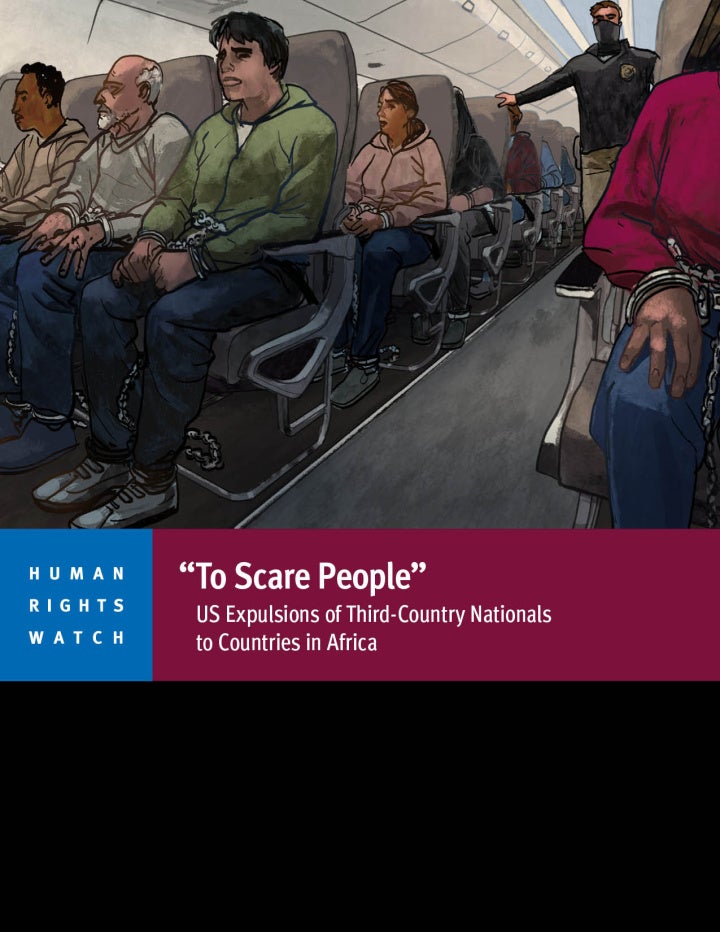
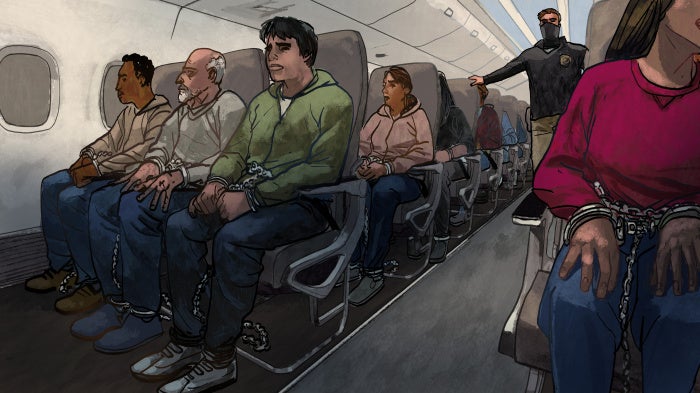
The 125-page report, “‘To Scare People’: US Expulsions of Third-Country Nationals to Countries in Africa,” documents that US authorities denied the more than 500 people transferred to third countries a meaningful chance to contest their removals or to articulate their fears of being removed to these countries. Some countries arbitrarily detained people they had accepted, and some have sent people onward to the risk of persecution or torture in their home countries, violating the international law principle of nonrefoulement.
The interrogation techniques used by U.S. personnel on detainees at the naval base at Guantanamo Bay, Cuba remain shrouded in mystery. While U.S. policy is that the detainees be treated “humanely,” the Department of Defense has never revealed publicly how the detainees have been interrogated.
Brief outlines of the military commissions, the combatant status review panels, and the administrative review procedures adopted by the U.S. Department of Defense (DOD) for use at Guantanamo Bay, Cuba.
This 11-page briefing paper documents how the Zimbabwean government threatens its citizens’ access to sufficient food by concealing the basis for its 2004 crop-yield estimate, the size of its strategic grain reserve and the details of the government’s Grain Marketing Board’s operations in food distribution and assistance.
This 35-page report documents how the Sudanese armed forces and the government-backed Janjaweed militias continue to target civilians and their livestock in villages in rural areas and in the towns and camps under government control. The report also analyzes Sudanese government pledges to rein in the militias, end impunity and restore security in Darfur.
The U.N. Security Council's Approach to Human Rights Violations in the Global Anti-Terrorism Effort
This 17-page briefing paper documents how countries as diverse as Egypt, Uzbekistan, Malaysia, Morocco and Sweden—have violated human rights in their efforts to combat terrorism. These are the very kinds of violations that the U.N. Counter-Terrorism Committee should pay closer attention to.
This 82-page report documents the increasing frustration of thousands of displaced Kurds, as well as Turkomans and Assyrians, who are living in desperate conditions as they await a resolution of their property claims. Human Rights Watch details how the U.S.-led Coalition Provisional Authority failed to act even as the situation grew more volatile.
Abuses Against Children Affected by HIV/AIDS in India
This 209-page report documents how many doctors refuse to treat or even touch HIV-positive children. Some schools expel or segregate children because they or their parents are HIV-positive. Many orphanages and other residential institutions reject HIV-positive children or deny that they house them.
This 66-page report documents the widespread attacks against Serbs, Roma, Ashkali (Albanian-speaking Roma) and other minorities that took place in Kosovo on March 17-18. Human Rights Watch details the near-complete collapse during the crisis of Kosovo’s security institutions—the NATO-led Kosovo Force (KFOR), international civilian police from the U.N.
Abuses against Female Migrant Domestic Workers in Indonesia and Malaysia
This 110-page report documents the abuse and exploitation that Indonesian female domestic workers experience at each step of the migration process. Most domestic workers are forbidden to leave their workplace and unknown numbers suffer psychological, physical, and sexual assault by labor agents and employers.
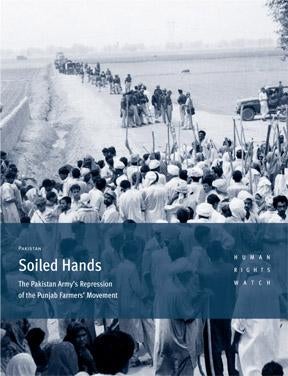
The Pakistan Army’s Repression of the Punjab Farmers’ Movement
In the Pakistani military’s traditional stronghold of Punjab, paramilitary forces working with the army are killing and torturing farmers who refuse to sign contracts that would cede their land rights to the army.
A Human Rights Watch Briefing Paper, July 20, 2004
Numerous reports from Human Rights Watch and other sources have described the “hand-in-glove” manner in which the Government of Sudan and the nomadic ethnic militias known as the Janjaweed have operated together to combat a rebel insurgency in Darfur. Hundreds of eyewitnesses and victims of attacks have testified to the close coordination between government forces and their militia partners in the conflict. Militia leaders and members have been supplied with arms, communications equipment, salaries and uniforms by government officials and have participated in joint ground attacks on civilians with government troops, often with aerial bombing and reconnaissance support from government aircraft.
In a memorandum published today, Human Rights Watch seeks to clarify some of the questions and misconceptions that have arisen in response to our recent report regarding threats to judicial independence in Venezuela.
Two years after the April 4, 2002, ceasefire agreement between the Angolan government and the opposition National Union for the Total Independence of Angola (UNITA), Angola is in transition. Although no date has been set for the first national elections since 1992, these are widely expected to be held no later than 2006.
Exploitation and Abuse of Migrant Workers in Saudi Arabia
Migrant workers in the purportedly modern society that Saudi Arabia has become continue to suffer extreme forms of labor exploitation that sometimes rise to slavery-like conditions. Their lives are further complicated by deeply rooted gender, religious, and racial discrimination.