Dear Prime Minister Takaichi,
CC: Foreign Minister Toshimitsu Motegi
We are writing on behalf of Human Rights Watch in advance of the official visit to Japan of To Lam, President of Vietnam and Communist Party of Vietnam General Secretary, from November 8 to November 11, 2026. We urge you to use this opportunity to raise grave concerns about the Vietnamese government’s human rights record both in your public statements and in private meetings.
Human Rights Watch is an independent nongovernmental organization dedicated to defending and protecting human rights. We monitor and report on violations of international human rights and humanitarian law in about 100 countries around the world, and have documented human rights abuses in Vietnam for almost three decades.
The Japan-Vietnam relationship has strengthened significantly in recent years. In November 2023, the two countries upgraded their relationship to the highest level, namely the “comprehensive strategic partnership for Peace and Prosperity in Asia and the World.” Leaders between the two countries frequently visit one another.
Japan is among Vietnam’s top trade partners and one of the largest sources of foreign direct investment (FDI) in Vietnam. In addition, Japan has been the largest bilateral Official Development Assistance (ODA) donor to Vietnam for more than 20 years. In March 2026, Japan agreed to provide US$609 million in ODA loans for the fiscal year 2025 “to support Viet Nam’s green transition and climate resilience.”
Considering that Japan is an important long-term donor and trade partner of Vietnam, we believe that your government is in a very favorable position to persuade Vietnam to improve the human rights situation in the country.
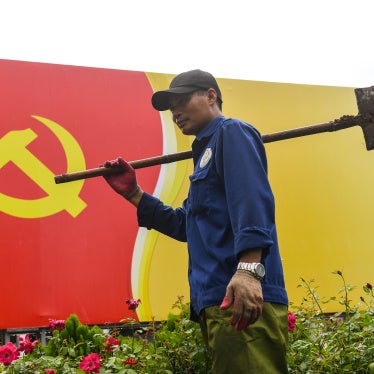
The Vietnamese government has sharply intensified its repression in the last decade, a period during which To Lam served as minister of the Ministry of Public Security (2016-2024) and subsequently as the country’s leader. On To Lam’s watch, Vietnamese police launched a far-reaching crackdown that has decimated the country’s civil society, stepped up transnational repression, and expanded the scope and use of draconian laws that criminalize free speech.
There are now more than 160 political prisoners in Vietnam, imprisoned for exercising rights to freedom of expression or peaceful activism for human rights and democracy, and charged under draconian laws. Human Rights Watch has documented how the Vietnamese authorities are increasingly using a vague, overbroad, and abusive provision of the penal code (article 331) prohibiting the “abuse of democratic freedoms,” both to silence prominent activists and to retaliate against ordinary people who complain about poor services, corruption, or police abuse.
We also wish to draw your attention to labor rights issues in Vietnam. In the labor section of the 2018 Comprehensive and Progressive Agreement for Trans-Pacific Partnership (CPTPP), to which both Vietnam and Japan are parties, article 19.3, Vietnam committed to “adopt and maintain in its statutes and regulations, and practices thereunder,” the rights outlined in the International Labour Organization (ILO Declaration), including the “freedom of association and the effective recognition of the right to collective bargaining.” Vietnam pledged to ratify ILO Convention No. 87 by January 2024 under its CPTPP commitments, but it has not done so by October 2026. The Vietnamese authorities systematically suppress the rights of workers to organize independent unions. As a result, none exists. Vietnam is violating its obligations under the CPTPP, an issue that should be prominently raised with To Lam.
In addition, Japan’s Diplomatic Bluebook 2026 states that “the CPTPP has great strategic significance in that it will establish a free and fair economic order with countries sharing fundamental values and principles, including freedom, democracy, fundamental human rights and the rule of law,” values that Vietnam systematically disrespects.
We urge you and your government to publicly voice concerns about all these issues during To Lam’s visit, and specifically press the Vietnamese government to:
- Unconditionally release all persons detained for exercising rights to freedom of expression, association, religion and assembly.
- Repeal vaguely worded “national security” provisions and other provisions in the Vietnamese penal code that have been used to prosecute individuals for peaceful dissent, including: “abusing democratic freedom” (article 331); “sabotaging the unity policy” (article 116); and propaganda against the state (article 117).
- Take meaningful steps to implement labor reforms to allow independent labor unions to be formed—in law and in practice—and end intimidation and retaliation against workers who attempt to organize for labor rights protections outside of government-controlled mechanisms.
- Promptly ratify ILO Convention No. 87 on freedom of association and genuinely engage with the ILO to reform laws and policies as necessary to ensure the proper application of ILO Convention No. 98, which Vietnam has ratified, on the right to organize and engage in collective bargaining.
- Amend the Criminal Procedure Code to ensure the due process rights of all criminal suspects, including prompt and unhindered access to legal counsel throughout the investigation period, which exposes defendants to an increased risk of torture and other ill-treatment and undermines the principles of due process of law and right to a fair trial.
We thank you in advance for your attention to our requests and stand ready to provide further information and discuss these issues with you at any time.
Sincerely,
Elaine Pearson
Asia Director at Human Rights Watch
Kanae Doi
Japan Director at Human Rights Watch
Appendix: Vietnam’s Entrenched Authoritarianism and Worsening Abuses
Political Prisoners
The Vietnamese government frequently uses vaguely worded and loosely interpreted provisions in Vietnam’s penal code and other laws to prosecute and imprison peaceful political and religious activists. These include “undermining the unity policy” (article 116), “making, storing, disseminating or propagandizing information, materials and products that aim to oppose the State of the Socialist Republic of Vietnam” (article 117), and “abusing the rights to democracy and freedoms to infringe upon the interests of the State, the legitimate rights and interests of organizations, individuals” (article 331).
During the first nine months of 2026, the authorities convicted and sentenced at least 31 activists to many years in prison including prominent bloggers Hoang Thi Hong Thai and Huynh Ngoc Tuan. Police arrested at least 46 other people for criticizing the government.
We urge you to raise the following cases of prisoners held for exercising their basic rights. Several are suffering from severe health issues. All those arbitrarily detained should be immediately and unconditionally released.
- Can Thi Theu, land rights activist
- Hoang Duc Binh, labor activist
- Le Dinh Luong, democracy campaigner
- Nguyen Trung Ton, democracy campaigner
- Nguyen Tuong Thuy, independent journalist
- Nguyen Van Tuc, democracy campaigner
- Pham Chi Dung, independent journalist
- Pham Doan Trang, writer and human rights advocate
- Tran Duc Thach, democracy campaigner
- Tran Van Bang, democracy campaigner
Repression of Labor Rights
Vietnam has not ratified ILO Convention No. 87 on Freedom of Association and Protection of the Right to Organise, despite pledging to do so by January 2024. It has also made little progress in fulfilling obligations under ratified conventions, including ILO Convention No. 98 on collective bargaining, or in guaranteeing workers’ rights to form and operate independent trade unions.
Although the authorities claim to support worker representation, independent unions are not allowed in practice. The Vietnam General Confederation of Labor (VGCL), described by the government as a labor confederation, is not independent. Its leadership is appointed by the government or the Communist Party of Vietnam, while unions within its structure are generally led by individuals approved by management.
The government also argues that the 2019 Labor Code (in force since 2021) permits independent worker organizations at the enterprise level. However, no such organizations are known to exist. Authorities have not issued the regulations or established the legal and administrative processes necessary for their registration and operation.
The absence of implementing regulations, together with provisions of the Trade Union Law, suggests that the government intends to maintain worker representation under the control of the VGCL rather than allow genuinely independent trade unions.
State control is further reflected in Communist Party Directive 24, which calls for increased scrutiny of labor groups, civil society organizations, and foreign actors, particularly in connection with international trade agreements and engagement with the ILO.
Official media have portrayed independent unions as “hostile forces” seeking to undermine the political system. Combined with arrests of labor activists and restrictions on independent labor organizing, these policies raise serious concerns about Vietnam’s commitment to freedom of association and internationally recognized labor rights.
Transnational Repression
In recent years, the Vietnamese authorities have stepped up transnational repression, government efforts to silence dissent by targeting dissidents and critics outside their territory. They have pressured other governments including Thailand and Cambodia to return Vietnamese citizens who fled Vietnam out of fear of arbitrary arrest, torture, or imprisonment.
Vietnamese security forces have abducted Vietnamese citizens in Germany and Thailand, including Trinh Xuan Thanh, Truong Duy Nhat and Duong Van Thai. In the past year, courts in Vietnam put on trial in absentia Vietnamese who live overseas, convicted, and sentenced them to long prison terms, including Le Trung Khoa, Nguyen Van Dai, Doan Bao Chau, Dinh Yum, Siu Di, and Dang Thi Hue. Since the trials, the police have issued numerous warnings and fined Vietnamese citizens for interacting with those convicted in absentia.
The government pressed Thailand to return activists seeking asylum, including former political prisoner Le Chi Thanh. In September, the overseas political organization Viet Tan claimed that Vietnamese police subjected three of its members to extraordinary rendition and detention in Cambodia.